The IELTS Reading test assesses your ability to locate specific information, understand technical descriptions, recognise paraphrased ideas, and identify relationships between different points in a passage.
Roman Tunnels Reading Answers is based on a passage about ancient tunnel-building techniques. It explores how Persian qanats influenced Roman methods for water supply, mineral extraction, ventilation, and overcoming construction challenges.
This Roman Tunnels practice page includes 13 IELTS Reading questions with answers and explanations to help you understand key details and paraphrased information.
Use this Roman Tunnels reading answer key to check your answers for the IELTS reading test:
Question
Answer
1
POSTS
2
CANAL
3
VENTILATION
4
LID
5
WEIGHT
6
CLIMBING
7
FALSE
8
NOT GIVEN
9
FALSE
10
TRUE
11
GOLD
12
ARCHITECT
13
HARBOUR
After checking your answers, use this practice page to test how well you can locate specific information, understand the different tunnel construction methods, identify paraphrased details, and follow the sequence of events and construction techniques described in the Roman Tunnels passage.
Roman Tunnels IELTS Reading Passage for Practice
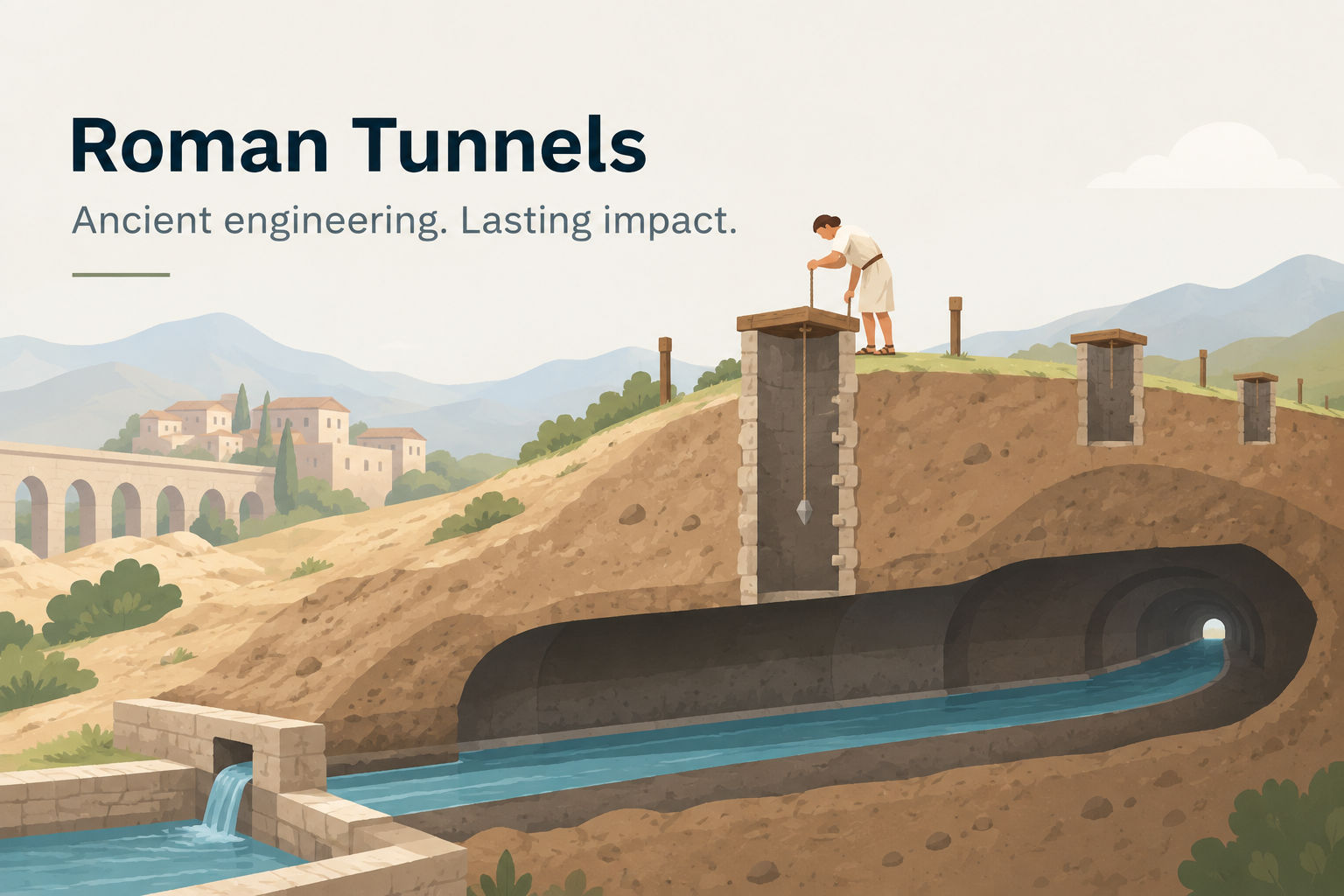
The Roman Tunnels passage focuses on the development and use of underground tunnels by ancient civilizations. It describes the Persian qanat system, Roman adaptations of this technique, counter-excavation, and the engineering problems encountered during tunnel construction.
For practice, read the original passage carefully and pay attention to construction methods, measurements, locations, materials, historical periods, and examples of Roman tunnels. These details become useful scanning clues when solving the questions.
Roman Tunnels
Paragraph 1
The tunnels were constructed by the Persians to provide a reliable water supply to human settlements in the dry areas of present-day Iran. The qanat method of tunnel construction was introduced in the early first millennium BCE. In this method, posts were placed in a straight line over a hill, and vertical shafts were dug at regular intervals into the ground to ensure that the tunnel followed the planned route. Workers then removed the earth between the ends of the shafts underground to create the tunnel. The shafts were used to remove the excavated soil to the surface and also provided ventilation during the work. Once the tunnel was completed, the water could flow towards a canal for use by the settlements.
Paragraph 2
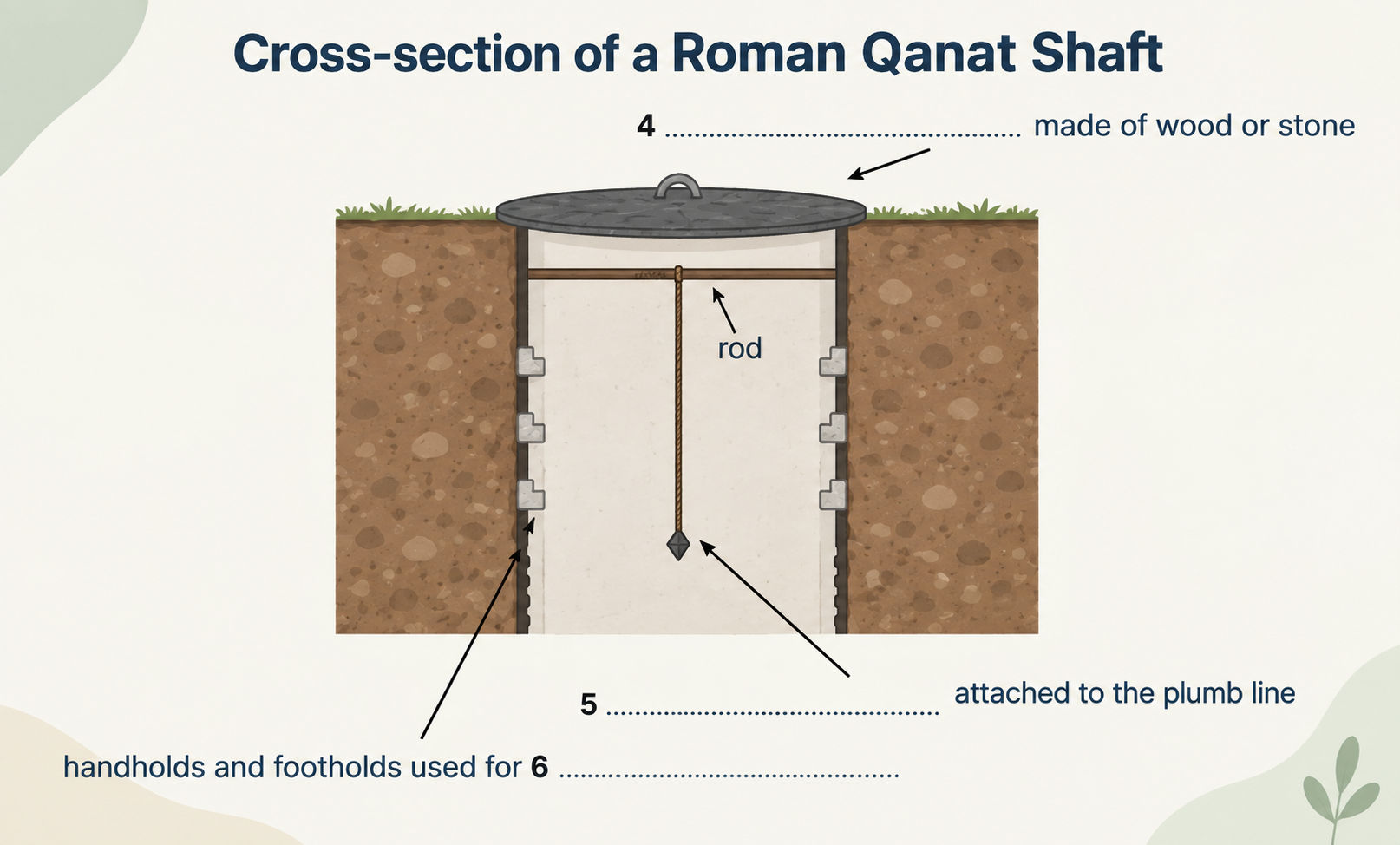
Knowledge of the qanat method of constructing tunnels for water supply and agriculture was transferred by the Persians to the Romans. Vertical shafts were dug at intervals of between 30 and 60 metres in Roman qanat tunnels. To help workers move in and out of the shafts, they were equipped with handholds and footholds for climbing, while wooden or stone lids were used to close the openings. The Romans also hung a plumb line from the top of a shaft using a rod placed across it. A weight was attached to the end of the line and had to hang in the middle of the shaft to check whether it was vertical. The plumb line could also be used to identify the tunnel slope and determine the depth of the shaft. The Claudius tunnel, built in 41 CE to drain the Fucine Lake in Central Italy, was 5–6 kilometres long and had a shaft 122 metres deep. Approximately 30,000 workers were involved in completing the tunnel over 11 years. Mineral extraction tunnels were also built by the Romans.
Paragraph 3
Counter-excavation was the second method of tunnel construction and originated in the 6th century BCE. In this method, tunnels were built from both ends and were particularly useful for cutting through mountains where the qanat method was not a practical alternative. Since the two ends had to meet at the centre of the mountain, careful planning and advanced knowledge were required. When geological problems occurred, or the route deviated from its intended direction, adjustments had to be made. The direction of the tunnel was constantly checked. For example, workers could look back towards the mouth of the tunnel to check for light penetration and identify any deviation before making corrections. In some cases, the deviation could become so large that one end of the tunnel was left unused.
Paragraph 4
The Saldae aqueduct system in modern-day Algeria was built by the Romans and is 428 metres long. During its construction, the workers failed to meet at the intended point inside the mountain. An inscription written on the tunnel explains how the two groups missed each other and how the problem was later corrected using a lateral link between the two corridors. The Romans also used the counter-excavation method to construct tunnels for roads in places where mountains and hills were too high to cross. The 37-metre-long and 6-metre-high Furlo Pass tunnel in Italy, built between 69 and 79 CE, is an example of a tunnel constructed for a road using this method.
Paragraph 5
The Romans also built tunnels for mineral extraction. Once mineral veins were located, miners could construct tunnels underground using shafts. An example can be found at the Dolaucothi mines in Wales, where tunnels were used for mining gold. When mineral extraction was the sole purpose of a tunnel, the planning process was relatively simple because the route was determined by the location of the mineral vein. The Romans carefully planned and executed their tunnel projects, but the construction method and the type of rock in the excavation area affected the time required to complete them. The qanat method generally allowed faster progress than counter-excavation because workers could excavate not only from the tunnel mouth but also through the shafts.
Paragraph 6
The type of rock also affected the speed of construction. The Romans used a technique known as fire quenching, in which they heated the rock and then suddenly cooled it with water to create cracks in hard rock. Progress through solid rock was slow and could take years, sometimes even a decade, to complete a tunnel. Construction marks in the Roman tunnel of Bologna indicate that the rate of advance through solid rock was only about 30 centimetres per day, while the rate of advancement in the Claudius tunnel was approximately 1.4 metres per day. The names of the patrons who started tunnel projects and, in some cases, the architects were inscribed in many tunnels. For example, an inscription can still be found in the 1.4-kilometre Çevlik tunnel in Turkey, which was started in 69 CE and completed in 81 CE. The tunnel was built to divert floodwater away from the harbour of the ancient city of Seleuceia Pieria.
Roman Tunnels Reading Questions
The Roman Tunnels Reading Answers section contains three different question types. Questions 1–6 require you to label parts of diagrams, Questions 7–10 ask you to decide whether statements are True, False, or Not Given, and Questions 11–13 require short answers.
Before answering, identify words related to tunnel construction, water, shafts, historical events, minerals, people, places, and measurements. The passage often expresses the same idea using different words.
Questions 1–6: Diagram Completion
These questions test your ability to connect labels in a diagram with descriptions in the passage.
Instruction: Choose ONE WORD ONLY from the passage for each answer.
What was placed in a straight line over the hill to guide the tunnel route?
Where did the water flow after passing through the completed qanat?
What additional purpose did the vertical shafts serve during construction?
What covered the Roman shafts?
What was attached to the end of the plumb line?
What activity were the handholds and footholds intended to help with?
Questions 7–10: True/False/Not Given
These questions test whether the statements agree with the information in the passage.
TRUE – the statement agrees with the passage.
FALSE – the statement contradicts the passage.
NOT GIVEN – the passage does not provide enough information.
7. Were Roman qanat tunnels equipped with features that helped workers climb in and out of the shafts?
8. Did the Claudius tunnel take less than five years to complete?
9. Does the passage state that every Roman tunnel was constructed using the qanat method?
10. Could workers use light from the tunnel entrance to check whether the tunnel had deviated from its intended direction?
Questions 11–13: Short Answer Questions
These questions require you to locate a specific fact in the passage and answer using the required words.
Instruction: Choose NO MORE THAN TWO WORDS from the passage for each answer.
11. What was attached to the end of the plumb line used by Roman workers?
12. What technique did the Romans use to crack hard rock by heating and then cooling it?
13. How long was the Furlo Pass tunnel?
Looking to strengthen your IELTS preparation before you take the test? Get practical guidance with upGrad’sfree IELTS course and work on your skills at your own pace.
Roman Tunnels Reading Answers with Explanation
The following Roman Tunnels Reading Answers with Location section explains where each answer comes from and how the wording in the questions connects with the passage. The explanations focus on the important keywords and paraphrases rather than simply repeating the answer key.
Answers 1–6: Diagram Completion
Q1: What was placed in a straight line over the hill to guide the tunnel route?
Answer: POSTS
Explanation: The description of the qanat method explains that posts were placed over a hill in a straight line. Their purpose was to help keep the tunnel on its intended route while workers dug the shafts and underground passage. Therefore, POSTS is the correct answer.
Answer Location: Paragraph 1 Keywords: straight line, hill, tunnel route, qanat Paraphrase: “ensure that the tunnel kept to its route” → guide the tunnel route
Q2: Where did the water flow after the tunnel was completed?
Answer: CANAL
Explanation: The passage explains that once the qanat tunnel was completed, water could move from the hillside towards a canal. The canal was used to supply water for human use. Therefore, the missing word referring to the destination of the water is CANAL.
Answer Location: Paragraph 1 Keywords: water, completed tunnel, flow, human use Paraphrase: “flow ... towards a canal” → water runs into a canal
Q3: What additional purpose did the vertical shafts serve?
Answer: VENTILATION
Explanation: The vertical shafts were not used only for removing excavated soil. The passage also explains that they provided ventilation while the tunnel was being constructed. This second function is what the diagram question is asking for.
Answer Location: Paragraph 1 Keywords: vertical shafts, excavated soil, construction Paraphrase: “provided ventilation during the work” → additional function of the shafts
Q4: What covered the Roman shafts?
Answer: LID
Explanation: The Roman qanat shafts were fitted with handholds and footholds to make movement easier. The passage then states that the shafts were covered with a wooden or stone lid. Since the diagram asks for the covering, LID is the correct answer.
Answer Location: Paragraph 2 Keywords: shafts, covered, wooden, stone Paraphrase: “covered with a wooden or stone lid” → covering of the shaft
Q5: What was attached to the end of the plumb line?
Answer: WEIGHT
Explanation: The Romans used a plumb line to check whether the shafts were vertical. A weight was attached to the end of the line, and its position in the centre of the shaft helped workers check the alignment. Therefore, WEIGHT fits the diagram.
Answer Location: Paragraph 2 Keywords: plumb line, vertical, centre, shaft Paraphrase: “weight at the end of it” → object attached to the plumb line
Q6: What activity did the handholds and footholds help with?
Answer: CLIMBING
Explanation: The shafts contained handholds and footholds so that workers could move up and down them. The passage specifically connects these features with climbing in and out of the shafts. Therefore, CLIMBING is the correct answer.
Answer Location: Paragraph 2 Keywords: handholds, footholds, shafts, in and out Paraphrase: “help those climbing in and out” → support for climbing
Answers 7–10: True/False/Not Given
Read the statement carefully and decide whether the information is True, False, or Not Given based only on what is stated in the passage.
Q7: Were Roman qanat tunnels equipped with features that helped workers climb in and out of the shafts?
Answer: TRUE
Explanation: Paragraph 2 explains that the vertical shafts in Roman qanat tunnels were equipped with handholds and footholds for climbing. These features helped workers move in and out of the shafts.
Therefore, the statement agrees directly with the passage.
Answer Location: Paragraph 2 Keywords: qanat tunnels, shafts, handholds, footholds, climbing Paraphrase: “Handholds and footholds for climbing” → “features that helped workers climb”
Q8: Did the Claudius tunnel take less than five years to complete?
Answer: FALSE
Explanation: Paragraph 2 states that the Claudius tunnel was completed over 11 years. Therefore, the statement that it took less than five years contradicts the information in the passage.
Answer Location: Paragraph 2 Keywords: Claudius tunnel, completed, 11 years Paraphrase: “Over 11 years” → “more than five years”
Q9: Does the passage state that every Roman tunnel was constructed using the qanat method?
Answer: NOT GIVEN
Explanation: The passage explains that the Romans used the qanat method and later describes counter-excavation as another method. It also mentions tunnels built for mineral extraction and roads.
However, it does not state that every Roman tunnel was constructed using the qanat method. Since this specific claim is neither confirmed nor contradicted, the answer is NOT GIVEN.
Answer Location: Not Given Keywords: every tunnel, qanat method, Roman tunnels Paraphrase: “Every Roman tunnel” → “all Roman tunnels”
Q10: Could workers use light from the tunnel entrance to check whether the tunnel had deviated from its intended direction?
Answer: TRUE
Explanation: Paragraph 3 explains that workers could look back towards the mouth of the tunnel to check for light penetration. This allowed them to identify deviations from the planned direction and make corrections.
Therefore, the statement agrees with the passage.
Answer Location: Paragraph 3 Keywords: tunnel direction, mouth, light penetration, deviation, corrections Paraphrase: “Check for light penetration” → “use light from the tunnel entrance to check direction” “Deviated from its intended direction” → “moved away from the planned route”
Answers 11–13: Short Answer Questions
Q11: What was attached to the end of the plumb line used by Roman workers?
Answer: WEIGHT
Explanation: Paragraph 2 describes how Roman workers used a plumb line to check whether a shaft was vertical. A weight was attached to the end of the line and had to hang in the middle of the shaft.
Answer Location: Paragraph 2 Keywords: plumb line, weight, shaft, vertical Paraphrase: “A weight was attached to the end of the line” → “weight attached to the plumb line”
Q12: What technique did the Romans use to crack hard rock by heating and then cooling it?
Answer: FIRE QUENCHING
Explanation: Paragraph 6 names the technique fire quenching. The Romans heated hard rock and then suddenly cooled it with water, causing cracks to form.
The answer should be taken directly from the passage and fits the NO MORE THAN TWO WORDS instruction.
Answer Location: Paragraph 6 Keywords: hard rock, heated, cooled, cracks, fire quenching Paraphrase: “Heated the rock and then suddenly cooled it” → “fire quenching”
Q13: How long was the Furlo Pass tunnel?
Answer: 37 METRES
Explanation: Paragraph 4 identifies the Furlo Pass tunnel in Italy as an example of a tunnel constructed for a road using the counter-excavation method. It states that the tunnel was 37 metres long and 6 metres high.
Since the question asks for its length, the correct answer is 37 metres.
How to Approach Roman Tunnels IELTS Reading Questions?
The Roman Tunnels passage combines history, engineering, geography, and technical information. A good approach is to identify the type of information each question requires before scanning the passage.
For Roman tunnel reading answers, focus on specific clues such as construction methods, places, measurements, historical events, and technical terms rather than trying to remember every sentence.
Identify Names, Dates and Locations
Names of places and specific historical details can make scanning much easier. Look for locations such as Algeria, Wales, Italy, Turkey, as well as names such as Saldae, Dolaucothi, and Seleuceia Pieria.
Dates and measurements are also useful because they are less likely to appear repeatedly in a passage. When you see a question containing a specific place or number, use it as a scanning clue.
Understand the Different Tunnel-Building Methods
The passage mainly discusses the qanat method and the counter-excavation method.
The qanat method involved vertical shafts and was useful for moving water. Counter-excavation involved digging from both ends and was particularly useful when tunnels had to pass through mountains.
Keeping these two methods separate can help prevent confusion when answering questions.
Follow Cause-and-Effect Relationships
Several parts of the passage explain why particular methods or techniques were used.
For example:
Hard rock → fire quenching → rock cracks → slower/faster progress depending on conditions
Similarly:
High mountain → qanat not practical → counter-excavation method
Following these relationships makes it easier to understand the author's explanation instead of relying only on individual keywords.
Use Technical Terms as Scanning Clues
Terms such as qanat, counter-excavation, plumb line, shafts, ventilation, mineral vein, fire quenching, and aqueduct are strong clues.
If one of these terms appears in a question, scan for it or for a related expression in the passage. Technical vocabulary is particularly useful because it tends to appear in specific sections.
Track Numbers and Measurements
The passage contains several measurements, including tunnel lengths, shaft depths, construction periods, and rates of progress.
These details can quickly take you to the relevant paragraph. However, always read the surrounding sentence because the number itself may not answer the question.
Look for Paraphrased Information
IELTS rarely requires you to find only exact word matches. The question may use different wording from the passage.
For example:
failed to meet → missed each other
protect → divert floodwater threatening
guide the route → ensure the tunnel kept to its route
additional purpose → also provided ventilation
Understanding these relationships is important when working on Roman Tunnels Reading Answers.
Follow the Word Limit
Questions 1–6 require ONE WORD ONLY, while Questions 11–13 require NO MORE THAN TWO WORDS.
Always check the instructions before writing your answer. Also check spelling and whether the answer needs to be singular or plural.
The Roman Tunnels Reading Answers passage is useful practice for questions involving historical facts, technical descriptions, construction methods, and specific details. It tests your ability to locate information about Roman engineering, distinguish between different tunnel-building techniques, follow cause-and-effect relationships, and identify information that is True, False, or Not Given.
When reviewing your answers, do not focus only on whether you got the correct word. Check where the answer appears, which keywords helped you find it, and how the question paraphrased the passage. This makes the exercise more useful for future IELTS Reading passages.
For students looking specifically for Roman Tunnels Reading Answers with Location, the answer explanations above identify the relevant paragraph for each answer and show how the wording of the question connects with the passage.
What is the Roman Tunnels IELTS Reading passage about?
The passage explains how the Persians and Romans developed and used underground tunnels for purposes such as water supply, road construction, and mineral extraction. It also discusses tunnel-building methods, surveying techniques, construction challenges, and the effect of different types of rock on progress.
What question types are included in the Roman Tunnels Reading passage?
The passage includes Diagram Completion, True/False/Not Given, and Short Answer Questions. Each type requires a different approach, such as following labels in a diagram, checking whether a statement agrees with the passage, or locating a specific fact.
What is the qanat method of tunnel construction?
The qanat method used a series of vertical shafts connected by an underground tunnel. Posts helped workers maintain the planned route, while the shafts were used to remove excavated soil and provide ventilation during construction.
How was the counter-excavation method different from the qanat method?
Counter-excavation involved digging towards the centre from both ends of a tunnel. It was particularly useful when tunnels had to pass through mountains where the qanat method was not practical.
Why were plumb lines used in Roman tunnels?
A plumb line helped workers check whether a shaft was vertical. The Romans could also use it to determine the slope of the tunnel and estimate the depth of the shaft.
What challenges did Roman tunnel builders face?
Construction could be affected by difficult geological conditions, incorrect tunnel alignment, and the type of rock being excavated. Hard rock could significantly slow progress, which led workers to use techniques such as fire quenching.
What was the purpose of fire quenching?
Fire quenching was used to break hard rock. Workers heated the rock and then suddenly cooled it with water, causing cracks that made excavation easier.
Why are inscriptions important in the Roman Tunnels passage?
Inscriptions provide historical information about tunnel projects. They could record the names of patrons and, in some cases, architects, while also describing construction problems and how they were resolved.
How can I use Roman tunnel reading answers to improve my IELTS Reading skills?
Use the answers to review not only your mistakes but also the clues that led to each answer. Compare the wording in the questions with the relevant parts of the passage and note useful paraphrases, technical terms, and scanning clues.
How can Roman tunnels reading answers with explanation help with difficult questions?
The explanations show how an answer is connected to the passage rather than simply giving the correct word. Reviewing the keywords, paraphrases, and answer locations can help you understand why an option is correct or why a statement should be marked False or Not Given.
What should I focus on when practising Roman Tunnels reading answers?
Pay attention to technical terms, names of places, dates, measurements, construction methods, and cause-and-effect relationships. These details can help you locate the relevant section quickly and avoid confusing similar information.
Where can I find Roman tunnels reading answers with location?
The answer explanations on this page include the answer location for each question, wherever the information is stated in the passage. You can use these locations to review the relevant paragraph and understand how the question connects with the text.
How can I improve my performance with Roman Tunnels Reading Answers?
After completing the passage, review every incorrect response and identify what caused the mistake. It may be a missed keyword, an unfamiliar paraphrase, confusion between tunnel-building methods, or failure to follow the word limit. This makes your practice more useful for future IELTS Reading tests.
upGrad Abroad Editorial Team |4982 articles published
We are a dedicated team of study-abroad experts, ensuring intensive research and comprehensive information in each of our blogs. With every piece written, we aim at simplifying the overseas education ...
Refer Your Friend & Earn upto ₹15000
Help your friend upgrade to a Global Career and earn rewards together.