With an acceptance rate ranging between 8% and 10%, the Technical University of Munich (TUM) stands among the most competitive universities in Germany. In the Winter Semester 2026, over 14,000 new students enrolled, including 7,536 undergraduates, out of nearly 53,000 total students. Notably, 45% of TUM’s student body comprises international students, highlighting its global appeal and rigorous selection process.
In this guide, you’ll read more about TUM’s acceptance rate, what make TUM one of the best universities in Germany, why is it so competitive, detailed admission statistics, specific insights for Indian students, eligibility and GPA requirements, program-wise acceptance trends, tips to improve your chances, and the complete application process.
What Is the Acceptance Rate at the Technical University of Munich?
The Technical University of Munich (TUM) is one of Germany’s most selective universities. With an overall acceptance rate between 8% and 10%, getting into TUM is no easy feat. This figure reflects the university’s high academic standards and its global reputation for excellence in science, engineering, and technology.
Acceptance Rate Overview: UG vs PG:
Program Level
New Enrollments (Winter 2026)
Estimated Acceptance Rate
Undergraduate
7,536
8–10%
Postgraduate
~6,500 (approx.)
30–40% (varies by course)
Postgraduate programs tend to have a slightly higher acceptance rate, but top programs like Data Science and Management & Technology are still highly competitive.
Why Is TUM So Competitive?
The Technical University of Munich (TUM) is not just one of Germany’s top universities, it’s a global powerhouse in science, engineering, and innovation. Its competitiveness stems from a combination of academic excellence, global rankings, research output, and strong industry ties.
Let’s break down the key reasons why TUM is so selective and sought-after:
1. World-Class Rankings and Reputation
Ranked #22 globally in the QS World University Rankings 2026
#19 globally for engineering and technology
Recognized as a “University of Excellence” by the German government
Top 10 globally in THE Impact Rankings for innovation and infrastructure.
These rankings reflect TUM’s consistent performance in teaching, research, and international outlook.
2. Research-Driven Ecosystem
TUM is one of Europe’s most research-intensive universities:
Over 185,000+ scientific publications and 5.8 million citations
Collaborations with Max Planck Society, Helmholtz Association, and Fraunhofer Institutes
Focus areas include AI, quantum computing, aerospace, sustainability, and biomedicine
TUM’s Garching campus is one of Europe’s largest science and technology hubs.
3. Industry Partnerships and Innovation
TUM has deep-rooted ties with global companies:
Collaborates with BMW, Siemens, Google, SAP, GE Aerospace, and more
Hosts UnternehmerTUM, Europe’s largest university-based startup incubator
Offers students real-world exposure through internships, research projects, and co-ops
TUM has produced more startup founders than any other German university.
4. Selective Admissions and Aptitude Assessments
TUM uses a multi-step admission process, especially for postgraduate programs:
Many courses require aptitude assessments or interviews
Some programs have Numerus Clausus (NC) restrictions, meaning limited seats based on GPA
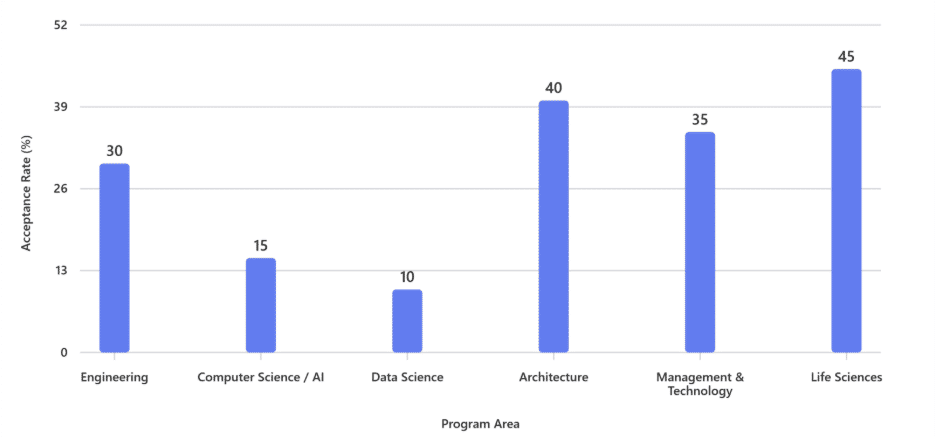
High-demand programs like Computer Science, Data Science, and Management & Technology have lower acceptance rates (as low as 10–15%)
5. Global Student Demand
TUM offers 77+ English-taught programs, attracting students from over 140 countries
45% of students are international, making it one of the most diverse campuses in Germany
Its location in Munich, a global tech and innovation hub, adds to its appeal
6. Strong Alumni and Career Outcomes
TUM has produced 17 Nobel laureates and numerous global leaders
90% of graduates secure employment or research positions within months of graduation
The university’s alumni network spans over 330,000 professionals worldwide
TUM Admission Requirements for International Students
If you're an international student planning to apply to the Technical University of Munich (TUM), it's important to understand the specific admission requirements for both undergraduate (UG) and postgraduate (PG) programs.
TUM has a rigorous but transparent process designed to ensure that all students meet the academic and language standards needed to succeed.
General Eligibility Criteria
Before applying, make sure you meet the following basic requirements:
Academic qualifications equivalent to German standards
Language proficiency in English or German (depending on the program)
Valid passport and health insurance
APS certificate (mandatory for Indian applicants)
Preliminary documentation (VPD) from uni-assist for degree recognition
Undergraduate Admission Requirements
To apply for a Bachelor’s program, you must:
Have completed secondary school education outside Germany
Hold a Higher Education Entrance Qualification equivalent to the German Abitur
If your qualification is not directly recognized, you may need to attend a Studienkolleg (a one-year preparatory course) and pass the Feststellungsprüfung (FSP) exam
Provide proof of language proficiency (German or English, depending on the program)
Submit all required documents via the TUMonline portal
Use https://anabin.kmk.org/ to check if your school-leaving certificate is recognized in Germany.
Postgraduate Admission Requirements
To apply for a Master’s program, you must:
Hold a recognized undergraduate degree equivalent to a German bachelor’s (minimum 3 years or 6 semesters)
Meet program-specific prerequisites (e.g., relevant coursework, GPA, or entrance exams)
All documents must be in German or English. If not, they must be translated by a certified translator.
Program-Wise Admission Criteria at TUM in 2026
Admission cutoffs at the Technical University of Munich (TUM) vary significantly depending on the faculty and program. While all programs maintain high academic standards, some are more competitive than others due to demand, prerequisites, and intake capacity.
Programs in Engineering, Data Science, and Artificial Intelligence are among the most selective, often requiring a GPA of 8.5 or higher and standardized test scores like the GRE. On the other hand, fields like Management and Architecture may accept slightly lower GPAs but still follow a rigorous shortlisting process.
Use the table below to understand the minimum GPA, language test scores, and application platforms for different programs at TUM in 2026:
Program Area
Minimum Entry Requirements
Additional Notes
Engineering Programs
GPA ≥ 8.0 / 75%, IELTS 6.5, German A2
Highly competitive in Mech, Civil, ECE; lower success rate for international students
Computer Science / AI
UG: Math test; MSc: GRE ≥ 315, IELTS 6.5–7.0
Most selective; among top TUM admission stats in 2026
Data Science (MSc)
GPA ≥ 8.5, GRE > 317, IELTS 7.0
Strong background in mathematics and statistics required
Architecture
German B2, GPA ≥ 7.5, Portfolio
Portfolio scores are heavily weighted
Management & Technology
GPA ≥ 75%, IELTS 6.5, GMAT ≥ 640 or GRE ≥ 310
No interviews; Statement of Purpose (SOP) is highly important
Life Sciences
GPA ≥ 7.5, IELTS 6.5
Lab or research experience is preferred
Note: English-taught programs require IELTS/TOEFL scores, while German-taught programs mandate proficiency in German (TestDaF 4×4 or DSH-2).
How to Improve Your Chances of Admission to TUM
Getting into the Technical University of Munich (TUM) is challenging, but with the right strategy, you can significantly boost your chances.
Here are practical steps to make your application stand out:
Maintain a Strong Academic Profile
Aim for a GPA of 8.0+ for engineering and tech programs; 8.5+ for Data Science and AI.
For management programs, a GMAT score of 640+ or GRE score of 310+ can strengthen your profile.
Ensure your transcripts are clear and verified through uni-assist and APS certificate (mandatory for Indian students).
2. Prepare for Language Requirements
For English-taught programs:
IELTS: 6.5–7.0
TOEFL iBT: 88+
For German-taught programs:
TestDaF: 4×4
DSH-2
Start language prep early to avoid last-minute stress.
3. Craft a Strong SOP and CV
Highlight academic achievements, research projects, and internships.
Explain why TUM and how the program aligns with your career goals.
Keep your CV concise but impactful, include relevant certifications and technical skills.
4. Gain Relevant Experience
Internships in your field can make a big difference.
For Data Science and AI, showcase coding skills, projects, and mathematical foundations.
For Architecture, prepare a high-quality portfolio.
5. Prepare for Aptitude Assessments
Many programs require aptitude tests or interviews.
Review program-specific requirements on TUM’s official site.
Practice problem-solving and subject-specific questions.
6. Apply Early and Correctly
Use TUMonline or Uni-assist as per program guidelines.
Double-check deadlines for Winter and Summer intakes.
Upload all documents in German or English (certified translations if needed).
Certifications in data analytics, programming, or management tools add value.
Research publications or conference papers are a bonus for STEM applicants.
Application Process and Deadlines
Applying to the Technical University of Munich (TUM) requires careful planning and adherence to deadlines. The process differs slightly for undergraduate (UG) and postgraduate (PG) programs, but both follow a structured online application system.
Step-by-Step Application Process:
1. Check Eligibility
Verify your qualifications using the Anabin database for degree recognition.
For Indian students, an APS certificate is mandatory before applying.
Language proficiency proof (IELTS/TOEFL or TestDaF/DSH)
CV and Statement of Purpose (for PG)
Preliminary Documentation (VPD) from uni-assist for international applicants
3. Apply Online
TUMonline is the official portal for all degree programs.
Upload all documents in PDF format; no hard copies required during initial application.
For international applicants, apply for VPD via uni-assist and then submit your application on TUMonline.
4. Aptitude Assessment
Many programs require an aptitude test or interview.
For PG programs, this may include curricular analysis and point-based evaluation.
5. Track Application
Monitor your status in TUMonline.
Submit missing documents promptly if requested.
While applying, keep a note of the following:
All documents must be in German or English; translations must be certified.
Digital-only enrollment applies from Summer 2026, no postal submissions required.
Most UG programs accept applications only for the Winter semester. PG programs may offer both intakes.
Conclusion
Getting into the Technical University of Munich isn’t easy, and the numbers make that clear. But behind those stats there is an opportunity to study at one of the world’s most respected universities. If you’re passionate about engineering, technology, or research-driven careers, TUM offers an environment that challenges you and helps you grow.
Yes, the process is competitive, but it’s not impossible. Start early, understand the requirements, and build a strong application that reflects your skills and goals. Remember, thousands of international students succeed every year, and with the right preparation, you can be one of them.
FAQs About Technical University of Munich Acceptance Rate and Admissions
How does TUM’s acceptance rate compare to other German universities?
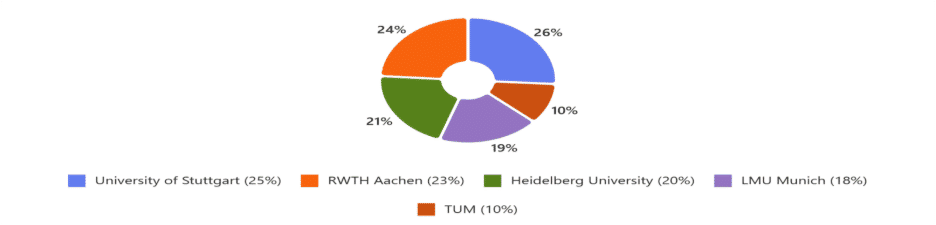
TUM’s acceptance rate is around 8–10%, making it one of the most selective universities in Germany. In comparison, LMU Munich averages 18%, Heidelberg 20%, and RWTH Aachen about 23%. This reflects TUM’s strong global ranking, research reputation, and high demand for STEM programs.
Does TUM have a different acceptance rate for English-taught programs?
Yes. English-taught programs at TUM attract a larger international applicant pool, making them more competitive. Programs like Data Science and Management & Technology often have acceptance rates below 15%, while German-taught programs may offer slightly higher chances due to language prerequisites.
What is the role of the APS certificate in TUM admissions for Indian students?
The APS certificate verifies the authenticity of Indian academic documents and is mandatory for all Indian applicants to German universities, including TUM. Without APS, your application will not be processed. It ensures transparency and speeds up visa and admission procedures.
Can Indian students apply to TUM without knowing German?
Yes, if you choose an English-taught program. TUM offers over 70 master’s programs in English. However, basic German (A2 level) is recommended for daily life and internships. For German-taught programs, TestDaF or DSH certification is compulsory.
How important is work experience for TUM postgraduate admissions?
Work experience is not mandatory for most TUM master’s programs but can strengthen your profile, especially for Management & Technology or interdisciplinary courses. Relevant internships or research projects are highly valued and can compensate for a slightly lower GPA.
Do all TUM programs require GRE or GMAT scores?
No. GRE or GMAT is required only for specific programs like Management & Technology and some technical master’s courses. For Data Science and AI, GRE scores above 310–315 are recommended. Engineering programs generally do not require GRE.
What is the minimum IELTS or TOEFL score required for TUM?
For English-taught programs, TUM requires IELTS 6.5 or higher and TOEFL iBT 88+. Some competitive programs like Data Science may prefer IELTS 7.0. German-taught programs require TestDaF (4×4) or DSH-2 certification.
How does TUM evaluate Indian academic transcripts and CGPA?
TUM uses the Bavarian formula to convert Indian grades to the German scale. A CGPA of 7.5–8.5 or 75%+ is generally competitive. The university also checks degree recognition via the Anabin database and may require curricular analysis for master’s programs.
Is there a quota or reservation system for Indian or international students at TUM?
No. TUM does not follow any quota or reservation system. Admissions are merit-based and depend on academic performance, aptitude assessments, and language proficiency. International students make up about 45% of TUM’s student body.
What is the typical profile of a successful TUM applicant from India?
A strong academic record (CGPA 8.0+), good language scores (IELTS 6.5+), and relevant internships or projects. For technical programs, coding or research experience helps. For management, GMAT 640+ or GRE 310+ and a well-written SOP are key.
How competitive are TUM’s Data Science and Computer Science programs?
Extremely competitive. Acceptance rates for these programs are often below 15%. Applicants need a strong quantitative background, GPA of 8.5+, and GRE scores above 315. Prior experience in programming and statistics is highly recommended.
What is the acceptance rate for TUM’s Management and Technology programs?
Management & Technology programs have an estimated acceptance rate of 25–30%. While less competitive than STEM programs, they still require a strong academic profile, GMAT 640+ or GRE 310+, and a compelling SOP.
Does TUM offer conditional admission to students with pending documents or results?
Yes. TUM may grant conditional admission if final transcripts or language certificates are pending. However, all conditions must be fulfilled before enrollment. Check program-specific guidelines on TUMonline.
How does TUM’s aptitude assessment affect the final admission decision?
Aptitude assessments are crucial for many master’s programs. They evaluate academic background, motivation, and sometimes technical skills. Scores from these assessments often determine whether an applicant is shortlisted for admission.
Can Indian students apply to multiple programs at TUM simultaneously?
Yes. You can apply to multiple programs through TUMonline, but each application requires separate documents and fees. Ensure you meet eligibility criteria for all selected programs.
California State University Northridge Acceptance Rate
The California State University Northridge is a public comprehensive institution that is located in the San Fernando Valley, just 15 miles away from Los Angeles...../
Stanford University is a private research university in California, USA. The University originated as the Leland Stanford Junior University in 1885...../
The University of California, Berkeley (UC Berkeley) was founded in 1868 on the Oakland site of the College of California. It moved to Berkeley in 1873...../
University Admission Expert |151 articles published
With over10 years of experience in the ed-tech sector, Sachin holds expertise in operations management, ensuring the smooth functioning of study abroad programs. He has deep understanding of the globa...
Refer Your Friend & Earn upto ₹15000
Help your friend upgrade to a Global Career and earn rewards together.