What Is Responsible AI: Principles, Frameworks, Implementation and Best Practices
By upGrad
Updated on Aug 17, 2026 | 8 min read | 2.69K+ views
Share:

All courses
Certifications
More
By upGrad
Updated on Aug 17, 2026 | 8 min read | 2.69K+ views
Share:
Table of Contents
Key Highlights
Ready to take the next step in your career? Explore the best management courses to build in-demand leadership skills and strengthen your business expertise.
Popular Management Programs
Responsible AI is the practice of developing and using AI in a way that considers fairness, privacy, safety, transparency, and accountability.
The focus is not limited to the model. Training data, human decisions, technology infrastructure, and business processes can all affect the outcome. For example, a recruitment model may learn bias from historical hiring data and repeat it in future recommendations.
Responsible AI also continues after deployment. Organisations need to monitor performance, identify new risks, and improve controls as conditions change.
Ethical AI and responsible AI are closely related, but they focus on different aspects. Ethical AI is mainly concerned with whether the use of technology aligns with values and principles.
It asks questions such as:
Responsible AI goes a step further by turning these concerns into practical actions. It involves policies, testing, human oversight, risk controls and monitoring to make sure those principles are followed in real-world use.
Also read: AI Governance Framework: How It Works, Components & Examples
Free Courses
AI can influence decisions related to money, jobs, privacy, safety and access to services. Even a small technical issue can create larger business or social problems. Responsible AI helps organisations identify risks early and put suitable controls in place.
Models learn from data. When historical data contains bias, those patterns can appear in future decisions. Fairness testing helps teams identify unequal outcomes and review the data, model and decision process.
Bias may not always be completely removed. The aim is to understand where unfairness comes from, assess its impact and reduce unacceptable outcomes.
AI tools can process personal and confidential information. Organisations need clear rules around what data is collected, why it is needed, who can access it and how long it is retained.
Good practices include:
People are more likely to trust technology when they understand how it is being used. Organisations should explain its purpose, limitations and role in important decisions.
For high-impact decisions, users should also receive meaningful information about relevant factors behind an outcome and what options are available if something goes wrong.
Risks can emerge at any stage. Data may have quality issues, security weaknesses can appear during deployment and models may behave unexpectedly after launch.
NIST's AI Risk Management Framework groups risk management into four functions:
AI-related rules and guidance are evolving. Organisations may need policies, risk assessments, audits, security controls and clear accountability.
Standards such as ISO/IEC 42001 provide a structured approach for establishing and continually improving AI management practices.
Clear guidelines make adoption more organised. Employees know which tools they can use, developers understand testing expectations and managers know who owns important decisions.
A structured approach helps organisations move from experimentation to production while maintaining greater control and confidence.
Also read: AI Developer Roadmap: Start Your AI Development Career
Responsible AI involves several principles that guide how AI systems are designed, developed and used. Different organisations and frameworks may use different terms, but the following principles are widely recognised.
| Principle | What It Means |
| Fairness | Avoiding unjustified discrimination and promoting fair outcomes. |
| Transparency | Making the use and purpose of AI clear to relevant stakeholders. |
| Explainability | Helping people understand the factors behind important outputs. |
| Privacy & Security | Protecting personal data and preventing security threats. |
| Safety & Reliability | Ensuring systems work consistently and handle unexpected situations safely. |
| Accountability | Clearly assigning responsibility for decisions, risks and incidents. |
| Inclusiveness & Human Oversight | Considering different user needs and allowing human intervention when needed. |
AI systems should treat users fairly and avoid unjustified discrimination. Models can learn patterns from historical data, including existing biases, which may lead to unequal outcomes.
Teams can assess fairness by:
Transparency means making the use and purpose of AI clear to relevant users and stakeholders. People should understand when the technology is involved and what role it plays in an output or decision.
Organisations can explain how it is used, what outputs it produces and where human involvement exists.
Explainability helps people understand the factors behind an AI output. It becomes particularly useful when technology supports decisions that can significantly affect individuals.
A clear explanation can help someone understand an outcome, question it and decide whether further review is needed.
AI applications may handle personal, confidential or sensitive information. Organisations need appropriate controls for collecting, storing, accessing and using such data.
They should also protect systems against threats such as malicious inputs, data poisoning and prompt injection.
Systems need to perform consistently for their intended purpose and respond appropriately to unexpected situations. Testing should therefore cover more than average accuracy.
Teams can examine edge cases, unexpected inputs, failure conditions and potentially harmful outputs. Human escalation or suitable fallback processes should be available when needed.
Accountability means having clear ownership of an AI system and its outcomes. Organisations should document important decisions, maintain records and establish processes for handling incidents.
When something goes wrong, teams should know who is responsible, what controls were in place and what corrective action is required.
Inclusive development considers different user needs, accessibility requirements and potential effects on underrepresented groups.
Human oversight gives people an opportunity to review, question or override outputs. It becomes especially important when the technology supports decisions with significant consequences.
The OECD AI Principles also emphasise human-centred values, fairness, transparency, robustness, security, safety and accountability. The principles were updated in 2024 to address newer concerns involving generative AI, privacy, intellectual property and information integrity.
Also read: How to Build Your Own AI System: Step-by-Step Guide| upGrad blog
Responsible AI works across the complete AI lifecycle. It starts before development and continues after deployment. A practical workflow is:
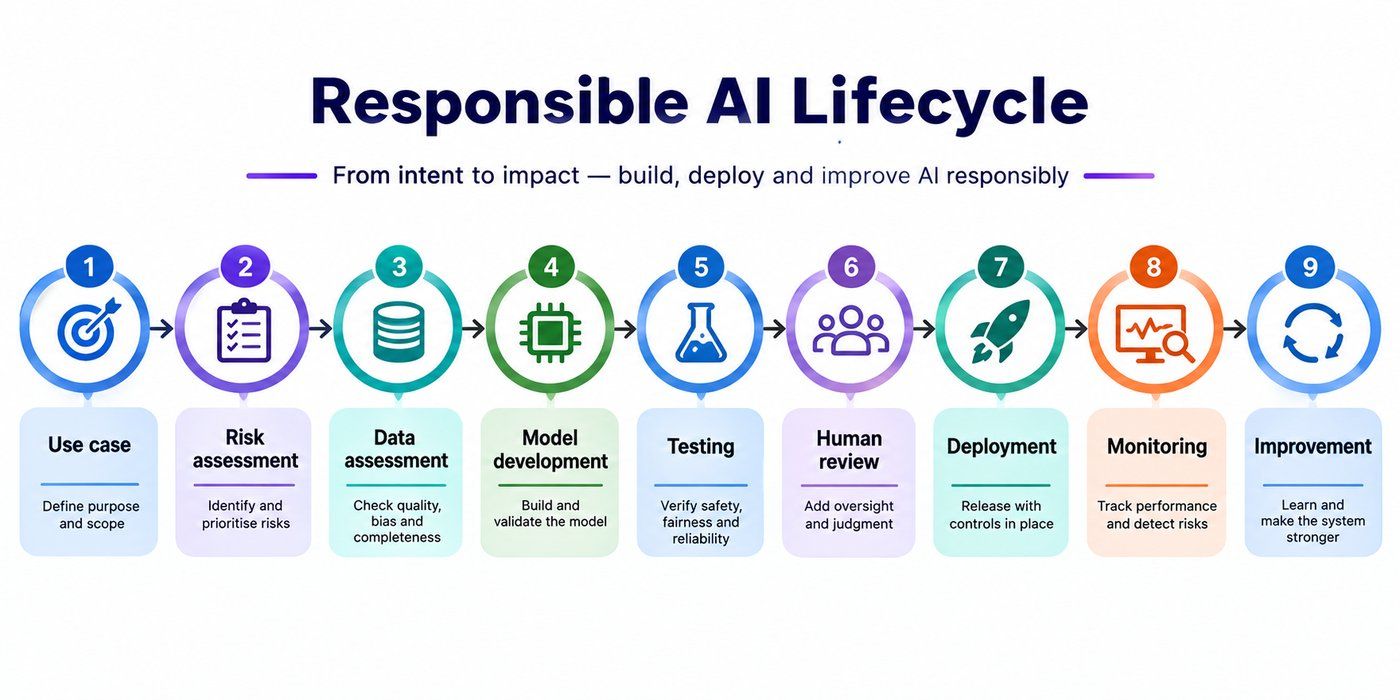
Start by asking: Why are we using AI?
Teams should clearly define the problem, intended users, expected benefits and possible negative outcomes. The level of oversight should depend on the potential impact of the AI system.
Before development, teams should identify what could go wrong. A responsible AI framework can help structure the assessment.
Key questions include:
Data quality directly affects AI performance. Teams should examine the source, relevance, quality and representativeness of the data.
They should also check whether sensitive information is being handled appropriately and whether certain groups are underrepresented. Data assessment can help identify potential privacy and bias risks before they affect model outcomes.
Developers build or select the model while considering the risks identified earlier.
Important factors can include model complexity, explainability, security, training data, access controls and performance requirements. Teams should also document key decisions, assumptions, limitations and testing results.
Testing should go beyond a single accuracy score. Teams should evaluate performance across different conditions and users.
Testing may cover:
For generative AI, testing can also include hallucinations, toxicity and prompt injection. NIST recommends testing AI systems before deployment and monitoring them during operation.
Human oversight is important when AI outputs can significantly affect people. Reviewers may approve decisions, investigate unusual results or override AI recommendations.
Effective oversight requires more than simply placing a person in the workflow. Reviewers need sufficient authority, information and time to question AI outputs.
After testing, organisations should deploy AI with appropriate safeguards. Controls may include access restrictions, logging, approval processes, usage limits and incident-response procedures.
Employees should also understand how to use the system, when they should not rely on it and when a problem needs human escalation.
Responsible AI does not end when a system goes live. Data, user behaviour, regulations and operating conditions can change over time.
Teams should monitor factors such as:
When problems appear, teams may retrain the model, update controls, restrict its use or remove it from production. NIST treats AI risk management as a continuous activity across the AI lifecycle rather than a one-time review.
Ready to move from understanding AI to leading it? Build the skills to drive data and AI transformation with the IIIT-B & IIMU Chief Data and AI Officer Programme Online.
There is no single universal responsible AI framework that every organisation must use. Different approaches solve different problems.
| Framework/Standard | Primary Focus | When It Is Useful |
| NIST AI RMF | AI risk management | Building a practical AI risk-management process |
| ISO/IEC 42001 | AI management systems | Establishing organisation-wide AI governance |
| OECD AI Principles | Responsible AI policy | Understanding high-level policy and trust principles |
| Microsoft Responsible AI | AI development and deployment | Applying responsible AI practices across product development |
| EU AI Act | Risk-based AI regulation | Understanding legal obligations connected with the EU market |
The NIST AI Risk Management Framework provides a voluntary approach to managing AI risks. Its Core is organised around four functions: Govern, Map, Measure and Manage.
It is useful for teams that want a structured risk-management process and a practical way to identify, assess and manage AI risks.
ISO/IEC 42001 is an international standard for an Artificial Intelligence Management System (AIMS).
It provides requirements for establishing, implementing, maintaining and continually improving AI management practices. It is useful for organisations seeking a formal approach to AI policies, risk management, accountability and continuous improvement.
The OECD AI Principles provide a policy-level foundation for trustworthy AI. They focus on human-centred values, fairness, transparency, robustness, security, safety and accountability.
They can help organisations and policymakers understand broader expectations for responsible AI development and use.
Microsoft's approach provides practical guidance for responsible AI across the development and deployment lifecycle. It covers areas such as fairness, reliability and safety, privacy and security, inclusiveness, transparency and accountability.
It can be useful for organisations looking for practical guidance during AI product development and deployment.
The EU AI Act follows a risk-based regulatory approach. Requirements vary according to the level and type of AI risk. Certain AI practices are prohibited, while high-risk systems face specific requirements and some systems have transparency obligations.
Also read: Artificial Intelligence Creativity: How AI Powers Ideas
Generative AI can create text, images, audio, video and code at scale. While it offers major benefits, it also introduces risks that require additional responsible AI controls.
Generative AI can produce information that sounds convincing but is incorrect. Organisations should not assume every AI-generated response is accurate.
Grounding techniques, retrieval systems, human review and regular output evaluation can help reduce the impact of hallucinations.
Generative models learn from large datasets and may reflect biases present in their training data. They can also produce offensive, unsafe or harmful content.
Testing should cover different prompts, languages, user groups and situations to identify problematic outputs.
Users may accidentally enter confidential or personal information into AI tools. Organisations should establish clear rules for handling sensitive data and apply appropriate access and security controls.
Generative AI can raise questions about copyrighted material, ownership, licensing and permitted use.
Businesses should review AI-generated content before publishing or using it commercially, particularly when intellectual property rights may be involved.
Generative AI can create realistic synthetic images, videos and audio. Such content can make it harder to distinguish authentic information from manipulated material.
Organisations can consider:
Attackers may use carefully crafted instructions to manipulate an AI system. For example, an AI assistant connected to internal documents could be tricked into exposing information it should not reveal.
Security testing should include adversarial prompts, access-control checks and safeguards around connected tools and data.
Generative AI produces probabilistic outputs, so human review remains important for high-impact tasks.
Organisations should clearly define where AI can operate independently and where human approval is required.
Generative AI needs continuous evaluation because output quality can vary across prompts and situations.
Teams can monitor:
Regular monitoring helps teams identify emerging problems and improve AI systems over time.
Also read: Top 25 AI Skills in Demand for a Successful Engineering Career
India is building its AI ecosystem while also focusing on safe and responsible adoption. For businesses, responsible AI needs to work alongside data protection, cybersecurity and sector-specific requirements.
The IndiaAI Mission supports India's broader AI development through areas such as:
The mission aims to support AI adoption while encouraging responsible development and use.
AI systems often process personal and sensitive information. Indian organisations need to consider applicable data protection requirements when collecting, processing and storing such data.
The Digital Personal Data Protection Act, 2023 provides a legal framework for processing digital personal data in India. AI governance and privacy practices should therefore work together rather than operate as separate processes.
Generative AI can create realistic images, videos, audio and text. Such capabilities can increase risks related to misinformation, impersonation and fraud.
Businesses can reduce these risks through:
AI risks depend heavily on the industry and use case.
| Sector | Key Areas of Concern |
| Banking | Financial decisions, fraud and privacy |
| Healthcare | Patient safety and sensitive data |
| Education | Student data and assessment fairness |
| Retail | Customer data and automated recommendations |
| Recruitment | Bias and discriminatory outcomes |
Before deploying an AI system, businesses should evaluate five key areas:
Businesses should also establish processes for monitoring performance and responding to AI incidents.
A practical responsible AI governance approach connects business ownership, technical controls, compliance requirements and continuous monitoring.
Also read: How to Learn Artificial Intelligence: Step-by-Step Guide
Responsible AI needs measurable indicators. Without measurement, organisations may have policies but little evidence that those policies are working.
Possible measures include:
| Area | Example Metrics |
| Fairness | Difference in error rates or outcomes across groups |
| Accuracy | Accuracy, precision, recall and error rates |
| Explainability | Percentage of decisions with available explanations |
| Privacy | Number and severity of privacy incidents |
| Security | Security events and successful attacks |
| GenAI | Hallucination, toxicity and harmful-output rates |
| Human oversight | Review, intervention and override rates |
| Reliability | Failure rates and system availability |
| Model drift | Changes in performance over time |
| Incidents | Number, severity and resolution time |
Metrics should match the AI use case.
For example, measuring only accuracy for a loan decision system would leave important questions unanswered. Teams may also need fairness, explainability, privacy and human-override measures.
NIST recommends using quantitative, qualitative or mixed methods to assess AI risks and monitoring systems regularly during operation.
Measurement also needs context. A high override rate may indicate that humans are effectively controlling an AI system, but it could also mean the model is performing poorly. Numbers need investigation rather than automatic interpretation.
Also read: AI Effects on Society: Benefits, Risks and Daily Life Impact
Responsible AI sounds straightforward in theory. Implementation can be difficult.
Also read: Will AI Replace Data Analysts? Future, Impact & Reality
Responsible AI helps organisations develop and use AI while considering fairness, privacy, safety, transparency and accountability. What is responsible AI goes beyond model accuracy by asking whether AI is being used appropriately, risks are managed and people have suitable protection.
The core principles of responsible AI, supported by frameworks such as NIST AI RMF and ISO/IEC 42001, help organisations turn responsible AI goals into practical processes. The focus is on identifying risks, applying suitable controls, monitoring outcomes and improving systems continuously.
Take the next step in your career? Book a consultation call with upGrad to explore the right learning programme for your goals.
AI can create risks when systems are poorly designed, misused or deployed without proper safeguards. However, responsible development, human oversight, security measures and ongoing monitoring can help reduce potential harm.
Responsibility can be shared among developers, business leaders, data teams, vendors and governance teams. Organisations should clearly assign ownership so someone is accountable for decisions, risks, incidents and ongoing system performance.
Yes. Responsible AI can reduce costly errors, improve customer trust, support compliance and identify risks earlier. Clear governance can also make employees more confident when adopting AI tools and integrating them into business processes.
Risk assessment should begin before development and continue throughout the system lifecycle. Early assessment helps teams identify privacy, fairness, security and safety concerns before they become difficult or expensive to address.
Companies can build trust by communicating how AI is used, protecting user data, testing system performance, providing meaningful explanations and maintaining human oversight for important decisions. Consistent monitoring also helps identify problems early.
Documentation creates a record of important decisions, data sources, model limitations, testing results and risk controls. It helps teams understand how an AI system was developed and makes audits, troubleshooting and accountability easier.
AI systems should be reviewed regularly rather than only before launch. Review frequency can depend on risk, usage and system changes. High-impact applications generally require more frequent evaluation and closer monitoring.
Yes. Small businesses can begin with practical measures such as approved AI tools, data-handling rules, basic risk assessments, human review and performance monitoring. The level of governance should match the risks associated with each use case.
Organisations should have an incident-management process for investigating the issue, assessing its impact and taking corrective action. Depending on the situation, teams may modify controls, retrain the model, restrict usage or stop deployment.
Responsible AI gives employees clearer guidance about AI usage, data handling, review requirements and escalation procedures. It can also help employees understand when AI outputs require verification rather than being accepted automatically.
No. Any organisation using AI can face risks involving privacy, security, bias or unreliable outputs. Smaller organisations may use simpler governance processes, but they should still assess risks and establish appropriate safeguards.
1008 articles published
We are an online education platform providing industry-relevant programs for professionals, designed and delivered in collaboration with world-class faculty and businesses. Merging the latest technolo...
Get Free Consultation
By submitting, I accept the T&C and
Privacy Policy
Top Resources
Certification
3 Months
Certification
6 Months
O.P. Jindal Global University
Masters in International Accounting and Finance (Accredited by ACCA, UK)Master's Degree
12 Months