AI Governance Framework: Components, Principles and How to Build One
By upGrad
Updated on Aug 17, 2026 | 8 min read | 3.61K+ views
Share:

All courses
Certifications
More
By upGrad
Updated on Aug 17, 2026 | 8 min read | 3.61K+ views
Share:
Table of Contents
Key Highlights
Ready to take your management skills to the next level? Explore the best management courses and build the expertise you need to stay ahead in today’s competitive business world.
Popular Management Programs
An AI governance framework is a set of policies, processes, roles, and controls that guides how an organisation develops, deploys, and uses AI responsibly. It acts as a practical rulebook for managing AI risks and accountability.
A good framework answers questions such as:
For example, a bank using AI for loan assessment must look beyond model accuracy. Governance also considers bias, data quality, privacy, explainability, human review, and changes in model performance after deployment.
Free Courses
The terms are related, but they have different meanings.
A simple way to remember the difference:
The AI governance framework 2026 conversation is becoming more important as AI capabilities, standards, and regulations continue to evolve. NIST is revising its AI Risk Management Framework, while ISO/IEC 42001 provides requirements for establishing and improving an AI management system.
Also read: Challenges of Artificial Intelligence with Solutions [2026]
Management Courses to upskill
Explore Management Courses for Career Progression
IIIT-B & IIM, Udaipur
Chief Technology Officer & AI Leadership ProgrammeA company using an AI chatbot will have different requirements from a bank using AI for loan decisions. However, most mature governance programmes cover these key areas.
Governance and accountability define who is responsible for an AI system and who has the authority to make decisions about it. Like one team may develop a model, another may purchase it from a vendor, and a third team may use it. Clear roles prevent confusion when a problem occurs.
AI risk management is the process of identifying, assessing, and controlling the potential risks associated with an AI use case.
Not every application carries the same level of risk. A meeting-summary tool may have limited impact, while a system used for recruitment, lending, or healthcare can significantly affect people.
Risk assessments should consider:
Data governance ensures that the data used by AI systems is reliable, appropriate, secure, and properly managed.
Organisations should check:
Model governance provides oversight of a model throughout its lifecycle, from development and testing to approval and ongoing monitoring.
Organisations should document the model's purpose, training data, assumptions, performance, limitations, and version history. A model AI governance framework helps manage these processes and keeps models properly documented and controlled.
Security and privacy protect data, models, applications, and users from unauthorised access, misuse, or exposure. AI applications may handle customer information, employee records, financial data, or confidential business information.
Common controls in security and privacy include:
Transparency and explainability help people understand when AI is being used and, where necessary, how it reaches or influences a decision.
The level of explanation depends on the use case and its potential impact. A recommendation system may only need to explain why something was recommended, while a high-impact system may require a clearer explanation of its decision.
Transparency can include:
Human oversight ensures that people remain involved when automated decisions can have significant consequences. It is particularly important when a system can affect someone's finances, employment, rights, access to services, or wellbeing.
Human reviewers should have enough knowledge and authority to question, investigate, or override an output when necessary.
Monitoring and auditing ensure that governance controls continue to work after a system is deployed. Performance can change as data, users, and business conditions evolve.
Organisations should continuously monitor:
Also read: Top Artificial Intelligence Applications Across Industries
A governance framework defines the controls an organisation needs to put in place. Clear principles help teams apply those controls consistently, especially when a situation is not covered by a specific policy.
Bias can enter an AI system through training data, model design, labels, features or even the way results are used. Organisations should therefore test systems for unfair patterns before and after deployment.
Fairness does not always mean treating everyone identically. It means identifying and addressing unjustified differences in outcomes.
People should have clear information about how AI is being used. For example, customers may need to know when they are interacting with an AI system or understand how an automated decision was made. The level of information provided should depend on the use case and its potential impact.
AI systems need clearly defined ownership. If a model produces an unexpected or harmful result, the organisation should be able to identify who is responsible for investigating it and deciding what action to take.
Accountability should exist across the AI lifecycle, not only after something goes wrong.
AI systems often depend on large amounts of data, making privacy an important governance concern. Organisations should:
AI systems need protection from both traditional cybersecurity threats and AI-specific attacks. Controls should cover the model, data, applications, APIs and supporting infrastructure.
Organisations should also prepare for incidents such as data exposure, malicious inputs or compromised AI services.
People should remain involved when AI decisions can have significant consequences. Human reviewers need enough knowledge and authority to question an AI output, request additional information or override the system when necessary.
7. Reliability
An AI system should perform consistently for its intended purpose. Teams should test:
Also read: AI Ethics: Ensuring Responsible Innovation for a Better Tomorrow
Governance works best when it is built into the entire lifecycle.
Waiting until deployment to check compliance can be too late. Decisions made during planning and development can already affect the system's risks.
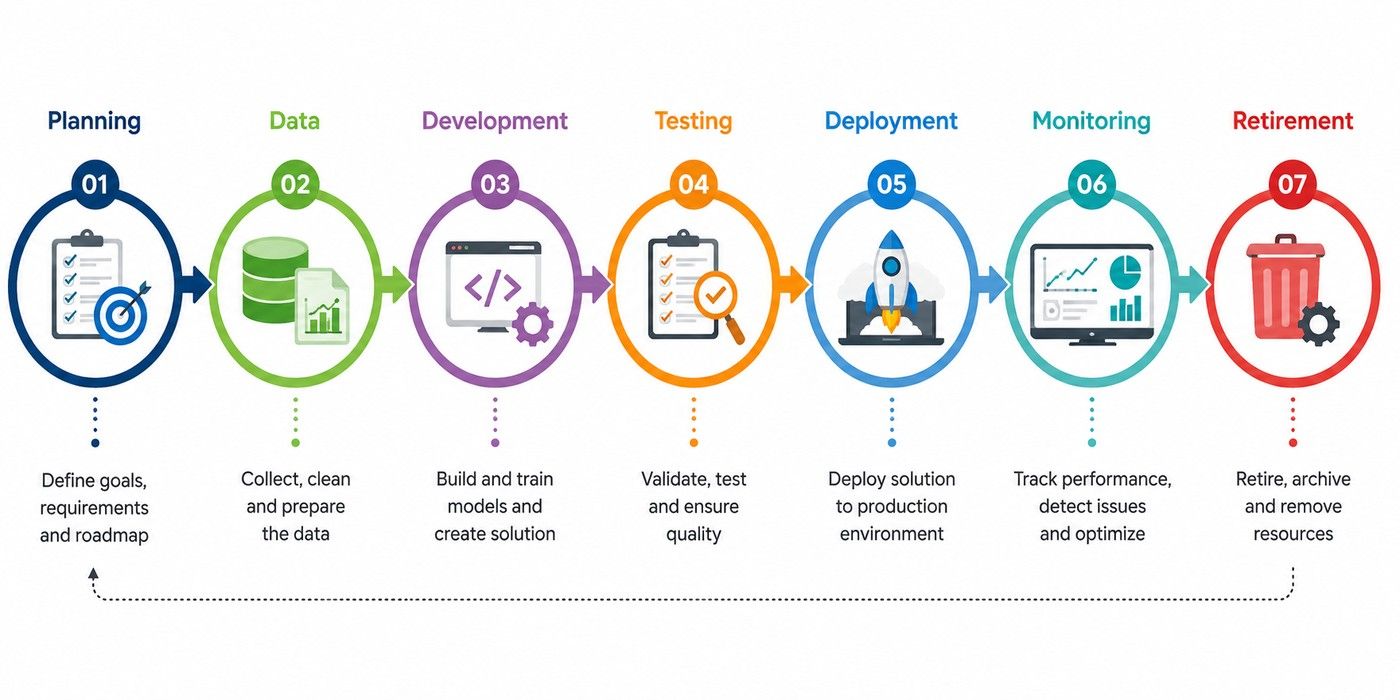
Governance begins before a model is built. The organisation should define why the system is needed and what decision or task it will support. At this stage, teams can ask:
A risk classification can then determine how much governance is required.
Teams should verify the source, quality, relevance, and permitted use of data before using it for AI applications. Sensitive information should be properly protected, while the data should also be checked for representation and potential bias.
For example, if a recruitment model is trained mainly on historical data from one demographic group, the organisation should assess whether the data could result in unfair hiring outcomes.
During development, teams should document key technical decisions, including the model architecture, training approach, parameters, datasets, and known limitations. Good documentation makes it easier to evaluate, maintain, and govern the system throughout its lifecycle.
Developers should also follow security and privacy requirements.
Governance does not mean that every technical decision needs approval from a committee. Low-risk technical decisions can remain with the development team. Higher-risk decisions can go through additional review.
Testing should examine more than accuracy. Teams may test, performance, bias, robustness, security, privacy, explainability, edge cases, and failure scenarios.
The results should be documented before deployment. If the model fails an important requirement, the team should fix the issue or reconsider whether the system should be deployed.
Before deployment, the organisation should confirm that the necessary approvals and controls are in place. This can include:
The deployment decision should be based on evidence rather than enthusiasm for the technology.
Once deployed, the system should be monitored regularly. Teams can track model performance, changes in input data, unusual outputs, complaints and other relevant signals. Monitoring should also have clear thresholds.
For example, if accuracy falls below a defined level, the system may need additional testing or temporary suspension.
AI systems should also have an exit plan. When a model is no longer useful, accurate or safe, the organisation should know when to replace or retire it.
Retirement can involve archiving documentation, removing access, managing stored data and recording the reason for decommissioning.
Also read: Future Scope of Artificial Intelligence in 2026 and Beyond
Building governance does not require an organisation to create hundreds of pages of policies.
A practical approach is to start with the AI systems already being used and build controls around their actual risks.
Here is a seven-step process.
Begin by identifying where AI is currently being used across the organisation. Include both approved AI systems and tools employees may be using independently. Look beyond machine learning models and consider generative AI applications, automated decision systems, recommendation engines, and AI features built into third-party software.
The first question is simple:
Where is AI making or influencing decisions in our organisation?
Once use cases are identified, create a central inventory.
For each system, record information such as:
| Information | What to Record |
| AI system | Name and purpose |
| Owner | Business and technical owner |
| Provider | Internal or third-party |
| Data | Types of data used |
| Risk level | Low, medium or high |
| Users | Who interacts with the system |
| Status | Development, testing or production |
| Review date | Next governance review |
A useful approach is to classify systems based on factors such as potential harm, sensitivity of data, level of automation and impact on individuals. A low-risk internal productivity tool may need basic controls.
High-impact AI systems may require detailed testing, formal approval, human review, and frequent monitoring. A risk-based approach ensures stronger controls for higher-risk systems without making governance unnecessarily complex for lower-risk applications.
Every AI system should have a named owner. The owner does not necessarily have to be the person who built the model.
Their role is to make sure the system has appropriate oversight throughout its lifecycle. Responsibilities can be divided between business, technical, legal, security and risk teams.
Now convert governance principles into practical rules. Policies may cover:
The controls should match the risk. A simple chatbot should not require the same approval process as an AI system making high-impact decisions.
Define what should be monitored and how often.
Different systems will need different metrics. For a predictive model, performance and drift may be important. For a generative AI application, organisations may monitor harmful outputs, hallucinations, data leakage and user feedback.
Monitoring should also have an escalation process so that teams know what to do when something goes wrong.
Finally, review the framework itself. Ask:
AI governance should evolve as the organisation learns. The goal is not to create a perfect framework on day one. It is to create a system that can improve over time.
Ready to lead the next wave of AI innovation? Explore the IIIT-B & IIMU Chief Data and AI Officer Programme Online and build the strategic expertise to drive data and AI transformation.
Organisations do not have to create an AI governance approach entirely from scratch. Several international frameworks and standards provide guidance for managing AI risks and responsibilities.
They are not interchangeable. Each has a different purpose.
| Framework/Standard | Main Focus |
| NIST AI RMF | AI risk management |
| ISO/IEC 42001 | AI management system |
| EU AI Act | Risk-based regulation |
| OECD AI Principles | Responsible AI |
| India AI Governance Guidelines | Principle-based AI governance |
The NIST AI Risk Management Framework helps organisations identify and manage risks associated with AI.
It is organised around four core functions: Govern, Map, Measure and Manage.
The framework is voluntary and can be adapted to different types of organisations and AI systems. NIST also provides a Generative AI Profile to help organisations consider risks that are specific to generative AI.
ISO/IEC 42001 is an international standard for an AI management system.
Instead of focusing only on individual models, it looks at how an organisation manages AI as a whole. It provides requirements for establishing, implementing, maintaining and continually improving an AI management system.
The EU AI Act takes a risk-based regulatory approach.
It categorises AI applications according to their level of risk and establishes different obligations for different categories. Certain AI practices are prohibited, while high-risk systems face requirements around areas such as risk management, data governance, documentation, transparency and human oversight.
Organisations operating in or serving the European market need to understand whether the Act applies to their AI activities.
The OECD AI Principles provide a broader foundation for trustworthy AI. They promote ideas such as inclusive growth, human-centred values, transparency, robustness, security, safety and accountability.
They are useful when organisations want to establish high-level principles that can guide AI policy and decision-making.
India is taking a principle-based approach to AI governance, with the IndiaAI Mission and related policy work focusing on responsible and inclusive AI adoption.
The AI governance framework India develops should therefore be understood in the context of India's broader approach to innovation, safety, inclusion and responsible AI.
For businesses, the practical approach is not to copy one international framework blindly. Organisations can use established standards as references and adap
Also read: Artificial Intelligence Subjects: Complete Guide (2026)
Consider a bank that uses an AI system to help assess loan applications.
The model analyses customer information and generates a risk score. A loan officer then uses that score as one input when reviewing the application.
Here is how governance can work.
The bank clearly defines the AI system's purpose. It is designed to support loan assessment, not make final decisions without human review. Defining the model's role helps establish clear boundaries for its use and ensures appropriate human oversight.
The bank identifies the system as high impact because its output can influence access to financial services.
The risk assessment considers:
The higher risk means stronger controls are required.
The bank checks where the training data came from and whether it is appropriate for the intended use. The team examines data quality and looks for patterns that could lead to unfair outcomes. Sensitive information is also protected through appropriate access controls.
The model is tested before deployment. The bank measures overall performance but also examines whether error rates differ significantly across relevant groups.
The team also tests unusual cases.
If the model performs poorly for certain applicants, the issue needs to be investigated before the system goes live.
The model provides a recommendation rather than making the final decision independently. A trained loan officer reviews cases based on the bank's defined procedures. If the officer believes the AI output is incorrect, they can challenge or override it.
After deployment, the bank continues to monitor performance. Suppose the model's accuracy starts declining because customer behaviour has changed. The monitoring system detects the change.
The bank can then investigate the cause, retrain or replace the model, or temporarily reduce its use.
Periodic audits check whether the governance controls are actually being followed. The audit may examine model documentation, approval records, monitoring reports, incident logs and human override decisions.
The example highlights why governance involves more than model accuracy. Even a technically strong model needs controls for data quality, fairness, security, accountability, and human decision-making to ensure responsible use.
Also read: Corporate Governance: A Guide to Models and Principles
A strong framework should protect people and the organisation without making every AI project unnecessarily difficult.
The following practices can help.
Do not apply identical controls to every AI system.
A low-risk productivity assistant and a high-impact financial decision system should not go through the same governance process.
Classify AI applications according to their potential impact and apply controls accordingly.
Avoid situations where everyone is involved but nobody is accountable. Every AI system should have clearly defined owners and responsibilities. Teams should know who approves the system, who monitors it and who responds when something goes wrong.
AI governance is not complete at deployment. Models can experience performance changes, data drift and unexpected behaviour.
Define monitoring requirements before deployment and establish clear thresholds for escalation.
Good documentation makes governance easier. Keep records of:
Documentation also helps when a new team member takes ownership of an existing system.
Human oversight should not become a box-ticking exercise. People reviewing AI outputs should understand the system's limitations and have enough authority to question its recommendations.
For high-impact applications, this can make a significant difference.
Audits can identify gaps that routine monitoring may miss.
They can examine whether teams are following policies, whether documentation is complete and whether risk controls remain appropriate. The frequency of audits should depend on the system's risk.
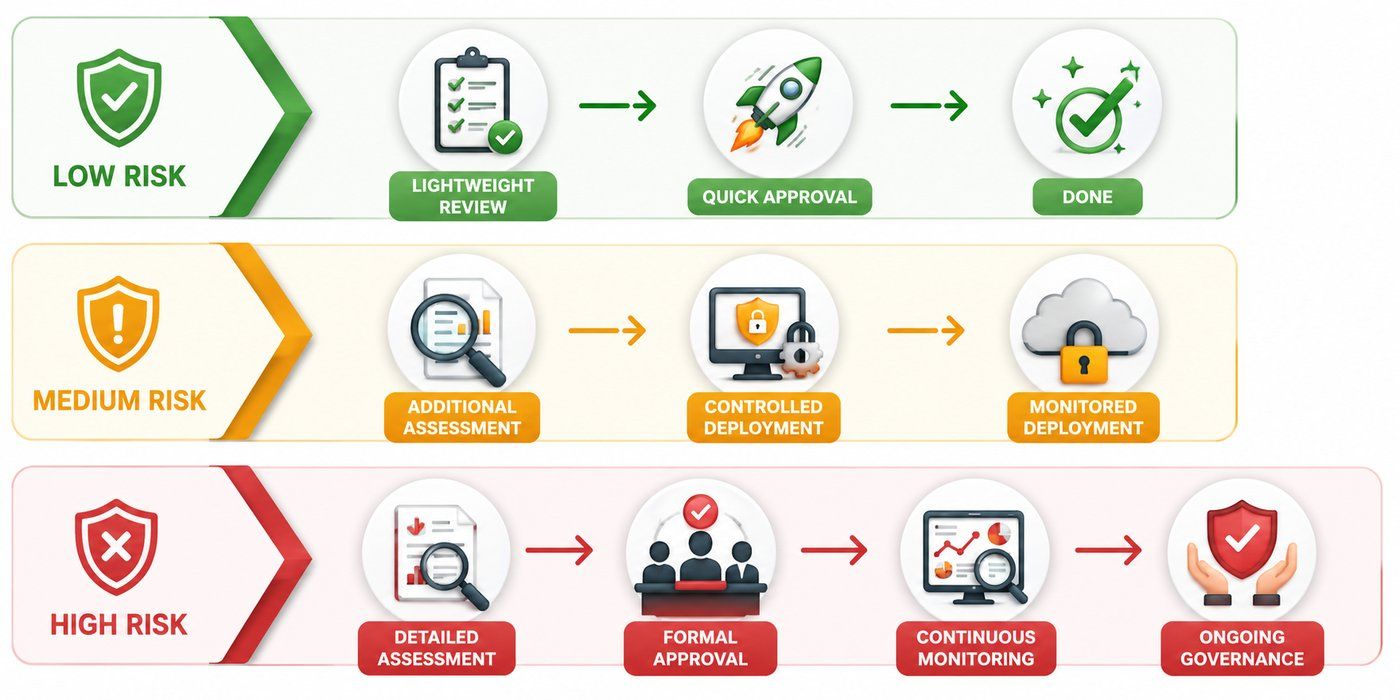
One of the biggest challenges is finding the right balance. If every experiment requires a lengthy approval process, employees may avoid using official AI tools and start using unapproved alternatives.
A better approach is to create different governance paths.
For example:
Also read: Types of AI: Explained with Examples, Learning & Agents
An effective AI governance framework brings together accountability, risk management, data and model governance, security, transparency, human oversight, and monitoring.
Organisations should start by identifying AI use cases, assessing risks, assigning ownership, and implementing appropriate controls. Governance should remain an ongoing process as AI systems and risks evolve.
Take the next step in your AI career. Book a consultation call with upGrad to explore programmes that can help you build in-demand skills and stay ahead of the curve.
An AI governance framework helps organisations manage the risks and responsibilities associated with AI. It provides structure for areas such as accountability, data, security, model development, human oversight, monitoring and audits throughout the AI lifecycle.
AI ethics focuses mainly on values such as fairness, transparency and human wellbeing. AI governance turns those values into practical policies, responsibilities, processes and controls that guide how AI is actually developed and used.
Responsibility should be shared across business, technical, legal, risk, security and compliance teams. However, each AI system should have clearly identified owners who are accountable for its operation and governance.
No. Smaller organisations also benefit from governance. The framework can be scaled according to the organisation's size and AI risk. A small business may need only a basic inventory, usage policy, risk assessment and monitoring process.
There is no universal schedule. Higher-risk systems generally require more frequent reviews, while lower-risk applications may be reviewed less often. Organisations should also conduct additional reviews after major model, data, regulatory or business changes.
Generative AI can produce inaccurate, biased or inappropriate outputs and may create data privacy and security risks. Governance helps organisations define acceptable use, protect sensitive information, evaluate outputs and establish human review where needed.
Yes. Governance gives teams clearer information about an AI system's limitations, risks and expected performance. This can help decision-makers understand when an AI recommendation can be trusted and when additional human judgement is needed.
An AI inventory can record each system's purpose, owner, provider, data sources, users, risk classification, deployment status, key controls and review dates. This gives the organisation a central view of where and how AI is being used.
Use a risk-based model. Apply lightweight controls to low-risk applications and stronger reviews to systems that can significantly affect people, finances, safety or rights. This keeps governance proportional to the actual risk.
Standards provide organisations with established approaches for managing AI. NIST AI RMF focuses on risk management, while ISO/IEC 42001 provides a management-system approach. Organisations can use these standards as foundations and adapt them to their needs.
Human oversight provides a way to review important AI outputs before they cause significant harm. It is especially valuable for high-impact decisions because people can question results, investigate unusual cases and override AI recommendations when necessary.
1008 articles published
We are an online education platform providing industry-relevant programs for professionals, designed and delivered in collaboration with world-class faculty and businesses. Merging the latest technolo...
Get Free Consultation
By submitting, I accept the T&C and
Privacy Policy
Top Resources
Certification
3 Months
Certification
6 Months
O.P. Jindal Global University
Masters in International Accounting and Finance (Accredited by ACCA, UK)Master's Degree
12 Months