Employee Value Proposition: Meaning, Components and How to Build One
By upGrad
Updated on Aug 17, 2026 | 7 min read | 3.61K+ views
Share:

All courses
Certifications
More
By upGrad
Updated on Aug 17, 2026 | 7 min read | 3.61K+ views
Share:
Table of Contents
EVP is the complete set of pay, benefits, culture, growth opportunities, and day-to-day experiences a company offers employees in return for their skills, time, and commitment.
This blog breaks down what an employee value proposition actually means, the components that make one strong, a practical step-by-step framework to build your own, real example patterns you can model, the mistakes that quietly weaken most EVPs, and how to check whether your EVP is actually working.
Take the next step toward a rewarding career in business leadership. Enroll in our Management and MBA Courses today to build the strategic, analytical, and decision –making skills employers value most
It's a common mistake to treat it as a synonym for salary. Pay is part of it, but a candidate comparing two similar offers is rarely deciding on compensation alone they're weighing growth opportunities, the manager they'd report to, how flexible the role is, and whether the company's culture matches what they're looking for. An EVP that begins and ends with "we pay well" is not really a value proposition; it's a single line item.
The clearest way to think about it is as an exchange. On one side, the employee brings their skills, time, effort, and commitment to the organisation's goals. On the other, the company offers something back in return fair compensation, benefits, career development, a workable environment, capable leadership, and a sense of purpose. When that exchange feels balanced and honest, people stay, refer others, and do better work. When it feels one-sided, even good pay struggles to hold on to talent for long.
Most EVP frameworks including the widely referenced Mercer EVP model organise the EVP into a small set of connected pillars rather than a single benefit. The table below breaks down the six components that consistently show up across strong EVPs.
| Component | What It Covers |
| Compensation | Base pay, bonuses, equity, and pay transparency relative to market rates. |
| Benefits and Rewards | Health cover, insurance, retirement contributions, and total rewards beyond salary. |
| Career Development | Learning budgets, internal mobility, mentorship, and clear paths to promotion. |
| Culture and Values | How people treat each other day to day, and whether stated values hold up in practice. |
| Leadership and Management | The quality of direct managers, trust in senior leadership, and how decisions get communicated. |
| Flexibility and Work-Life Balance | Hybrid or remote options, flexible hours, and realistic workload expectations. |
These six components work as a connected system, not a checklist to tick off independently. A company can offer excellent compensation and still lose people if leadership is weak or the culture feels toxic being strong in one area rarely offsets being genuinely weak in another. This is also why understanding the key functions of human resource management is useful background before attempting to design or refresh an EVP.
Also Read: Key Functions of Human Resource Management (HRM)
It helps to separate EVP components into tangible and intangible categories. Tangible components pay, benefits, perks, hardware, and office setup are visible, easy to compare, and relatively easy for competitors to copy. Intangible components culture, purpose, trust in leadership, and real opportunities to grow are harder to see from the outside and much harder for another company to replicate, because they're built over time through consistent behaviour, not a policy document. The strongest employee value propositions lean on both, but it's usually the intangible half that decides whether people stay.
A well-defined employee value proposition directly affects three things recruiters and business leaders both care about: retention, speed of hiring, and referral quality. Employees who feel the exchange is fair are less likely to leave, which lowers the cost and disruption of replacing them. Candidates who can clearly see what a company offers beyond salary tend to move through the hiring process faster, since there's less back-and-forth negotiation and fewer late-stage drop-offs.
Referrals are where a strong EVP compounds. Employee referral hires are consistently reported as faster to hire and cheaper to source than candidates from open job boards, largely because current employees only refer people when they genuinely believe in what the company offers which is the EVP doing its job. This matters even more for companies that can't always win on salary alone and need to compete on growth, culture, or flexibility instead.
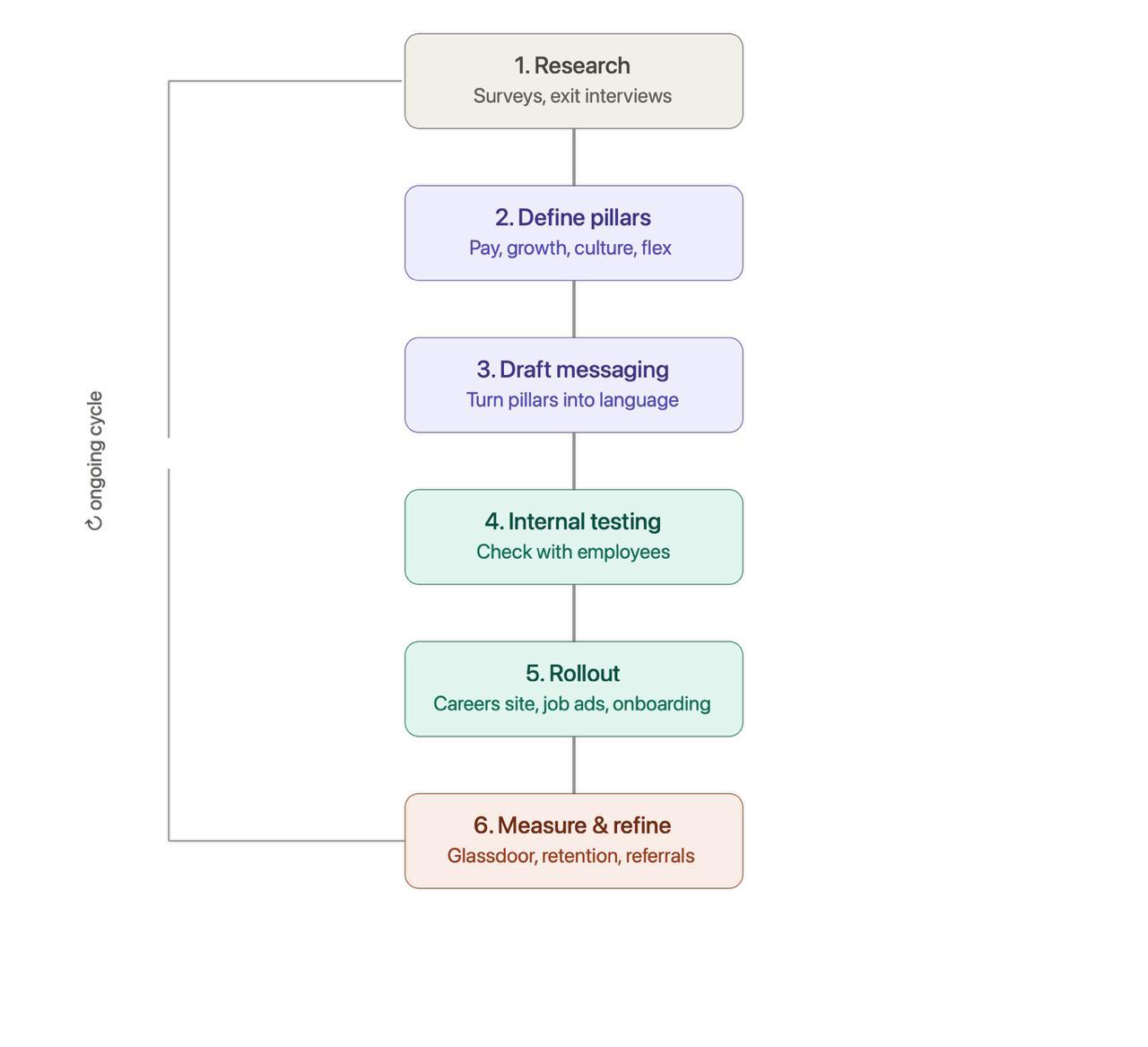
Building a strong employee value proposition starts with understanding what makes people want to join an organisation, stay there, and feel motivated to contribute. It should reflect the real employee experience rather than sounding like a polished marketing promise. The following steps can help organisations develop an approach that is authentic, competitive, and meaningful to both existing employees and potential candidates.
Rather than pointing to specific named companies since exact internal EVP language shifts often and can be hard to verify, it's more useful to look at the broad patterns that most real-world employee value propositions fall into. Most organisations lean toward one of the following, then layer in secondary elements from the others.
| EVP Type | What It Emphasizes | Best Fit For |
| Purpose-Led EVP | Mission, social or environmental impact, meaningful work | Nonprofits, mission-driven startups, public sector |
| Flexibility-Led EVP | Remote or hybrid options, flexible hours, autonomy over schedule | Distributed teams, companies competing for parents and caregivers |
| Growth-Led EVP | Learning budgets, fast promotions, mentorship, skill-building | High-growth companies, early-career talent, tech and consulting |
| Culture-Led EVP | Team environment, psychological safety, day-to-day collaboration style | Companies where retention and team cohesion are the biggest lever |
The single biggest factor across every pattern above is believability. An employee value proposition only works if a new hire's actual day-to-day experience backs up the message they were sold during hiring. A growth-led EVP that promises fast promotions but delivers none within two years will damage trust faster than never mentioning growth at all. Believability is earned through consistency, not through better copywriting.
An Employee Value Proposition (EVP) can be a powerful way to attract and retain the right people, but it can also fall flat when it is built around assumptions rather than what employees value. From making unrealistic promises to copying competitors, even well-intentioned EVPs can end up feeling generic or disconnected from everyday employee experiences. In this section, we’ll look at the most common EVP mistakes organisations make and, more importantly, how to avoid them.
Fix: build pillars from your own employee research, not someone else's careers page.
Fix: test messaging with current employees before publishing it externally.
Fix: put it on a recurring review cycle, not a "set it and forget it" document.
Fix: the six-component framework so no single pillar carries the whole message.
Fix: run surveys and focus groups before finalising, not after launch.
Fix: brief managers directly so the EVP is consistent in every conversation, not just on the careers page.
An employee value proposition isn't something you publish and forget, it needs to be checked against real outcomes. The metrics below are the most direct signals of whether an EVP is landing with employees and candidates.
| Metric | What It Tells You |
| Retention rate | Whether employees are staying long enough to validate the promise made to them |
| Offer acceptance rate | Whether candidates find the full package compelling enough to say yes |
| Employee referral rate | Whether current employees believe in the EVP enough to recommend it to others |
| Glassdoor / employee review sentiment | Whether the public perception matches the internal promise |
| Engagement survey scores | Whether day-to-day experience is tracking the stated EVP pillars over time |
Review the EVP at least once a year, and sooner if something major shifts a change in hybrid or remote policy, new senior leadership, a restructuring, or a noticeable dip in any of the metrics above. An EVP built two years ago for a fully in-office team, for instance, needs revisiting the moment that team goes hybrid.
An employee value proposition isn't a poster on a careers page, a paragraph in an offer letter it's a living promise that must hold up in how people are managed, paid, developed, and treated every day. Get it right, and the payoff shows up directly in the numbers that matter most to any growing business: people stay longer, open roles get filled faster, and current employees become the company's strongest recruiting channel through referrals.
Getting there takes the same discipline as any other strategic HR function research, honest positioning, internal testing, and consistent communication, reviewed regularly rather than left untouched for years. If you're looking to build these strategic and people-focused capabilities more formally, up Grad's HR and management programs are designed to help HR professionals move from routine tasks into the kind of strategic work that shapes retention, culture, and employer branding.
An employee value proposition (EVP) is essentially the deal a company offers its people, think pay, benefits, growth opportunities, culture, and flexibility in return for the skills, effort, and commitment employees bring to the table. It's less a formal document and more a genuine promise: "here's what you can expect from us if you choose to work here." A strong EVP answers the question every candidate is silently asking: "why should I pick you over the company down the street?"
Total rewards are narrower, more tangible slice your salary, bonuses, health insurance, retirement contributions, and similar perks. EVP is the bigger picture that wraps around all of that, adding in things money can't fully capture, like company culture, quality of leadership, learning and career growth, and how much flexibility you get in your day-to-day work. In short, total rewards is what's in your pay check and benefits package; EVP is why you'd want to stay.
HR usually takes the lead on pulling it together, but a genuinely good EVP is rarely built in isolation. It works best when senior leadership is involved to keep it aligned with business strategy, marketing or employer branding teams help shape how it's communicated, and crucially actual employees are consulted so the final version reflects reality rather than wishful thinking. Skipping that last step is often why EVPs end up feeling hollow or disconnected from what it's really like to work there.
For a mid-sized organisation, a proper EVP process covering research, drafting, internal testing, and rollout typically takes somewhere between eight and twelve weeks. That timeline includes gathering input from employees and leadership, shaping the messaging, and pressure-testing it before it goes public. Smaller teams can usually move faster since there are fewer layers of approval and a smaller group of people to consult, sometimes wrapping the whole thing up in just a few weeks.
Absolutely and often more effectively than people expect. Small businesses may not be able to compete on salary or elaborate benefits packages, but they tend to have real strengths in areas like close-knit culture, flexibility, and direct, everyday access to leadership and decision-makers. Those intangible pillars can be just as compelling to candidates as a bigger paycheck, especially for people who value autonomy and a genuine sense of belonging over corporate scale.
Yes, quite a bit. A lot of traditional EVP elements free lunches, a nice office, in-person mentorship — simply don't translate to a distributed workforce, so companies need to rethink what flexibility, communication, and access to growth actually look like when the team isn't sharing a physical space. That might mean clearer async communication norms, more intentional virtual mentorship programs, or flexible hours that genuinely respect different time zones and life circumstances. Getting this right matters more than ever, since remote employees often have even more options elsewhere.
When a company's EVP is authentic and lines up with the day-to-day employee experience, it tends to show up organically as positive reviews, higher ratings, and employees willingly referring friends on platforms like Glassdoor and LinkedIn. But when there's a gap between what's promised and what's delivered, that mismatch surfaces just as publicly usually in the form of blunt, critical reviews calling out the disconnect. In other words, your EVP doesn't just live in a slide deck; it plays out in public, in real time, whether you manage it actively or not.
1008 articles published
We are an online education platform providing industry-relevant programs for professionals, designed and delivered in collaboration with world-class faculty and businesses. Merging the latest technolo...
Speak with DBA expert
By submitting, I accept the T&C and
Privacy Policy