Artificial Intelligence Effects on Society: Benefits, Risks, and Real-World Impact
By Sriram
Updated on Jul 17, 2026 | 11 min read | 4.5K+ views
Share:

All courses
Certifications
More
By Sriram
Updated on Jul 17, 2026 | 11 min read | 4.5K+ views
Share:
Table of Contents
Key Takeaway
This blog breaks down exactly how AI is reshaping the world around you.
Explore upGrad's AI programs to develop practical skills in artificial intelligence, machine learning, generative AI, AI ethics, intelligent system design, and real-world AI applications through hands-on projects, industry tools, and case studies that prepare you to build responsible AI solutions.
Popular AI Programs
AI started as simple automation. Now it’s making decisions, predicting outcomes, and learning from data at a scale no human team could match. That shift changed everything.
Think about your day for a moment. You unlock your phone with facial recognition, stream music suggested by an algorithm, receive personalized shopping recommendations, and perhaps ask a virtual assistant for directions. Most of these interactions happen in seconds, yet each one reflects a broader shift in how AI supports daily activities.
The effects of artificial intelligence on society touch nearly every sector you can name. Some of these changes are obvious. Others are quiet, buried inside apps you already use every day. A single recommendation engine on a shopping site touches millions of purchase decisions without anyone realizing an algorithm made the call.
Area of Society |
How AI Shows Up |
| Economy | Automated forecasting, fraud detection |
| Healthcare | Diagnostic imaging, patient triage |
| Education | Adaptive learning platforms |
| Government | Traffic systems, public safety tools |
| Daily life | Voice assistants, navigation apps |
Do read: A Beginner’s Introduction to AI: History, Pros, Cons & More
Free Courses
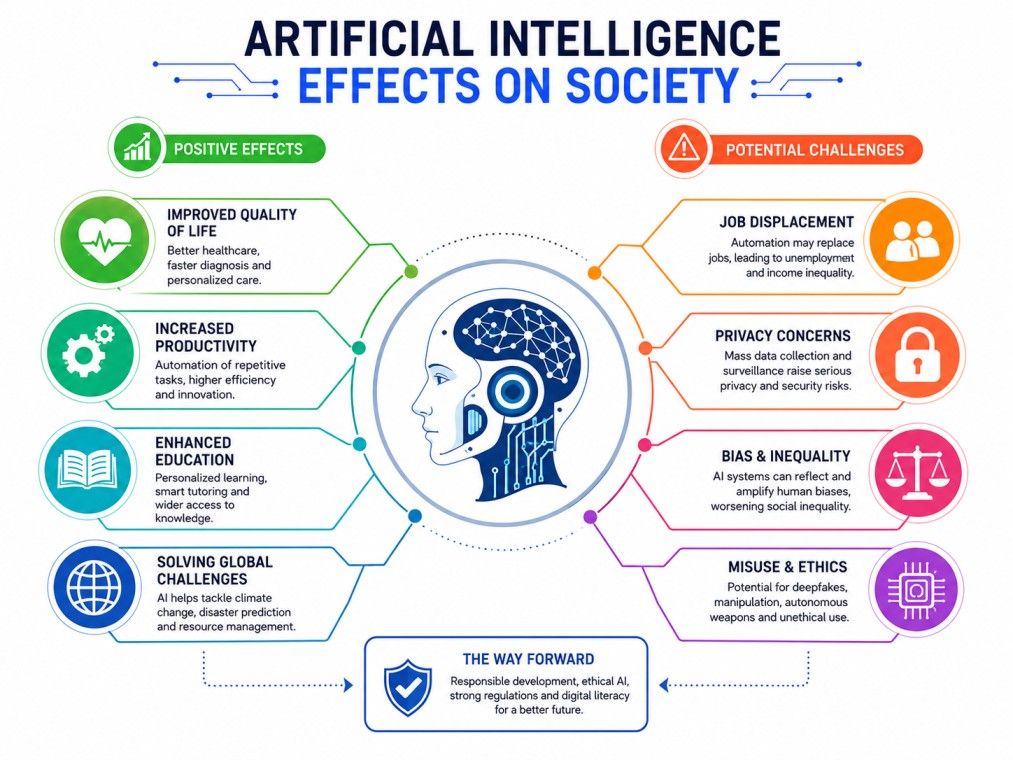
Artificial intelligence is changing society in ways that are both exciting and challenging. The positive and negative effects of artificial intelligence on society exist side by side. AI has the potential to improve healthcare, education, transportation, and productivity while also creating challenges related to privacy, fairness, employment, and security.
The overall impact depends not only on the technology itself but also on how responsibly it is designed, implemented, and used.
Area |
Positive Effects of AI |
Negative Effects of AI |
| Healthcare | Faster medical diagnosis through AI-powered image analysis | Biased or inaccurate diagnoses if trained on poor-quality or unrepresentative data |
| Education | Personalized learning paths that adapt to individual student needs | Unequal access to AI tools can widen educational disparities |
| Employment | Increased workplace productivity by automating routine tasks | Job displacement in repetitive and manual roles due to automation |
| Finance | Smarter fraud detection and improved financial security | Privacy concerns from large-scale data collection and financial profiling |
| Accessibility | Speech recognition, live captions, and text-to-speech improve digital inclusion | Overdependence on AI tools may reduce independent problem-solving skills |
| Transportation | Better traffic management through real-time route optimization | AI system failures or cyberattacks can disrupt transportation networks |
| Research & Innovation | Faster scientific discoveries by analyzing complex datasets | AI-generated misinformation and deepfakes can spread false or misleading information |
| Public Services | Smarter city management and more efficient public services | Digital inequality may prevent some communities from benefiting equally |
| Decision-Making | Faster analysis supports quicker business and public-sector decisions | Algorithmic bias can lead to unfair outcomes in hiring, lending, healthcare, and law enforcement |
| Cybersecurity | AI helps detect threats and suspicious activities in real time | AI-powered cyberattacks are becoming more sophisticated and harder to detect |
Must read: Job Opportunities in AI: Salaries, Skills & Careers
AI Courses to upskill
Explore Artificial Intelligence Courses for Career Progression
From the moment you unlock your phone until you stream a movie at night, AI quietly works in the background. These everyday interactions demonstrate the practical artificial intelligence effects on society more clearly than any technical explanation.
Think about your last few hours. Did you unlock your phone with face recognition? Ask a voice assistant for directions? Scroll through a feed that somehow knew exactly what you'd click on?
That's AI, quietly running in the background of an ordinary day.
Everyday Area |
AI Application |
Key Benefit |
| Online Shopping | Product recommendations and personalized offers | Faster, more relevant shopping |
| Entertainment & Streaming | Personalized movie, music, and content recommendations | Better viewing and listening experience |
| Banking & Digital Payments | Fraud detection and spending insights | Improved security and convenience |
| Navigation & Travel | Traffic prediction and route suggestions | Quicker and more efficient travel |
| Smart Homes | Automated lighting, security, and appliances | Greater comfort and energy savings |
| Smartphones | Facial recognition and voice assistants | Easier and more personalized device use |
It's convenient, but it also means a handful of companies know an uncomfortable amount about your habits, preferences, and routines. Most people never read the terms and conditions that explain how.
Do read: Applications of Artificial Intelligence and Its Impact
Businesses adopting AI report real productivity gains. Reports from firms like McKinsey have pointed to measurable output increases in sectors that integrate automation well. That's not nothing.
But productivity gains for a company don't always translate to job security for individual workers. Manufacturing and customer service roles have already seen cuts tied directly to automation tools. Meanwhile, entirely new careers, like prompt engineers and AI ethics auditors, didn't exist five years ago.
Is this a net positive for the economy? It depends heavily on how fast workers can retrain and how much support governments actually provide during the shift.
The economic impact of artificial intelligence is not limited to higher profits. It also influences employment, innovation, productivity, and global competitiveness, making AI one of the most significant drivers of economic transformation today.
Also read: Top Artificial Intelligence Jobs in 2026: Roles and Salary
As AI becomes more capable, ethical issues of artificial intelligence in society become harder to ignore. Organizations must balance efficiency with fairness while protecting people's rights and maintaining public trust.
Fairness and Bias
AI learns from historical data. If that data contains bias, AI may repeat or even amplify unfair decisions. Regular testing and diverse datasets help reduce this risk.
Accountability
When an AI system makes an incorrect recommendation, responsibility still belongs to the people or organizations deploying it. Human oversight remains essential.
Transparency
Many advanced AI systems operate as "black boxes." Users often don't know how decisions are made. Greater transparency helps build confidence and allows experts to identify potential problems.
Privacy
Many AI applications depend on large amounts of personal data. Organizations must balance personalized experiences with responsible data collection and strong privacy protections.
Human Oversight
AI performs best when people remain involved in important decisions. Healthcare, finance, education, and legal services all require human judgment alongside machine intelligence.
Subscribe to upGrad's Newsletter
Join thousands of learners who receive useful tips
Artificial Intelligence effects on society become easier to understand when viewed through practical examples.
Some of the most familiar examples of AI include:
Sector |
AI Application |
Societal Benefit |
| Healthcare | Early disease detection | Faster diagnosis |
| Banking | Fraud detection | Better financial security |
| Retail | Product recommendations | Personalized shopping |
| Transportation | Smart traffic management | Reduced congestion |
| Insurance | Risk assessment | Faster policy decisions |
| Agriculture | Crop yield prediction | Improved farming efficiency |
Each example carries its own tradeoff. Faster fraud detection also means more of your spending data gets analyzed than you'd probably guess.
Explore upGrad's Executive Diploma in Machine Learning & AI from IIIT Bangalore to build practical expertise in machine learning, deep learning, generative AI, agentic AI, MLOps, and AI system development through hands-on projects, industry tools, and real-world business applications.
Artificial intelligence is changing the way people work rather than simply replacing jobs. By automating repetitive tasks, AI helps organizations improve efficiency and productivity, but it also reshapes job roles, skill requirements, and career opportunities. As AI adoption grows, employees and employers alike must adapt to a rapidly evolving workplace.
The social impact of AI on employment is complex. While some routine jobs are becoming automated, new roles are emerging in AI development, data analysis, cybersecurity, and AI governance. The biggest challenge is helping workers transition from declining roles to new opportunities.
Employment Area |
Positive Impact |
Challenge |
| Routine Tasks | Automates repetitive work and improves efficiency | Reduces demand for some manual and administrative roles |
| Job Creation | Creates new careers in AI, data science, and cybersecurity | Requires specialized technical skills |
| Workplace Productivity | Helps employees focus on strategic and creative tasks | Employees must learn to work alongside AI systems |
| Skill Development | Increases demand for digital and analytical skills | Continuous upskilling becomes essential |
| Recruitment | Speeds up resume screening and candidate matching | Biased AI models may lead to unfair hiring decisions |
| Remote Work | Supports virtual collaboration and task automation | Increased reliance on AI-powered workplace tools |
The long-term social impact of AI on employment will depend on how businesses, educational institutions, and governments support workforce reskilling. Investing in lifelong learning and digital skills can help more people benefit from AI while reducing the challenges associated with workplace transformation.
Access isn't equal. A student with a fast internet connection and a decent laptop gets far more out of AI tutoring tools than one without either. That gap widens every year technology moves forward faster than infrastructure does.
Rural regions, lower-income communities, and older populations often get left behind in this shift. It's not intentional exclusion, but the outcome looks a lot like it anyway.
Also read: AI vs. Human Intelligence: Key Differences & Job Impact
Artificial intelligence is creating meaningful improvements across industries and everyday life. It helps people make faster decisions, reduces repetitive work, and solves complex problems using data-driven insights. While AI isn't a replacement for human expertise, it supports individuals and organizations by improving efficiency, accuracy, and accessibility.
Benefit |
Example |
Impact on Society |
| Better healthcare | AI-assisted medical diagnosis | Earlier disease detection and improved patient care |
| Personalized education | Adaptive learning platforms | Better learning outcomes for students |
| Higher productivity | Workflow automation | Saves time and reduces repetitive work |
| Financial security | AI-powered fraud detection | Safer online banking and transactions |
| Improved accessibility | Speech-to-text and screen readers | Greater digital inclusion for people with disabilities |
| Smarter transportation | Traffic prediction and route optimization | Reduced congestion and travel time |
| Faster research | AI-driven data analysis | Quicker scientific discoveries and innovation |
| Efficient public services | Smart city applications | Better resource management and citizen services |
When developed and used responsibly, AI has the potential to improve quality of life, boost economic growth, and make essential services more efficient and accessible for people around the world.
Do read: AI Proof Jobs: Careers That AI Can’t Replace in 2026
Artificial intelligence offers many advantages, but it also raises artificial intelligence and privacy concerns, along with other risks that affect individuals, businesses, and governments.
As AI becomes more integrated into daily life, concerns around privacy, fairness, employment, and security continue to grow. Understanding these risks is essential for using AI responsibly and minimizing unintended consequences.
Risk |
Example |
Potential Impact |
| Job displacement | Automation of routine work | Workforce disruption and reskilling needs |
| Algorithmic bias | Biased hiring or loan approval systems | Unfair and discriminatory outcomes |
| Privacy concerns | Collection of personal and behavioral data | Loss of privacy and data misuse |
| Misinformation | AI-generated deepfakes and fake news | Public confusion and reduced trust |
| Cybersecurity threats | AI-powered phishing and malware | Increased digital security risks |
| Overdependence on AI | Blind reliance on AI recommendations | Poor decision-making and human error |
| Digital divide | Limited access to AI technologies | Wider social and economic inequality |
| Lack of transparency | Black-box AI models | Difficulty understanding or challenging decisions |
| Ethical concerns | Unclear responsibility for AI decisions | Reduced accountability and trust |
| Misuse of AI | Mass surveillance or identity fraud | Threats to personal freedom and security |
While these risks are significant, they don't outweigh the benefits of AI by default. The impact of artificial intelligence on society depends largely on how responsibly it is designed, governed, and used. Strong ethical practices, human oversight, and transparent AI systems can help reduce these risks while maximizing AI's positive contributions.
Must read: Impact of Artificial Intelligence: Benefits, Risks, and What’s Next
Where does the future of AI in society go next? Human-AI collaboration looks like the likely direction, not full replacement. Doctors using AI as a second opinion. Teachers using it to handle grading so they can spend more time actually teaching.
None of this is settled. The direction depends on choices made by companies, regulators, and everyday users over the next few years.
The effects of artificial intelligence on society aren't one-sided. It's creating real value while also introducing risks that deserve honest attention, not blind optimism or blanket fear. Understanding both sides is what actually prepares you for what's coming.
The artificial intelligence effects on society reach far beyond technology. AI is influencing healthcare, education, finance, transportation, employment, and everyday decision-making in ways that were difficult to imagine only a decade ago.
Its benefits are significant. Faster medical diagnosis, personalized learning, smarter public services, and improved productivity are already creating measurable value.
Challenges remain equally important. Privacy concerns, algorithmic bias, workforce changes, and misinformation remind us that AI isn't perfect. Human judgment, ethical development, and responsible adoption will continue to shape how society benefits from this technology.
Rather than replacing people, AI is changing how people solve problems, make decisions, and create new opportunities. Understanding both its advantages and its limitations is the best way to prepare for a future where AI becomes an even more familiar part of everyday life.
Ready to start your journey? Book a free consultation with upGrad today to find the best path for your career.
Artificial intelligence is influencing healthcare, education, finance, transportation, and communication through automation and data-driven decision-making. The artificial intelligence effects on society are visible in everyday activities, from personalized recommendations to smarter public services, while also raising questions about privacy, fairness, and workforce changes.
The biggest challenges include biased algorithms, misinformation, cybersecurity threats, unequal access to AI technologies, and the negative effects of artificial intelligence on society such as job disruption and privacy risks. Addressing these issues requires responsible development, transparent systems, and continued human oversight.
AI is expected to automate many repetitive tasks while creating new opportunities in fields such as AI development, cybersecurity, robotics, and data science. However, the transition may be uneven, making reskilling and continuous learning essential for workers adapting to changing job markets.
Healthcare, finance, manufacturing, retail, education, logistics, and customer service are among the fastest adopters of AI. These sectors use intelligent systems to improve accuracy, automate repetitive work, enhance customer experiences, and make faster operational decisions.
AI analyzes large datasets to identify patterns and generate insights that support faster decisions. Businesses use it for forecasting and risk assessment, while hospitals rely on it for diagnosis. Human judgment remains important because AI recommendations depend on the quality of the underlying data.
Not always. AI can automate repetitive work and improve efficiency, but poorly implemented systems may produce inaccurate results, increase operational complexity, or require additional human review. Organizations typically achieve the best outcomes when AI supports employees rather than replacing their expertise.
AI models learn from historical data, which may already contain social or cultural biases. Even well-designed systems can produce unfair outcomes if training data lacks diversity or quality. Regular testing, representative datasets, and human review help reduce these risks but cannot eliminate them completely.
Yes. AI supports climate research, disaster prediction, medical discoveries, food production, and energy optimization by processing complex datasets quickly. While it isn't a complete solution, it helps researchers and governments make faster, more informed decisions on large-scale global problems.
Generative AI has made it easier to create realistic text, images, audio, and videos. While these tools offer many benefits, they also make misinformation and deepfakes harder to identify. Verifying sources and checking information from trusted publishers has become more important than ever.
AI adoption is expanding across almost every sector because organizations are finding practical ways to improve efficiency and decision-making. Industries are adopting AI at different speeds, but its influence is expected to grow as tools become more affordable, accessible, and easier to integrate into existing workflows.
Understanding the artificial intelligence effects on society helps people make informed decisions about technology at work and in daily life. It also encourages responsible AI adoption by balancing innovation with awareness of ethical concerns, privacy issues, and the negative effects of artificial intelligence on society.
724 articles published
Sriram K is a Senior SEO Executive with a B.Tech in Information Technology from Dr. M.G.R. Educational and Research Institute, Chennai. With over a decade of experience in digital marketing, he specia...
Speak with AI & ML expert
By submitting, I accept the T&C and
Privacy Policy
Top Resources
Master's Degree
18 Months
Executive Diploma
12 Months
IIIT Bangalore
Executive Programme in Generative AI & Agentic AI for LeadersIndia’s #1 Tech University
Dual Certification
5 Months