Will AI Replace Data Analysts? What AI Can and Cannot Do in Modern Data Analytics
By Sriram
Updated on Jul 12, 2026 | 9 min read | 4.46K+ views
Share:

All courses
Certifications
More
By Sriram
Updated on Jul 12, 2026 | 9 min read | 4.46K+ views
Share:
Table of Contents
Key Highlights
This blog explains how AI is changing data analytics, which tasks it can automate, and where human expertise still matters. You'll also learn how the data analyst role is evolving and what skills will remain valuable in the AI era.
Explore upGrad's AI course to build practical skills in AI tools, data analytics, machine learning, and business intelligence, and stay ready for the next generation of analytics roles.
Popular AI Programs
AI is replacing parts of the job, not the profession itself. It can automate repetitive and rule-based tasks remarkably well, but data analysis isn't only about processing information. It's about understanding business goals, asking meaningful questions, and helping people make informed decisions.
If a company's sales drop by 15%, AI can identify the decline, compare it with previous quarters, and even suggest possible reasons. But can it confidently explain whether the problem came from changing customer behavior, a failed marketing campaign, or a new competitor entering the market? Not without human input and business context.
AI performs best when the process follows clear rules and patterns.
Today, it can automate tasks such as:
These activities once consumed a large part of a data analyst's day. Now they take minutes instead of hours.
Also read : Role of Data Science in Healthcare: Applications & Future Impact
Business decisions rarely depend on data alone.
A human analyst still needs to:
Those responsibilities involve judgment. AI doesn't possess business experience or accountability.
Some activities are highly automatable, while others remain human-led.
Activity |
AI Capability |
Human Involvement |
| Data cleaning | High | Low |
| SQL generation | High | Review and optimization |
| Dashboard creation | High | Customization |
| Trend detection | High | Validation |
| Business interpretation | Low | High |
| Executive presentations | Low | High |
| Strategic recommendations | Low | High |
Instead of manually preparing reports every week, many analysts now focus on solving business problems, validating AI outputs, and communicating insights that influence decisions.
Entry-level analytical work is seeing the biggest impact.
Routine reporting, basic dashboard creation, and repetitive data preparation are becoming increasingly automated. Analysts who rely only on these activities could find fewer opportunities over time.
The opposite is happening for professionals who combine analytics with business knowledge.
Companies increasingly value analysts who can:
That's why the conversation around will AI replace data analysts shouldn't focus only on job loss. The bigger story is how the role is moving toward higher-value work.
Must Read : Learn Data Science – An Ultimate Guide to become Data Scientist
Free Courses
The daily work of a data analyst looks very different today than it did just a few years ago.
Many repetitive tasks that once required technical expertise now happen automatically. Analysts aren't spending less time with data. They're spending their time differently.
Traditional analytics often revolved around producing reports.
Instead of building every report manually, analysts increasingly review AI-generated dashboards and focus on explaining what the results actually mean.
Many modern analytics platforms now include built-in AI capabilities.
Examples include:
Tool |
AI Capability |
| Microsoft Power BI Copilot | Dashboard generation and report summaries |
| Tableau Pulse | Automated insights and trend detection |
| Google Gemini | Natural language data exploration |
| Snowflake Cortex | AI-powered SQL and analytics |
| Microsoft Copilot | Data summarization and analysis assistance |
These tools don't replace analysts.They reduce manual work and speed up routine analysis.
Business users no longer need to write SQL to ask simple questions.
They can type prompts such as:
AI converts those questions into database queries and presents results in seconds.That improves access to data across an organization.
It also changes the analyst's role.Instead of answering every simple request, analysts spend more time solving complex business challenges.
Preparing data has traditionally consumed a significant portion of an analyst's workload.
AI now helps by:
It doesn't remove responsibility.Someone still needs to verify whether the cleaned data accurately represents the business.
Imagine an e-commerce company tracking online sales.
Without AI:
With AI
The work becomes faster.The responsibility becomes more strategic.
Traditional Data Analyst |
Modern AI-Assisted Data Analyst |
| Manual reporting | AI-assisted reporting |
| Writing SQL manually | Reviewing AI-generated SQL |
| Building dashboards | Improving dashboards and validating results |
| Collecting data | Solving business problems |
| Reporting numbers | Explaining business impact |
This evolution explains why organisations continue hiring analysts even as AI capabilities improve. They're hiring for judgment, communication, and business understanding.
Future-ready data analysts don't compete with AI; they know how to use it. Build job-ready AI skills with upGrad's Executive Post Graduate Programme in Applied AI and Agentic AI through industry projects and hands-on learning.
AI Courses to upskill
Explore Artificial Intelligence Courses for Career Progression
AI tools can now clean data, generate SQL queries, build dashboards, and summarize reports in minutes. Tasks that once required technical expertise are becoming faster and more automated, leading many people to wonder whether data analysts will still be needed.
The answer isn't that simple. While AI excels at repetitive work, it can't fully understand business goals, interpret results in context, or recommend decisions that align with an organization's priorities. Human judgment is still essential.
Several trends have accelerated this discussion:
Instead of spending hours preparing data and creating reports, data analysts now focus more on validating AI-generated insights, solving business problems, and supporting decision-making.
Earlier Analytics |
AI-Assisted Analytics |
| Manual data cleaning | Automated data preparation |
| Manual reporting | AI-generated reports |
| Writing SQL manually | AI-assisted SQL generation |
| Human interpretation | Human validation and business decisions |
As AI automates routine tasks, the value of data analysts shifts from producing reports to delivering insights and guiding business decisions.
AI has become highly effective at repetitive analytical work.Whenever a task follows clear patterns or predictable rules, AI usually performs it faster than a human.
That's valuable because analysts can focus on work that creates greater business impact.
AI is particularly effective at:
These tasks involve speed, repetition, and pattern recognition.
Even when AI completes the technical work, analysts still verify the results.
Examples include:
A report isn't valuable simply because it's generated quickly.
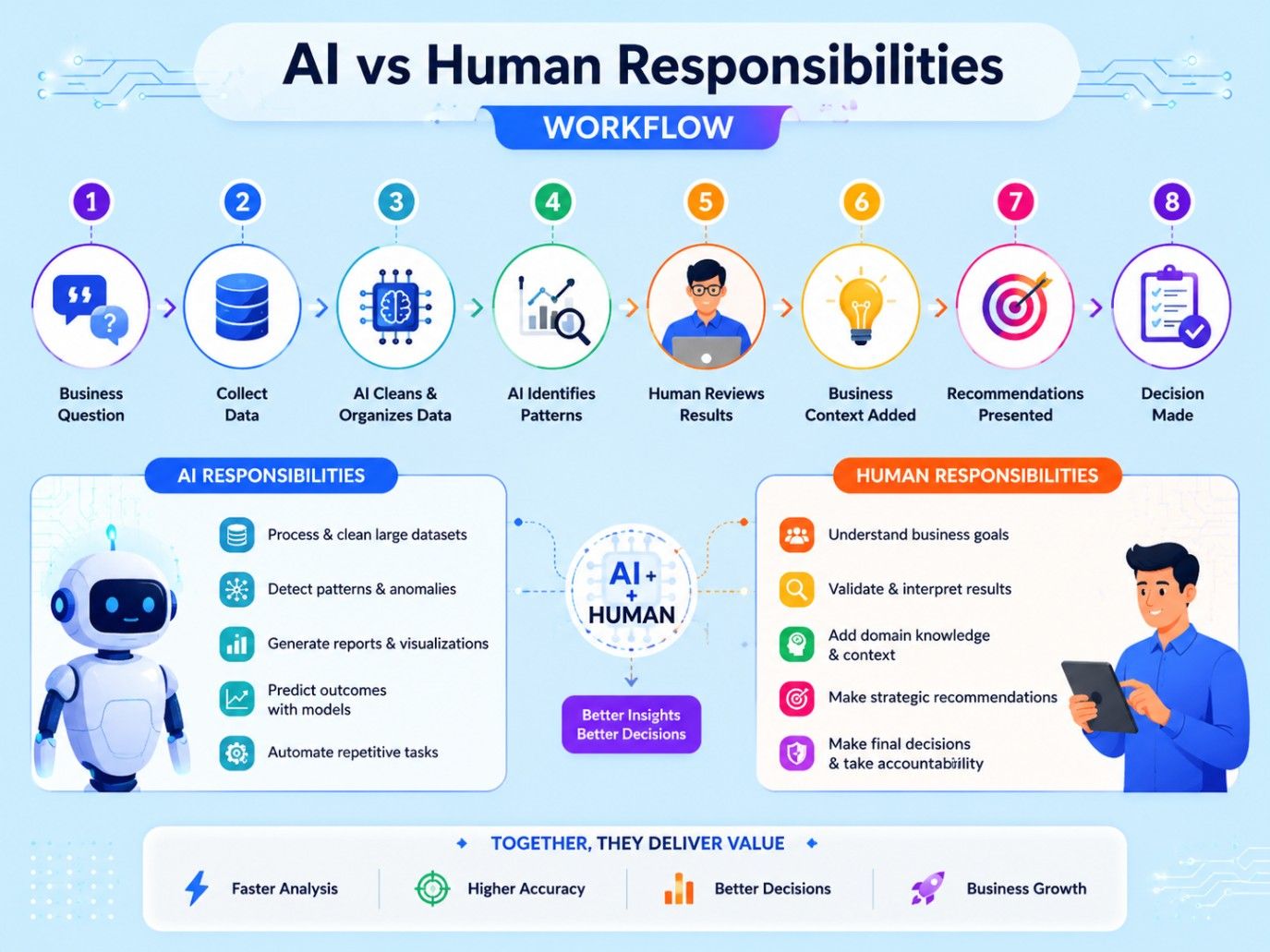
AI completes the technical groundwork.The analyst turns information into action.
The future isn't about choosing between AI and people. It's about combining both strengths to make faster, smarter, and more reliable decisions.
AI can analyze large datasets, detect patterns, and generate reports quickly. However, it can't replace the human judgment needed to connect data with business goals and make informed decisions.
AI identifies patterns but doesn't fully understand why they happen. For example, declining sales could result from seasonal demand, pricing changes, or customer experience issues. A data analyst investigates the real business context before drawing conclusions.
Good analysis starts with asking the right questions, not just finding answers. Analysts evaluate data quality, challenge unexpected results, and identify issues that AI may overlook.
AI can summarize findings, but analysts explain insights in a way that different stakeholders can understand and act upon. Clear communication helps turn data into business decisions.
Analysts also assess bias, privacy concerns, and the potential impact of data-driven recommendations. These decisions require human responsibility and accountability.
Human strengths vs AI strengths :
Human Analyst Strength |
Why It Matters |
| Business understanding | Connects insights to business goals |
| Critical thinking | Validates findings and challenges assumptions |
| Communication | Explains insights to stakeholders |
| Ethical judgment | Supports responsible decision-making |
AI handles repetitive tasks efficiently, but data analysts remain essential for interpreting results, solving business problems, and guiding strategic decisions.
Also Read: Why AI Is The Future & How It Will Change The Future?
People often compare AI and human analysts as though one will eventually replace the other.
Each brings different strengths to the analytical process, and the best outcomes usually come from combining both.
AI can process enormous datasets almost instantly. Humans can't. But processing data isn't the same as understanding why the results matter.An analyst can recognize that customer satisfaction dropped after a pricing change because they understand the business context, customer expectations, and recent company decisions. AI only sees patterns unless that context is explicitly available.
Capability comparison:
Capability |
AI |
Human Data Analyst |
| Process large datasets | Excellent | Good |
| Detect patterns | Excellent | Good |
| Generate SQL | Excellent | Good |
| Create dashboards | Excellent | Good |
| Business reasoning | Limited | Excellent |
| Strategic planning | Limited | Excellent |
| Stakeholder communication | Limited | Excellent |
| Creative problem-solving | Limited | Excellent |
| Ethical judgment | Limited | Excellent |
| Final business decisions | Assists | Leads |
AI improves efficiency. Humans create direction.
The strongest analytics teams combine automation with human expertise.
A typical workflow looks like this:
Everyone contributes something different.
Businesses don't hire analysts simply to create reports.
They hire them to answer questions that influence revenue, customer satisfaction, product strategy, and operational efficiency.
Those questions rarely have straightforward answers.
That's why AI is becoming a powerful assistant rather than a complete replacement.
Read: Data vs Information: A guide to understanding the key differences
AI can automate many data analysis tasks, but it still has important limitations. Understanding these challenges helps organizations use AI more effectively while relying on human analysts for validation, business context, and final decision-making.
AI Limitation |
Business Impact |
How Human Analysts Help |
| Poor Data Quality | Inaccurate or misleading insights due to incomplete, duplicate, or incorrect data. | Clean, validate, and prepare data before analysis. |
| Lack of Business Context | Recommendations may not align with business goals or customer needs. | Interpret results using domain knowledge and organizational priorities. |
| Hallucinations and Incorrect Outputs | AI may generate incorrect SQL, metrics, or unsupported conclusions. | Review and verify AI-generated outputs before using them. |
| Bias in Training Data | Historical bias can lead to unfair or inaccurate recommendations. | Detect, evaluate, and correct biased results. |
| Privacy and Compliance Risks | Sensitive business or customer data may be exposed or mishandled. | Apply governance policies and comply with data protection regulations. |
| Limited Critical Thinking | AI cannot question assumptions or investigate unexpected findings independently. | Ask the right questions, validate anomalies, and identify root causes. |
| No Accountability | AI cannot take responsibility for business decisions or outcomes. | Make informed decisions and remain accountable for results. |
| Difficulty Handling Ambiguous Problems | Complex or open-ended business questions may receive incomplete or generic answers. | Define the problem, provide strategic direction, and apply human judgment. |
Must read: Types of AI: From Narrow to Super Intelligence with Examples
AI is more likely to reshape data analyst jobs than replace them. As organizations generate more data, they need professionals who can interpret AI-generated insights, solve business problems, and support better decision-making.
AI speeds up analysis, but it also enables businesses to ask more complex questions about customers, operations, and growth. Human analysts are still needed to provide context and recommend the right actions.
Instead of spending time on repetitive reporting, modern data analysts focus on:
AI Contributes |
Data Analyst Contributes |
| Automation | Business understanding |
| Speed | Critical thinking |
| Pattern recognition | Strategic planning |
| Predictive insights | Decision-making |
| Large-scale data processing | Communication and stakeholder management |
Rather than replacing analysts, AI is shifting their role toward higher-value work that combines technical expertise with business judgment.
AI is already part of everyday analytics work. It isn't something organizations are waiting to adopt. Many businesses use AI to reduce repetitive work, improve reporting speed, and uncover insights that would otherwise take much longer to find.
AI doesn't work alone. Analysts still review results, verify accuracy, and decide what actions the business should take.
Weekly and monthly reports used to take hours to prepare.
Today, AI can automatically collect data from multiple sources, update dashboards, and generate written summaries.
For example, a retail company can receive a daily sales report every morning without an analyst manually creating it. The analyst then reviews unusual trends and explains why they happened
Read: Advanced SQL: Functions and Formulas
Writing SQL is one of the most time-consuming tasks for many analysts.
Modern AI assistants can generate SQL queries from simple prompts such as:
Analysts still review the generated queries before using them in production.
AI models help organizations predict future outcomes based on historical data.
Common examples include:
Predictions support decision-making, but analysts decide whether those predictions make business sense.
Business users don't always know SQL or analytics tools.
AI allows them to ask questions in plain English.
Examples include:
The AI produces charts and summaries almost instantly.
Analysts then validate the results and provide deeper business insights.
Tool |
AI Capability |
Common Use |
| Microsoft Power BI Copilot | Report creation and summaries | Business intelligence |
| Tableau Pulse | Automated insights | Dashboard monitoring |
| Google Gemini | Natural language analysis | Data exploration |
| Snowflake Cortex | AI-assisted SQL | Cloud analytics |
| Microsoft Copilot | Spreadsheet analysis | Productivity and reporting |
These examples show why businesses continue investing in analytics professionals.
The most successful organizations don't ask whether humans or AI should perform analytics.
AI improves efficiency while analysts provide judgment, context, and accountability. Each contributes something different.
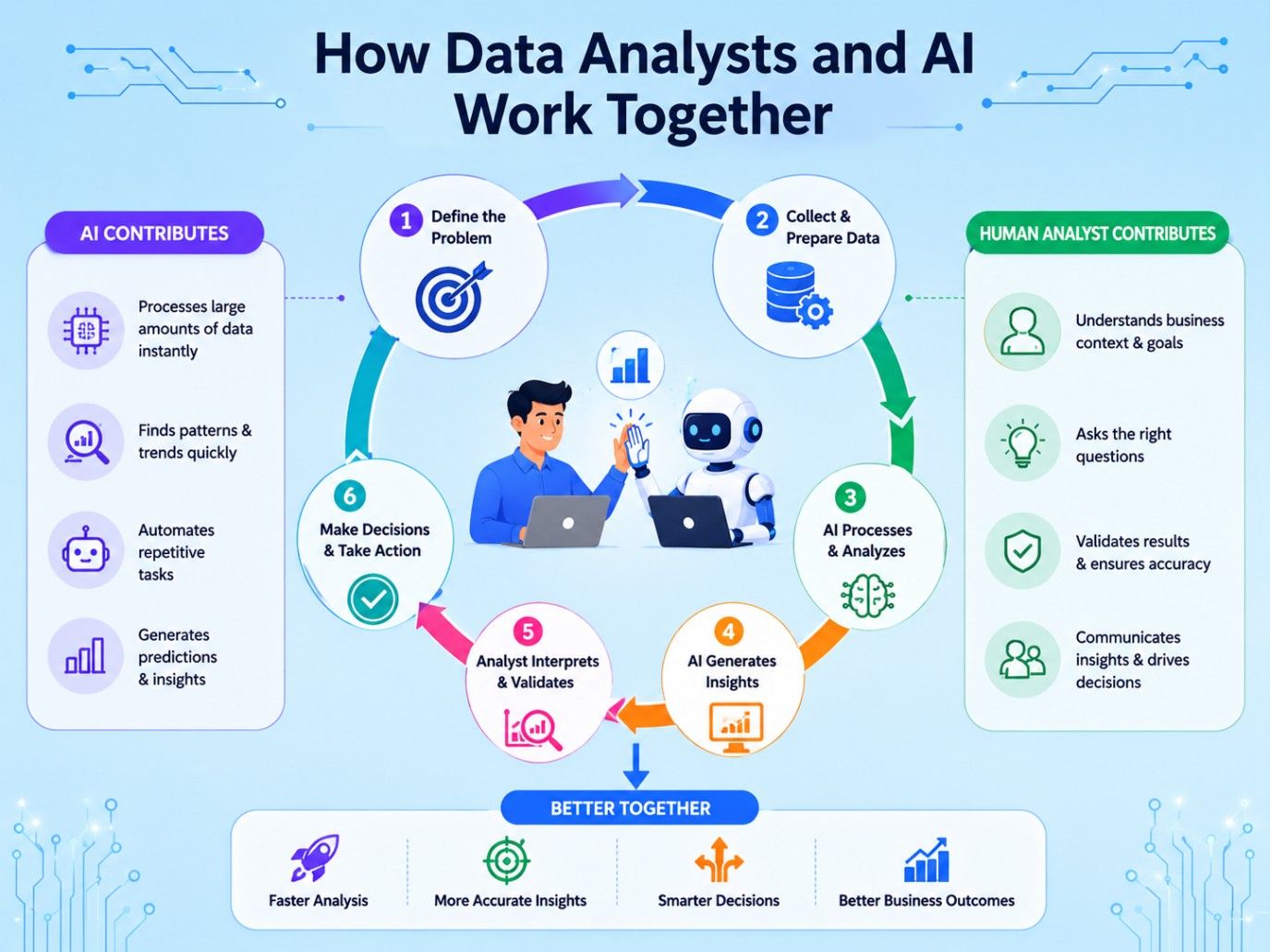
AI accelerates the technical work.The analyst guides the decision-making process.
Working together offers several advantages.
Organizations that treat AI as an assistant instead of a replacement often gain the greatest value from analytics.
Do read: AI Impact on Jobs: 16 Critical Shifts in Work, Skills, and Employment
Many headlines make AI sound like a complete replacement for analytics professionals.
Reality is more balanced.Let's separate facts from assumptions.
Myth |
Reality |
| AI will eliminate all data analyst jobs. | AI automates repetitive tasks but still depends on human oversight. |
| AI never makes mistakes. | AI can produce inaccurate or misleading results. |
| AI understands business strategy. | It identifies patterns but doesn't understand organizational priorities. |
| AI removes the need for analysts. | Analysts validate insights and guide decisions. |
| AI can replace executive communication. | Business discussions still rely on people. |
The biggest misconception is that data analysis only involves working with numbers.
The profession combines technical skills with business thinking, communication, and decision support.Those capabilities remain difficult for AI to replicate.
Read: The Evolving Future of Data Analytics in India: Insights for 2025 and Beyond
AI produces the best results when it's used thoughtfully rather than blindly.
Organizations that rely entirely on automation often discover hidden errors later.
A balanced approach works better.
These habits improve both accuracy and trust.
Some organization's expect AI to solve every analytical problem. That rarely works.
Avoid these mistakes:
Technology works best when experienced analysts remain involved throughout the process.
Read: What is Data warehousing? Type, Definition & Examples
Data analysts are gradually moving away from routine reporting and toward strategic decision-making. Routine work will continue shrinking. Strategic work will continue growing.
What the next few years could look like:
Timeline |
Expected Shift |
| Today | AI assists with reporting and dashboard creation |
| Next few years | Greater automation of repetitive analysis |
| Long term | Analysts focus primarily on business strategy, governance, and decision support |
Future analysts are likely to spend more time:
Those responsibilities require human judgment.
Also Read: Data Mining Architecture: Components, Types & Techniques
AI has already changed how analytics teams work. It automates repetitive activities, speeds up reporting, and helps organizations analyze larger volumes of data than ever before.
At the same time, businesses still depend on analysts to ask better questions, validate AI-generated results, understand business context, and recommend actions that align with organizational goals.
The future belongs to professionals who combine analytical thinking with AI tools instead of competing against them. As technology continues to improve, the value of human judgment, communication, and strategic decision-making will only become more important.
Ready to start your journey? Book a free consultation with upGrad today to find the best path for your career.
Yes. Data analytics remains a strong career because businesses still need people who can turn data into decisions. AI speeds up analysis, but it doesn't understand business priorities or explain why insights matter. Professionals who combine analytical thinking with AI skills will continue to have strong career opportunities.
Absolutely. The role is evolving rather than disappearing. Instead of spending hours preparing reports, data analysts are focusing more on interpreting AI-generated insights, solving business problems, and helping organizations make informed decisions. Human judgment is becoming more valuable as automation increases.
Jobs that require judgment, creativity, and human interaction are expected to remain valuable. Data analysts, healthcare professionals, and teachers are good examples. While AI can assist with routine work, these roles depend on problem-solving, communication, and decision-making that technology cannot fully replicate.
Demand is expected to remain strong because organizations will continue generating larger volumes of data. Businesses won't simply need more reports. They'll need professionals who can evaluate AI-generated insights, understand business context, and recommend practical actions that support long-term growth.
AI is unlikely to fully replace careers that rely heavily on human expertise and interpersonal skills. Examples include data analysts, doctors, psychologists, teachers, and business consultants. These roles require critical thinking, ethical judgment, and the ability to understand situations that extend beyond data alone.
Entry-level roles are changing, but they aren't disappearing. Routine reporting and basic data preparation are becoming more automated, so employers increasingly expect beginners to understand AI tools alongside core skills such as SQL, Excel, Python, and data visualization.
ChatGPT can help write SQL queries, summarize datasets, and explain trends, but it doesn't replace a data analyst. It lacks business understanding, accountability, and the ability to validate whether its responses accurately reflect an organization's goals or real-world challenges.
Future-ready analysts should strengthen both technical and business skills. Learning AI tools, prompt engineering, SQL, Python, data visualization, critical thinking, communication, and data storytelling helps professionals work effectively alongside AI while delivering greater business value.
Industries generating large amounts of data are likely to see the highest demand. Healthcare, banking, retail, manufacturing, logistics, telecommunications, and e-commerce all require analysts who can combine AI-powered insights with business knowledge to support better operational and strategic decisions.
AI will automate repetitive tasks such as data cleaning, report generation, and trend detection. As a result, analysts will spend more time validating AI outputs, investigating business problems, collaborating with stakeholders, and delivering recommendations that support smarter decision-making.
If you're new to the field, start with data analytics fundamentals. Learning statistics, SQL, Excel, Python, and visualization creates a strong foundation. Once you understand how data is collected and analyzed, adding AI skills becomes easier and significantly improves your long-term career prospects.
730 articles published
Sriram K is a Senior SEO Executive with a B.Tech in Information Technology from Dr. M.G.R. Educational and Research Institute, Chennai. With over a decade of experience in digital marketing, he specia...
Speak with AI & ML expert
By submitting, I accept the T&C and
Privacy Policy
Top Resources
Master's Degree
18 Months
Executive Diploma
12 Months
IIIT Bangalore
Executive Programme in Generative AI & Agentic AI for LeadersIndia’s #1 Tech University
Dual Certification
5 Months