Requirement Analysis in Software Engineering: Complete Guide
By Sriram
Updated on Jul 10, 2026 | 6 min read | 1.62K+ views
Share:

All courses
Certifications
More
By Sriram
Updated on Jul 10, 2026 | 6 min read | 1.62K+ views
Share:
Table of Contents
Key Takeaway
This blog breaks down what that phase really means in software engineering, why it matters, and how to do it well.
Explore upGrad's AI programs to build practical skills in requirement analysis, software engineering, system design, Agile development, software testing, SDLC, business analysis, and AI-powered application development.
Popular AI Programs
So, what is requirement analysis in software engineering? It's the stage where a team studies what stakeholders need and turns those needs into requirements a developer can build against.
Think of it as translation work. Business goals go in on one side. Clear, testable requirements come out the other.
The objective is understanding priorities, spotting conflicts between what different people want, and documenting everything so nothing gets lost later. This phase sits right after requirement gathering and right before design begins.
A requirement that sounds clear in a meeting often falls apart the moment a developer tries to build it. That gap is exactly what requirement analysis is meant to close.
A small SaaS team once told stakeholders they'd "add reporting" to their product. Nobody defined which reports, which data, or which users needed access. Three weeks in, the developer had built the wrong dashboard entirely. That's the cost of skipping this step, and it's a cost most teams pay at least once before they take the phase seriously.
Also read: The Ultimate Guide to Requirement Elicitation Techniques
Not all requirements serve the same purpose. Some define what the software should do, while others explain why it's needed or how it should perform. Understanding the different types of requirement analysis helps teams organize requirements, reduce ambiguity, and build software that meets both business and user expectations.
Functional requirement analysis focuses on the features and functions the software must perform. It defines how users interact with the system and what actions the application should support.
Examples include:
These requirements describe what the system should do.
Non-functional requirement analysis evaluates the quality attributes of the system rather than its features. These requirements determine how well the software performs under different conditions.
Common non-functional requirements include:
For example, an e-commerce website should load within two seconds during peak traffic and protect customer payment data.
Business requirement analysis identifies the organization's goals and the business problems the software is expected to solve. It helps align technical development with strategic objectives.
Examples include:
These requirements explain why the project is being developed.
User requirement analysis focuses on the expectations and needs of end users. It helps teams understand how different users will interact with the system and which features matter most to them.
Examples include:
Gathering user feedback early leads to software that's easier to use and more likely to meet real-world needs.
System requirement analysis defines the technical environment needed to support the application. It specifies hardware, software, integration, and infrastructure requirements that developers must consider.
Typical system requirements include:
Ignoring these requirements can lead to deployment issues and performance problems later in the project.
Explore upGrad's Post Graduate Programme in Data Science & AI to build practical skills in Python, SQL, statistics, machine learning, deep learning, data visualization, generative AI, and big data analytics.
AI Courses to upskill
Explore Artificial Intelligence Courses for Career Progression
One of the most important parts of requirement analysis is separating functional requirements from non-functional requirements. While both are essential, they answer different questions. Functional requirements define what the system should do, whereas non-functional requirements describe how well the system should perform.
Understanding this distinction helps development teams build software that is both feature-rich and reliable.
Functional requirements describe the core features and operations of a software system. They specify the actions the application must perform to meet user and business needs.
Examples of functional requirements include:
These requirements define the expected behavior of the system and are directly linked to user interactions.
Non-functional requirements define the quality standards and performance expectations of the software. Instead of describing features, they specify how the system should operate under different conditions.
Common non-functional requirements include:
These requirements help create software that is secure, fast, stable, and easy to use.
Why Both Requirement Types Matter? During requirement analysis, teams should identify, document, and validate both requirement types together. This creates a balanced set of requirements that guides development, testing, and deployment while reducing the risk of costly changes later in the project.
Must read: SDLC Guide: The 7 Key Software Development Life Cycle Phases Explained
Many software projects fail because requirements are unclear, incomplete, or constantly changing, not because of poor coding. Requirement analysis helps everyone understand the project's goals before development begins, reducing confusion and costly rework.
Area |
Key Benefits |
| Development Teams | Reduces misunderstandings, improves team communication, prevents unnecessary features, simplifies testing, and makes future maintenance easier. |
| Business | Enables better planning, lowers development costs through reduced rework, prioritizes high-value features, improves customer satisfaction, and reduces project risks. |
| Project Management | Helps define realistic timelines, manages project scope effectively, minimizes scope creep, and supports informed decision-making. |
| Software Quality | Produces clearer requirements, reduces design changes, improves collaboration, and increases the chances of delivering software that meets business and user expectations. |
Do read: Top 8 Process Models in Software Engineering: Features, Differences and How to Choose
This process usually follows a consistent flow, even if the tools and terminology shift between teams.
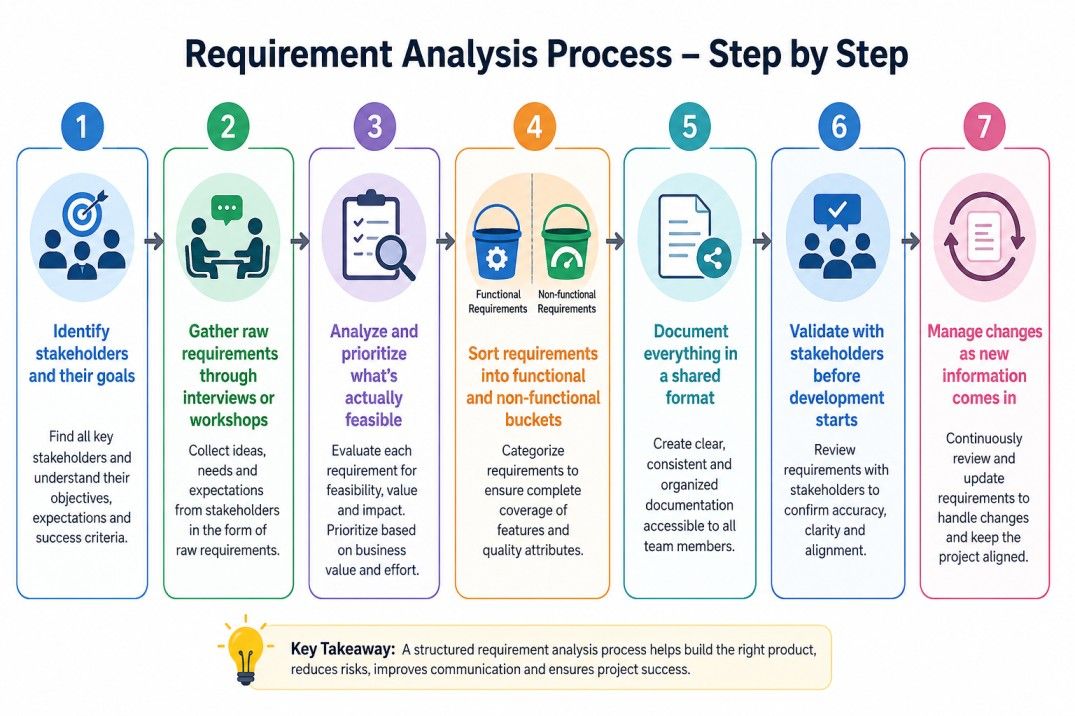
You may have noticed that validation isn't the last step. Requirements keep evolving, and a good process expects that instead of resisting it.
Prioritization isn't just about urgency, it's about dependency too. A "nice to have" feature might actually block three other requirements if the underlying data model depends on it. Map those dependencies early, not after sprint planning is already locked.
Do read: What is Agile Software Development?
Different situations call for different techniques. There's no single right method, only the right one for the context.
Technique |
Best Used When |
| Interviews | You need depth from a specific stakeholder |
| Workshops | Multiple stakeholders need to align quickly |
| Observation | Users can't clearly explain their own workflow |
| Prototyping | Requirements are still fuzzy and need visual proof |
| Use cases | You need to map specific user actions |
| User stories | Agile teams want quick, iterative requirements |
Interviews work well one on one, but they're slow at scale. Workshops move faster but can drown out quieter stakeholders. Pick based on your team size, timeline, and how clear the initial ask already is.
Many teams combine two or three techniques rather than picking just one. A workshop to align stakeholders, followed by a handful of user stories to break the work into buildable chunks, often beats relying on a single method. It's less about finding the perfect technique and more about matching the tool to the messiness of the actual problem in front of you.
Also read: Agile Methodology Steps & Phases: Complete Explanation
Requirement analysis isn't a one-person activity. It depends on people with different expertise working toward the same goal. When the right stakeholders participate early, teams capture better requirements and avoid expensive changes later. Miss someone, though, and critical needs can easily slip through the cracks.
Every stakeholder contributes a unique perspective. That's what makes this stage so valuable.
Stakeholder |
Primary Role in Requirement Analysis |
Key Responsibilities |
| Business Stakeholders | Define the project vision and business goals | • Define business objectives • Set priorities • Approve major requirements • Review project outcomes |
| Product Owners | Bridge business needs and the development team | • Maintain the product backlog • Prioritize features • Clarify business requirements • Accept completed functionality |
| Business Analysts | Translate business needs into actionable requirements | • Conduct interviews and workshops • Identify missing requirements • Resolve conflicts • Prepare requirement documentation • Support requirement validation |
| Developers | Assess technical feasibility and implementation | • Review technical feasibility • Identify dependencies • Estimate development effort • Suggest alternative solutions |
| Quality Assurance (QA) Teams | Ensure requirements are testable and complete | • Review requirement clarity • Create test scenarios • Identify missing acceptance criteria • Support requirement validation |
| End Users | Provide practical insights based on real-world usage | • Share day-to-day challenges • Provide usability feedback • Suggest workflow improvements • Validate whether requirements meet actual needs |
| Project Managers | Coordinate the requirement analysis process | • Manage timelines • Monitor budget • Control project scope • Plan resources • Facilitate stakeholder communication and resolve conflicts |
Must read: Software Design Patterns: A Complete Guide
Conversations help uncover requirements. Documentation keeps everyone aligned.
As projects grow, relying on memory or meeting notes becomes risky. Clear documentation provides a reliable reference throughout design, development, testing, and maintenance. It also reduces misunderstandings when new team members join the project.
Different documents serve different purposes.
Requirement Analysis Document |
Purpose |
Key Contents / Features |
| Software Requirements Specification (SRS) | Defines the complete set of software requirements for development and testing | • Project overview • Functional requirements • Non-functional requirements • System constraints • External interfaces • Acceptance criteria |
| Business Requirement Document (BRD) | Captures business goals and the reasons behind the project | • Business objectives •Business problems to solve • Expected outcomes • High-level business requirements |
| User Stories | Describe requirements from the end user's perspective, commonly used in Agile projects | • Written in the format "As a [user], I want [goal] so that [benefit]." • Focus on user value and expected benefits |
| Acceptance Criteria | Define the conditions that must be met for a requirement to be considered complete | • Testable completion conditions• Functional expectations• Security or performance requirements• Validation rules |
| Requirement Traceability Matrix (RTM) | Tracks requirements throughout the project lifecycle | • Maps requirements to development tasks • Links requirements to test cases• Ensures complete coverage and traceability |
| Functional Specification Document (FSD) | Explains how functional requirements will be implemented technically | • Inputs and outputs • Business rules • Process logic • Error handling • Technical implementation details |
Clear documentation doesn't slow development. It prevents confusion that would otherwise cost much more time later.
Do read: 25 Biggest Software Engineering Challenges in 2026 and Their Solutions
Even experienced teams run into friction here. It's rarely about skill. It's about competing priorities and incomplete information.
Challenge |
Common Cause |
Practical Fix |
| Ambiguous requirements | Vague stakeholder language | Ask for specific, measurable outcomes |
| Conflicting expectations | Multiple decision makers | Set a single point of sign-off |
| Scope creep | Requirements added mid-project | Freeze scope after formal approval |
| Missing requirements | Rushed discovery phase | Slow down elicitation, involve more users |
| Poor communication | Siloed teams | Use shared documentation, not scattered notes |
Scope creep deserves a special mention. It rarely arrives as one big change. It shows up as a dozen small "just one more thing" requests that quietly rewrite the project.
Communication gaps cause more damage than most teams admit. A developer assumes one thing, a business analyst assumes another, and nobody notices the mismatch until testing begins. Regular check ins, even short ones, catch this far earlier than a single upfront meeting ever could.
Requirement analysis lays the foundation for every successful software project. It helps teams understand business objectives, clarify user needs, document expectations, validate requirements, and reduce costly misunderstandings before development begins.
Whether you're building a small application or a large enterprise system, investing time in requirement analysis leads to clearer communication, better planning, and higher-quality software. A structured approach helps every stakeholder work toward the same outcome, making projects easier to manage from planning through deployment.
Ready to start your journey? Book a free consultation with upGrad today to find the best path for your career.
Good software requirements are clear, specific, measurable, and testable. Each requirement should describe one expectation without ambiguity and include acceptance criteria where needed. In requirement analysis in software engineering, well-written requirements reduce misunderstandings, simplify testing, and help development teams deliver the intended solution.
A requirement is testable when QA teams can objectively verify whether it has been met. It should define expected behavior, measurable conditions, and acceptance criteria without vague terms like "fast" or "easy." Testable requirements improve quality assurance and reduce disagreements during project validation.
Requirements engineering is the broader discipline covering elicitation, analysis, documentation, validation, and ongoing management of requirements. Requirement analysis is one phase within that process, focusing on refining and validating stakeholder needs before development begins. The two terms are related but not identical.
There's no single best technique. Large or complex projects usually combine stakeholder interviews, workshops, prototyping, observation, use cases, and user stories to uncover complete requirements. Choosing multiple complementary techniques helps identify hidden assumptions and improves requirement quality from the start.
Teams identify missing requirements through stakeholder reviews, walkthroughs, requirement validation sessions, prototypes, and peer discussions. Asking "what happens if" questions and examining edge cases often exposes overlooked scenarios. Early validation helps avoid expensive redesigns after coding has already begun.
Many software projects struggle because requirements are incomplete, unclear, or constantly changing without proper evaluation. These issues create scope creep, unrealistic expectations, rework, and testing challenges. Strong requirement analysis in software engineering minimizes these risks by establishing shared understanding before implementation begins.
A high-quality requirement is clear, complete, consistent, feasible, traceable, testable, and aligned with business objectives. It should describe exactly what the system must achieve without conflicting with other requirements. These characteristics make implementation, maintenance, and testing significantly easier throughout the SDLC.
Requirement analysis tools centralize documentation, version history, stakeholder feedback, and requirement traceability in one place. They make collaboration easier across business analysts, developers, testers, and project managers while reducing communication gaps and ensuring everyone works from the latest approved requirements.
Yes. Requirements often evolve because of customer feedback, changing business priorities, regulatory updates, or technical discoveries. Change management processes evaluate the impact before approval, ensuring updates don't disrupt project scope, timelines, or product quality more than necessary.
Requirement analysis defines what the software should accomplish, while system design determines how those requirements will be implemented. Accurate requirements provide the foundation for architecture, database design, user interfaces, and development decisions, reducing costly design changes later in the project lifecycle.
No. Even small applications benefit from what is requirement analysis in software engineering practices. Spending time clarifying user needs, defining priorities, and validating requirements helps reduce misunderstandings, prevents unnecessary features, and improves development efficiency regardless of project size.
705 articles published
Sriram K is a Senior SEO Executive with a B.Tech in Information Technology from Dr. M.G.R. Educational and Research Institute, Chennai. With over a decade of experience in digital marketing, he specia...
Speak with AI & ML expert
By submitting, I accept the T&C and
Privacy Policy
Top Resources
Master's Degree
18 Months
Executive Diploma
12 Months
IIIT Bangalore
Executive Programme in Generative AI & Agentic AI for LeadersIndia’s #1 Tech University
Dual Certification
5 Months