Google Agent Smith AI: What It Is & How It Works
By Sriram
Updated on Jul 15, 2026 | 14 min read | 4.46K+ views
Share:

All courses
Certifications
More
By Sriram
Updated on Jul 15, 2026 | 14 min read | 4.46K+ views
Share:
Table of Contents
Quick Overview
This blog breaks down everything currently known about Google Agent Smith AI. You will learn what it is, how it works, what makes it different from tools like GitHub Copilot or Claude Code, who it is built for, and what alternatives exist while you wait for a public release.
If topics like AI agents, designing intelligent workflows, automating business processes, and integrating large language models with real-world applications interest you, upGrad's Agentic AI Programs can help you develop the practical skills to build, deploy, and scale production-ready AI agents with confidence.
Agentic AI Courses to upskill
Explore Agentic AI Courses for Career Progression
IIIT Bangalore
EPGP in Applied AI and Agentic AIIIIT Bangalore
Executive Diploma in Machine Learning and AI360° Career Support
Google Agent Smith AI is the name of an internal tool Google has developed to help employees, mainly software engineers, automate coding-related tasks. Unlike a typical autocomplete-style assistant, this tool is designed to plan and execute multi-step tasks autonomously.
Google Agent Smith AI combines autonomous coding, browser automation, and intelligent task execution to streamline software development and repetitive workflows. Some of its key features are:
Also Read: Top 7 Data Extraction Tools in the Market
At its core, Smith AI is described as a coding assistant that goes beyond suggesting the next line of code. It is built to understand a task, break it into steps, and execute those steps with minimal check-ins from the person who assigned the work.
Here is what separates it from a standard AI code helper:
In short, Google Agent Smith AI behaves less like a helper and more like a junior engineer working through a task list.
Also Read: Top AI Tools for Coding: A Practical Guide for Developers
No. As of now, Google Agent Smith AI is an internal tool used by Google employees, primarily software engineers. There is no public sign-up, no download link, and no confirmed release date.
Most of the information available today comes from leaks, internal reports, and coverage by outlets tracking Google's AI projects. Google has not published an official announcement detailing the tool's full feature set or roadmap. If you are searching for a way to try it yourself right now, there isn't one yet.
Also Read: AI Coding Agents Complete Guide for Developers in 2026
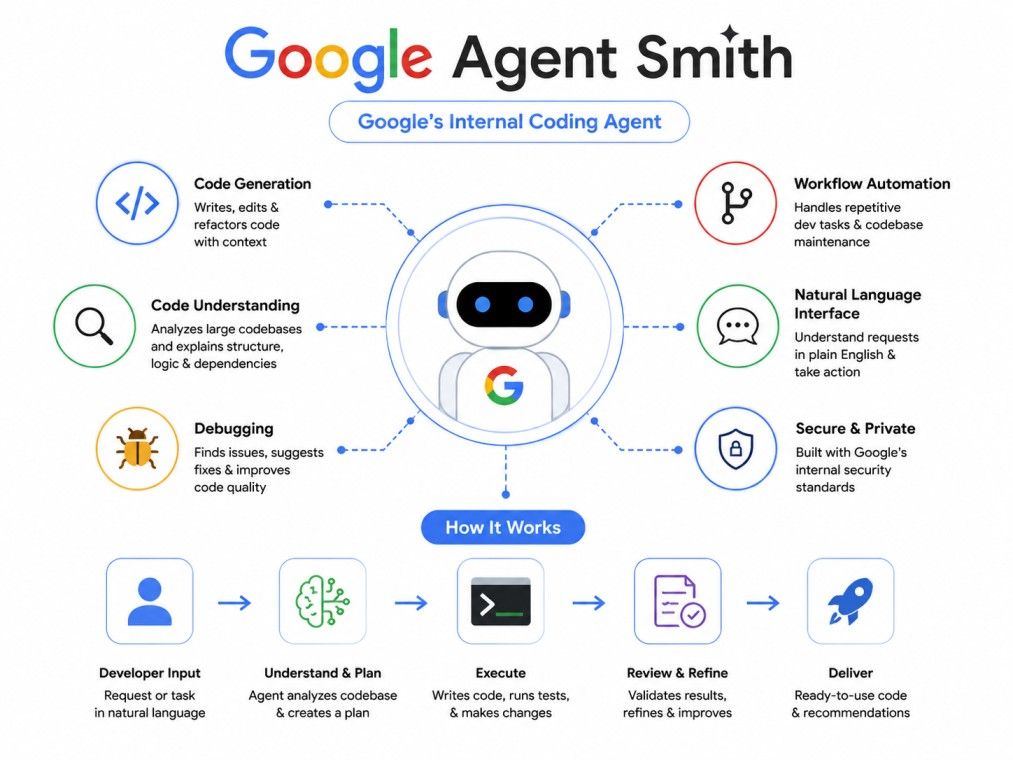
Understanding how this tool operates helps explain why it has drawn so much attention. It is not just another chat-based coding assistant. It is built around autonomy, background processing, and integration with Google's internal systems.
Agent Smith is reportedly built on Antigravity, an internal Google platform for developing and running AI agents. Think of Antigravity as the underlying infrastructure that gives Smith AI the ability to plan tasks, take actions, and operate with a level of independence that typical coding tools do not have.
While Google has not released detailed public documentation on Antigravity, the platform appears to be the foundation that supports:
In simple terms, Antigravity is the engine, and Agent Smith is one of the agents running on top of it.
One of the most talked-about aspects of Smith AI is that it does not require an engineer to sit and watch it work. It runs asynchronously, meaning tasks continue in the background even after the person has stepped away from their laptop.
This is a meaningful shift from how most coding assistants function today. A typical tool waits for you to type a prompt, gives you a suggestion, and then waits again. Smith AI, by contrast, is designed to keep working on a task over time, much like a human colleague picking up a ticket and working through it across a few hours.
Because the agent works asynchronously, Google has reportedly built in the ability for employees to check progress and give new instructions from their phone. This means an engineer does not need to be at their desk to monitor or redirect a task.
This kind of mobile check-in feature is not common in most AI coding tools available today, which mostly assume you are sitting at a computer. It reflects a design choice aimed at fitting into how engineers actually manage ongoing work, not just how they write code in the moment.
Google Agent Smith AI is also said to be integrated directly into Google's internal chat and messaging tools. This means engineers can assign tasks, request updates, or provide feedback through the same chat apps they already use daily, rather than opening a separate application.
This kind of integration lowers the friction of using the tool. Instead of learning a new interface, employees can interact with Agent Smith the same way they would message a teammate.
Also Read: Generative AI vs Traditional AI: Which One Is Right for You?
Google Agent Smith AI works seamlessly across all major Chromium-based browsers, including Google Chrome, Arc, Microsoft Edge, and Brave. Since it is built as a standard Chrome extension, it can also be installed on virtually any browser that supports extensions from the Chrome Web Store.
This broad compatibility lets you use the same AI-powered browsing and automation features without changing your preferred browser.
Take your skills to the next level with upGrad's Executive Post Graduate Programme in Applied AI and Agentic AI from IIITB. The program covers AI fundamentals, agentic AI, large language models, prompt engineering, RAG, AI workflows, and real-world projects to help you build job-ready expertise and advance your career in AI.
Beyond the basic mechanics, a few features stand out as the reason this tool is getting attention across the AI and software development world.
Smith AI is reportedly capable of planning a coding task and executing it in multiple steps without requiring approval at each stage. This could include writing code, testing it, fixing errors, and moving on to the next part of a task, all with limited human input along the way.
This kind of autonomous execution is a key part of what sets agent-based tools apart from older, suggestion-only assistants.
One reported capability that makes Smith AI particularly useful inside Google is its access to internal documentation and employee profiles. This allows the agent to automatically pull relevant context rather than relying on the engineer to explain everything from scratch.
For example, if a task references a specific internal system or process, Smith AI can reportedly look up related documentation on its own rather than asking the engineer to paste it in manually.
Most AI coding tools people use today, including popular ones like GitHub Copilot, work by suggesting code as you type. Smith AI is described as working differently. It plans out a sequence of actions first, then carries out that plan.
Here is a simple way to see the difference:
Approach |
How It Works |
Example |
| Traditional suggestion tools | Predicts the next line or block of code as you type | Autocomplete while writing a function |
| Planning-based agents like Smith AI | Breaks a task into steps and executes them independently | Given a bug report, it investigates, fixes, and tests the fix without step-by-step prompting |
This planning-first approach is what puts Smith AI in the same conversation as other advanced coding agents, rather than basic autocomplete tools.
If you are hoping to try Smith AI yourself, here is what the current situation actually looks like.
Right now, access is limited to Google employees, and even within Google, it appears to be rolling out gradually rather than to every team at once. There is no external beta program or waitlist that has been confirmed publicly.
Google has not announced an official release date for a public version of Agent Smith. Given how Google has handled other internal AI tools in the past, a public release, if it happens, would likely come after further internal testing and refinement.
For now, treat any claims about a specific public launch date with caution unless they come directly from Google.
Because Smith AI reportedly has access to internal documents, employee profiles, and company systems, security is an important part of the conversation. An agent that can act autonomously and pull sensitive internal data needs strong safeguards around what it can access and what actions it can take without human approval.
For any organization considering a similar tool in the future, questions worth asking include:
These are the same questions Google itself is likely working through as it further develops Smith AI.
Google Agent Smith AI is entering a space that already has several strong players. Tools like GitHub Copilot, Cursor AI, Claude Code, and Devin AI have each taken a different approach to AI-assisted coding, from simple suggestions to fully autonomous task execution. Comparing Smith AI to these tools helps put its design choices into context, even though Smith AI is not yet publicly available for direct testing.
Below is a quick look at how Smith AI compares to some of the better-known names in this space.
Tool |
Developed By |
Autonomy Level |
Public Availability |
Standout Trait |
| Google Agent Smith AI | High (asynchronous, plans and executes) | Internal only | Runs in the background, phone check-ins | |
| GitHub Copilot | Microsoft/GitHub | Low to medium | Public | Real-time code suggestions inside the editor |
| Cursor AI | Cursor | Medium to high | Public | AI-native code editor with agent features |
| Claude Code | Anthropic | High | Public | Strong reasoning and multi-file task handling |
| Devin AI | Cognition | High | Limited/public access | Positioned as an autonomous AI software engineer |
| Google Jules | Medium to high | Public (limited) | Google's public-facing coding agent | |
| Gemini Code Assist | Low to medium | Public | Built into Google's developer tools | |
| ChatGPT Codex | OpenAI | Medium to high | Public | Coding features built into ChatGPT's ecosystem |
Copilot mainly focuses on real-time code suggestions as you type inside your editor. Smith AI, on the other hand, is designed to take a task and run with it independently, without needing you to write line by line. Copilot is a writing partner. Smith AI is closer to a task owner.
Cursor AI has moved toward agent-style features within its editor, letting you assign broader tasks rather than just accepting suggestions. Smith AI takes this further by working asynchronously in the background, not just within an active editor session.
Claude Code is known for handling complex, multi-file coding tasks with strong reasoning. Smith AI shares that ambition for autonomy but adds a layer of deep integration with Google's internal systems and chat tools, something Claude Code is not built around since it is a general-purpose tool.
Devin AI was one of the first tools marketed as a fully autonomous AI software engineer. Smith AI appears to be Google's internal answer to that same idea, though built specifically around Google's own infrastructure and workflows rather than as a general-purpose product.
Jules is Google's own public-facing coding agent, which makes it the closest publicly available comparison to Smith AI. The key difference is access. Jules is something outside developers can actually use today, while Smith AI remains internal to Google.
Gemini Code Assist is built more around code completion and suggestions inside developer tools, similar in spirit to Copilot. Smith AI's asynchronous, multi-step task execution puts it in a different category, closer to an autonomous agent than a suggestion engine.
ChatGPT Codex brings coding capabilities to the ChatGPT ecosystem, allowing users to assign coding tasks via a chat interface. Smith AI follows a similar chat-based interaction model to that used internally at Google, though it is tied specifically to Google's own tools and data rather than being a general consumer product.
Across all these comparisons, the common thread is autonomy. Google Agent Smith AI is positioned closer to the more advanced end of the spectrum, alongside tools like Claude Code and Devin AI, rather than simpler suggestion-based assistants. The real test will come once, or if, Google opens it up beyond internal use.
Also Read: Top 10 Free AI Agents in 2026
Even though it is not public yet, it is worth understanding who this tool is actually built for and how it fits into daily work.
The primary audience for Smith AI is software engineers at Google. The tool is meant to reduce the time engineers spend on repetitive or time-consuming coding tasks, freeing them up for higher-level problem solving. Early reports suggest it is already helping some teams move faster on routine work.
Beyond writing new code, an agent like Smith AI could assist with reviewing existing code, flagging issues, or preparing changes for a human reviewer to approve. This fits naturally into how engineering teams already work, where code review is a regular part of the process.
While Smith AI itself is internal to Google, the broader idea behind it, an autonomous coding agent integrated into daily workflows, is relevant to enterprise development teams everywhere. Companies watching this space are likely evaluating similar agent-based tools for their own engineering teams.
Smith AI's design also points to broader workflow automation, not just coding. An agent that can plan, execute, and check in via chat or phone could extend to other repetitive technical workflows beyond code writing, though Google's current focus appears to be squarely on software engineering tasks.
Since Smith AI is not open to the public, it makes sense to look at what is actually available right now if you want similar capabilities.
If autonomous, multi-step coding assistance is what you are after, a few tools currently offer something in that direction:
If you want something simpler and more focused on in-editor assistance rather than full autonomy, these are solid, widely used options:
Each of these tools takes a different approach, so the right pick depends on whether you want full task autonomy or lighter, suggestion-based help.
Also Read: Agentic AI Risk and Challenges: Key Issues and Solutions
Google Agent Smith AI represents a clear shift in Google’s approach to AI's role in software engineering. Instead of another tool that suggests the next line of code, it is being built as an agent that can plan, execute, and manage tasks with far less hand-holding. The asynchronous design, phone check-ins, and deep integration with Google's internal systems all point to a tool meant to work more like a teammate than a typewriter assistant.
For now, the best move is to keep an eye on official Google announcements while exploring publicly available alternatives like Claude Code, Devin AI, Cursor AI, or Google Jules if you want a taste of what autonomous coding agents can already do today.
Want to get started with Agentic AI? Speak with an expert for a free 1:1 counselling session today.
Google Agent Smith is used internally at Google to help software engineers automate coding tasks. It can plan out a task, execute it across multiple steps, and work asynchronously in the background, reducing the amount of manual effort engineers need to put into repetitive coding work.
There is no confirmed public launch date for Google Agent Smith AI. It currently remains an internal tool used by Google employees. Any public rollout would likely follow further internal testing, and updates would come directly from Google rather than through leaks or rumors.
Since Smith AI is internal to Google and not available for enterprise use yet, its security setup has not been made public. However, given its access to internal documents and systems, strong access controls and approval steps for autonomous actions would be essential for any similar enterprise deployment.
A normal coding assistant typically suggests code as you type and waits for your next input. Agent Smith is designed to plan a task, carry it out across multiple steps, and keep working in the background without needing constant supervision, making it closer to an autonomous agent than a suggestion tool.
No. Google Jules is a publicly available coding agent from Google, while Agent Smith is an internal tool currently limited to Google employees. They may share some underlying technology, but Jules is the tool outside developers can actually access today.
No, current reports describe Smith AI as a productivity tool that reduces manual work for engineers, not a replacement for them. It is designed to handle repetitive or time-consuming tasks so engineers can focus on more complex problem solving and decision making.
Antigravity is the internal Google platform reportedly used to build and run AI agents like Smith AI. It provides the infrastructure for task planning, execution, and coordination across tools, acting as the foundation that supports Smith AI's autonomous behavior.
There is currently no public sign-up or waitlist for Google Agent Smith AI. It remains an internal Google tool, and no official early access program has been announced. Any future access details would come directly from Google's official channels.
While Agent Smith AI is currently focused on software engineering at Google, the underlying approach of autonomous, chat-integrated task execution could benefit any industry with repetitive technical workflows, including IT operations, quality assurance, and technical support teams.
Both are built around high levels of autonomy, planning tasks and executing them with limited supervision. The main difference is that Devin AI is a public, general-purpose product, while Agent Smith AI is built specifically around Google's internal tools, data, and workflows.
Since Google has not published a dedicated product page for Agent Smith AI, the most reliable updates would come from official Google blog posts, Google Cloud or Google AI announcements, and verified reporting from established tech news outlets covering Google's AI projects.
724 articles published
Sriram K is a Senior SEO Executive with a B.Tech in Information Technology from Dr. M.G.R. Educational and Research Institute, Chennai. With over a decade of experience in digital marketing, he specia...
Speak with AI & ML expert
By submitting, I accept the T&C and
Privacy Policy