Enterprise Risk Management: Framework, Process, Types, Tools & Implementation
By upGrad
Updated on Sep 17, 2026 | 9 min read | 3.46K+ views
Share:

All courses
Certifications
More
By upGrad
Updated on Sep 17, 2026 | 9 min read | 3.46K+ views
Share:
Table of Contents
Key Highlights
Looking to advance beyond a Master's? DBA programs offer the research depth and leadership skills to move into senior executive roles.
Enterprise Risk Management (ERM) is an approach a company chooses to look at all its risks together, instead of each department dealing with its own risks on its own. It helps the company spot problems (and sometimes opportunities) early, and decide what to do about them, all from one unified view.
It also goes beyond just avoiding problems. A well-run Enterprise Risk Management program looks at opportunities too, cases where taking on a certain amount of risk could actually work in the company's favor.
Risk, in this sense, is not something to eliminate entirely. It is something to understand well enough that a company can act with confidence instead of holding back out of caution.
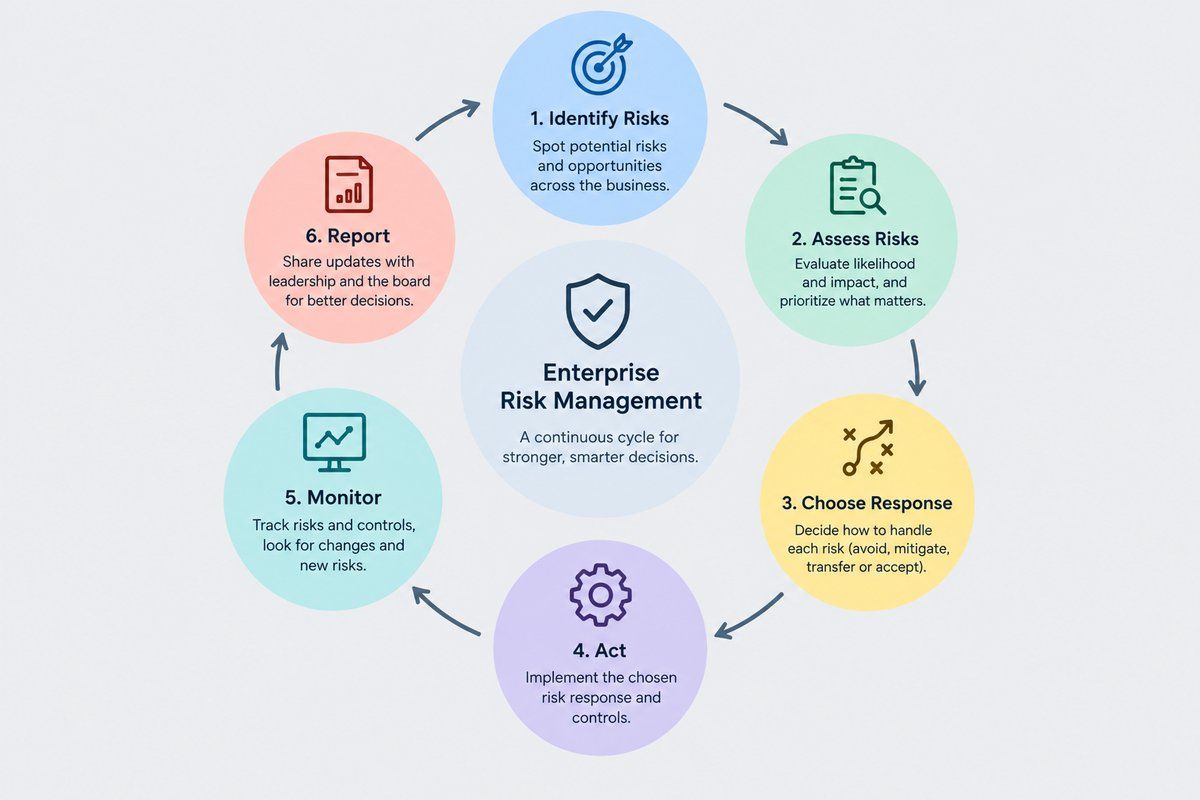
A good ERM program usually includes these parts:
1. Risk Identification. Systematically finding potential risks across categories:
2. Risk Assessment. It involves evaluating how likely each risk is to occur and how much damage it could cause. This is often plotted on a risk matrix, comparing probability against severity, to help decide which risks need attention first.
3. Risk Response. Deciding how to handle each risk, typically one of four strategies:
4. Monitoring and Reporting. Ongoing tracking of risks and controls, with regular reporting to leadership and the board.
5. Governance. Clear roles and accountability, often including a Chief Risk Officer (CRO), risk committees, and integration into board oversight.
Also read: Risk Management Framework (RMF): A Complete Guide
Enterprise Risk Management changes how a company deals with risk, turning it into useful information rather than just something to avoid. Instead of reacting to problems as they come up, companies get a clearer, more connected view of what could go wrong and how to handle it before it becomes serious.
Also read: 10 Most Popular Type of Management Style: Choosing the Right Approach
DBA Courses to upskill
Explore DBA Courses for Career Progression
IIIT-B & IIM, Udaipur
Chief Technology Officer & AI Leadership ProgrammeNot all risks look the same, and they do not get handled the same way either. A solid enterprise risk management program sorts them into categories and these are as follows:
Category |
What It Covers |
Why It Matters |
| Strategic risk | New markets, product launches, acquisitions | Poor timing or a bad fit can affect the company for years |
| Operational risk | Supply chain failures, system outages, processes that cannot scale | Slowly reduces efficiency if left unchecked |
| Financial risk | Cash flow problems, currency changes, interest rate shifts, credit exposure | Can hurt even a strong business if not planned for |
| Compliance and legal risk | Regulatory failures, data privacy issues, labor law violations, contract disputes, lawsuits, IP battles | Fines and legal costs often hit at the worst possible time |
| Reputational risk | Bad reviews, scandals, viral complaints | Builds up slowly and is slow and costly to fix once trust is lost |
| Cybersecurity risk | Data breaches, ransomware, phishing | Costs keep rising, and damage often extends beyond money |
| Technology risk | Outdated systems, failed rollouts, infrastructure gaps | Slows down operations even without a security incident |
| Third-party risk | Vendors, contractors, service providers | A problem with any of them can quickly become the company's problem |
Also read: An Introduction to Principles of Management

Most companies do not build ERMt framework from scratch. They lean on an established enterprise risk management framework and below are some of those frameworks mentioned:
COSO, developed by the Committee of Sponsoring Organizations of the Treadway Commission in the US, has gained solid footing in India, especially among listed companies. It aligns with Section 134(5) of the Companies Act, 2013, which requires directors to confirm adequate internal financial controls, and with SEBI's LODR norms on risk management committees.
It runs on five components:
For large Indian conglomerates and companies with cross-border reporting obligations, COSO tends to integrate smoothly into existing audit and internal control structures. Smaller and mid-sized companies, though, often find it heavier than what their governance maturity actually calls for.
ISO 31000 takes a lighter, more adaptable route, suited to the diversity of Indian business, from family-run enterprises to IT services firms to manufacturers. Being principles-based rather than prescriptive, and carrying no certification requirement, it's often used as a flexible reference point rather than a strict rulebook.
It centers on three core ideas:
It also appeals to Indian companies with significant export or global operations, since it's internationally recognized and isn't tied to any single country's regulatory framework, useful for dealing with clients and partners across jurisdictions.
Neither framework is really competing with the other here, they just answer different needs depending on where a company sits.
From experienced professional to C-suite leader: SSBM's Global DBA offers 19+ specializations and a PwC board advisory certification to help you get there, 100% online.
The Enterprise Risk Management process runs in a loop, not a straight line. Six stages, repeated continuously, and these are as follows:
Stage 1: Spot the Risks.
This cannot just come from the risk team. Finance notices things operations never will, and IT sees threats that never cross a salesperson's desk. Pulling together interviews, surveys, historical incidents, and industry data gives a far more honest picture than any single department working alone.
Stage 2: Weigh Them Against Each Other.
Every risk gets measured on two dimensions:
The obvious calls are easy. High likelihood, high impact, deal with it now. The tricky part is the middle ground, risks that are moderately worrying on both fronts and easy to keep pushing down the list until they're suddenly not moderate anymore.
Stage 3: Choose How to Handle Each One.
There are four real options here. Walk away from the risk entirely. Shrink it with better controls. Hand it off through insurance or a contract. Or accept it, when fighting it costs more than just living with it. Which option makes sense depends entirely on the company's appetite for risk and what it can genuinely afford to lose.
Stage 4: Actually Do Something.
This is where good intentions go to die. A response sitting in a document nobody reopens isn't a response, it's a memory. Real follow-through needs a named owner, a deadline, and some way of checking later whether it actually worked.
Stage 5: Keep Watching.
Risk doesn't hold still. A few things keep this stage honest:
A reliable vendor last year can be a liability this year. A rule that didn't apply yesterday might apply today. These are what catch shifts like that before they turn into surprises.
Stage 6: Push It Upward.
All of this is wasted if it stays buried inside one department. Getting risk information in front of leadership and the board is what keeps it connected to actual decision-making, instead of sitting quietly in a folder somewhere.
Also read: Top 10 Risk Management Strategies You Need to Follow for Success!
Once a company has more than a handful of risks to track across multiple departments, manual tracking starts breaking down, updates lag, ownership gets fuzzy, and nobody's looking at the same version of the data. And, that is the point where organizations start looking at dedicated software.
Also read: Risk Management Tools: Types, Examples, and How They Work
Understanding the framework and process is one thing but implementing it inside a real company, with real politics and budget constraints can be difficult.
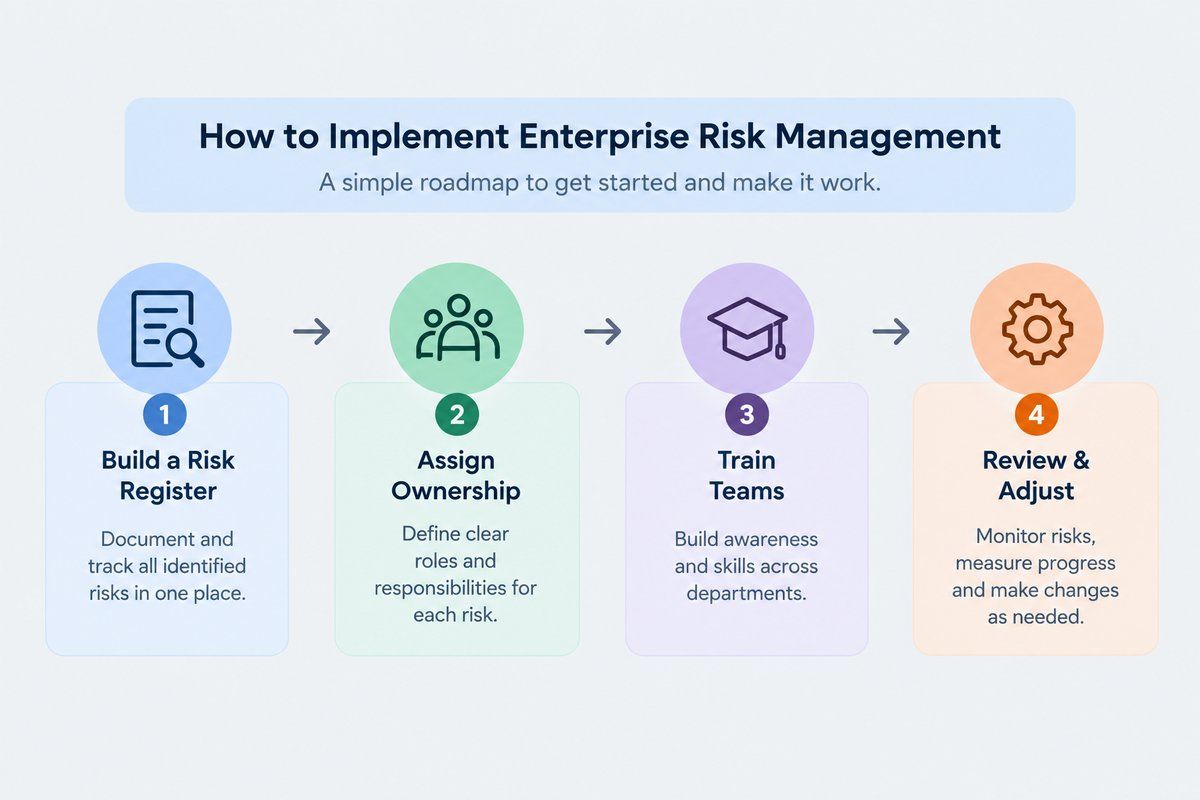
Below are some ways you can follow for implementation:
Also read: Top 21+ Risk Management Projects: The 2026 Master List
Enterprise Risk Management is not a one-time project or a compliance formality, It is an ongoing habit that helps a company see problems before they become crises. From identifying risks and choosing the right framework to following a consistent process and using the right tools.
ERM gives leadership the visibility needed to make better decisions and protect the business over the long run. Companies that treat it as part of daily operations, not an annual checkbox, are the ones best placed to handle whatever comes next.
Have questions about your next step? Book a one-on-one consultation with our experts today.
A Chief Risk Officer or dedicated risk team usually leads the effort, but responsibility extends beyond them. Every department head is expected to flag risks within their own area, while the board provides overall oversight and accountability.
No, smaller companies benefit too, though their approach is usually lighter. Instead of dedicated software or a large risk team, they often rely on a simple risk register and regular reviews to stay on top of things.
Traditional risk management typically handles specific areas separately, such as insurance or workplace safety, within individual departments. Enterprise risk management instead looks at all risks together across the organization, connecting them directly to overall business strategy and goals.
Yes, several certifications exist for professionals wanting formal expertise, including the Certified Risk Management Professional (CRMP) and COSO-based Enterprise Risk Management certifications, both of which are recognized across industries and help build structured, credible risk management knowledge.
Costs vary significantly depending on company size and required features. Basic tools may cost a few hundred dollars monthly, while enterprise-level platforms with advanced compliance, reporting, and integration capabilities can cost considerably more for larger organizations.
Banking, insurance, healthcare, and pharmaceuticals face the strictest regulatory requirements, making formal risk management essential. That said, any company with significant operational, financial, or reputational exposure can benefit from having a structured, organization-wide approach in place.
Without it, risks are often discovered too late, typically after they have already caused financial loss, legal trouble, or reputational damage. There is no coordinated system in place to catch early warning signs across departments.
Risk appetite refers to the overall amount of risk a company is willing to accept while pursuing its goals. Risk tolerance is narrower, defining the acceptable range of variation around a specific risk before corrective action becomes necessary.
No, its purpose is not to eliminate every risk but to help a company understand its risks well enough to respond effectively, whether through avoiding, reducing, transferring, or simply accepting certain risks based on their severity.
By giving leadership a clear, organization-wide view of potential risks, companies can pursue new markets, products, or partnerships with greater confidence, since they already understand what could go wrong and have plans ready to respond.
Risk management committees usually include senior executives from finance, operations, legal, and technology departments, along with independent board members, ensuring risk-related decisions are reviewed from multiple perspectives rather than a single department's viewpoint alone.
980 articles published
We are an online education platform providing industry-relevant programs for professionals, designed and delivered in collaboration with world-class faculty and businesses. Merging the latest technolo...
Speak with DBA expert
By submitting, I accept the T&C and
Privacy Policy