Supply Chain Resilience: Meaning, Importance, Pillars, & Strategies
By upGrad
Updated on Sep 17, 2026 | 9 min read | 3.26K+ views
Share:

All courses
Certifications
More
By upGrad
Updated on Sep 17, 2026 | 9 min read | 3.26K+ views
Share:
Table of Contents
Key Highlights
Looking to advance your expertise in supply chain strategy? Explore DBA programs built to develop the leadership and analytical skills modern businesses demand.
Supply chain resilience is how well a supply chain can spot trouble coming, hold up under pressure, adjust when needed, and bounce back quickly, all while the business keeps running.
Traditional "just-in-time" models focus mainly on saving money and staying efficient. A resilient supply chain thinks differently. It expects disruptions like natural disasters, political conflicts, labor shortages, and cyberattacks to happen sooner or later, instead of treating them as rare surprises.
The whole point is to build a supply chain that can bend under stress without actually breaking.
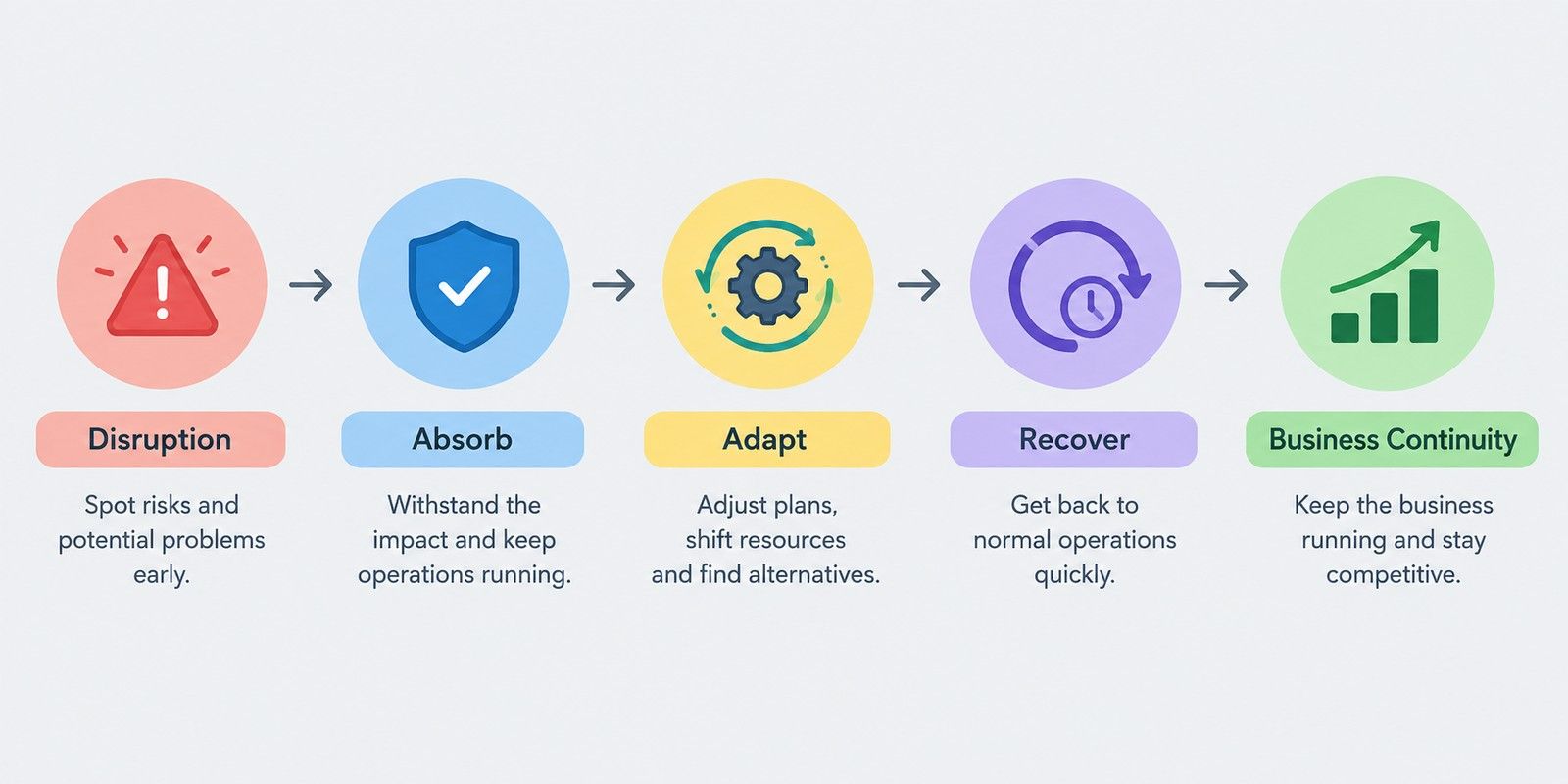
Supply chain resilience matters for the following reasons:
Benefit |
What it does |
Why it helps |
| Keeps operations going | Keeps factories and shipping running during a crisis | Avoids expensive downtime |
| Spots risks early | Finds weak points in suppliers, even ones a few steps removed | Stops small problems from turning into big ones |
| Stays flexible | Moves production or shipping to backup options fast | Helps respond quickly when demand jumps |
| Protects profits long-term | Handles cost spikes and manages stock levels wisely | Keeps profit margins steady over time |
Also read: What is Supply Chain Management: Components, Process & Benefits
DBA Courses to upskill
Explore DBA Courses for Career Progression
IIIT-B & IIM, Udaipur
Chief Technology Officer & AI Leadership ProgrammeThe four pillars of Supply Chain Resilience are as follows:
Visibility means being able to see everything happening in the supply chain from the moment raw materials arrive to when the final product reaches the customer. It gives companies a picture in real time so they can notice issues as they happen and fix them before they become big problems. By waiting until things fall apart, visibility lets teams take action early.
Key Elements of Visibility:
Flexibility is the ability to change course quickly without huge costs or long delays. If one part of the supply chain breaks down, a flexible system can shift work or resources somewhere else right away.
Key Elements of Flexibility:
Collaboration means building strong, honest relationships with both internal teams and outside partners. Supply chains are deeply connected. When a crisis hits, open communication means information moves fast and everyone can solve problems together.
Key Elements of Collaboration:
Control is about having the oversight and decision-making power to act when something goes wrong. It is what turns information into action, kicking off backup plans the moment something crosses a warning line.
Key Elements of Control:
To put these ideas into practice, companies usually have to move away from systems built only around cutting costs.
Feature |
Lean Supply Chain (Traditional) |
Resilient Supply Chain (Modern) |
| Main goal | Cut costs as much as possible | Keep the business running no matter what |
| Sourcing | One supplier, often overseas | Multiple suppliers in different places |
| Inventory | Bare minimum stock (just-in-time) | Extra stock on hand (just-in-case) |
| Structure | Rigid and fixed | Flexible and adaptable |
Also read: Top 12 Supply Chain Manager Skills: Logistics & Operations Expertise
Putting these supply chain strategies in place helps protect a business when something goes wrong. Operations keep running, revenue loss stays low, and customers stay happy even during a crisis.
Relying on one supplier or one region is risky. A lockdown, political unrest, or a new tariff in that one spot can throw everything off.
That is why many manufacturers now follow a "main supplier plus backup" approach, splitting orders between a primary and secondary source. One of the supply chain resilience examples is how Samsung took this further and moved large chunks of its production to Vietnam and India, which kept the company out of the crossfire during recent trade disputes.
Moving production closer to where products actually sell helps too, since shorter shipping distances mean fewer border crossings and fewer chances for something to get stuck along the way.
Ultra-lean supply chains look great on paper, but they break easily. Companies are now trading that approach for a bit more cushion.
Most of the risk in a supply chain does not sit with the obvious, direct suppliers. It hides further back, with the vendors that supply the suppliers.
Ready to lead at the top? Advance your career with the Global DBA from SSBM, featuring 19+ specializations and a PwC board advisory certification.
For building the resilient supply chain, follow these strategies and steps shared below:
Strategy |
Core Action |
Impact |
| End-to-End Visibility | Map suppliers across all tiers, not just the direct ones | Uncovers hidden risks and regional dependencies |
| Supplier Diversification | Use a "main supplier plus backup" or multi-sourcing approach | Removes single-source dependency and softens local disruptions |
| Strategic Buffers | Keep safety stock and spare capacity for critical parts | Keeps production going during shortages or demand surges |
| Shift-Left Development | Factor in sourcing and backup parts early in design | Avoids part obsolescence and engineering delays |
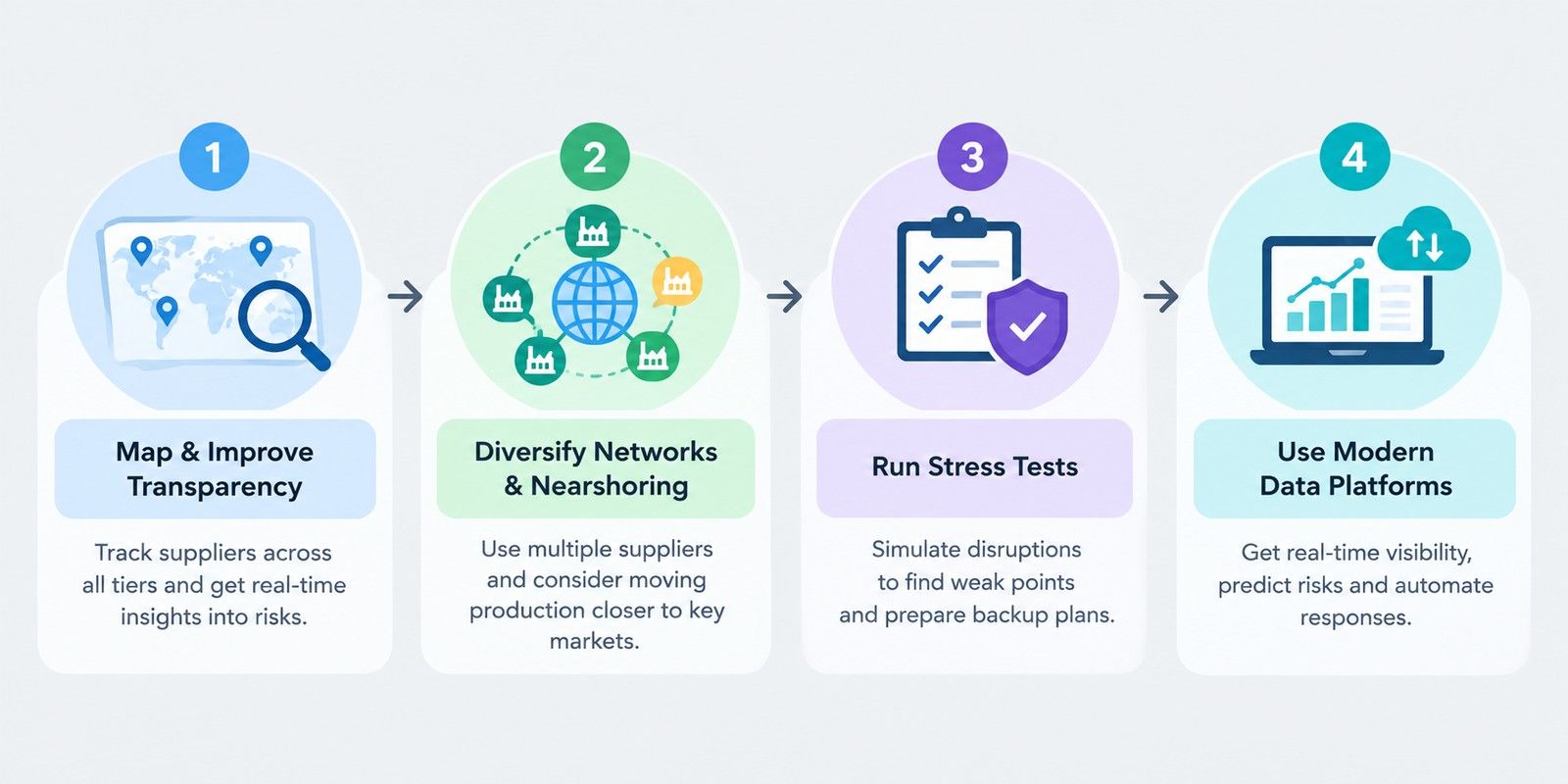
You can't protect what you can't see, so tracking should run continuously across every supplier tier. Pulling together data like country risk levels, news monitoring, and supplier sustainability records gives a fuller picture of how healthy the operation really is.
Depending on one supplier or one region is a fragile position. Building in redundancy helps protect against that.
Test disruption like a regional shutdown or a shipping bottleneck, so it shows how well the network can handle pressure. Digital twin simulations help companies do this test safely, without having any risk. Watching what happens when a key part of the network suddenly goes offline makes it much easier to catch weak spots ahead of time, long before a real crisis forces the issue.
Disconnected spreadsheets can't keep up with how fast modern disruptions unfold. They lack the real-time responsiveness a crisis demands.
Cloud-based tools change that. Integrated product lifecycle management systems and AI-driven control towers can catch risks early, automate predictive analysis, and keep sensitive company data secure at the same time.
Building resilience in supply chain sounds simple in theory, but most companies understand this in a hard way that they are not prepared as they thought. Below are some challenges that companies face:
Also read: Basic Components of Supply Chain Management
To see how healthy and adaptable a supply chain really is, companies track a few standard metrics, often through platforms like ASCM.
Metric |
What It Measures |
What You Want |
| Time-to-Survive (TTS) | How long operations can keep running normally if a facility or supplier fails completely | Higher, since it gives a bigger safety window |
| Time-to-Recover (TTR) | How long it takes a location or the whole network to get back to normal after a disruption | Lower, since it shows a faster bounce-back |
| Supplier Coverage Rate | The percentage of suppliers that are mapped, checked, and actively monitored | Higher, so there are no blind spots |
| Corrective Action Closure Time | How fast partners fix problems or compliance issues once they're found | Lower, since it shows the team can move fast |
Also read: Role of Logistics in Supply Chain Management: A Detailed Study
Supply chain resilience is not a one-time fix. It is an ongoing shift in how a business thinks about risk, trading some short-term efficiency for the ability to keep going when things fall apart. The companies that treat disruption as a certainty, not an exception, are the ones that come out ahead when the next crisis hits.
Building that mindset takes time and investment, and it rarely comes without trade-offs. But staying fragile usually costs more in the long run. A single major disruption can undo years of savings from running lean.
Resilience in supply chain is not about predicting every crisis. It is about building a supply chain that can take a hit and keep going.
Not sure where to start? Book a consultation and get personalized guidance on choosing the right DBA program for your goals.
A company keeping backup suppliers across different countries is a strong example. If one region faces a shutdown due to political unrest or a natural disaster, production can continue elsewhere without a major disruption to overall business operations.
980 articles published
We are an online education platform providing industry-relevant programs for professionals, designed and delivered in collaboration with world-class faculty and businesses. Merging the latest technolo...
Speak with DBA expert
By submitting, I accept the T&C and
Privacy Policy