Top 10 Career Options After M.Sc: What To Do After M.Sc in 2026
By Sriram
Updated on Aug 24, 2026 | 10 min read | 41.26K+ views
Share:

All courses
Certifications
More
By Sriram
Updated on Aug 24, 2026 | 10 min read | 41.26K+ views
Share:
Table of Contents
Key Highlight
Explore machine learning courses in India with upGrad and develop practical skills and strengthen your career prospects with Artifical Intelligence and Machine Learning.
Popular upGrad Programs
After completing Master’s in Science naturally a question comes to mind, what can I do after M.Sc? An MSc in India offers a wide range of career opportunities catering to different specializations and fields. As time advances, research, development, and innovation gain more prominence in the global economy. This leads to the way to multiple career avenues.
The following table provides insight into the average annual salary for different job opportunities after an MSc in India:
| PROFILE | Average Annual Salary Range (INR) |
| Data Analyst Salary | ₹6.5L/yr-₹7.2L/yr |
| Research Assistant | ₹4L/yr-₹4.4L/yr |
| Professor | ₹16.2L/yr-₹17.9L/yr |
| Biochemist | ₹3.9L/yr-₹4.4L/yr |
| Environmental Consultant | ₹8.2L/yr-₹9.3L/yr |
| Statistician | ₹7.3L/yr-₹8.1L/yr |
| Forensic Expert | ₹3.7L/yr-₹4.1L/yr |
| Actuarial Analyst | ₹8.4L/yr-₹9.3L/yr |
| Agricultural Scientist | ₹8.4L/yr-₹10.9L/yr |
| Government Jobs After M.Sc | 1 - 10 L/yr (varies by role) |
Source: Ambition box and government website
Explore upGrad’s Executive Post Graduate Certificate in Building AI Products, Systems & Services from IIT Kharagpur and develop product-focused AI skills for the evolving tech landscape.
Let us further examine these job opportunities after M.Sc in detail:
A data analyst is a professional responsible for gathering, processing, and evaluating data to assist organizations in making wise decisions. They work with huge data sets to find patterns and insights that help boost operations, advance strategic goals, and enhance corporate performance.
Want to sharpen your data analysis skills further? Check out these 60 Advanced Excel Formulas to streamline your workflows and make your reports more impactful.
Key Responsibilities
Explore more here: Data Analyst Job Description: Salary, Top Companies, and Future
Where They Work
Want to explore the bigger picture beyond data analysis? Dive into our comprehensive guide on career paths in data science and uncover how you can level up to more advanced and high-impact roles in this booming field.
A Research Assistant is an individual who supports research undertakings, typically in academic, scientific, or professional settings The role can involve a wide range of duties, depending on the field and the specific project.
Key Responsibilities
Where do they work?
You may also explore this guide: Master of Science – Eligibility, Specialisations, Opportunities, and More!
From cutting-edge roles in healthcare to exciting opportunities in technology, discover the top career options after 12th science and choose the path that aligns with your passion and goals.
A professor is an academic instructor, researcher, and scholar at a college or university. Professors are subject-matter specialists, who are usually in charge of planning lectures, instructing, guiding students, carrying out research, and advancing their discipline.
Key Responsibilities
Where do they work?
Curious about what the future holds beyond a career in academia? Take a look at some of the best career options in the future that are shaping the world ahead.
A biochemist is a scientist who studies the chemical processes and substances that occur within living organisms. They combine principles of biology and chemistry to understand various molecular mechanisms.
Key Responsibilities
Where do they work?
Want to explore more exciting career possibilities that blend science, innovation, and real-world impact? Discover a wide range of career options after PCMB and find the one that sparks your interest
An environmental consultant offers expert advice on environmental issues to assist businesses in adhering to rules, reducing their environmental effect, and implementing sustainable practices. They operate in a variety of sectors, such as government, manufacturing, energy, and construction.
Key Responsibilities
Where do they work?
Also Read: Salary After MSc Mathematics in India 2026: Highest Paying Jobs & Career Opportunities
A statistician supports organizations in making well-informed decisions, statisticians gather, examine, interpret, and present data using statistical techniques. They are employed in a number of industries, including market research, healthcare, government, finance, and sports.
Key Responsibilities
Where Do They Work?
A forensic expert applies scientific principles and techniques to investigate crimes. They collect, preserve, and analyze evidence such as DNA, fingerprints, ballistics, or toxicology samples to help solve criminal cases. Their findings often play a key role in criminal investigations, trials, or legal proceedings.
Key Responsibilities
Where do they work?
An actuarial analyst evaluates risk and uncertainty using statistics, mathematics, and financial theory in fields including insurance, banking, pensions, and investing. They offer models and insights to assist companies in making data-driven choices about pricing, forecasting, and risk management.
Key Responsibilities
Where do they work?
Know more about Actuary Salary in India here!
An agricultural scientist studies crops, livestock, soil, and environmental factors to develop methods that increase food production, promote ecological balance, and ensure safe, high-quality agricultural products.
Key Responsibilities
Where do they work?
Government jobs after M.Sc offer stable careers, strong growth opportunities, and the chance to contribute to national development. With a master’s degree in science, you can apply for roles in research organizations, defense labs, public sector units, and various administrative departments. These jobs provide competitive salaries, job security, and long-term benefits, making them a top choice for many M.Sc graduates.
Key Responsibilities
Where They Work
Free Courses
If you're wondering after M.Sc which course is best, the answer depends on your specialization and career goals. Many learners choose advanced degrees, professional certifications, or industry-specific diplomas to improve their skills and expand job opportunities. Below are the top PG-level courses you can consider after completing your M.Sc.
Here are the best options in science and tech fields after M.Sc.:
Here are the best options in life science fields after M.Sc.:
Here are the best options in math and physics fields after M.Sc.:
Here are the best options in chemistry after M.Sc.:
Here are the best options in computer science field after M.Sc.:
Recommended Courses to upskill
Explore Our Popular Courses for Career Progression
IIIT Bangalore
Executive Diploma in Machine Learning and AI360° Career Support
O.P.Jindal Global University
MBA from O.P.Jindal Global UniversityLive Case Studies and Projects
After MSc, candidates are eligible for job roles across a multitude of sectors owing to their advanced knowledge, technical expertise, and analytical skills. We shall further take a look at the sectors and the various job profiles within them, where MSc graduates can gain employee opportunities.
The table below sheds light on the top industries hiring MSc graduates in India:
SECTOR/INDUSTRY |
TOP JOB ROLES |
Consulting |
Business Consultant, Market Research Analyst, and Strategy Analyst |
IT and Software |
Software Developer, Cybersecurity Analyst, AI/ML Engineer |
Education |
Research Assistant, Lecturer, Curriculum Developer |
Banking and Finance |
Financial Analyst, Investment Banker, Risk Analyst |
Agriculture and Food Technology |
Food Safety Officer, Agricultural Researcher |
Health and Pharmaceuticals |
Clinical Research Associate, Quality Assurance Analyst |
Environmental Science |
Climate Change Analyst, Environmental Consultant |
Engineering and Manufacturing |
Operations Manager, Product Development Engineer, Process Engineer |
Research and Development |
Research Scientist, Public Health Researcher, Sustainability Researcher |
Telecommunications |
Network Engineer, Systems Engineer, Telecom Project Manager |
After completing your M.Sc, having the right mix of technical and soft skills is crucial to land the best jobs. Employers look for both domain expertise and transferable skills that help you solve problems, collaborate, and adapt to modern workplaces. Here’s a breakdown of key skills you should focus on, depending on your specialization:
Technical skills
Soft Skills
Future advances in technology, changing societal demands, and changing sectors will all influence MSc program patterns in India. A number of significant changes are anticipated to impact MSc education in the upcoming years as India's economy continues to grow and diversify.
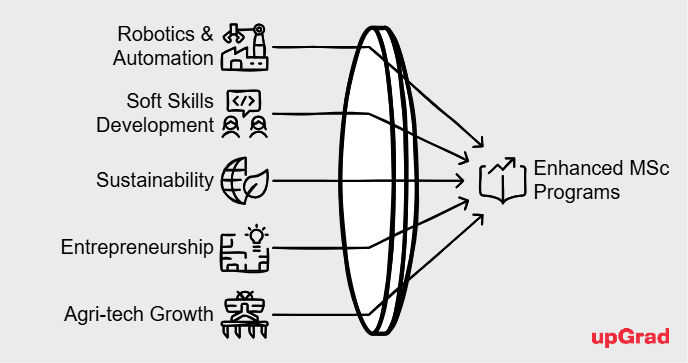
The following are some of the most notable upcoming developments for MSc degrees in India:
Check out upGrad’s free certificate course in Entrepreneurship
Also, take a look at upGrad’s Artificial intelligence courses and upskill yourself with advanced knowledge!
Subscribe to upGrad's Newsletter
Join thousands of learners who receive useful tips
Figuring out what to do after your M.Sc can feel overwhelming, but following a clear path can make it much easier to choose the right career or further studies.
Step-by-Step Path to Choose the Right Career


In this text, we examined the various career options after MSc in India, which offers multifaceted pathways for graduates, with strong prospects in both public and private sectors. The ever-growing demand for specialized skills in fields like biotechnology, data science, and artificial intelligence results in increased job opportunities.
Moreover, MSc graduates can go on to pursue the path of higher education by enrolling in diploma programs, fellowships, or PhD programs if they are inclined towards research roles. Some MSc graduates also undertake the path of building their ventures and delving into entrepreneurship.
If you are still wondering about your career choices, you can seek expert guidance to navigate your decisions. Book a free counseling session with upGrad and get complete assistance for your path in education and skill development!
Some of the institutes for studying MSc programs in India are the University of Delhi, IITs, BHU, Tata Institute for Fundamental Research, and JNU.
In a majority of cases, this is the norm. You are usually required to have a BSc for enrollment in MSc. However specific requirements for each department and university may differ, which is why it is best to closely follow the official information of specific institutes.
The top career options after M.sc. Maths in India are data scientist, actuary, statistician, data analyst, research scientist, quantitative analyst and operations research analyst as they use mathematics as core.
To equip yourself with practical experience during your MSc course program, you can adopt multiple strategies. You can seek opportunities for internships, and participate in research projects and lab work. Further, you can work on building your network and attending seminars and workshops to further improve your profile.
Yes, you may pursue a PhD after an MSc course given you qualify for the NET JRF exam or university-specific entrance exam.
To improve your chances of better jobs after MSc you can focus on building your professional network, approaching professionals and mentors for guidance and referral opportunities, pursuing skill development certificates, and working on developing a specialized skill set।
Biotechnology has a broad scope after MSc in India. You can work in research, pharma, biotech companies, academia as well as agriculture.
Yes, you are eligible to become a school teacher after your MSc. You would typically be eligible for a TGT and PGT position and may also be required to have a necessary teaching qualification such as a B.Ed course.
In India, an MSc course has a duration of 2 years. With the new NEP rules, students can complete an MSc course in 1 year after their 4-year undergraduate degree.
You can work at entry-level roles in pharma, IT, academia, and research without having prior experience. However, you need to have a strong hold on theoretical knowledge to advance in these positions.
If you have an educational background in data science, computer science, and mathematics, you are eligible to work across roles in data analysis, software development, AI and even consulting.
The best career options after M.sc. physics are research scientist, scientific officer, medical physicist, data scientist, physicist, lecturer or assistant professor and technical consultant.
High-paying jobs after M.Sc include Data Scientist, Research Scientist, Biostatistician, Technical Product Manager, and positions in government research labs like DRDO, ISRO, and ICMR. Salaries vary by specialization, experience, and industry, but these roles offer excellent growth and competitive pay.
You can pursue a PhD or apply for assistant professor/lecturer roles. Additionally, research fellowships in CSIR, ICMR, DRDO, and other scientific institutions allow you to gain hands-on research experience and build a strong academic profile.
Enroll in specialized data science, AI, or analytics courses. Learning Python, R, SQL, and tools like Tableau or Power BI helps you qualify for roles like Data Analyst, Data Scientist, or Business Analyst. Practical projects and internships will improve your employability.
Short courses and certifications in Data Science, AI/ML, Cloud Computing, Clinical Research, Biotech, or Quality Control add practical skills. These enhance your resume and make you more competitive in both industry jobs and government roles.
The top career options after M.sc. Botany are botanist, plant scientist, research scientist, plant breeder, agricultural scientist, ecologist, environmental consultant, plant pathologist, lecturer or assistant professor.
M.Sc graduates can apply for roles in ISRO, DRDO, ICMR, CSIR labs, UPSC, and State PSCs. Positions include Research Officer, Scientist, Technical Officer, Lab Analyst, and other administrative roles. These jobs offer stability, good pay, and career growth.
Focus on skill-based courses, certifications, and internships that match industry needs. For pharma and biotech, practical lab and research experience is crucial. For IT and data-related roles, develop skills in programming, analytics, and cloud tools. Networking and mentoring also help in making a smooth transition.
To boost employability, combine technical expertise with soft skills like communication, problem-solving, and teamwork. Pursue certifications, internships, and research projects. Staying updated with industry trends and building a professional network will help you secure better jobs after MSc and grow your career over time.
The top career options after M.sc. Zoology are zoologist, wildlife biologist, research scientist, ecologist, conservation scientist, entomologist, fisheries scientist, lecturer or assistant professor and forensic scientist.
Reference links
https://www.ambitionbox.com/profile/data-science-analyst-salary
https://www.ambitionbox.com/profile/research-assistant-salary
https://www.ambitionbox.com/profile/professor-salary
https://www.ambitionbox.com/profile/biochemist-salary
https://www.ambitionbox.com/profile/environmental-consultant-salary
https://www.ambitionbox.com/profile/statistician-salary
https://www.ambitionbox.com/profile/forensic-expert-salary
https://www.ambitionbox.com/profile/actuarial-analyst-salary
https://www.ambitionbox.com/salaries/indian-council-of-agricultural-research-salaries/scientist
https://www.ambitionbox.com/profile/government-job-salary
725 articles published
Sriram K is a Senior SEO Executive with a B.Tech in Information Technology from Dr. M.G.R. Educational and Research Institute, Chennai. With over a decade of experience in digital marketing, he specia...
Get Free Consultation
By submitting, I accept the T&C and
Privacy Policy
Top Resources
Certification
3 Months
Certification
6 Months
O.P. Jindal Global University
Masters in International Accounting and Finance (Accredited by ACCA, UK)Master's Degree
12 Months