AES Encryption Explained: How It Works, Modes, and Key Sizes
By Sriram
Updated on Jul 07, 2026 | 11 min read | 3.72K+ views
Share:

All courses
Certifications
More
By Sriram
Updated on Jul 07, 2026 | 11 min read | 3.72K+ views
Share:
Table of Contents
Popular Data Science Programs
This guide explains what AES encryption is, how it works, and why it is considered highly secure. It covers the fundamentals of AES, its key sizes, operational modes, comparisons with other encryption methods, and solutions to common implementation challenges.
Enroll in Data Science Courses from upGrad to enhance your software development skills with the hands-on expertise employers actively seek today.
Free Courses
AES encryption is a symmetric encryption algorithm. That means the same key is used for both encryption and decryption.
It was established by the National Institute of Standards and Technology (NIST) in 2001, following a five-year public competition to replace the older DES (Data Encryption Standard).
AES was originally designed by two Belgian cryptographers, Vincent Rijmen and Joan Daemen. Their algorithm, called Rijndael, won the NIST competition and became what we now call AES.
Since its adoption, AES has become the standard for data encryption across a wide range of applications. It is recognized for its speed, reliability, and resilience against cryptanalytic attacks over several decades.
Also Read: What is End-to-End Encryption? How It Works, and Why We Need It
AES includes several defining features that make it one of the most trusted encryption standards for ensuring the security of digital data. Here is what makes AES distinct from other encryption methods:
Understanding AES begins with one fundamental idea: its security comes not from hiding the algorithm but from making the encryption key virtually impossible to guess.
Data Science Courses to upskill
Explore Data Science Courses for Career Progression
IIIT Bangalore
Executive Post Graduate Certificate in Data Science & AIPlacement Assistance
AES became the global standard due to its unique combination of speed and security, which few other algorithms can achieve.
Advantage |
Why It Matters |
| Speed | Handles large volumes of data without lag |
| Security | Resistant to brute-force and known cryptographic attacks |
| Adoption | Backed by NIST, used across industries globally |
| Hardware support | Built into modern CPUs for faster performance |
Ready to build a career in Data Science? Gain industry-relevant skills with the Executive Post Graduate Certificate Programme in Data Science & AI from IIIT Bangalore and take the next step toward becoming an AI-driven professional.
Source: AES ENCRYPTION
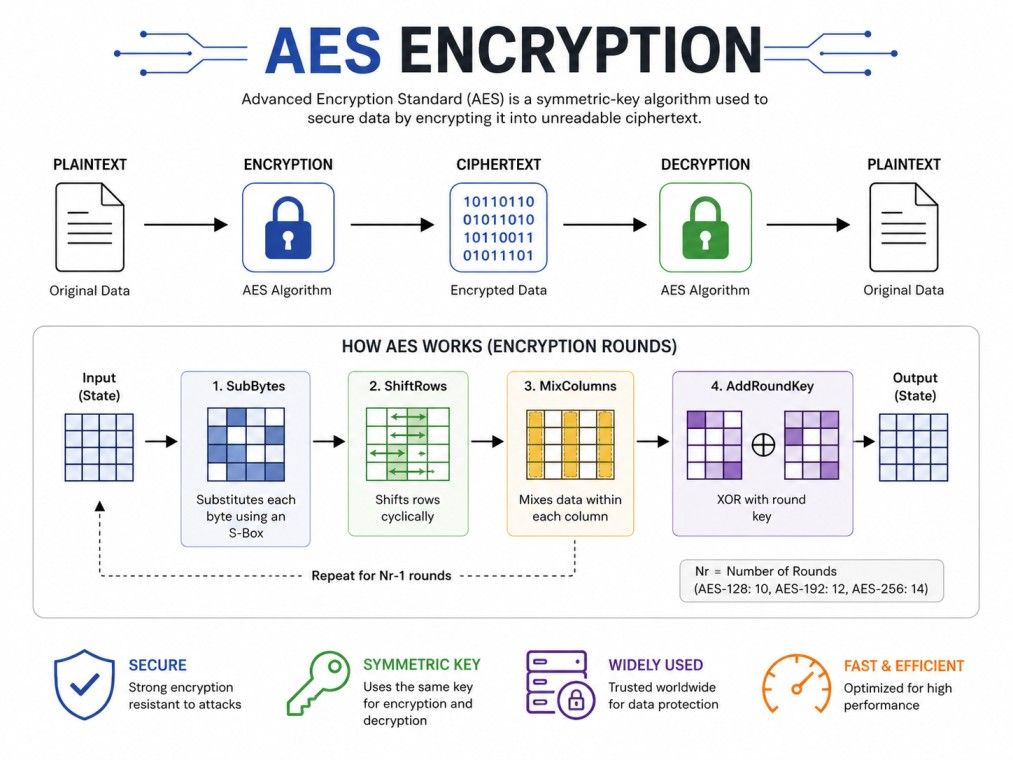
AES encryption works by transforming plain data (plaintext) into unreadable data (ciphertext) through a series of steps repeated over multiple rounds. The number of rounds depends on the key size: 10 rounds for AES-128, 12 for AES-192, and 14 for AES-256.
Each round applies four main transformations to the data.
This step replaces each byte in the data block with another byte using a lookup table called the S-box (substitution box).
It adds non-linearity to the encryption, making it much harder for attackers to predict patterns.
Here, the rows of the data block are shifted left by varying amounts. This step shuffles the byte positions so that columns from the input mix together, spreading the data and adding diffusion.
This step mixes the data within each column of the block using matrix multiplication.
It ensures that even a small change in the input yields a completely different output, a key property of strong encryption.
Finally, the current state of the data is combined with a portion of the encryption key using an XOR operation. This is what actually ties the encryption to the secret key.
Before any of this happens, AES needs to generate a set of round keys from the original key. This process, called key expansion, generates a unique key for each encryption round.
It uses the original key as a base and applies a series of transformations to produce each subsequent round key.
The S-box is a fixed table used during the SubBytes step. It was designed to resist known cryptographic attacks by ensuring there is no simple mathematical relationship between the input and output bytes.
This is one of the core reasons AES has remained secure for over two decades.
AES encryption key sizes determine how strong the encryption is and how many rounds the data goes through.
Key Size |
Rounds |
Common Use Case |
| AES-128 | 10 | General consumer applications, everyday encryption |
| AES-192 | 12 | Enterprise-level security needs |
| AES-256 | 14 | Government, military, and highly sensitive data |
AES-128 uses a 128-bit key and is the fastest of the three. It is widely used in consumer software, mobile apps, and everyday encryption tasks.
Despite being the "smallest" option, it is still considered secure enough for most practical purposes.
AES-192 sits between AES-128 and AES-256. It offers a stronger security margin than AES-128 but is less common in practice, since most systems either choose AES-128 for speed or AES-256 for maximum security.
AES-256 uses a 256-bit key and 14 rounds of encryption. It is the choice for highly sensitive data, such as government files, financial records, and military communications.
For most everyday applications, AES-128 is already secure enough. AES-256 adds extra protection but also slightly more processing overhead. Unless you are handling classified information or need to meet strict compliance standards, AES-128 is usually a practical and sufficient choice.
Subscribe to upGrad's Newsletter
Join thousands of learners who receive useful tips
AES is a block cipher, which means it requires a "mode of operation" to handle data that is larger than a single block. Different modes offer different trade-offs between speed, security, and complexity.
Cipher Block Chaining (CBC) mode links each plaintext block to the previous ciphertext block before encryption. This means identical blocks of plaintext will not produce identical ciphertext, which adds an extra layer of protection.
CBC requires an initialization vector (IV) to encrypt the first block.
Galois/Counter Mode (GCM) is a newer mode that provides both encryption and data integrity checking simultaneously.
It is widely used in modern protocols because it verifies that the data has not been tampered with and helps maintain its confidentiality.
Feature |
AES-CBC |
AES-GCM |
| Data integrity check | No, needs a separate mechanism | Yes, built-in |
| Speed | Slower for large data | Faster, supports parallel processing |
| Common use | Older systems, some legacy apps | TLS 1.2, TLS 1.3, modern APIs |
| Padding required | Yes | No |
For most modern applications, AES-GCM is a better choice. It is faster and includes built-in integrity verification to protect against tampering.
AES-CBC still works but requires extra steps to verify data integrity, and it is more prone to implementation errors, such as padding oracle attacks.
AES encryption is used in a wide range of everyday technologies. It protects data both when it is stored and when it is being transmitted.
Every time you visit a website over HTTPS, AES encryption likely secures that connection.
TLS (Transport Layer Security), the protocol behind HTTPS, uses AES to encrypt data exchanged between your browser and the server.
Virtual Private Networks use AES to encrypt data passing through the secure tunnel between your device and the VPN server. Most reputable VPN providers use AES-256 for this purpose.
Businesses use AES to encrypt sensitive files and entire databases. This ensures that even if someone gains unauthorized access to storage systems, the actual data remains unreadable without the key.
Cloud providers like Google Drive, Dropbox, and AWS use AES encryption to protect data at rest. This means your files are encrypted while sitting on their servers, not just during upload or download.
Many mobile apps use AES to encrypt local data storage, protecting items such as saved passwords, personal messages, and cached data on your device.
While password hashing algorithms are more common for storing passwords directly, AES is often used to encrypt password vaults and credential managers, adding another layer of protection around stored login data.
Source: AES vs DES ENCRYPTION
Understanding how AES compares to other algorithms helps clarify why it is the preferred choice in most situations.
AES is a symmetric algorithm, meaning it uses one key for both encryption and decryption. RSA (Rivest–Shamir–Adleman) is an asymmetric-key algorithm that uses a public key to encrypt and a private key to decrypt.
AES is much faster and is typically used to encrypt the actual data, while RSA is often used to securely exchange the AES key itself.
Aspect |
AES |
RSA |
| Type | Symmetric | Asymmetric |
| Speed | Fast | Slower |
| Common use | Encrypting bulk data | Key exchange, digital signatures |
| Key management | Single shared key | Public and private key pair |
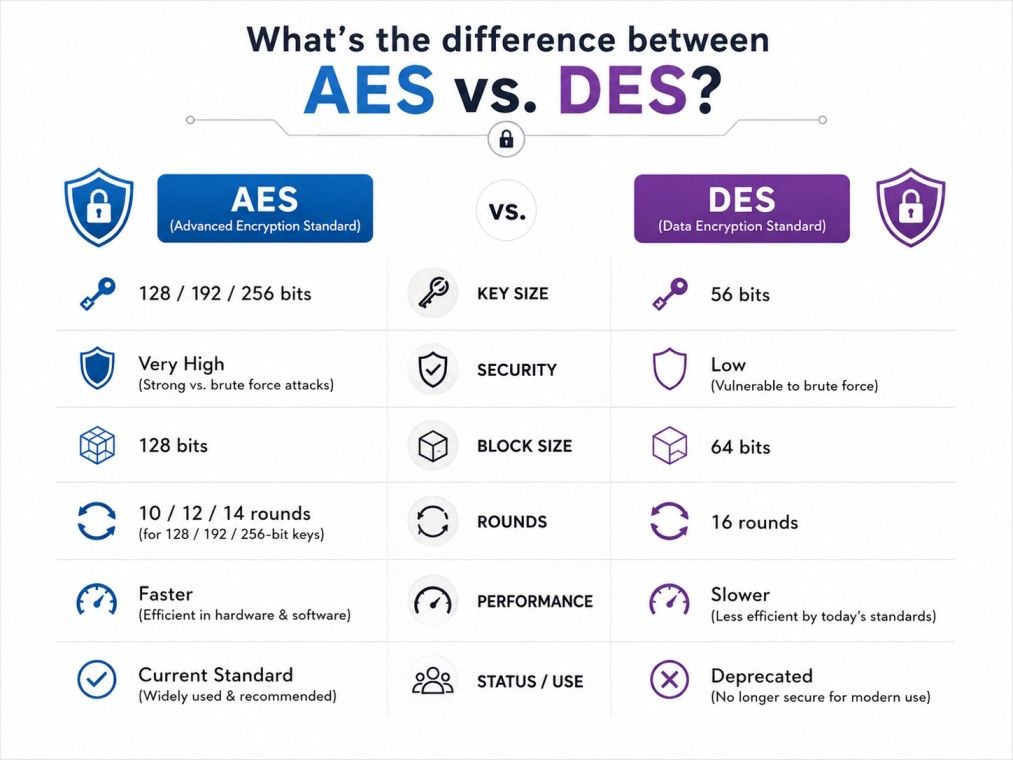
DES, the predecessor to AES, used a 56-bit key, which is now considered far too weak against modern computing power. AES replaced DES because it offers significantly stronger security with better performance.
ChaCha20 is a newer stream cipher that performs well on devices without hardware AES acceleration, such as some mobile processors. AES tends to outperform ChaCha20 on hardware with AES-NI support, but ChaCha20 can be faster on systems without that support.
Twofish was actually one of the finalists in the same competition AES won. It is considered secure and fast, but it never achieved the same level of adoption or hardware optimization as AES.
Yes, AES encryption is considered secure enough for virtually all current applications, including government and military use. No practical attack has been found that can break properly implemented AES encryption, especially AES-256, within a realistic time frame using current technology.
The security of AES depends on the sheer number of possible key combinations. AES-128 alone has 2^128 possible keys, a number so large that brute-forcing it would take longer than the age of the universe with current computing power.
That said, security also depends heavily on correct implementation. Weak key management, poor random number generation, or outdated modes like ECB can undermine even the strongest encryption algorithm.
While AES itself is mathematically strong, real-world implementations can introduce weaknesses.
Developers working with AES often run into a handful of recurring issues. Here is how to resolve them.
This error usually occurs when the ciphertext has been altered, the wrong key is used, or the padding scheme differs between encryption and decryption. Double-check that both sides use the same padding method, such as PKCS7, and confirm the data has not been corrupted in transit.
Key-mismatch errors occur when the decryption key does not match the encryption key. This is often caused by encoding issues, such as mismatched character encoding or incorrect key derivation. Always verify that keys are generated and stored consistently across systems.
Each AES mode requires a specific IV length: 16 bytes for CBC and 12 bytes for GCM. An IV length error typically means the wrong size was used. Check your library's documentation to confirm the expected IV length for your chosen mode.
AES encryption has earned its place as the global standard for protecting digital data. It combines speed, flexibility, and strong security, which is why it powers everything from HTTPS connections to VPNs and cloud storage.
Understanding AES provides valuable insight into the mechanisms that secure digital data. Selecting appropriate key sizes and modes, as well as avoiding common implementation errors, is often more critical than the choice of algorithm itself. The effectiveness of AES depends on its correct application.
Ready to kickstart your career in Data Science but unsure where to begin? Connect with upGrad’s counselors or visit your nearest upGrad career centre for personalized guidance to accelerate your Data Science journey. Don’t wait—take the first step today!
AES stands for Advanced Encryption Standard. It is a symmetric block cipher established by NIST in 2001 to replace the older DES algorithm. Today it is the most widely used encryption standard across industries, from banking to messaging apps.
No practical method currently exists to break properly implemented AES encryption, especially AES-256. The number of possible keys is far too large for brute-force attacks to succeed with current computing technology, even using powerful supercomputers.
Yes, AES is a public algorithm and free for anyone to implement. It is not patented or restricted, which is one reason it has been adopted so widely across software, hardware, and government systems worldwide.
Quantum computers could theoretically weaken AES through algorithms like Grover's algorithm, but this would only reduce AES-256 security to roughly AES-128 level, not break it entirely. AES-256 is currently considered quantum-resistant for the foreseeable future.
Encryption is a broad term for converting readable data into an unreadable format. AES is one specific algorithm used to perform that encryption. Other algorithms like RSA and ChaCha20 also perform encryption, but using different methods.
Multiple rounds increase the complexity of the encryption process, making it significantly harder to reverse-engineer or find patterns in the ciphertext. Each round adds another layer of transformation, which strengthens the overall security of the algorithm.
Yes, many messaging apps use AES as part of their end-to-end encryption systems. It typically works alongside other cryptographic protocols to secure messages, calls, and shared media between users.
Encryption is reversible, meaning encrypted data can be decrypted back to its original form using a key. Hashing is a one-way process that cannot be reversed. AES is an encryption algorithm, not a hashing algorithm.
With current computing technology, cracking AES-256 through brute force would take an amount of time far longer than the age of the universe. This is why AES-256 is trusted for the most sensitive government and military data.
AES is designed to be efficient, and modern processors include hardware acceleration specifically for AES operations. In most cases, the performance impact is minimal and not noticeable to end users.
AES is widely used across banking, healthcare, government, cloud computing, and e-commerce. Any industry handling sensitive personal or financial data typically relies on AES to meet security and compliance requirements.
698 articles published
Sriram K is a Senior SEO Executive with a B.Tech in Information Technology from Dr. M.G.R. Educational and Research Institute, Chennai. With over a decade of experience in digital marketing, he specia...
Speak with Data Science Expert
By submitting, I accept the T&C and
Privacy Policy
Start Your Career in Data Science Today
Top Resources
Executive Diploma
12 Months
Master's Degree
18 Months
Bootcamp
6 Months