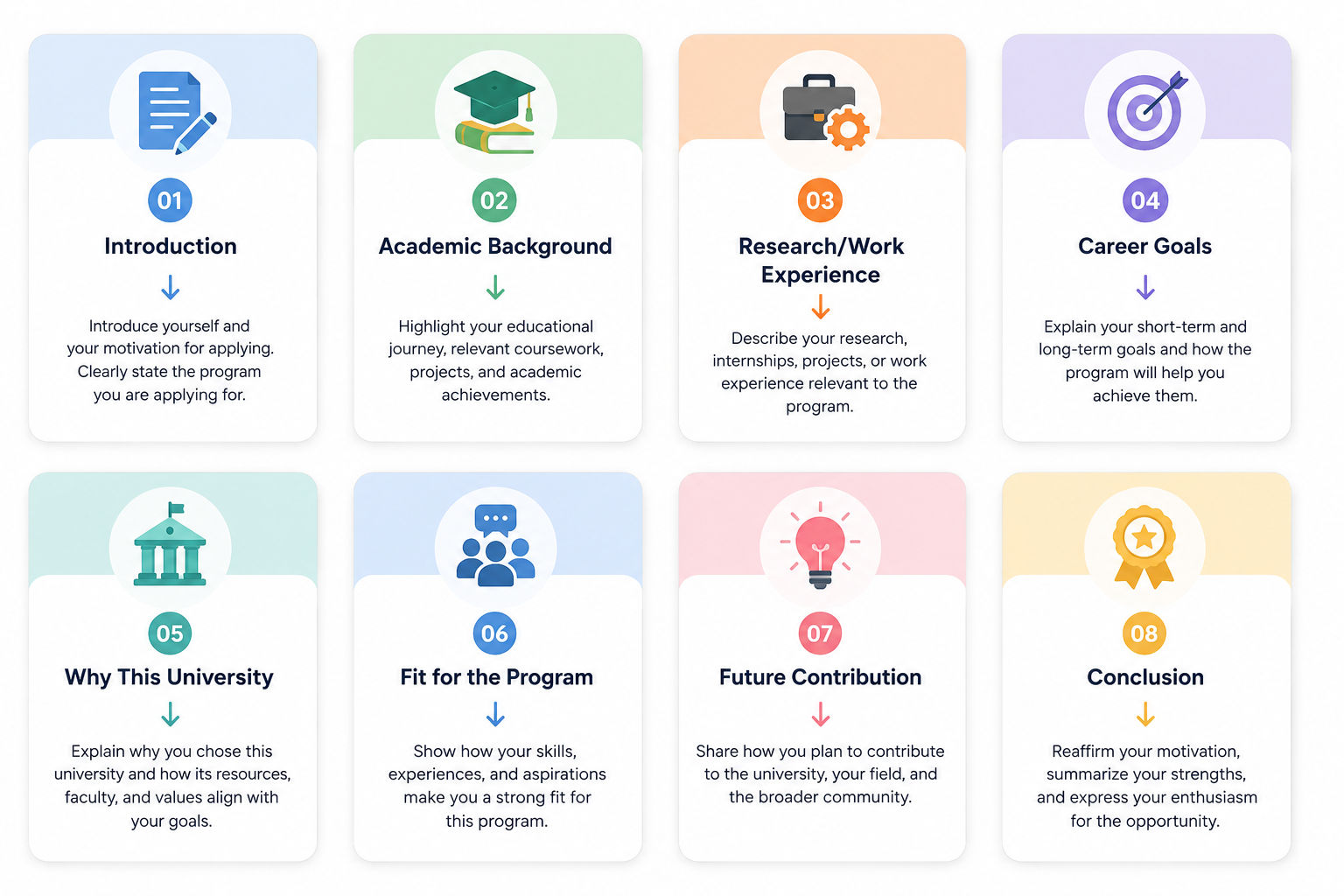
A Statement of Purpose (SOP) is generally organized into 5–7 well-structured paragraphs spread across about two pages. Statement of Purpose format explains your academic and professional background, the reasons for choosing a particular program, and how it aligns with your future career aspirations, giving the admissions committee a clear understanding of your goals and suitability.
Admissions committees evaluate an SOP to understand your academic preparation, research interests, and program fit, not simply your personal story. Most universities expect an SOP to be 500–1,000 words (1–2 pages), written in Times New Roman or Arial (11–12 pt) with 1.5 or double spacing and 1-inch margins for a professional presentation.
Standard Statement of Purpose Format Used by Universities
Most universities follow a widely accepted Statement of Purpose Format to evaluate applicants. While specific requirements may vary by institution, the core expectation is a clear, logical flow that demonstrates academic readiness and program fit.
Universally Accepted SOP Structure:
Introduction: Present your motivation and intended program.
Academic Background: Highlight degrees, coursework, and achievements relevant to the field.
Professional or Research Experience: Showcase internships, projects, or roles that shaped your skills.
Career Goals: Define short-term and long-term objectives.
University and Program Fit: Explain why this institution is the right choice.
Conclusion: Reaffirm your commitment and summarize your strengths.
Core Sections of a Statement of Purpose
A well-written SOP is organized into distinct sections that guide the reader through your academic journey, professional experience, career vision, and program fit. Universities expect applicants to follow this structure because it ensures clarity, logical flow, and easy evaluation by admissions committees. Each section has a specific purpose, and together they create a cohesive narrative that demonstrates why you are an ideal candidate for the program.
1. Introduction Format for a Statement of Purpose
The introduction sets the tone for the entire SOP. It should briefly explain your motivation for pursuing the program, highlight a defining moment or personal interest, and clearly mention the intended field of study. This section provides direction for the rest of the essay and helps admissions committees understand your academic intent from the start.
Key Element
What to Include
Motivation
A personal story, defining moment, or academic interest that led you to the field
Program Mention
Clear reference to the intended program and specialization
Direction
Outline how the introduction connects to the rest of the SOP
2. Academic Background Format in an SOP
This section demonstrates your academic preparedness and establishes credibility. It should highlight your degrees, institutions, relevant coursework, and projects that connect directly to your chosen field. Admissions committees look for evidence of consistent performance and subject-specific achievements that justify your readiness for advanced study.
Key Element
What to Include
Degrees & Institutions
List major qualifications and the universities attended
Relevant Coursework
Mention subjects or modules that align with your intended program
Projects & Research
Highlight academic projects or research work that showcase applied knowledge
Achievements
Awards, honors, or distinctions linked to your chosen field
3. Work Experience and Internship Format in a Statement of Purpose
This section highlights your professional exposure and its relevance to your academic journey. Admissions committees look for practical skills and experiences that complement your academic background. Keep the description concise, focusing on responsibilities, achievements, and how these experiences prepare you for advanced study.
Key Element
What to Include
Roles & Responsibilities
Outline positions held, tasks managed, and scope of work
Skills Gained
Emphasize transferable skills such as research, teamwork, or leadership
Relevance
Connect professional experience to your academic goals and chosen program
Internships/Projects
Highlight specific projects or internships that demonstrate applied learning
4. Career Goals Format in a Statement of Purpose
This section demonstrates your vision and long-term planning. Universities want to see clear, realistic goals that align with the program’s strengths. Keep it concise, showing how short-term objectives connect to long-term ambitions.
Key Element
What to Include
Short Term Goals
Immediate plans after graduation, such as roles, research, or further study
Long-Term Vision
Broader professional aspirations, leadership positions, or contributions to the field
Program Alignment
How the chosen program supports and enables these goals
Realism & Clarity
Goals should be achievable, specific, and logically connected
5. University and Program Fit Format in an SOP
This section explains why you selected a particular institution and program. Admissions committees expect applicants to demonstrate genuine alignment rather than generic praise. Be specific about what attracts you to the university and how it supports your academic and career goals.
Key Element
What to Include
Specific Courses/Faculty
Mention modules, professors, or research areas that match your interests
Institutional Strengths
Highlight unique resources such as labs, centers, or collaborations
Mutual Fit
Show how your background and goals align with the university’s offerings
Avoid Generic Statements
Replace broad claims (“top university”) with tailored, evidence-based reasons
6. Conclusion Format for a Statement of Purpose
The conclusion is your final opportunity to leave a strong impression. It should reinforce your motivation, summarize what you bring to the program, and end with a confident, forward-looking statement. Keep it concise and impactful, avoiding repetition of earlier sections.
Key Element
What to Include
Reaffirm Motivation
Restate your enthusiasm and commitment to the field
Highlight Strengths
Summarize unique qualities, skills, or experiences you contribute
Forward-looking Intent
End with a clear, confident statement about readiness for the program
Concise Closure
Keep the conclusion brief, professional, and memorable
Statement of Purpose Requirements at Top Global Universities
Top universities around the world publish clear Statement of Purpose format guidelines to help applicants present their academic journey, professional exposure, and career vision effectively. While the structure is broadly similar, each institution emphasizes different aspects such as research interests, career goals, or intellectual motivation.
Comparing these requirements side by side helps applicants tailor their SOPs to meet specific expectations.
Demonstrate academic readiness, professional exposure, and alignment with program strengths; clarity and conciseness emphasized.
Statement of Purpose Sample Format Used by Top Universities
A well-structured Statement of Purpose helps admissions committees quickly understand your academic journey, research interests, career aspirations, and overall suitability for the program. While every university may have slightly different guidelines, most top institutions follow a similar format that presents information in a clear, logical, and professional manner.
The sample below illustrates the standard Statement of Purpose sample format structure commonly accepted by leading universities worldwide.
Introduction & Motivation My interest in Data Science began during my undergraduate studies when I worked on a predictive analytics project that demonstrated how data can solve real-world business problems. This experience inspired me to pursue advanced studies in Data Science and build a career in analytics.
Academic Background I completed my Bachelors degree in Computer Science, where I developed a strong foundation in programming, statistics, database management, and machine learning. My final-year research project focused on customer churn prediction using classification algorithms.
Professional Experience As a Data Analyst Intern, I worked with large datasets, built dashboards using Power BI, and supported business decisions through data visualization and predictive modelling. This experience strengthened both my technical and analytical skills.
Extracurricular Activities & Skills Apart from academics, I actively participated in hackathons and coding competitions, which improved my problem-solving, teamwork, and communication abilities.
Why This Course & University? I am particularly interested in this program because of its strong focus on machine learning, big data, and applied research. The opportunity to work with faculty members researching Artificial Intelligence and Business Analytics aligns perfectly with my academic interests.
Career Goals In the short term, I aim to work as a Data Scientist in the technology sector. In the long term, I aspire to lead AI-driven research projects that solve large-scale business and social challenges.
Conclusion
With my academic background, practical experience, and passion for data-driven innovation, I am confident that I can contribute meaningfully to the university's academic community while making the most of the learning and research opportunities offered by the program.
Note: This is a reference format only. Always customize your Statement of Purpose according to your academic background, career goals, and the specific university and program you are applying to.
Country-Wise Statement of Purpose Requirements for Study Abroad
Statement of Purpose requirements vary by country, even though the overall structure remains similar. Universities in different study abroad destinations emphasise different elements such as academic background, research intent, professional experience, or career goals. Understanding these country-specific expectations helps applicants align their SOP format with what universities and admissions committees prioritise.
1. Statement of Purpose Requirements in the United States
SOP for USA universities emphasizes research interests, academic preparation, and professional exposure. Graduate programs expect clarity in career goals and alignment with long-term objectives.
Focus Area
What US Universities Expect
Academic Background
Relevant coursework, grades, and academic preparation
Research Interests
Clear research direction for research-based programs
Professional Experience
Internships, work experience, and applied skills
Career Goals
Specific short-term and long-term objectives aligned with the program
SOP Length
Typically, 500–1,000 words, program specific guidelines apply
2. Statement of Purpose Requirements in the United Kingdom
SOP for UK universities focuses on intellectual motivation, suitability for the program, and research proposals. Applicants should demonstrate subject knowledge and readiness for advanced study.
Focus Area
What UK Universities Expect
Academic Preparedness
Strong subject knowledge and relevant coursework
Research Proposal
Detailed outline of study areas and methodology
Career Goals
Clear alignment with chosen program and future objectives
Suitability
Evidence of fit with institution and program culture
SOP Length
Usually 600–1,000 words, depending on program guidelines
3. Statement of Purpose Requirements in Canada
SOP for Canada universities balances academic background, research interests, and career goals. Programs often provide specific prompts, so following instructions is crucial for success.
Focus Area
What Canadian Universities Expect
Academic Background
Relevant coursework and grades
Research Interests
Alignment with faculty expertise and program strengths
Professional Exposure
Internships, projects, or work experience
Career Goals
Short-term and long-term objectives tied to Canadian opportunities
SOP Length
Typically 700–1,000 words, program-specific requirements apply
4. Statement of Purpose Requirements in Australia
SOP for Australia universities highlights academic readiness, professional exposure, and program fit. Applicants must present concise career goals aligned with Australian industry or research opportunities.
Focus Area
What Australian Universities Expect
Academic Readiness
Strong subject knowledge and academic preparation
Professional Exposure
Work experience, internships, or practical projects
Program Fit
Clear explanation of why the chosen program suits your goals
Career Goals
Defined objectives linked to Australian industry or research opportunities
SOP Length
Usually 600–800 words, depending on program requirements
5. Statement of Purpose Requirements in India
SOP for India universities highlights academic achievements, subject strengths, and career goals. Applicants must show clear motivation for their chosen field and align their SOP with program expectations.
Focus Area
What Indian Universities Expect
Academic Achievements
Strong grades, subject strengths, and relevant coursework
Motivation
Clear reasons for choosing the field of study
Career Goals
Short-term and long-term objectives aligned with program
Program Fit
Evidence of suitability for the institution and course
SOP Length
Typically 500–800 words, depending on program guidelines
Formatting Guidelines for a Statement of Purpose
Universities expect SOPs to follow clear formatting rules to ensure professionalism and readability. While requirements vary slightly, most institutions provide similar technical guidelines.
Formatting Aspect
Standard Expectation
Length
1–2 pages, approx. 800–1000 words
Font & Size
Times New Roman or Arial, 11–12 pt
Spacing & Margins
Double-spaced, 1-inch margins
Paragraphs
5–8, each with a distinct focus
File Format
PDF or Word document, depending on university instructions
Tone
Formal, clear, concise, and authentic
Statement of Purpose Format for Different Levels of Study
The structure of an SOP varies depending on the level of study. While the core elements remain consistent, the emphasis shifts to reflect the applicant’s stage of academic and professional development.
1. Undergraduate SOP Format
Undergraduate SOPs emphasize academic interests, extracurricular activities, and personal motivation. Since professional exposure is limited, the focus should be on intellectual curiosity and potential.
Key Element
What to Include
Academic Interests
Subjects or fields that sparked your curiosity
Extracurriculars
Activities that demonstrate leadership, teamwork, or creativity
Personal Motivation
A defining moment or inspiration for choosing the program
Future Direction
How undergraduate study will shape your academic journey
2. Postgraduate SOP Format
Postgraduate SOPs like SOP for Master's or SOPs for MS highlight academic background, internships, and career goals. The emphasis is on readiness for advanced study and clarity of professional vision.
Key Element
What to Include
Academic Background
Degrees, coursework, and projects relevant to the field
Professional Exposure
Internships, roles, or projects that add practical skills
Career Goals
Short-term and long-term objectives are aligned with the program
Program Fit
Specific courses or faculty that support your academic and career plans
3. Research SOP Format
Research SOPs require a detailed discussion of prior research, methodologies, and alignment with faculty or labs. Applicants must clearly articulate research objectives and demonstrate scholarly potential.
Key Element
What to Include
Prior Research
Projects, publications, or theses showcasing research experience
Methodologies
Techniques or approaches mastered during past work
Research Objectives
Clear articulation of intended research questions or goals
Faculty/Lab Alignment
Specific professors, labs, or resources that match your research interests
Common Mistakes in SOP Formatting
Even strong applicants sometimes lose impact because of formatting errors. These mistakes make SOPs harder to read and can leave a poor impression on admissions committees. Recognizing and correcting them ensures your statement looks polished and professional.
Mistake
Why It Hurts
Correction
Exceeding Word Limit
Makes the SOP appear unfocused and careless.
Keep within 800–1000 words or the program’s specified limit.
Generic Language
Fails to show individuality or program fit.
Use specific examples and tailor content to the university.
Poor Structure
Random flow confuses the reader.
Organize into clear sections: intro, academics, experience, goals, fit, and conclusion.
Makes the SOP inaccessible to non-specialist readers.
Use simple, precise language while explaining technical terms briefly.
Conclusion
A well-structured SOP is not about impressing the admissions committee with big words, it's about presenting a clear academic journey, focused goals, and genuine motivation. Taking time to personalize every application can significantly improve your chances of admission.
What is the difference between a Statement of Purpose and a Personal Statement?
A Statement of Purpose is academic and career oriented, showing your goals and how the program fits them. A Personal Statement is more about your personality, values, and life journey. Think of the SOP as your professional roadmap, while the Personal Statement is your personal story. Both can complement each other when required.
What is the format of a statement of purpose?
A standard statement of purpose format usually follows a structured layout that includes an introduction, academic background, professional or research experience, career goals, reasons for choosing the university, and a conclusion. Most universities expect it to be 800–1,000 words, written in a clear, logical, and professional manner.
How long should a Statement of Purpose be for graduate school?
Most universities expect an SOP to be between 800 and 1,000 words, although some programs specify different limits. Staying within the recommended word count helps keep your statement focused and demonstrates your ability to communicate effectively.
Can I use the same SOP for multiple universities?
You can use the same overall structure, but every SOP should be customized for the university and program you are applying to. Mentioning specific courses, faculty members, or research opportunities shows genuine interest and significantly improves your application.
What is the best SOP format?
The graduate school statement of purpose format generally follows a logical structure that includes an introduction, academic background, professional or research experience, career goals, reasons for choosing the university, and a concise conclusion. Keeping the content well-organized, personalized, and easy to read helps create a stronger impression on the admissions committee.
Should I mention weaknesses in my SOP?
Yes, but only when necessary. Briefly explain any academic gaps or challenges while focusing on how you overcame them and what you learned. Presenting challenges as opportunities for growth demonstrates resilience and maturity.
How do I write my SOP?
Begin by understanding the university's requirements and researching the program thoroughly. Structure your SOP around your academic journey, research or professional experience, career goals, and reasons for choosing the university. Use specific examples, maintain a formal tone, and revise your draft multiple times before submission.
How important is proofreading for an SOP?
Proofreading is essential because grammar mistakes, spelling errors, and poor sentence structure can negatively impact your application. Reviewing your SOP multiple times and getting feedback from mentors or professors helps ensure it is polished and professional.
Can I mention extracurricular activities in my SOP?
Yes, especially for international applications. Briefly mention how the country’s academic culture, opportunities, or industry connections align with your goals. Keep it concise and relevant, showing that your choice is intentional and well researched.
Can I reuse parts of my SOP for scholarship applications?
Yes, provided they strengthen your application. Highlight activities that demonstrate leadership, teamwork, communication, volunteering, or problem-solving skills, especially if they complement your academic background or support your career aspirations.
Akansha Semwal is a content marketer at upGrad and has also worked as a social media marketer & sub-editor. Experienced in creating impressive Statement of Purpose, Essays, and LOR, she knows how to c...
Pragya Sharma is a content developer and marketer with 6.5+ years of experience in the education industry. She started her career as a social media copywriter for NIELIT, Ministry of Electronics & IT,...
Get Your Free SOP Samples Now
Refer Your Friend & Earn upto ₹15000
Help your friend upgrade to a Global Career and earn rewards together.