SQL Median: How to Calculate Median in SQL With Practical Examples
By Sriram
Updated on Jun 27, 2026 | 7 min read | 2.31K+ views
Share:

All courses
Certifications
More
By Sriram
Updated on Jun 27, 2026 | 7 min read | 2.31K+ views
Share:
Table of Contents
Median in SQL calculating depends entirely on your database system, there's no universal MEDIAN () function in standard SQL. Some platforms, like Oracle and Snowflake, have done the work for you - MEDIAN () is built right in. But if you're working in SQL Server, PostgreSQL, or MySQL, you'll need to roll up your sleeves a bit. That means leaning on window functions or writing out the logic yourself to locate that middle value.
In this blog, you’ll learn what SQL median is, why it matters, and how to calculate the SQL median using methods. We will talk about databases such as PostgreSQL, MySQL, SQL Server, and Oracle. Explain when you can use a SQL median function and give you examples that you can use in your projects.
Write SQL that analysts trust. Learn median calculations, window functions, and more with upGrad's expert-led Data Science Courses.
Popular Data Science Programs
The median in SQL is the number when values are arranged in order. The median is not affected much by high or very low numbers. This makes the median a good way to find the middle of real-world data sets unlike the average.
For example, consider employee salaries:
Employee |
Salary |
| A | 30,000 |
| B | 35,000 |
| C | 38,000 |
| D | 42,000 |
| E | 300,000 |
The average salary is really affected by the salary. The median salary is 38,000, which's a better idea of what most employees actually earn.
often like to use the SQL median when they are working with business data or healthcare data or finance data or customer data.
Also Read: Measure of Central Tendency: Mean, Median, and Mode
The median is a way to understand a set of data than the average. This is because the median does not take into account the extreme outliers in a dataset. So, the median gives us an idea of what the data is like.
The SQL median helps answer questions such as:
Feature |
Median |
Average |
| Represents | Middle value | Sum divided by count |
| Sensitive to outliers | No | Yes |
| Best for skewed data | Yes | No |
| Built-in SQL support | Depends on database | Yes |
Suppose a retail store records these daily sales:
120
130
135
140
145
150
5000
The average becomes much higher because of the single exceptional sale. The SQL median remains 140, giving a more realistic picture of a normal day.
Also Read: SQL Tutorials : Complete Learning Guide
This is where SQL becomes interesting. Not every database includes a dedicated SQL median function. The support we give depends on the kind of database engine that the user is working with.
Database |
Built-in Median Support |
| PostgreSQL | Yes (PERCENTILE_CONT) |
| Oracle | Yes (MEDIAN () and PERCENTILE_CONT) |
| SQL Server | Uses PERCENTILE_CONT () |
| MySQL 8+ | No direct median function |
MySQL does not have a built-in function to calculate the median. You can still find the median of a list of numbers. You can use functions like ROW_NUMBER to do this. You can use LIMIT and OFFSET together.
This can be confusing for people who're new to MySQL. This is because you can use functions like SUM and COUNT, and AVG in databases. If you want to calculate the median in SQL, you have to do it in a way that is specific to the database you are using, such as MySQL.
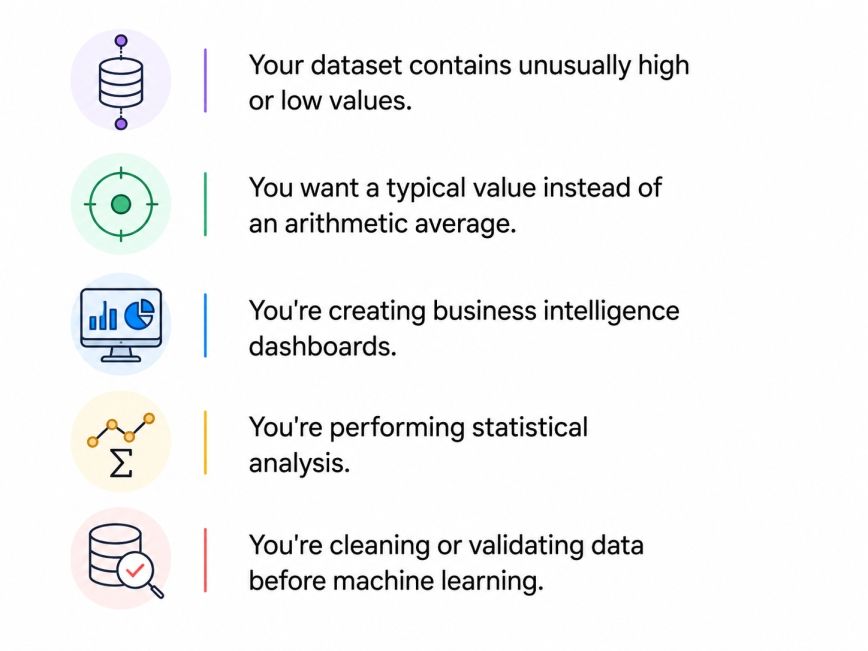
For example, a data analyst who is looking at home prices can use the SQL median instead of the average. This is because home prices can be affected by luxury properties.
You should consider using the SQL median when:
Assume you have the following table:
CREATE TABLE Employees (
EmployeeID INT,
EmployeeName VARCHAR(50),
Salary INT
);
Sample data:
EmployeeID |
EmployeeName |
Salary |
| 1 | Alice | 35000 |
| 2 | Bob | 42000 |
| 3 | Chris | 47000 |
| 4 | Diana | 51000 |
| 5 | Ethan | 62000 |
After sorting the salaries, I found that the middle value is 47,000. This value is what we call the SQL median.
When we have a lot of data, it is hard to find the value by hand. That's why we use SQL queries and a special SQL median function if it is available to help us analyze the data accurately and quickly.
Also Read: SQL Server Architecture: Core Components, Data Management, and Practical Uses
Free Courses
There is no SQL query that works for all databases to find the median. Some databases have a built-in function, but others need special tricks.
The good news is that all modern SQL databases can help you find the median. You just need to use the method for your database.
PostgreSQL does not have a MEDIAN function. PostgreSQL supports PERCENTILE_CONT, which is the way to calculate the median of the PostgreSQL data.
Example:
SELECT
   PERCENTILE_CONT(0.5)
   WITHIN GROUP (ORDER BY Salary) AS MedianSalary
FROM Employees;
How it works:
This approach is simple, accurate, and performs well on large datasets.
SQL Server also supports PERCENTILE_CONT () as an analytic function.
SELECT DISTINCT
   PERCENTILE_CONT (0.5)
   WITHIN GROUP (ORDER BY Salary)
   OVER () AS MedianSalary
FROM Employees;
Notice the use of the OVER () clause. This is different from PostgreSQL because SQL Server sees PERCENTILE_CONT () as a window function.
This query gives us the median salary for the entire table.
Oracle provides two common options. The first is the dedicated MEDIAN () aggregate function.
SELECT MEDIAN(Salary) AS MedianSalary
FROM Employees;
Oracle also supports PERCENTILE_CONT() if you need more flexibility.
SELECT
   PERCENTILE_CONT(0.5)
   WITHIN GROUP (ORDER BY Salary) AS MedianSalary
FROM Employees;
When we are working with numbers, MEDIAN is a choice because it is easy to understand. On the other hand, PERCENTILE_CONT is useful when we want to calculate other percentiles at the same time, as the MEDIAN.
MySQL does not have a built-in SQL function to find the median. To find the median, you can use window functions that were added to MySQL version 8.0.
WITH RankedData AS (
   SELECT
       Salary,
       ROW_NUMBER() OVER (ORDER BY Salary) AS RowNum,
       COUNT(*) OVER () AS TotalRows
   FROM Employees
)
SELECT AVG(Salary) AS MedianSalary
FROM RankedData
WHERE RowNum IN (
   FLOOR((TotalRows + 1) / 2),
   FLOOR((TotalRows + 2) / 2)
);
This solution works for both odd and even numbers of rows.
The query:
This query may look a bit longer than the ones that are already built in. The thing is it is really widely used in a lot of MySQL projects. People use this MySQL query all the time.
Also Read: Components of SQL: What They Are and How They Work
Database |
Recommended Method |
Built-in Support |
Difficulty |
| PostgreSQL | PERCENTILE_CONT() | Yes | Easy |
| SQL Server | PERCENTILE_CONT() | Yes | Easy |
| Oracle | MEDIAN() | Yes | Very Easy |
| Oracle | PERCENTILE_CONT() | Yes | Easy |
| MySQL 8+ | Window Functions | No | Moderate |
The calculation of the number's changes depending on how many rows are available.
Consider this dataset:
Salary |
30,000 |
35,000 |
42,000 |
50,000 |
55,000 |
There are five values, so the middle value is 42,000.
Now consider another dataset.
Salary |
30,000 |
35,000 |
42,000 |
50,000 |
55,000 |
60,000 |
There are six values. The two middle values are 42,000 and 50,000.
The median becomes:
(42,000 + 50,000) ÷ 2 = 46,000 Functions, like PERCENTILE_CONT () do this automatically. When you write your query, ensure it handles both cases properly.
Data Science Courses to upskill
Explore Data Science Courses for Career Progression
IIIT Bangalore
Executive Post Graduate Certificate in Data Science & AIPlacement Assistance
A small mistake in your query can give you information especially when you are working with big business data. It is good to check your logic to make sure your results make sense and are correct.
The SQL median can be tricky. Here are a few mistakes that people make when they are working with the SQL median that you should try to avoid:
Also Read: Top 20 Essential SQL Tools for Data Analysts and Engineers
When the database you are using has a SQL median function or PERCENTILE_CONT () it is a good idea to use this function. This is because built-in functions are simple to understand. They also have errors. Usually, the database engine can optimize them better.
If the database you are using does not have support, you should use window functions. Do not use the methods that have nested subqueries. Window functions are easy to read and understand. They are also easy to maintain. On SQL systems, they usually work better. The database you are using will be able to handle window functions in an efficient way.
Understanding the SQL median helps you analyze data more accurately, especially when outliers can distort averages. While some databases provide a built-in SQL median function, others require window functions or custom queries. By choosing the right approach for your database, you can calculate reliable median values and make better data-driven decisions. Either way, knowing which approach fits your setup means you can trust your results and make decisions that are grounded in what the data is actually telling you.
Want to explore more about management accounting? Book your free 1:1 personal consultation with our expert today.
You can find the SQL median by using database-specific functions or window functions. PostgreSQL and SQL Server support PERCENTILE_CONT(), while Oracle offers the MEDIAN() function. In MySQL, you can calculate the median using ROW_NUMBER(), COUNT(), and AVG() to identify and average the middle value or values.
The median is the middle value in a sorted dataset, while the mode is the value that appears most frequently. SQL provides built-in support for calculating the median in some databases, but mode usually requires grouping data with GROUP BY and COUNT() before selecting the most frequent value.
There is no universal SQL median function available across all database systems. Oracle includes a MEDIAN() function, while PostgreSQL and SQL Server use PERCENTILE_CONT(). MySQL does not provide a native median function, so developers typically calculate it using window functions and custom SQL queries.
The SQL median is less affected by extremely high or low values than the average. This makes it a better measure of central tendency when analyzing salaries, property prices, customer spending, or any dataset with significant outliers that could distort the overall average.
Yes. You can calculate the SQL median for each category by combining GROUP BY with window functions or percentile functions, depending on your database. This is useful when comparing median sales, salaries, or scores across different departments, regions, or product categories.
No. MySQL does not include a built-in SQL median function. Instead, you can calculate the median using window functions such as ROW_NUMBER() and COUNT() in MySQL 8.0 or later. Older versions often require more complex subqueries to achieve the same result.
MEDIAN() directly returns the median value, making it simple to use where supported. PERCENTILE_CONT() calculates any percentile, including the 50th percentile used for the median. It also interpolates values when the dataset contains an even number of records, offering greater flexibility.
Yes. Most SQL databases automatically exclude NULL values from percentile and median calculations. However, it's still a good practice to verify your query logic or explicitly filter unwanted values to ensure accurate and consistent results in your analysis.
Absolutely. The SQL median is widely used in business intelligence, financial reporting, healthcare analytics, and customer behavior analysis. It provides a more representative value than the average when datasets contain extreme values, helping analysts make more reliable and informed decisions.
Median calculations require sorting data, so they can be more resource-intensive than simple aggregate functions like AVG(). Using indexes where appropriate, filtering unnecessary rows, and relying on built-in percentile functions can improve query performance on large datasets.
Support varies by database. Oracle provides a native MEDIAN() function, while PostgreSQL and SQL Server use PERCENTILE_CONT() to calculate the median. MySQL does not have a built-in SQL median function, so developers typically rely on window functions or custom SQL logic.
730 articles published
Sriram K is a Senior SEO Executive with a B.Tech in Information Technology from Dr. M.G.R. Educational and Research Institute, Chennai. With over a decade of experience in digital marketing, he specia...
Speak with Data Science Expert
By submitting, I accept the T&C and
Privacy Policy
Start Your Career in Data Science Today
Top Resources
Executive Diploma
12 Months
Master's Degree
18 Months
Bootcamp
6 Months