Salesforce Marketing Cloud: Features, Modules, Benefits, and How It Works
By upGrad
Updated on Jul 08, 2026 | 7 min read | 1.97K+ views
Share:

All courses
Certifications
More
By upGrad
Updated on Jul 08, 2026 | 7 min read | 1.97K+ views
Share:
Table of Contents
Key takeaway
This blog breaks down every module, explains the architecture in plain language, and tells you exactly who should use it and who shouldn't bother.
Explore upGrad's Digital Marketing programs to build practical skills in SEO, social media marketing, performance marketing, content marketing, email marketing, web analytics, marketing automation, and AI-powered marketing. Work on industry projects, live campaigns, and real-world case studies to gain hands-on experience and prepare for high-growth careers in digital marketing.
Salesforce Marketing Cloud is a digital marketing platform developed by Salesforce that helps businesses create, automate, manage, and measure marketing campaigns across multiple communication channels. Companies use it to build, automate, and track marketing campaigns across multiple channels.
It didn't start out this way. Salesforce acquired a company called ExactTarget back in 2013, and that acquisition became the foundation of what we now call Marketing Cloud. Over the years, Salesforce kept adding modules. Today it's a full suite rather than a single tool.
Here's the simple version. You collect customer data. You segment that data into groups. You build a journey for each group. Then you send emails, texts, ads, and app notifications based on what each customer does.
Why do businesses bother with all this? A few reasons that happen.
Small teams sometimes find the platform heavier than they need.
Also read: Top 10 Email Marketing Tools Successful Email Marketing Experts Use
Free Courses
The workflow follows a logical sequence, even though it looks complicated from the outside.
First, customer data comes in from your website, app, CRM, or point of sale system. This data lands in Contact Builder, the module responsible for building a unified customer profile.
Next comes segmentation. You group customers based on behavior, purchase history, or demographics. A retail brand might separate first time buyers from repeat customers. A bank might separate people who abandoned a loan application from those who completed one.
After segmentation, you build the journey inside Journey Builder. This is where you map out what happens next. Does the customer get an email today and a text tomorrow? Does a discount trigger if they don't open the first message?
Once the journey is live, messages go out through Email Studio, Mobile Studio, or Advertising Studio depending on the channel you picked. Analytics then tracks opens, clicks, conversions, and drop off points.
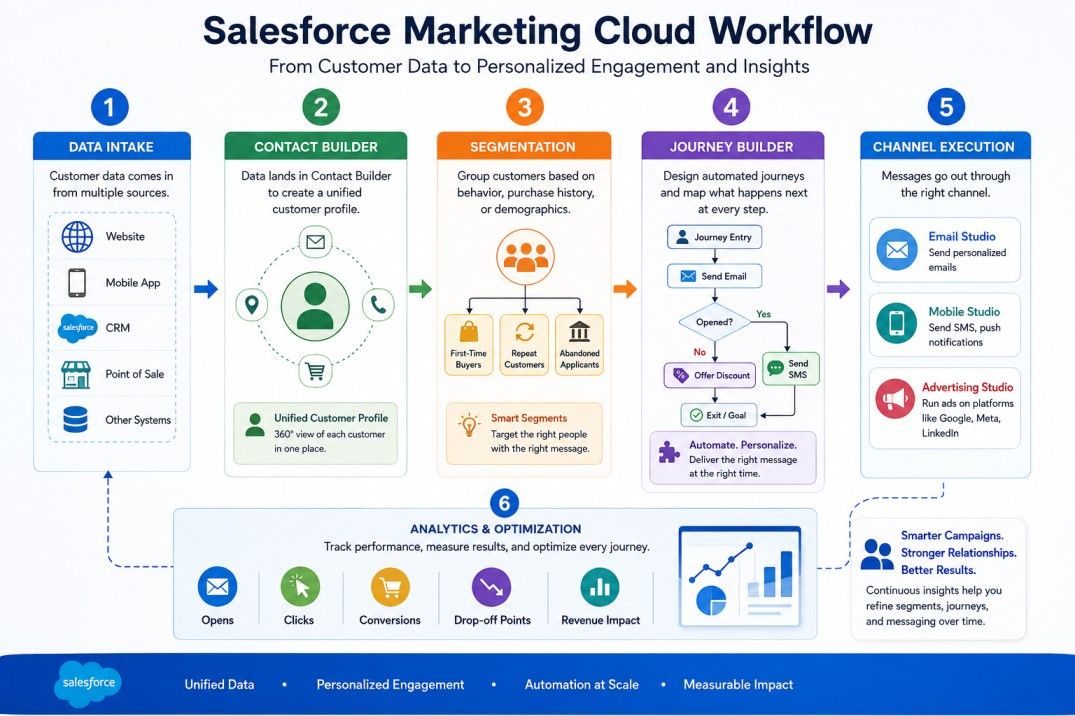
The whole point is automation without losing the personal touch. That's easier said than done, and plenty of teams struggle with journey design early on. Getting the sequencing wrong is common, and it's one of the biggest reasons campaigns underperform.
Do read: Top 20 Most Popular Salesforce Interview Questions & Answers [For Freshers & Experienced]
Digital Marketing Courses to upskill
Explore Digital Marketing Courses for Career Progression
MICA Executive Alumni Status
Understanding the underlying structure of Salesforce Marketing Cloud helps you see why the platform behaves the way it does.
There are five layers worth knowing.
Layer |
What It Does |
| Data Layer | Stores and organizes customer information |
| Engagement Layer | Delivers messages across channels |
| Automation Layer | Runs scheduled and triggered workflows |
| Intelligence Layer | Handles analytics and reporting |
| Integration Layer | Connects with CRM and third party tools |
The data layer sits at the bottom because everything else depends on it. If your customer data is messy, every layer above it inherits that mess. That's not unique to this platform. It's true of any marketing system.
The integration layer deserves a mention too. It connects with Sales Cloud, Service Cloud, and external systems through APIs. This is what lets a support ticket in Service Cloud trigger a follow up email automatically.
Must read: Social Media Analytics: What It Is, How It Works, and Why It Matters
This is where most of the actual work in Salesforce Marketing Cloud happens. Each module handles a specific job.
Module |
Purpose |
| Email Studio | Email campaigns and newsletters |
| Journey Builder | Automated customer journeys |
| Contact Builder | Unified customer profiles |
| Advertising Studio | Paid social and display ads |
| Mobile Studio | SMS and push notifications |
| Automation Studio | Scheduled data and workflow tasks |
Salesforce Marketing Cloud Email Studio is the module most teams touch first. Email Studio in Salesforce Marketing Cloud is designed for creating, sending, and optimizing email marketing campaigns. It's used for building templates, running A/B tests, and sending campaigns at scale.
You can personalize subject lines, insert dynamic content blocks, and schedule sends based on time zone. It's the workhorse of the whole suite.
Salesforce Marketing Cloud Journey Builder maps the customer path visually. Drag a trigger, add a wait step, insert a decision split. It sounds simple until you're managing twenty active journeys at once, and that's when things get messy without proper naming conventions.
Salesforce Marketing Cloud Contact Builder merges data from multiple sources into a single profile per customer. Think of it as the address book that every other module reads from.
Do read: How to Create Social Media Content Strategy? Everything You Need to Know
Salesforce Marketing Cloud Data Extensions are flexible tables used to store customer information within Salesforce Marketing Cloud. Unlike standard contact lists, they allow businesses to organize large amounts of structured data based on their own business requirements.
This structure makes it easier to build highly targeted audience segments for personalized campaigns.
Must read: Social Media Marketing Free Online Course with Certification [2026]
Advertising studio salesforce marketing cloud syncs your customer segments with Facebook, Google, and other ad platforms. Instead of running blind ad campaigns, you retarget people based on actual behavior inside your business.
Launching campaigns and understanding their performance is equally important. Salesforce Marketing Cloud Analytics and reporting includes reporting tools that help marketers monitor campaign effectiveness and customer engagement.
Together, Email Studio, Journey Builder, Contact Builder, Data Extensions, and Analytics form the foundation of Salesforce Marketing Cloud. Each module performs a specific function, but their real value comes from working together to deliver personalized customer experiences backed by data and measurable results.
Explore upGrad's MICA Advanced Certificate in AI-Powered Digital Marketing & Communication to master SEO, performance marketing, social media marketing, content marketing, email marketing, web analytics, branding, and AI-powered marketing. Gain hands-on experience through live campaigns, real-world case studies, industry projects, and specialized learning tracks to build job-ready skills for today's digital marketing landscape.
Salesforce Marketing Cloud isn't built for every business. It's genuinely built for a specific type of company.
Business Type |
Fit |
Reason |
| Enterprise brands | ✓ Good Fit | High-volume marketing |
| B2C omnichannel businesses | ✓ Good Fit | Multi-channel engagement |
| Existing Salesforce users | ✓ Good Fit | Native integration |
| Solo entrepreneurs | ✗ Not Ideal | Too advanced for simple needs |
| Small customer databases | ✗ Not Ideal | Better suited to basic tools |
| Teams without marketing support | ✗ Not Ideal | Requires ongoing management |
If you're a small business owner running a single email newsletter, this is probably overkill. The cost and learning curve won't pay off at that scale.
The demand for skilled Salesforce Marketing Cloud professionals has grown steadily. Salesforce marketing cloud jobs range from email specialists to full journey architects, and salaries vary widely based on experience and region.
If you're considering a career move, salesforce marketing cloud certification is worth looking into. Salesforce offers specific credentials like the Marketing Cloud Administrator and Marketing Cloud Email Specialist certifications. These credentials signal to employers that you understand the platform beyond the basics.
Certification isn't mandatory for every role, but it does open doors faster, especially if you're new to the ecosystem.
Must read: Salesforce Apex Interview Questions
Why do enterprises pay for Salesforce Marketing Cloud instead of stitching together cheaper tools? A few reasons stand out.
You need clean data and a team that understands how to build journeys. Without that, even the best platform underperforms.
Salesforce Marketing Cloud brings customer data, automation, and multichannel messaging into one platform. It works best for larger teams managing complex customer journeys across email, mobile, and advertising.
The modules, from Email Studio to Journey Builder, each solve a specific piece of the puzzle. Together, they let marketing teams personalize at a scale that manual work simply can't match. Choosing this platform comes down to your business size, your data maturity, and whether you have the team to run it properly.
Ready to start your journey? Book a free consultation with upGrad today to find the best path for your career.
Traditional email platforms mainly focus on sending newsletters and promotional emails. Salesforce Marketing Cloud combines email, SMS, advertising, automation, customer data, and analytics in one platform. This allows businesses to create connected customer journeys instead of running separate campaigns across multiple tools.
Email Studio in Salesforce Marketing Cloud is designed for creating, personalizing, testing, and sending email campaigns at scale. It supports dynamic content, audience segmentation, A/B testing, and automated delivery, making it suitable for businesses that want more than basic email marketing capabilities.
Advertising Studio Salesforce Marketing Cloud helps marketers sync customer audiences with advertising platforms like Google and Meta. Instead of targeting broad audiences, businesses can retarget existing customers or create lookalike audiences using real customer data, leading to more relevant and efficient advertising campaigns.
Most day-to-day marketing activities don't require programming knowledge. Marketers can build emails, customer journeys, and audience segments using visual tools. However, learning SQL, AMPscript, or HTML can help when creating advanced personalization, custom reports, or more sophisticated campaign workflows.
For newcomers, the Salesforce Marketing Cloud Email Specialist certification is often the best starting point because it focuses on email marketing fundamentals and campaign execution. After gaining practical experience, professionals can progress to Administrator, Consultant, or Developer certifications depending on their career goals.
There are many Salesforce Marketing Cloud jobs, including Marketing Cloud Administrator, Email Marketing Specialist, CRM Campaign Manager, Marketing Automation Consultant, Journey Builder Specialist, and Marketing Cloud Developer. The right role depends on whether your strengths lie in marketing strategy, campaign execution, analytics, or technical development.
Yes. Although it's widely known for B2C customer engagement, Salesforce Marketing Cloud also supports B2B organizations through personalized lead nurturing, customer onboarding, event communications, and account-based marketing. The campaign strategy changes, but the automation and personalization capabilities remain valuable for both business models.
Businesses should evaluate the size of their customer database, marketing goals, available resources, and existing technology stack. Salesforce Marketing Cloud delivers the most value when organizations have reliable customer data, defined marketing processes, and a team capable of managing ongoing campaign optimization.
Learning the basics usually takes a few weeks, while becoming proficient can take several months of hands-on practice. Building customer journeys, managing Email Studio in Salesforce Marketing Cloud, understanding data models, and analyzing campaign performance all require practical experience beyond theoretical learning.
Yes. Salesforce continues to add AI capabilities that help marketers personalize content, recommend products, predict customer behavior, and improve campaign performance. These features support faster decision-making while allowing marketing teams to maintain human oversight over customer communications and campaign strategy.
Demand for professionals with Salesforce Marketing Cloud expertise continues to grow as enterprises invest in customer engagement and marketing automation. Combining practical project experience with a Salesforce Marketing Cloud certification can improve credibility and increase opportunities for higher-paying Salesforce Marketing Cloud jobs across industries.
1011 articles published
We are an online education platform providing industry-relevant programs for professionals, designed and delivered in collaboration with world-class faculty and businesses. Merging the latest technolo...
Get Free Consultation
By submitting, I accept the T&C and
Privacy Policy
Level Up Your Digital Marketing Career Today!
Top Resources
MICA
Advanced Certificate in AI-Powered Digital Marketing & Communication from MICAMICA Executive Alumni Status
Certification
5 Specialisation
Classroom
4 Months
Certification
2 Months