Equity Principle of Management
By Sriram
Updated on Aug 07, 2026 | 11 min read | 7.07K+ views
Share:

All courses
Certifications
More
By Sriram
Updated on Aug 07, 2026 | 11 min read | 7.07K+ views
Share:
Table of Contents
Key Highlights
Take the next step in your career with management certification courses. Learn practical leadership, decision-making, and people management skills to become a more effective manager.
Popular Management Programs
The equity principle of management means treating employees fairly while considering their responsibilities, performance, and individual circumstances. Fair treatment does not always mean treating everyone the same. Instead, managers should make unbiased decisions based on merit and organizational policies.
The idea behind equity in principle of management is to build a workplace where employees feel respected, valued, and trusted. This creates stronger relationships between employees and managers and encourages better collaboration.
Henri Fayol introduced this principle to create a balance between authority and fairness. While managers are responsible for making decisions, those decisions should always be respectful and impartial.A fair workplace improves communication, reduces conflicts, and builds employee confidence in leadership.
Equity Principle briefly
Aspect |
Description |
| Definition | Treating employees fairly and without bias |
| Objective | Create a respectful and fair workplace |
| Focus | Fairness, respect, and equal opportunity |
| Outcome | Higher motivation and stronger employee trust |
Free Courses
Henri Fayol included equity as one of his 14 Principles of Management because he believed that fairness is a must for effective leadership. Fayol says that instead of relying on rules and discipline, managers should combine authority with kindness and impartiality.
The principle promotes the managers to make objective decisions while respecting all the employees. Fair treatment builds workplace relationships and contributes to a positive work culture.
Fayol believed employees perform better when they're treated with dignity and fairness. Transparent decisions reduce misunderstandings and help organizations build trust, loyalty, and long-term commitment.
Also read : Management process: Definition, Features & function
Management Courses to upskill
Explore Management Courses for Career Progression
IIIT-B & IIM, Udaipur
Chief Technology Officer & AI Leadership ProgrammeThe importance of equity principle in management goes beyond treating employees fairly. It creates an environment where employees feel respected, leading to higher motivation and better organizational performance.
Employees who feel they are treated fairly are more likely to:
A good example of an equity principle of management is to promote employees based on skills and performance, not personal preferences.
Fair managers make better teams and more objective decisions. This results in better communication and less conflict at work. Employees are also more likely to trust leaders who apply policies consistently and make unbiased decisions. Over time, this improves collaboration, strengthens leadership credibility, and creates a more positive and productive work environment.
Organizations that practice equity in principle of management often experience:
Also read : Top 4 Functions of Management Process Explained
The equity principle is reflected in daily management practices that promote fairness, consistency, and respect.
These features help managers build employee trust and create a positive work environment.
Feature |
Description |
| Fair and Impartial Treatment | Managers make decisions based on performance, facts, and organizational policies rather than personal preferences or bias. |
| Respect for Every Employee | Every employee is treated with dignity, respect, and professionalism, regardless of their role or background. |
| Equal Opportunities Based on Merit | Promotions, rewards, training, and career growth are provided based on merit, skills, and performance. |
| Consistency in Managerial Decisions | Similar situations are handled using the same standards to maintain fairness and build employee confidence. |
| Transparent Workplace Policies | Clear policies, performance expectations, and open communication help employees understand how decisions are made. |
Learn More: How to Build a Successful Marketing Strategy
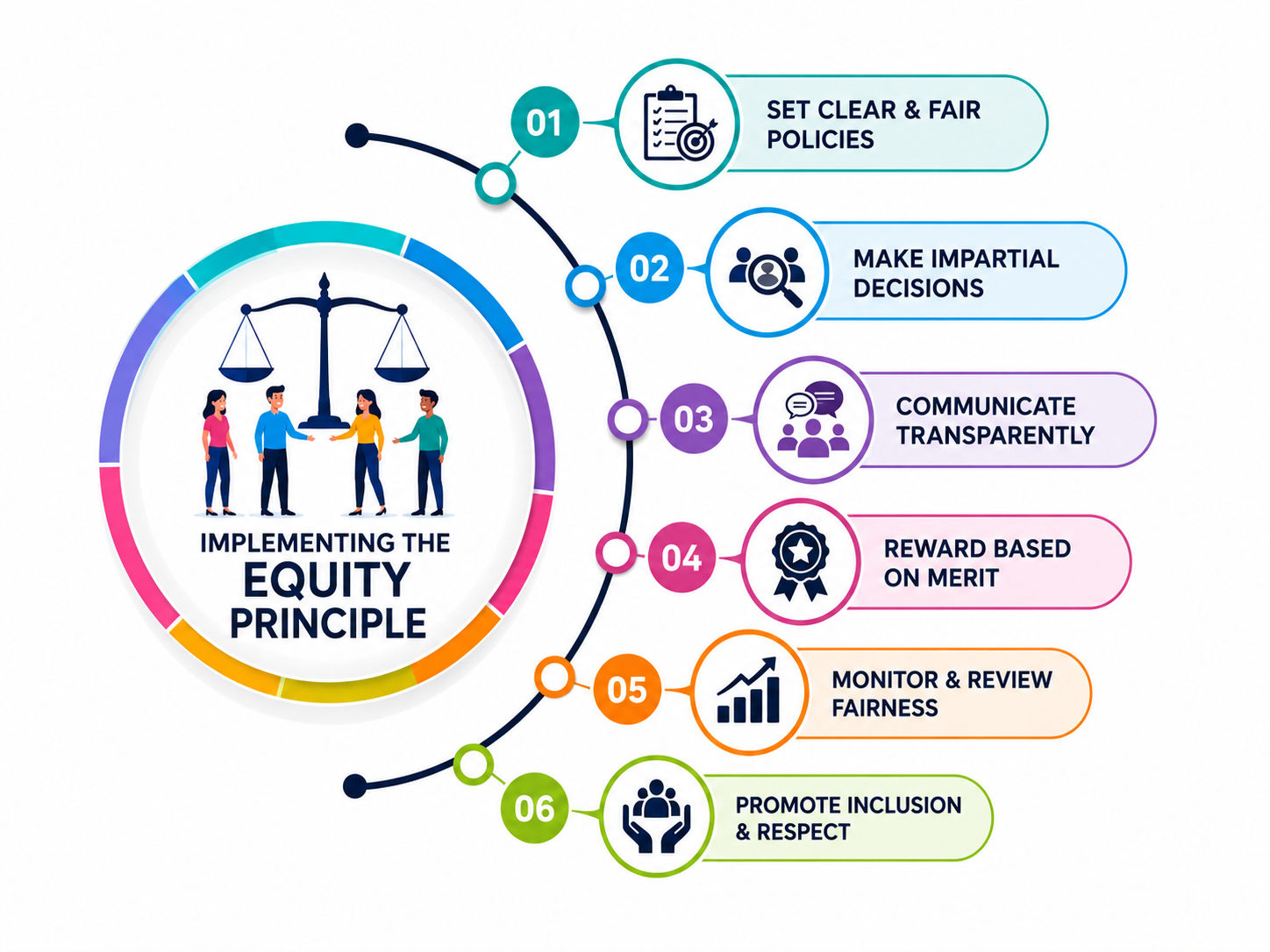
Applying the equity principle requires more than having fair policies on paper. Managers need to make consistent decisions, communicate openly, and create equal opportunities for employees. Small, fair actions taken every day help build a workplace where employees feel respected and valued.
Take your management skills to the next level with the IIMK AI for Business Professionals Certificate Program . Build practical leadership, strategic decision-making, and business management expertise to accelerate your career.
Organizations that practice fairness create a positive work environment where employees feel motivated and appreciated.
The benefits extend beyond employee satisfaction and contribute to long-term business success.
1. Improves Employee Motivation
Employees perform better when they know their efforts will be recognized fairly. This encourages them to take ownership of their work and contribute more effectively.
2. Increases Productivity
Fair treatment creates a positive workplace where employees stay focused on achieving goals instead of worrying about favoritism or unfair decisions.
3. Strengthens Employee Engagement
Engaged employees are more inclined to participate in team activities, bring ideas, and support organizational goals.
Employee involvement is generally higher in organizations practicing equity in principle of management.
4. Reduces Employee Turnover
Employees are more likely to stay with organizations that distribute promotions, rewards, and opportunities fairly. Less turnover also means less hiring and training costs.
5.Builds a Positive Workplace Culture
Fairness creates respect, trust, and collaboration among employees. Over time, these values become part of the organization's culture and improve overall performance.
Benefits and Business Impact:
Benefit |
Impact on Organization |
| Employee motivation | Better performance |
| Productivity | Improved efficiency |
| Employee retention | Lower hiring costs |
| Collaboration | Stronger teamwork |
| Business performance | Sustainable growth |
Also Read: Importance of Management in Every Organization
Although the equity principle offers many advantages, applying it consistently isn't always easy. Managers often face practical challenges when balancing fairness with business goals.
1. Different Perceptions of Fairness
Not every employee views fairness in the same way. A decision that seems fair to one employee may appear unfair to another.Managers should explain decisions clearly to reduce misunderstandings.
2. Difficulty in Large Organizations
Maintaining consistent standards across multiple departments or locations can be challenging. Different managers may interpret policies differently if clear guidelines aren't available.
3. Balancing Fairness with Business Goals
Organizations sometimes need to make difficult decisions because of budgets, restructuring, or changing priorities.Managers must balance employee expectations with organizational needs while remaining transparent.
4. Managerial Bias
Personal preferences or unconscious bias can influence workplace decisions.
Training managers and using objective performance measures helps reduce this risk.
Another equity principle of management example is using standardized evaluation criteria during performance reviews instead of relying on personal opinions.
Limitation vs Practical Solution
Limitation |
Solution |
| Different views of fairness | Communicate decisions clearly |
| Inconsistent policy implementation | Create standardized guidelines |
| Business constraints | Balance fairness with transparency |
| Managerial bias | Use objective performance metrics |
Read: Henri Fayol's 14 Principles of Management with Examples
The equity principle of management with example shows how managers apply fairness in everyday workplace decisions, such as hiring, promotions, rewards, and conflict resolution. It focuses on making objective, unbiased decisions that employees can trust.
Scenario |
Situation |
Fair Action (Equity Principle) |
| Recruitment | Multiple candidates apply for the same position. | Select the candidate based on qualifications, skills, and relevant experience instead of personal connections. |
| Promotion | Several employees are eligible for promotion. | Promote the employee with the best performance, leadership skills, and readiness for the role. |
| Performance Appraisal | Employees are evaluated during annual reviews. | Assess each employee against predefined performance goals and responsibilities using objective criteria. |
| Employee Rewards | Employees contribute differently to organizational success. | Recognize and reward employees based on measurable achievements and meaningful contributions. |
| Conflict Resolution | A disagreement arises between team members. | Listen to all parties, review the facts, and make an unbiased decision based on evidence. |
The application of equity principle in business organizations can be seen across different functions, from hiring employees to managing teams. Organizations that apply fairness consistently create stronger relationships between employees and leadership.
Equity is not limited to one department. It influences almost every area where managers make decisions.
Fair recruitment practices help organizations select employees based on capability rather than personal preferences.
Companies can apply equity by:
A transparent hiring process improves trust among current employees and new hires.
Performance management requires fair evaluation methods. Employees should understand how their work is measured and what factors influence ratings.
Managers should focus on achievements, responsibilities, and improvement areas instead of personal opinions.
This approach encourages employees to improve because they know expectations are clear.
Salary decisions and benefits should reflect factors such as experience, skills, responsibilities, and performance.
While employees may have different compensation levels, those differences should have clear reasons.
Fair compensation practices help organizations maintain employee confidence and reduce dissatisfaction.
There should be growth opportunities based on employee potential and performance.
Organizations can promote equity through access to:
When employees see a fair path for growth, they are more likely to stay engaged.
Managers influence workplace fairness through their daily actions.Fair leaders listen to employees, provide equal opportunities, and make decisions based on facts.
Strong leadership helps create an environment where employees feel respected and supported.
Also read : Top 4 Functions of Management Process Explained
Equity and equality are related but not the same. Equality means giving everyone the same resources, while equity means providing support based on individual needs.
For example, equal training for all employees is equality, whereas additional guidance for those who need it is equity.
Comparison Table
Aspect |
Equity |
Equality |
| Meaning | Fair treatment based on individual needs and situations | Same treatment for everyone |
| Purpose | Create fair opportunities and outcomes | Provide uniform access |
| Decision-making | Considers circumstances and responsibilities | Applies the same approach to all |
| Workplace Example | Additional training support for employees who need it | Same training provided to all employees |
| Business Outcome | Better inclusion and employee support | Consistency in workplace practices |
Managers should focus on equity when employees have different challenges, responsibilities, or levels of support needed to succeed.
For example, a new employee and an experienced employee may require different levels of guidance. Providing the same support to both may not create the same opportunity for success.
Equity helps managers address these differences while maintaining fairness.
In workplaces with diverse teams, equity in principle of management helps leaders create an environment where employees can perform at their best.
The equity principle of management helps organizations create a workplace built on fairness, respect, and trust. By making unbiased decisions in areas like promotions, rewards, and employee development, managers can improve relationships and encourage better performance.
Applying equity doesn't mean treating everyone identically. It means understanding employee needs and making fair decisions based on skills, contributions, and situations. When practiced consistently, this principle helps organizations build a motivated workforce and a stronger workplace culture.
Ready to start your journey? Book a free consultation with upGrad today to find the best path for your career.
The equity principle focuses on fairness, respect, and impartial treatment in management. It encourages managers to consider employee contributions, responsibilities, and situations before making decisions. The goal is to create a workplace where employees feel valued without creating unfair advantages or favoritism.
Henri Fayol’s 14 principles of management include division of work, authority and responsibility, discipline, unity of command, unity of direction, subordination of individual interest, remuneration, centralization, scalar chain, order, equity, stability of personnel, initiative, and esprit de corps.
Equity is considered important because it helps balance managerial authority with fairness. Fayol believed employees perform better when they receive respectful treatment and fair opportunities. This principle supports trust between managers and employees, which improves cooperation and workplace relationships.
The five basic principles of management are planning, organizing, staffing, directing, and controlling. These principles help managers coordinate resources, guide employees, and achieve organizational goals. Along with these practices, fairness-based approaches like the equity principle support better decision-making and employee relationships.
Equity focuses on providing fair support based on individual needs, roles, and circumstances, while equality focuses on giving everyone the same treatment or resources. In management, understanding this difference helps leaders make better decisions that support employee growth and organizational fairness.
The seven commonly discussed principles of management include planning, organizing, staffing, directing, coordinating, reporting, and budgeting. These principles are often associated with management functions. They help managers structure work effectively while principles like equity guide how they treat and manage people.
Companies can measure workplace equity by reviewing promotion patterns, compensation structures, employee feedback, performance evaluation methods, and access to development opportunities. Regular assessments help identify gaps and improve fairness. A strong equity in principle of management approach uses data along with employee experiences.
The 7 C’s of management generally refer to clarity, communication, collaboration, creativity, commitment, consistency, and competence. These principles help managers improve teamwork and decision-making. While they are different from Fayol’s principles, they support effective leadership and a fair workplace environment.
Managers can reduce bias by using clear evaluation criteria, documenting decisions, encouraging employee feedback, and applying policies consistently. A practical equity principle of management example is using performance-based promotion criteria instead of making decisions based on personal preferences or relationships.
The seven QMS principles include customer focus, leadership, engagement of people, process approach, improvement, evidence-based decision-making, and relationship management. They are different from Fayol’s management principles but share a focus on structured decision-making, continuous improvement, and effective organizational practices.
Yes, the equity principle remains relevant because modern workplaces depend on trust, inclusion, and fair decision-making. Whether employees work remotely, in hybrid teams, or traditional offices, managers need fair systems for recognition, growth, and opportunities to maintain employee confidence and engagement.
727 articles published
Sriram K is a Senior SEO Executive with a B.Tech in Information Technology from Dr. M.G.R. Educational and Research Institute, Chennai. With over a decade of experience in digital marketing, he specia...
Get Free Consultation
By submitting, I accept the T&C and
Privacy Policy
Top Resources
Certification
3 Months
Certification
6 Months
O.P. Jindal Global University
Masters in International Accounting and Finance (Accredited by ACCA, UK)Master's Degree
12 Months