Objectives of Financial Management
By upGrad
Updated on Aug 04, 2026 | 10 min read | 2.19K+ views
Share:

All courses
Certifications
More
By upGrad
Updated on Aug 04, 2026 | 10 min read | 2.19K+ views
Share:
Table of Contents
Take the next step in your career enroll in upGrad's Management Courses today and gain skills top companies value most.
Popular Management Programs
Financial management is about planning how a company will use its money. It is also about organizing and controlling the money to make sure the company does what it wants to do.
The main objective of financial management is to focus on maximizing value and supporting long-term business growth of the company.
Summary Table: The key objectives of financial management include:
Objective |
Purpose |
Business Impact |
| Profit Maximization | Increase earnings | Higher profitability |
| Wealth Maximization | Increase shareholder value | Sustainable long-term growth |
| Efficient Resource Utilization | Optimize use of funds | Better productivity and ROI |
| Maintaining Liquidity | Ensure adequate cash flow | Smooth business operations |
| Risk Management | Minimize financial uncertainty | Reduced losses and improved stability |
| Optimal Capital Structure | Balance debt and equity | Lower financing costs |
| Business Growth | Finance expansion opportunities | Increased market presence |
| Financial Stability | Maintain solvency | Stronger resilience during economic changes |
Each objective plays a role in helping businesses make informed financial decisions and achieve sustainable success.
The main goal of profit maximization is to increase a company's earnings. This is done by controlling costs and improving performance. Profits are very important for a business to survive. Nowadays companies also think about long-term sustainability.
Increase Business Profitability
Companies want to make money by selling better prices and keeping customers happy. They also try to control their expenses.
Improve Operational Efficiency
When a company's operations are efficient, it costs less to make things. This means they can get rid of activities and make more products, which leads to higher profit margins.
Optimize Costs
Financial managers look at how much the company spends on things like supplies and rent. They try to find ways to reduce these costs without making the products worse.
Wealth maximization is about increasing the value of the business in the run. It is not about making a lot of money now but also about thinking about the future. This includes considering things like cash flow, risk, and whether the business will still be around.
Enhance Shareholder Value
Companies want to make their shareholders happy by giving them returns on their investments. This makes the shareholders more confident and more likely to invest.
Increase Market Value of the Business
When a company does financially invest in good projects and grows in a sustainable way, its value in the market goes up.
Focus on Long-Term Growth
Financial decisions are evaluated based on their long-term contribution rather than immediate profits.
Companies should use their money where it will make a difference.
Allocate Capital Effectively: Companies prioritize investments that will give them financial benefits.
Improve Resource Productivity: When companies manage their people, equipment, technology and money well, they become productive overall.
Minimize Wastage: By reducing expenses and avoiding bad investments, companies can improve their financial performance.
Liquidity is important because it means a company has cash to meet its daily needs and pay its bills.
Ensure Sufficient Working Capital
Good working capital management helps companies pay for things like inventory and day-to-day operations.
Meet Short-Term Obligations
When a company has liquidity, it can pay its suppliers, employees, taxes, and creditors on time.
Maintain Cash Flow
Having a cash flow means a company can keep operating and avoid financial trouble.
Every financial decision involves some level of risk. Financial management helps companies find and manage these risks.
Identify Financial Risks
There are potential risks, such as changes in the market for people not paying their debts, changes in interest rates, inflation, and changes in foreign exchange rates.
Diversify Investments
By spreading investments across assets, industries, or markets, companies can reduce their risk.
Reduce Uncertainty
Companies can reduce uncertainty by using insurance, hedging strategies, planning emergencies, and having internal controls.
Financial managers have to decide how to balance debt and equity financing.
Balance Debt and Equity
Finding the mix of borrowed money and shareholder money helps minimize risk while still supporting growth.
Minimize Cost of Capital
Choosing financing options that cost less improves profitability and the return on investments.
Improve Financial Flexibility
Having a balanced capital structure means companies can get more funding when they need it.
Financial management gives companies the money they need to grow and develop.
Fund New Projects
Companies put money into projects that have a good chance of growing.
Support Innovation
Investing research into developing products and using new technology helps companies compete better in the long run.
Enter New Markets
Financial planning helps companies expand into new areas to buy other companies and diversify their markets.
Long-term financial stability helps companies survive hard economic times and stay competitive.
Maintain Solvency
Companies must have assets to cover their long-term debts.
Build Financial Resilience
Keeping some money aside and having financial policies helps companies prepare for unexpected events.
Prepare for Economic Uncertainties
Companies need to plan and have strategies in place for things like economic downturns, inflation and changes, in the market.
Free Courses
Financial management is the process of planning, organizing, and controlling an organization's financial resources. It ensures efficient fund utilization, supports informed decision-making, maintains financial stability, and helps achieve long-term business objectives.
Financial management is the process of planning, organizing, directing, and controlling the financial activities of a business. It involves obtaining funds, using them efficiently, and ensuring the financial stability and profitability of the organization.
Characteristics:
The scope of financial management includes all activities related to raising, managing, and using financial resources.
Major Areas:
The primary objective of financial management is to maximize the wealth of shareholders while ensuring the long-term sustainability of the business.
Main Objectives:
Start your leadership journey by joining IIM Bangalore's YLP General Management Program and building skills for a future-ready career.
Management Courses to upskill
Explore Management Courses for Career Progression
IIIT-B & IIM, Udaipur
Chief Technology Officer & AI Leadership ProgrammeFinancial management is about planning and organizing the money part of a business. This means making sure the business has money to do what it wants to do. Financial management is also about making sure the business uses its money in the way to reach its goals.
Definition
Financial management is the way a business gets and uses money to run its business. It is about being smart with business money so it can do well.
When a business does financial management well, it helps the business in many ways. Financial management helps businesses:
The objectives of management provide direction for every decision within an organization.
Financial objectives help managers evaluate investment opportunities, financing options, and operational strategies based on long-term value.
Resources are directed toward projects and activities that generate returns while minimizing waste.
Cost control, pricing strategies, and investment decisions improve profitability.
Strong financial performance and transparent financial management attract investors and improve access to capital.
Financial objectives encourage growth that consider profitability, liquidity and risk.
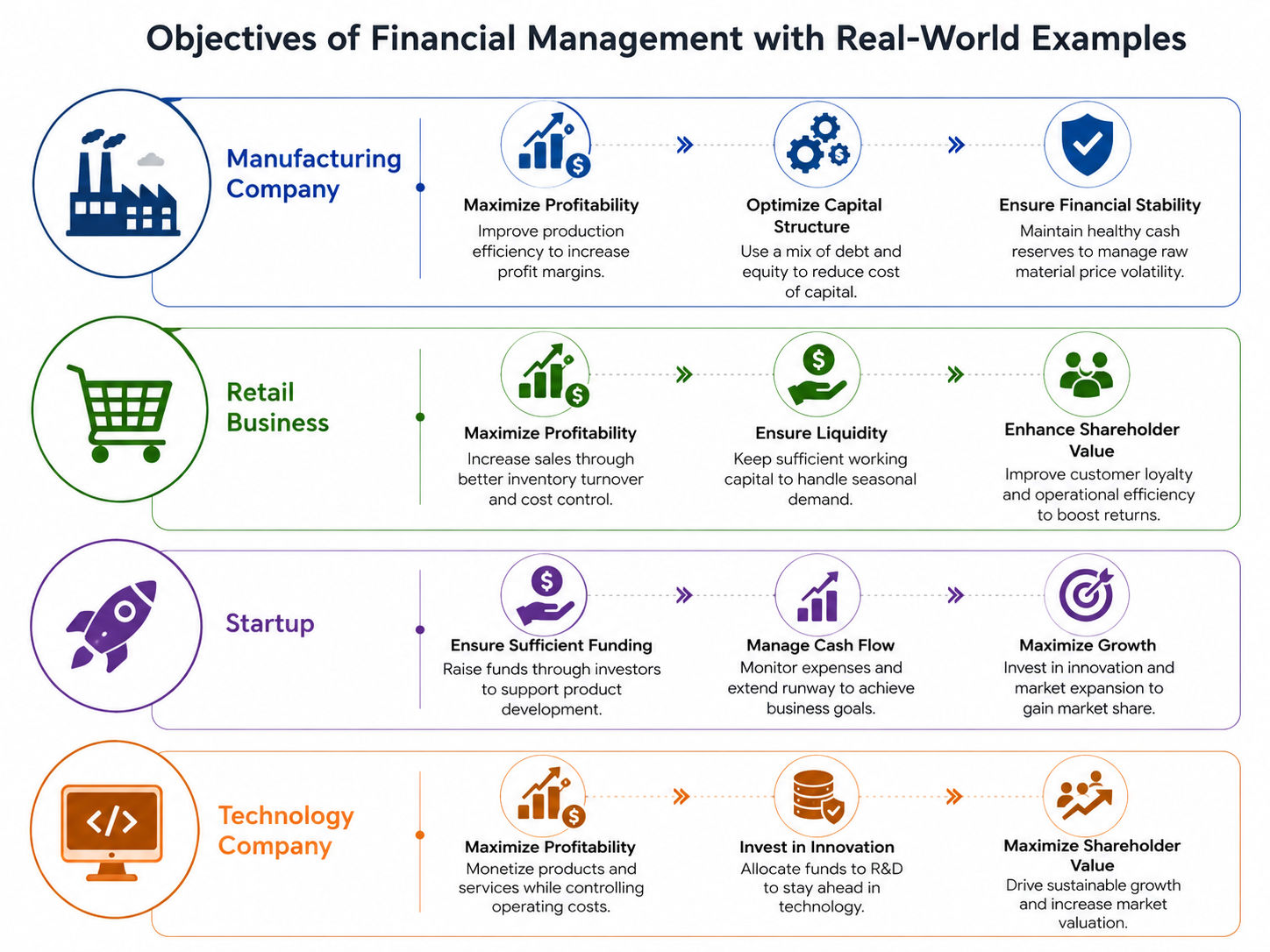
These examples demonstrate how financial objectives influence investment decisions, financing choices, resource allocation, and risk management across industries.
1. Manufacturing Company:
A manufacturing business invests in automated machinery to reduce production costs to improve efficiency to increase profits and strengthen long-term competitiveness.
2. Retail Business:
A retail chain manages inventory efficiently to maintain liquidity to reduce storage costs and improve cash flow during demand.
3. Startup:
A startup raises venture capital debt to maintain financial flexibility while funding product development and market expansion.
4. Technology Company:
A technology company invests heavily in research and development, accepting short-term profits to maximize long-term shareholder wealth and maintaining market leadership.
Although both goals aim for business success, they are very different in how they work.
Feature |
Profit Maximization |
Wealth Maximization |
| Primary Focus | Short-term profits | Long-term shareholder value |
| Time Horizon | Short-term | Long-term |
| Risk Consideration | Limited | Explicitly considers risk |
| Decision-Making Approach | Focuses on immediate earnings | Focuses on future cash flows and value creation |
| Business Sustainability | May overlook sustainability | Supports sustainable growth and competitiveness |
1. Time Horizon
Profit maximization focuses on financial gains while wealth maximization focuses on building long-term value that lasts. Profit maximization focuses on financial gains while wealth maximization focuses on building long-term value that lasts.
2. Risk Consideration
Profit maximization might not think much about risks involved. Wealth maximization looks at both returns and the risks before making choices. Profit maximization might not think much about risks involved. Wealth maximization looks at both returns and the risks before making choices.
3. Decision-Making Approach
Decisions based on profit look for improvements. Decisions based on wealth look at long-term business value what is happening in the market and future chances. Decisions based on profit look for improvements. Decisions based on wealth look at long-term business value what is happening in the market and future chances.
4. Business Sustainability
Wealth maximization encourages ideas, customers, proper money handling, and growth that lasts. This is why it is the choice for money management. Wealth maximization encourages ideas, customers, proper money handling, and growth that lasts. This is why it is the choice for money management.
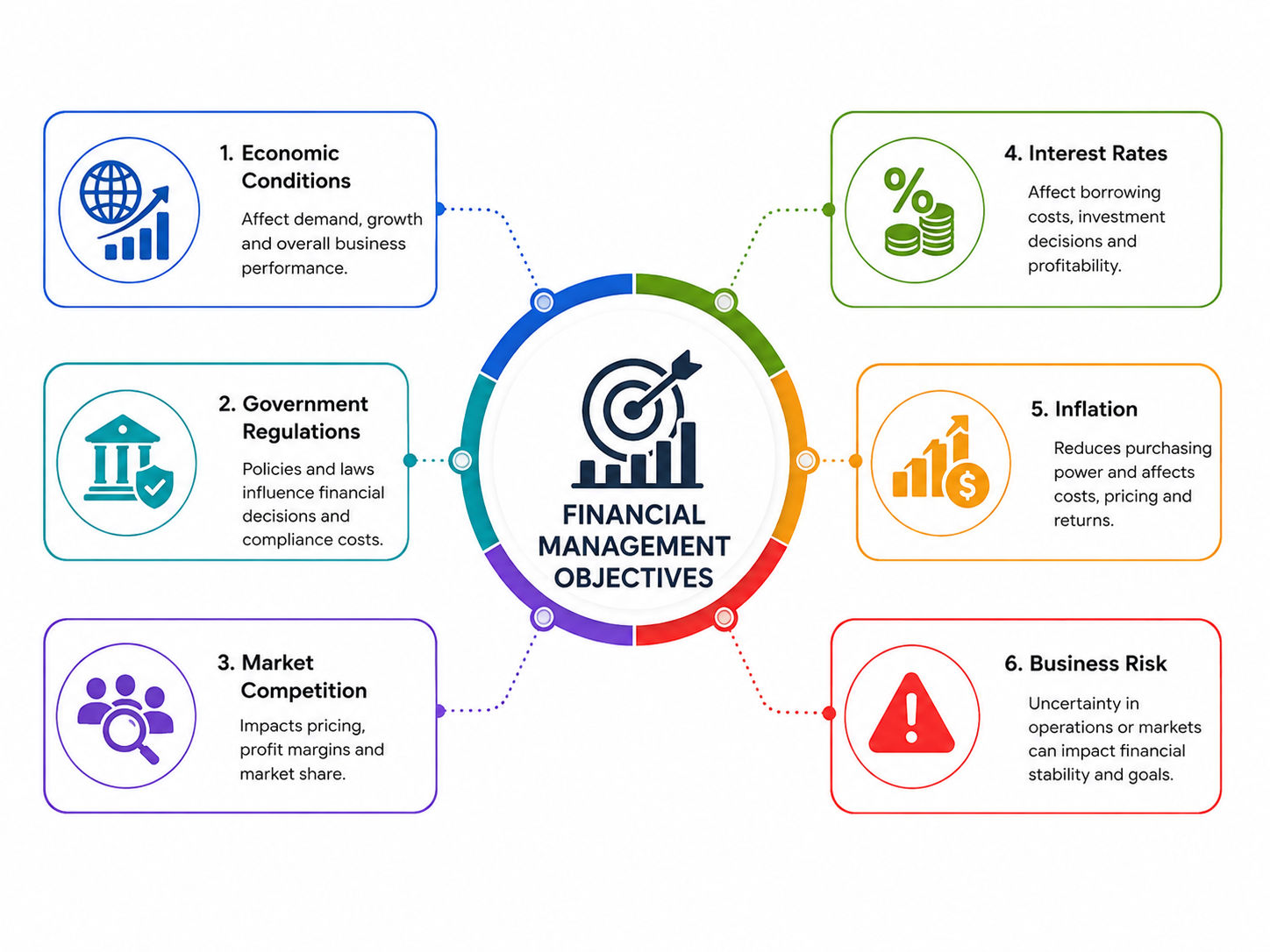
Several internal and external factors influence how effectively a business can achieve its financial management objectives. Understanding these factors enables financial managers to make informed decisions, adapt to changing business conditions, and maintain long-term financial health.
Economic conditions significantly impact financial planning, investment decisions, profitability, and business growth. During periods of economic expansion, businesses generally experience increased consumer demand, higher revenues, and greater opportunities for investment. In contrast, economic recessions often reduce consumer spending, increase unemployment, and make it more difficult for businesses to generate profits.
For example, during an economic slowdown, a company may postpone expansion projects, reduce discretionary spending, and focus on preserving cash to maintain financial stability.
Government policies and regulations play a vital role in shaping financial management decisions. Businesses must comply with tax laws, accounting standards, labor regulations, environmental policies, and industry-specific requirements.
Changes in corporate tax rates, import duties, minimum wages, or compliance regulations can directly affect profitability and financial planning. Failure to comply with these regulations may result in legal penalties, financial losses, or reputational damage.
The level of competition within an industry affects pricing strategies, profit margins, investment decisions, and business expansion plans.
Financial managers must balance competitive spending with profitability by identifying opportunities to improve operational efficiency, reduce costs, and differentiate the business from competitors.
Interest rates influence borrowing costs, investment returns, and capital structure decisions. When interest rates rise, loans become more expensive, increasing the cost of financing new projects or business expansion.
Conversely, lower interest rates encourage businesses to borrow funds for investment, expansion, and modernization because financing becomes more affordable.
Inflation affects the purchasing power of money and increases the cost of raw materials, wages, transportation, utilities, and other business expenses.
Financial managers account for inflation by regularly reviewing budgets, negotiating supplier contracts, improving operational efficiency, and adjusting financial forecasts to maintain profitability.
Every organization faces financial and operational risks that can affect the achievement of its financial objectives. These risks may arise from changing consumer preferences, technological disruptions, supply chain interruptions, cybersecurity threats, currency fluctuations, or natural disasters.
Businesses with strong risk management practices are better prepared to handle unexpected events while protecting profitability and shareholder value.
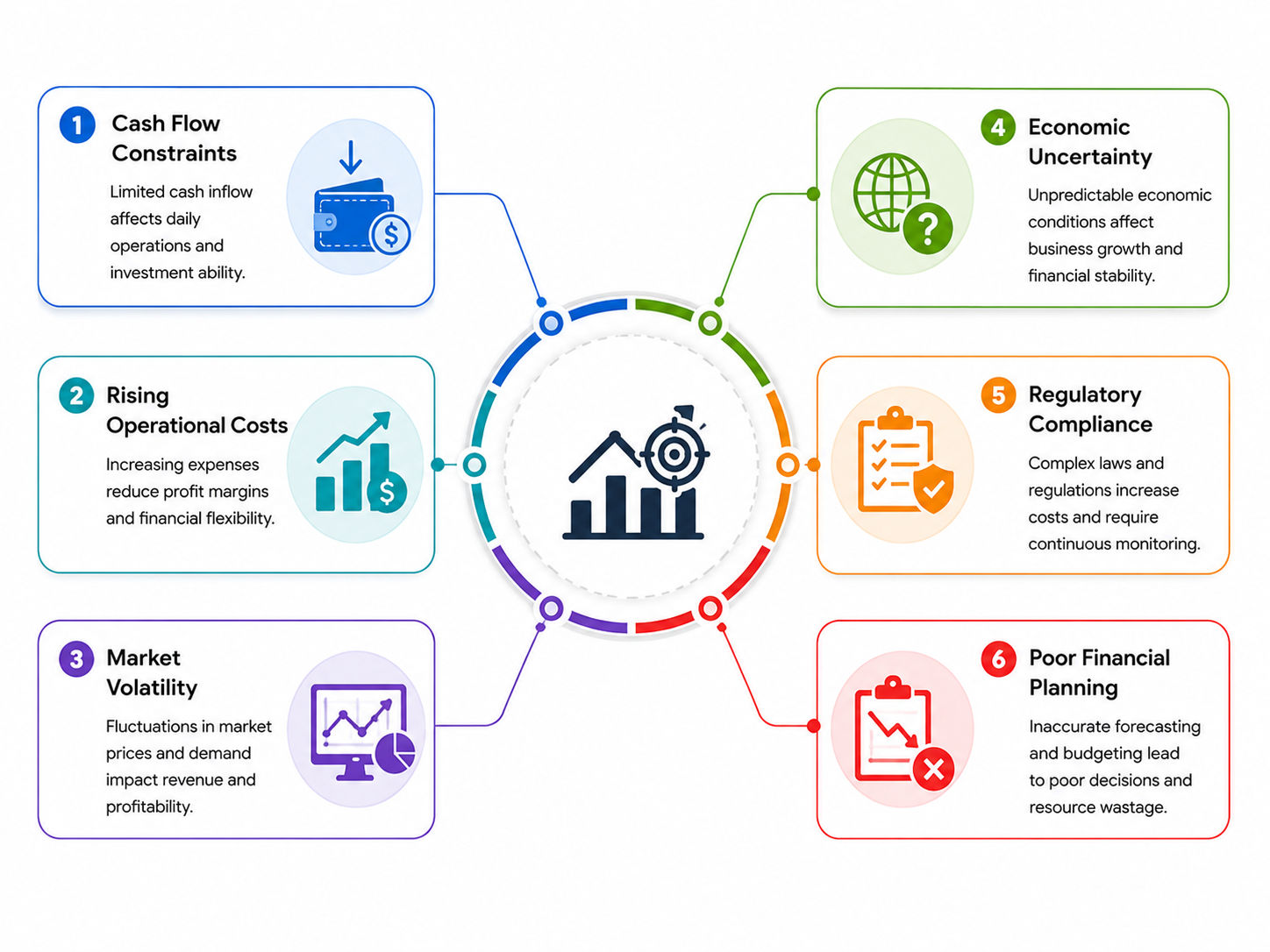
Although businesses establish clear financial objectives, achieving them is often challenging due to internal limitations and external uncertainties. Recognizing these challenges enables organizations to develop proactive strategies and improve financial performance.
Cash flow is the lifeblood of every business. Even profitable companies can face financial difficulties if they lack sufficient cash to meet short-term obligations. These constraints may prevent businesses from paying suppliers, investing in growth opportunities, or meeting payroll obligations.
Businesses can overcome cash flow challenges by improving collections, negotiating favorable payment terms with suppliers, maintaining appropriate cash reserves, and forecasting cash requirements accurately.
Increasing costs of labor, raw materials, energy, transportation, and technology can significantly reduce profit margins.
If operating expenses grow faster than revenues, businesses may struggle to achieve profitability and maintain competitive pricing.
Financial managers address rising costs by improving operational efficiency, automating repetitive processes, renegotiating supplier contracts, reducing waste, and implementing cost-control measures without compromising product quality or customer satisfaction.
Rapid changes in customer demand, stock markets, exchange rates, commodity prices, and global events create uncertainty for businesses.
Market volatility can affect investment returns, sales forecasts, financing decisions, and business expansion plans.
To manage market volatility, financial managers diversify investments, maintain flexible budgets, monitor market trends continuously, and develop contingency plans to respond quickly to changing conditions.
Economic uncertainty caused by recessions, geopolitical events, inflation, pandemics, or financial crises can disrupt business operations and reduce consumer spending.
Businesses often experience lower revenues, tighter credit conditions, and increased financial risks during uncertain economic periods.
Maintaining adequate liquidity, controlling expenses, diversifying revenue sources, and adopting conservative financial planning practices help organizations remain financially resilient during challenging times.
Businesses must comply with evolving financial reporting standards, taxation rules, labor laws, environmental regulations, and industry-specific requirements.
Frequent regulatory changes increase compliance costs and require continuous updates to internal processes and reporting systems.
Organizations can reduce compliance risks by conducting regular audits, investing in compliance management systems, training employees, and consulting legal and financial experts when necessary.
Ineffective budgeting, unrealistic forecasts, inadequate financial analysis, and poor investment decisions can prevent businesses from achieving their financial objectives.
Without proper planning, organizations may overspend, underinvest, accumulate excessive debt, or fail to anticipate future financial needs.
Comprehensive financial planning, accurate forecasting, regular performance reviews, and data-driven decision-making help businesses allocate resources efficiently and achieve long-term success.
Successful organizations adopt proven financial management practices that improve profitability, strengthen financial stability, and support sustainable business growth.
A well-structured financial plan serves as a roadmap for achieving business objectives. It outlines expected revenues, operating expenses, capital investments, financing requirements, and cash flow projections.
Comprehensive financial planning enables businesses to anticipate future challenges, allocate resources efficiently, and make informed investment decisions. The plan should be reviewed regularly and updated to reflect changing business conditions, market trends, and organizational priorities.
Continuous monitoring of financial performance helps organizations identify strengths, weaknesses, and emerging risks before they become significant problems.
Financial managers should regularly review:
Using financial dashboards and key performance indicators (KPIs) allows management to evaluate progress toward financial objectives and implement corrective actions promptly.
Choosing the appropriate balance between debt and equity financing is essential for minimizing financial risk and reducing the overall cost of capital.
Excessive borrowing increases interest obligations and financial risk, while relying solely on equity may dilute ownership and limit returns to shareholders.
Financial managers should periodically evaluate financing options based on market conditions, business growth plans, profitability, and risk tolerance to maintain financial flexibility and maximize shareholder value.
Strong cash flow management ensures that businesses have sufficient funds to support daily operations, invest in growth opportunities, and meet financial obligations.
Best practices include:
Effective cash flow management reduces the likelihood of liquidity shortages and enhances overall financial stability.
Financial ratios provide valuable insights into a company's operational efficiency, profitability, liquidity, solvency, and overall financial health.
Commonly used ratios include:
By analyzing these metrics over time and comparing them with industry benchmarks, financial managers can identify improvement opportunities, evaluate business performance, and make more informed strategic decisions.
Effective risk management protects businesses from financial losses and ensures long-term achievement of financial objectives.
Organizations should establish a structured risk management framework that includes:
A proactive approach to risk management enables businesses to respond quickly to unexpected events, protect assets, maintain stakeholder confidence, and ensure sustainable financial performance.
Financial management helps businesses achieve profitability, stability, and sustainable growth through effective planning, resource allocation, liquidity management, and risk control. By focusing on objectives such as wealth maximization, optimal capital structure, and efficient financial decision-making, organizations can strengthen their financial position, enhance shareholder value, and remain competitive in an evolving business environment.
The main objectives of financial management include profit maximization, wealth maximization, efficient utilization of financial resources, maintaining liquidity, managing financial risks, achieving an optimal capital structure, supporting business growth, and ensuring long-term financial stability and sustainability.
Wealth maximization is considered the primary objective because it focuses on increasing long-term shareholder value while considering risk, future cash flows, and business sustainability. It encourages strategic decisions that create lasting value rather than emphasizing only short-term financial gains.
Profit maximization aims to increase short-term earnings without fully considering risk or future value. Wealth maximization focuses on enhancing long-term shareholder wealth by evaluating investment risks, future cash flows, and sustainable business growth before making financial decisions.
Financial management improves business performance by optimizing resource allocation, controlling costs, maintaining healthy cash flow, supporting informed investment decisions, managing risks, and enhancing profitability. These practices increase operational efficiency, strengthen financial stability, and support long-term organizational success.
The primary functions of financial management include financial planning, investment decisions, financing decisions, dividend policy, working capital management, budgeting, financial control, risk management, and performance evaluation. Together, these functions help organizations achieve their financial objectives effectively.
Financial management supports business growth by ensuring adequate funding for expansion, allocating capital efficiently, maintaining liquidity, evaluating investment opportunities, and managing financial risks. It enables businesses to innovate, enter new markets, and achieve sustainable long-term development.
Liquidity ensures that a business has sufficient cash or liquid assets to meet short-term financial obligations. Effective liquidity management supports smooth operations, strengthens supplier relationships, prevents financial distress, and enables businesses to respond quickly to unexpected expenses.
Risk management contributes to financial objectives by identifying potential financial threats, reducing uncertainties, protecting business assets, and minimizing losses. Effective risk management supports stable cash flows, informed decision-making, and long-term financial sustainability while improving stakeholder confidence.
An optimal capital structure balances debt and equity financing to minimize the overall cost of capital while maintaining financial flexibility. It reduces financial risk, improves profitability, supports investment opportunities, and enhances shareholder value through efficient financing decisions.
Profit maximization focuses mainly on short-term earnings and often ignores factors such as risk, future cash flows, shareholder value, and sustainability. This narrow approach can encourage decisions that increase immediate profits but negatively affect long-term business performance and growth.
972 articles published
We are an online education platform providing industry-relevant programs for professionals, designed and delivered in collaboration with world-class faculty and businesses. Merging the latest technolo...
Get Free Consultation
By submitting, I accept the T&C and
Privacy Policy
Top Resources
Certification
3 Months
Certification
6 Months
O.P. Jindal Global University
Masters in International Accounting and Finance (Accredited by ACCA, UK)Master's Degree
12 Months