Employer Employee Relationship: Meaning, Elements, and Examples
By upGrad
Updated on Sep 22, 2026 | 9 min read | 2.37K+ views
Share:

All courses
Certifications
More
By upGrad
Updated on Sep 22, 2026 | 9 min read | 2.37K+ views
Share:
Table of Contents
Key Highlights
Want to understand workplace relationships better? Explore an online MBA for working professionals that helps you build HR and management skills, and prepares you for better career opportunities.
Popular MBA Programs
An employer-employee relationship is a legal and economic connection. In this connection, the employer hires an employee to do the work under the direction of the employer. And, the employee gets salary, wages or commission in return.
This is the foundation of the majority of workplaces run on, also it is recognized under labour law, tax rules, and employment contracts.
Three Legal Pillars of the Relationship
The courts and tax authorities check the three stages to understand if an employer-employee relationship exists.
Also read: The 5 Best Ways for Employee Engagement!

Free Courses
An employer employee relationship is built on a few key elements. If these elements are present, then the law treats it as employment, not independent contracting.
The following are the key elements of employer employee relationship:
In this, the employer gets the right to direct how the work happens. It includes setting work hours, giving tasks, and deciding the method the employee has to follow. The more control the employer has on day to day work, the stronger the case of employer employee relationship becomes.
The employee agrees to do the duties given by the employer. These duties are written in a job description or employment contract. And, the employee has to do them as per the employer's standard.
The employer pays the employee for the work, mostly as a regular salary or hourly wage. This is not linked to one project, like it happens with contractors. It stays ongoing and connects with the employment period.
Both the parties have duties towards each other. The employer must provide a safe work environment, fair wages, and other legal benefits. On the other hand, the employee must work honestly, and follow the workplace rules.
On these rules both employer and employee agree on, like working hours, leave policy, notice period, grounds of termination, and so on. Most of these terms and conditions are written in an offer letter, or employment contract.
The employer has a right to assign new tasks, change responsibilities, and check how work gets done. This right to direct and review the employee's work, again and again, is one of the clearest signs of employer employee relationship.
Also read: How to Increase the Productivity of your Employees?
An employer employee relationship exists when certain conditions get met between both parties. It doesn't matter what the arrangement is called on paper. Just signing a contract that calls someone a contractor doesn't make it true. The actual working conditions decide the real nature of the relationship.
Generally, an employer employee relationship exists when these conditions are present.
Two credentials, one 18-month journey. Gain an MBA from LJMU and an Executive Program in Business Management & AI Leadership from IIM Udaipur, built for working professionals who want to lead, not just manage.
MBA Courses to upskill
Explore MBA Courses for Career Progression
O.P.Jindal Global University
MBA (with Career Acceleration Program by upGrad)Become interview ready with Career Services
PSB MBA + IIML Certification
MBA from Paris School of Business with Certification from IIM LucknowBelow are the several factors that decide how strong and effective an employer employee relationship is.
Also read: Remote Work: A Win-Win for Employer and Employees
Since an employer-employee relationship is not always obvious from a contract alone, courts and labor authorities use certain tests to determine whether one truly exists.
These tests look at the actual nature of the working arrangement rather than just its label. The most commonly used tests are explained in the table below.
Test |
What It Examines |
| 1. Control test | Whether the employer controls what, how, when, and where the work is done. |
| 2. Organization test (integration test) | Whether the person's work is integrated into the core operations of the organization. |
| 3. Economic reality test | Whether the person depends on the employer for income, tools, and ongoing work. |
| 4. Multiple factor test (hybrid test) | A combination of control, integration, payment method, duration, and exclusivity. |
| 5.Mutuality of obligation test | Whether the employer must provide work and pay, and the employee must accept it. |
Understanding employer employee relationships gets easier with real world examples. Below are common job types that qualify as employer employee relationships. Also, one example is added that does not qualify.
Examples that qualify as employer employee relationships
Also read: Employee Development Plan
Building a strong employer employee relationship takes effort from both sides. But employers usually set the tone here, since they hold more control over policies and culture.
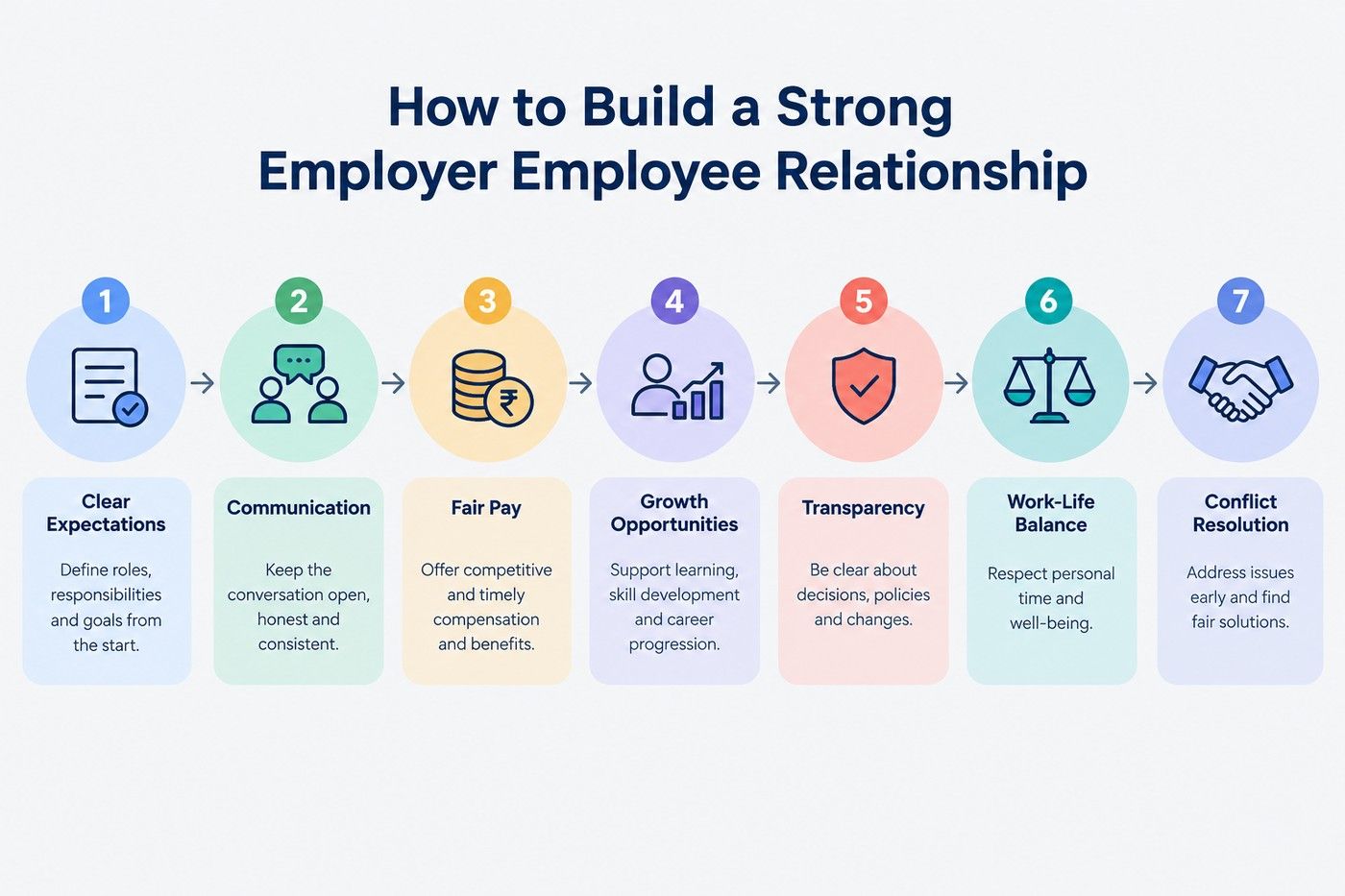
From day one, define job roles, responsibilities, and what good performance looks like. Write these down in the offer letter or job description, so there's no confusion later.
Communication should flow both ways, not just from employer to employee. A few things help build this habit:
Even small updates, shared on time, prevent bigger misunderstandings later.
Pay employees fairly for the work they put in. This includes not just the base salary, but also benefits like health insurance, paid leave, and retirement contributions. Alongside this, acknowledge employee achievements, big or small, through praise, bonuses, or promotions. Employees who feel paid and seen fairly tend to stay more motivated and loyal.
Offer employees a real path to grow within the company. This can include:
When employees can see a future at the organization, they commit to it for the long term instead of looking elsewhere.
Be honest about company decisions, changes, and policies that affect employees, even when the news is not great. At the same time, apply rules the same way for everyone, across departments and levels, whether it's promotions, leave policies, or statutory obligations like PF and minimum wage. Inconsistent or unclear treatment damages trust quickly.
Avoid making excessive demands outside work hours, such as late night calls or weekend work, unless truly necessary. A burnt out employee is far less productive than a well rested one.
When disagreements or complaints come up, deal with them promptly through a fair and transparent process. A clear grievance redressal process helps here, and prevents small issues from affecting morale.
Also read: 4 Inspiring Ways You Can Improve Your Employee Development Methods
Conclusion
In the employer employee relationship is the foundation of how organizations and their people work together. The relationship is shaped by some elements, like employer control, employee responsibilities, fair compensation, mutual obligations, and more. Also, if you know what tests to apply for this relationship, it helps both employers and employees know where they stand, legally and professionally.
When the relationship is built on trust, fair treatment, and clear communication, it leads to higher engagement, lower turnover, and a healthier workplace. Employers who put efforts in making this connection usually see the results too, in better productivity, stronger loyalty, and a good reputation over time.
Have questions about our MBA programs? Schedule a free one-on-one consultation and get clear, personalized answers before you decide.
No. While a written contract makes the terms clear and easier to prove, an employer employee relationship can exist even without one, as long as the actual working conditions show employer control and mutual obligation.
In an employer employee relationship, the employer controls how, when, and where the work is done, and pays regular wages. In a contractor relationship, the person works independently, often sets their own schedule, and is usually paid per project.
It depends on the nature of the internship. If the intern works under the employer's control, follows set hours, and receives payment, the relationship may be treated as employment. Unpaid internships mainly for learning purposes may not meet this standard.
Yes. The number of hours worked or the duration of employment does not change the nature of the relationship. As long as the employer controls the work and pays wages, it can qualify, even if it is part time or temporary.
Labor courts, tribunals, or relevant government authorities typically make this decision. They examine the actual working arrangement, rather than just the job title or contract wording.
This is known as misclassification. If found guilty, the employer may be required to pay back wages, benefits, and statutory dues, and may also face penalties under labor laws.
Not always. Many employment contracts require a notice period, during which the relationship continues until the notice period ends or is formally waived by the employer.
Yes, if the working conditions meet the usual standards of employment, such as regular pay, defined duties, and employer control. Being a family member does not automatically exclude someone from being treated as an employee.
HR departments usually play a central role by handling contracts, policies, grievances, and compliance, but the day to day relationship is also shaped by direct managers and company leadership.
Yes. While the core idea remains similar, the specific laws, tests, and employee rights connected to this relationship vary from country to country based on local labor legislation.
Yes. For example, a contractor who starts working fixed hours under close employer supervision over time may end up being treated as an employee, even if the original agreement labeled them as a contractor.
980 articles published
We are an online education platform providing industry-relevant programs for professionals, designed and delivered in collaboration with world-class faculty and businesses. Merging the latest technolo...
Speak with MBA expert
By submitting, I accept the T&C and
Privacy Policy
From MBA to Dream Job - Explore Our Alumni Success Stories
Top Resources
Master's Degree
13 Months
Master's Degree
12 Months
Master's Degree
15 Months