AIDA Model in Marketing: Meaning, Stages, Examples & How to Use It
By upGrad
Updated on Nov 03, 2026 | 8 min read | 4.57K+ views
Share:

All courses
Certifications
More
By upGrad
Updated on Nov 03, 2026 | 8 min read | 4.57K+ views
Share:
Table of Contents
Key Highlights
Want to use frameworks like the AIDA model in real campaigns? Explore upGrad’s digital marketing courses to build practical skills in SEO, paid ads, content and analytics.
In simple words, AIDA is the consumer journey from first noticing the product to the final checkout of buying that product. The AIDA model full form is Attention, Interest, Desire and Action. Some people write Awareness instead of Attention. It’s the same idea.
This model was given by Elias St. Elmo Lewis. He was an American advertising pioneer, who described how a salesperson should lead a customer to a sale. That was over 125 years ago, and marketers still use it every day.
In practice, customers first notice a product because of a catchy headline, explore it further after learning about its features, consider buying it after understanding its benefits, and finally make the purchase.
Marketers use the same structure when they plan an ad, email campaign, retargeting activity, or landing page. Before creating the content, they identify what they want the audience to do. Is the goal to get people to notice the brand, generate interest in a product or drive sales?
AIDA model marketing fixes that by giving each piece of content one clear job. That’s also why it’s called the AIDA model of communication. Because you pass one message at a time to the buyer.
Free Courses
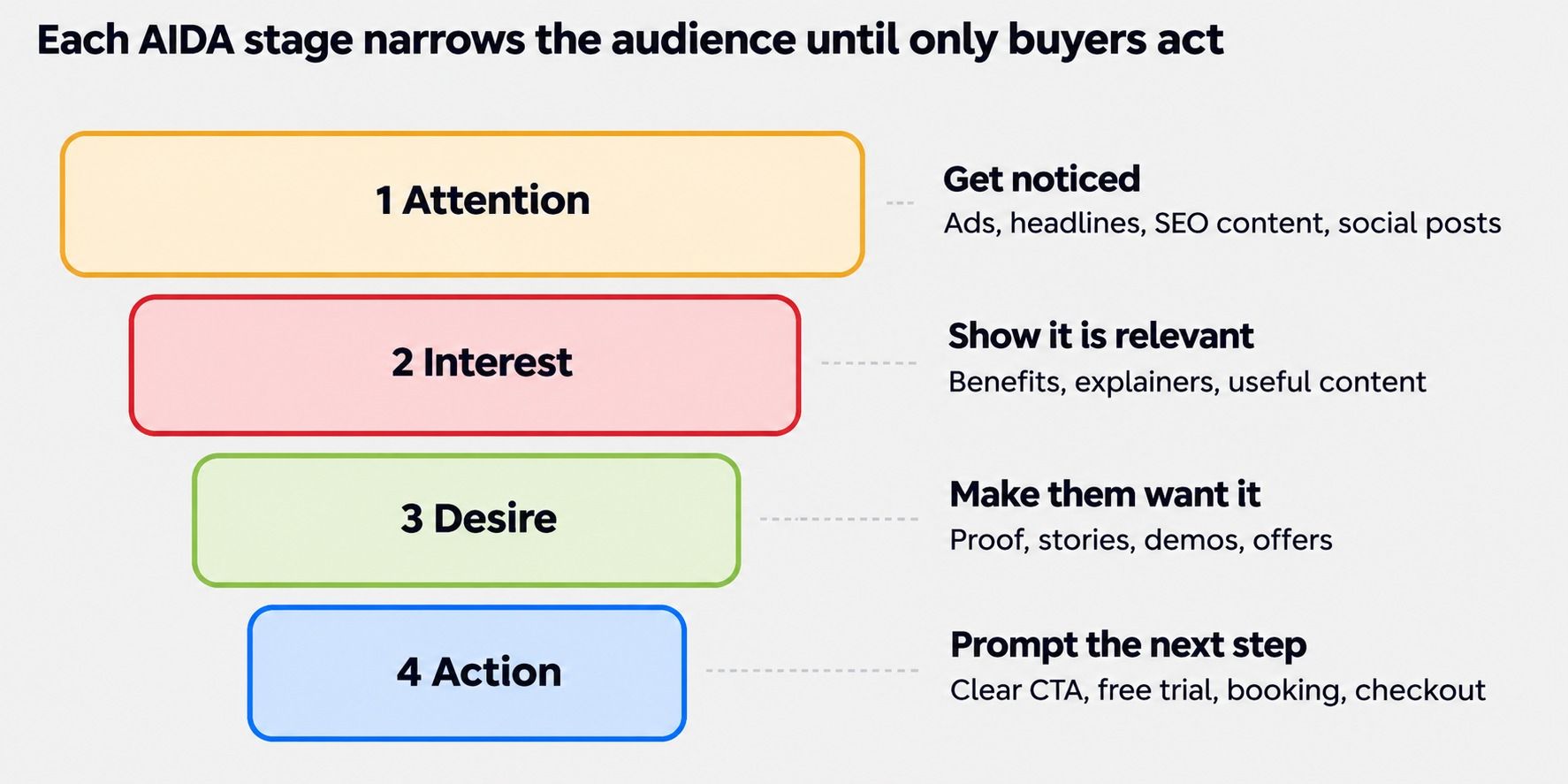
Check the AIDA model diagram from top to bottom. It is shaped like a funnel. A lot of people see your message at the top, and fewer move down at each step. By the bottom, only the people who really want the product are left.
Each stage works on its own. Do not try to mix all four messages in one ad, because nobody will act on it. So, plan one step at a time.
Nothing else works if nobody notices you. The first job is to make people aware that your product exists. Many marketers skip this step. They assume people already know the brand, but often they don't.
Ways to get attention:
Here an AIDA model example can be a video that opens with a catchy line like “your running shoes are older than your phone”. This line is short, engaging and can stop people’s scrolling.
Once you get the attention of potential buyers, show them how your product will help them, or matters to them. Here in this step, a person has stopped for a second, so you have to give them a reason to stay.
Keep the message short and easy to read. Talk about the benefits of a product that your audience cares about most, not just the features.
What works well here:
Interest makes a person think "this is useful". Desire makes them think "I want this". To get there, you need proof and a bit of feeling, not just facts.
Good ways to build desire:
The shoe ad could now show a customer who started running again after months away, along with a short review from her.
The last step is to ask. Tell people exactly what to do, such as "Buy now", "Book a call" or "Start your free trial". Then make it easy. Use a clear button, a short form and a simple checkout.
A reason to act today also helps. A limited-time offer or free delivery can push a person who is already close to deciding. In AIDA model advertising, this is usually the last line of the ad.
The shoe ad ends with "Get free delivery on your first pair this week. Order now."
Common mistakes at this stage:
Also read: Stages of Digital Marketing: A Complete Practical Guide
Digital Marketing Courses to upskill
Explore Digital Marketing Courses for Career Progression
MICA Executive Alumni Status
The AIDA model works on a few basic ideas, so if you understand them, you can use the model on every marketing campaign. These ideas are as follows:
Want to turn frameworks like the AIDA model into real campaigns? Explore MICA’s Advanced Certificate in AI-Powered Digital Marketing & Communication to build practical skills in SEO, Google and Meta Ads, email marketing and analytics.
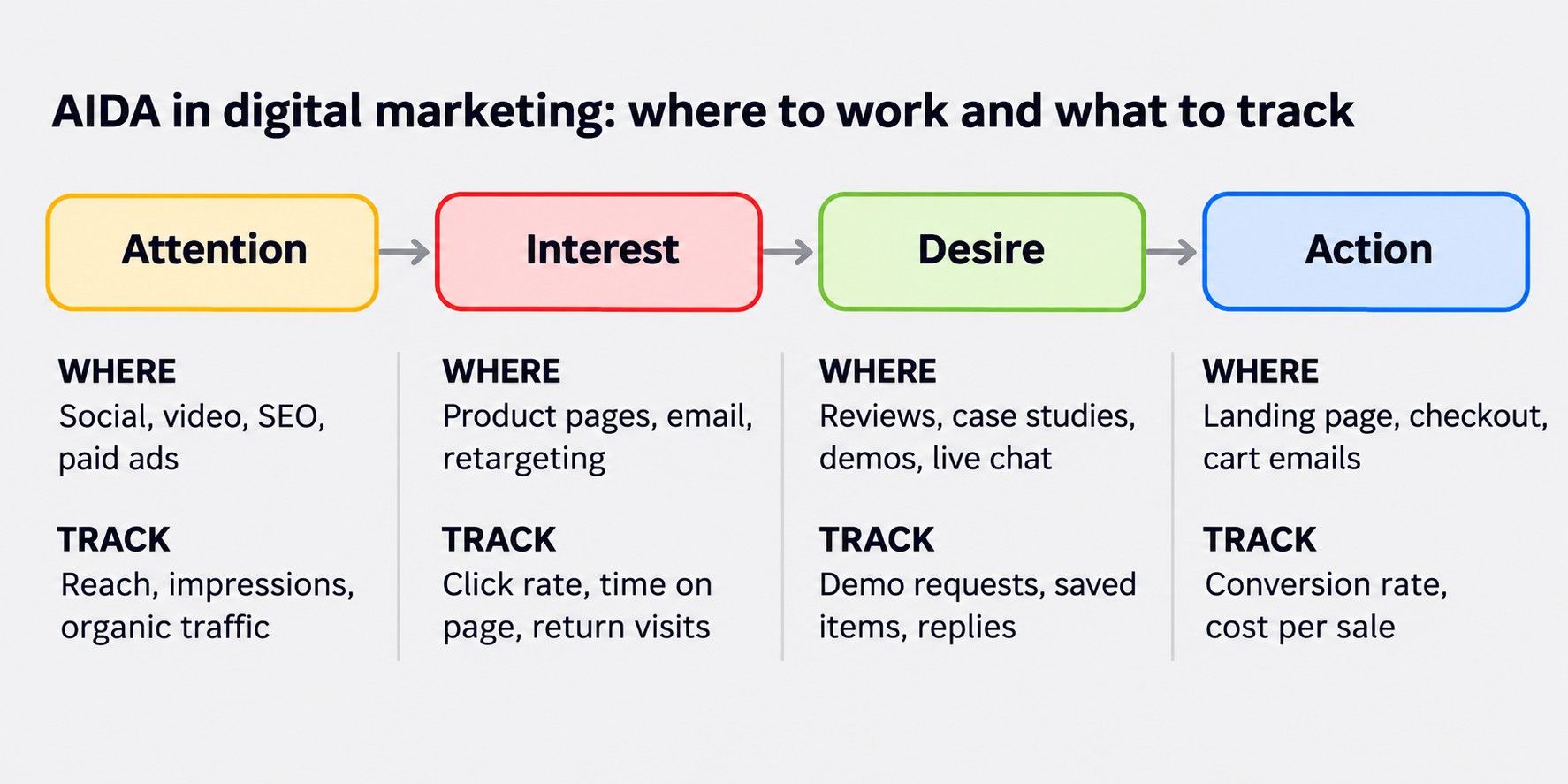
The steps stay the same online. What changes is the number of channels. Each channel is good at one stage of the AIDA model, and once you know which, planning a campaign gets much easier.
Here your goal is to make people aware about your brand. For that you can use social posts, short videos, and paid media. Other than this you write blog posts, answer questions related to your product or services on social forums. You should track your reach and impressions to get an understanding of growth.
When a visitor lands on your page, you have a few seconds to hold them. For that you can use:
This is where “looks fine” turns into “I want it”. People trust other buyers more than a brand telling about their product’s advantages. So, share the reviews, case studies, and success stories of real customers on your social media, newsletters, and more.
Also, you can give options to people to get demos, webinars, and free trials. Along with the live chat to solve doubts.
Remove anything that slows the buyer down.
Also read: Best Digital Marketing Campaign Examples to Learn From
Subscribe to upGrad's Newsletter
Join thousands of learners who receive useful tips
AIDA has lasted more than 100 years because it is easy to use. It also has weak spots. Know both, and you will know when to rely on it and when to add something else.
The biggest complaint is that the model is too neat. It assumes every buyer takes the same steps in the same order. Real buyers don’t. Someone who searches for your brand by name starts at interest and skips attention. Found points out that this happens in paid search, where interest comes before awareness. Smart Insights says critics find linear funnels like AIDA too simple, and it mentions a 2025 BCG article that argued for moving past the linear funnel.
Some other weak spots:
Several newer versions try to fix these gaps, such as AIDCAS, REAN and NAITDASE.
Conclusion
The AIDA model gives you a simple order to follow: get attention, build interest, create desire and ask for action. It is over 125 years old, and it still shapes how ads, emails and landing pages are written. It has lasted because it is easy to use.
It has gaps. Buyers don’t always move in a straight line, and the model says nothing about life after the sale. Treat it as a planning checklist, not a strict rule. Give each piece of content one job, track each stage on its own, and add retention and retargeting where your customers need them.
Pick one campaign you are running today and check it against the four steps. You will likely spot the weak stage in a few minutes.
Book a one-on-one consultation with upGrad counsellors to get personalized guidance on selecting the best course for your career.
The AIDA model describes what goes on in a buyer’s mind and what your message should do at each point. The marketing funnel describes where people are in their journey, and how their numbers shrink along the way. The two are usually laid over each other: attention sits at the top of the funnel and action at the bottom.
RACE (Reach, Act, Convert, Engage) covers the whole customer relationship, including life after the sale. AIDA focuses on steps before purchase. Marketers use AIDA for messages, RACE for yearly plans.
PAS means Problem, Agitate, Solution. It names a pain, raises its urgency, then offers the product as the fix. AIDA is broader and suits products without an obvious problem.
Yes, though the buying process is slower and involves more people. A single ad rarely closes a business sale, so each stage may take weeks and use different content. You might get attention with a LinkedIn post, build interest with a guide, create desire with a case study from a similar company, and ask for action with a demo booking.
Yes. It suits small budgets because each step needs only one job done. Free options work: a community group post, a simple web page, past customer reviews and a booking link.
Use the subject line to earn the open, then start with a problem the reader has. Add one customer result and end with a single button. Keep it to one idea.
Think of the page as a short story that reads from top to bottom. The headline and main image handle attention, and the lines just below explain the main benefits to build interest. Reviews, logos and short testimonials further down create desire. The button should appear near the top and again at the bottom, so people can act whenever they are ready.
It does, but you often cover only one or two stages in a single post, since people scroll quickly. A reel or a bold first line can get attention, while a carousel can explain benefits and build interest. A post with a customer story handles desire, and a link in the bio or a clear “message us” covers action. Plan a run of posts that together cover all four stages, and don’t force everything into one.
Yes, and that is where the model started. In a meeting you begin by getting the person’s attention with a relevant question or a short story, then show how the product fits what they have told you. Let them see it working, hear from other customers, or try it, so the want comes from them. Then ask plainly for a decision or the next step, and don’t leave it hanging.
Yes. A strong photo or true story gets attention, facts about the problem build interest, and showing what a gift achieves creates desire. End with a donate button with preset amounts.
There is no fixed rule, because it depends on the format. In a short ad, each stage might only be a line or two. In a long sales page, interest and desire can take up most of the space while attention takes only the headline. A useful guide is to spend more words on the stage your audience needs most. If they already know you, spend less on attention. If the product is expensive or new to them, spend more on desire.
1340 articles published
We are an online education platform providing industry-relevant programs for professionals, designed and delivered in collaboration with world-class faculty and businesses. Merging the latest technolo...
Get Free Consultation
By submitting, I accept the T&C and
Privacy Policy
Level Up Your Digital Marketing Career Today!
Top Resources
MICA
Advanced Certificate in AI-Powered Digital Marketing & Communication from MICAMICA Executive Alumni Status
Certification
5 Specialisation
Classroom
4 Months
Certification
2 Months