What Is a PMO in Project Management: 2026 Complete Guide
By upGrad
Updated on Oct 11, 2026 | 6 min read | 878.98K+ views
Share:

All courses
Certifications
More
By upGrad
Updated on Oct 11, 2026 | 6 min read | 878.98K+ views
Share:
Table of Contents
Quick Insights:
Want to build a career in management? Explore our Management Programs from top institutes, you can build strong skills and learn from experienced faculty and certified project managers.
Popular Management Programs
A PMO (Project Management Office) is a team or department that helps an organisation manage projects in a clear and consistent way.
It sets common project management practices and supports teams with processes, tools, resources, and project standards.
PMO stands for Project Management Office.
A PMO can work at different levels of an organisation, such as:
The project management office is also the keeper of documentation, guidance, and metrics needed for a project. It takes care of project work flow and checks if they are completed on time and within budget.
PMO or Project management office is the responsible body for maintaining best practices for project compilation in an organisation. They document project status and strategy in one place.
The main purpose of a PMO is to help teams manage projects better and keep them aligned with business goals.
A PMO can help an organisation:
In simple terms, a project manager focuses on a specific project and a PMO looks at project management from a wider organisational level.
To sharpen your skills explore: Project Management Techniques Training course
Free Courses
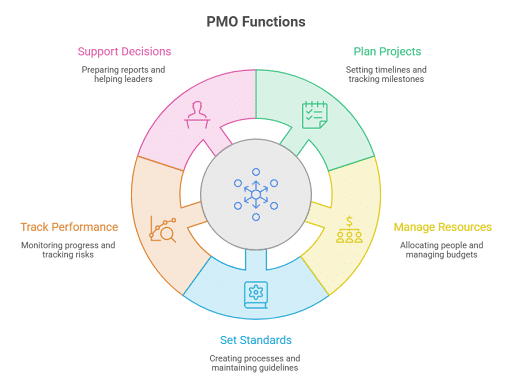
A PMO supports project teams in four main areas: planning, governance, resource management, and performance tracking.
A PMO helps teams plan projects in a consistent way and track their progress.
It can help teams:
A PMO sets common rules and processes for managing projects. This helps teams follow the same approach across the organisation.
It can set standards for:
A PMO helps organisations use their resources effectively across projects.
This can include:
A PMO gives leaders a clear view of how projects are performing.
It can track:
This helps leaders identify problems early and make better project decisions.
Want to build project management skills? Explore Project Management Certification courses and learn from experienced faculty and certified project managers.
Management Courses to upskill
Explore Management Courses for Career Progression
IIIT-B & IIM, Udaipur
Chief Technology Officer & AI Leadership ProgrammeThere are three main types of PMO. They are different in how much control they have over projects.
| Type | Level of Control | What It Does |
| Supportive PMO | Low | Provides templates, training, tools, and advice. |
| Controlling PMO | Medium | Sets project standards and checks if teams follow them. |
| Directive PMO | High | Directly manages projects and may provide project managers. |
A supportive PMO mainly helps project teams. It provides guidance, templates, training, and other resources.
It also gives teams more freedom to manage their projects.
A controlling PMO makes sure teams follow set project standards and processes.
It is useful when an organisation needs stronger control over areas such as documentation, compliance, and risk.
A directive PMO has the highest level of control. It can manage projects directly and may assign project managers to them.
It is useful when projects need strong control and consistency.
The right type of a PMO depends on the organisation. A company that needs flexibility can prefer a supportive PMO and organisation that needs more control may choose a controlling or directive PMO.
A PMO and a project manager both help projects run well, but their roles are different. A project manager focuses on one project, while a PMO supports project management across a wider organisation.
| Area | PMO | Project Manager |
| Main focus | Supports multiple projects and business goals | Manages one specific project |
| Responsibilities | Sets standards, tools, processes, and provides support | Manages project tasks, resources, progress, and quality |
| Decision-making | Level of control depends on the PMO type | Makes decisions related to the project |
| Scope | Can work across multiple projects | Focuses on one project |
A PMO and a project manager are complementary roles. The PMO provides the framework and support, while the project manager uses it to manage the project.
Also Read: Project Management vs Program Management
A PMO can help organisations manage projects in a more organised and consistent way. Its main benefits include:
A PMO gives teams and leaders a clear view of project progress. They can quickly see:
A PMO helps organisations manage people, budgets, and other resources across projects. It can also help make sure projects support the organisation's wider goals.
However, a PMO does not automatically make projects successful. It needs to be connected to the organisation's strategy and have support from senior leaders.
A PMO can create common processes for managing project risks and problems.
The level of control should match the project. High-risk projects may need more checks and low-risk projects can use simpler processes. This helps teams maintain control without adding unnecessary work.
Must Read: Top Project Management Tools For Your Business
A career in PMO can start with entry-level roles and grow into management positions. The exact path can vary by organisation.
Common PMO roles include:
Employers look for:
Certifications are not always required, but they can help you build PMO knowledge and improve your career options.
Some PMO-focused certifications:
For salaries, it is better to check current job listings because pay can vary by country, company, role, and experience.
You can also Study Product Management Courses online from the World’s top Universities.
Setting up a PMO starts with understanding what the organisation needs. The PMO should solve real project problems and support the organisation's goals.
Start by identifying the main problems with current projects.
Ask:
The PMO's goals should match the organisation's priorities.
The PMO structure should match the organisation's culture, needs, and level of project management maturity.
Choose how much control the PMO should have. A PMO that is too strict may slow teams down, while a PMO with too little control may not solve the organisation's problems.
Start with a few important processes instead of creating too many rules at once.
These can include:
A senior leader should also support the PMO and help it get the resources it needs.
A PMO should also measure its own performance. Track whether it is helping projects improve and whether it is meeting its goals.
Regular reviews can help the PMO:
A PMO should grow and improve as the organisation's needs change.
Conclusion:
If you are setting up a PMO, start with a real problem and a few simple processes. Also, if you want to build a PMO career, start with roles such as Project Coordinator or PMO Analyst, build your project and stakeholder skills, and consider a PMO certification as you gain experience.
Want to start your project management journey? Book a free consultation with upGrad today to find the best path for your career.
No. A small organisation with only a few projects may not need a PMO. The need usually increases when projects become more numerous or complex.
A PMO may:
A well-designed PMO can help teams follow better processes, manage resources, and keep projects aligned with business goals. Its success also depends on the organisation's needs and support from leadership.
Many people start as Project Coordinators or Project Administrators. Build skills in data, reporting, communication, and stakeholder management. A PMO certification can also help.
Useful skills include:
No. Certifications are not always required. However, they can help you build project management knowledge and improve your career options.
PMI-PMOCP is a PMO certification from the Project Management Institute (PMI). It is designed for professionals who work with or support PMOs.
P3O is a framework for portfolio, program, and project offices. Its Foundation level can be useful for people starting in PMO roles, while Practitioner is aimed at more experienced professionals.
PMO teams may use tools for project tracking, reporting, resource planning, risk management, and communication. The tools can vary depending on the organisation and its project needs.
AI can help PMO teams with tasks such as reporting, summaries, data analysis, and risk insights. PMOs are also exploring how AI can support project decisions and improve everyday work.
1020 articles published
We are an online education platform providing industry-relevant programs for professionals, designed and delivered in collaboration with world-class faculty and businesses. Merging the latest technolo...
Get Free Consultation
By submitting, I accept the T&C and
Privacy Policy
Top Resources
Certification
3 Months
Certification
6 Months
O.P. Jindal Global University
Masters in International Accounting and Finance (Accredited by ACCA, UK)Master's Degree
12 Months