Sprint Retrospective: How to Run One That Actually Improves Your Team
By upGrad
Updated on Jul 16, 2026 | 7 min read | 1.62K+ views
Share:

All courses
Certifications
More
By upGrad
Updated on Jul 16, 2026 | 7 min read | 1.62K+ views
Share:
Table of Contents
Key Takeaway
This blog walks through what this meeting is, how to run one step by step, and what separates a useful retro from a wasted hour.
Explore upGrad's Management programs to build practical skills in leadership, project management, business strategy, operations, Agile methodologies, product management, decision-making, and AI-enabled business transformation through hands-on projects and real-world case studies.
Popular Management Programs
A sprint retrospective is a meeting held at the end of every sprint where the team looks back at how things went. It's to review how the team worked together and identify realistic improvements for the next sprint. The point is simple. What worked, what didn't, and what should change before the next sprint starts?
In Scrum, the retrospective is one of the four core ceremonies alongside sprint planning, the daily standup, and the sprint review. Where the sprint review focuses on the product, the retrospective focuses on the process and the people building it.
Teams that run retros consistently tend to catch small problems before they turn into big ones. A recurring blocker mentioned once might get missed.
Continuous improvement sits at the heart of Agile. A sprint retrospective gives teams a structured way to improve rather than hoping problems resolve themselves.
Imagine a development team that repeatedly misses sprint goals because user stories aren't clearly defined. If nobody discusses the issue, it continues into every sprint. During a retrospective, the team might identify unclear acceptance criteria as the root cause and agree to refine stories before sprint planning. One discussion changes future sprints.
That's the real value. Teams don't just identify issues. They solve them together.
Some common benefits include:
Benefit |
How it Helps |
| Better communication | Encourages open discussions and honest feedback |
| Higher productivity | Removes recurring obstacles |
| Stronger teamwork | Builds trust and accountability |
| Improved sprint planning | Lessons influence future planning |
| Continuous improvement | Small changes accumulate over multiple sprints |
Must read: Sprint Planning in Agile Methodology: Its Importance and Benefits
People mix these up because both happen near the end of a sprint. The sprint review vs sprint retrospective distinction comes down to audience and focus. The review is for stakeholders and covers what was built. The retrospective is for the team and covers how they built it.
Aspect |
Sprint Retrospective |
Sprint Review |
| Audience | Scrum team only | Team plus stakeholders |
| Focus | Process, teamwork, workflow | Product increment, features |
| Goal | Improve how the team works | Get feedback on what was built |
| Timing | After the sprint review | Before the retrospective |
| Output | Action items for next sprint | Feedback on the product backlog |
One looks at the product while the other looks at the people and the process behind it. Both matter, but confusing them leads to awkward meetings where stakeholders end up hearing internal team friction they didn't need to see.
Imagine a Scrum team completing a two-week sprint.
The sprint goal was achieved, but several user stories required additional testing before release. During the sprint retrospective, developers explained that testing began too late because acceptance criteria weren't fully defined. Testers added that requirements changed midway through development, creating extra work.
Instead of assigning blame, the team agreed on one practical improvement. Every backlog refinement session would now include developers, testers, and the Product Owner so acceptance criteria could be finalized before sprint planning. That's often enough to improve the next sprint significantly.
Do read: Story Points in Agile: Meaning, Estimation Techniques, and Examples
Free Courses
Running a good retrospective isn't complicated, but it does need structure. Without one, the conversation drifts and nothing gets decided.
Here's a step-by-step approach that works for most teams, remote or in person.
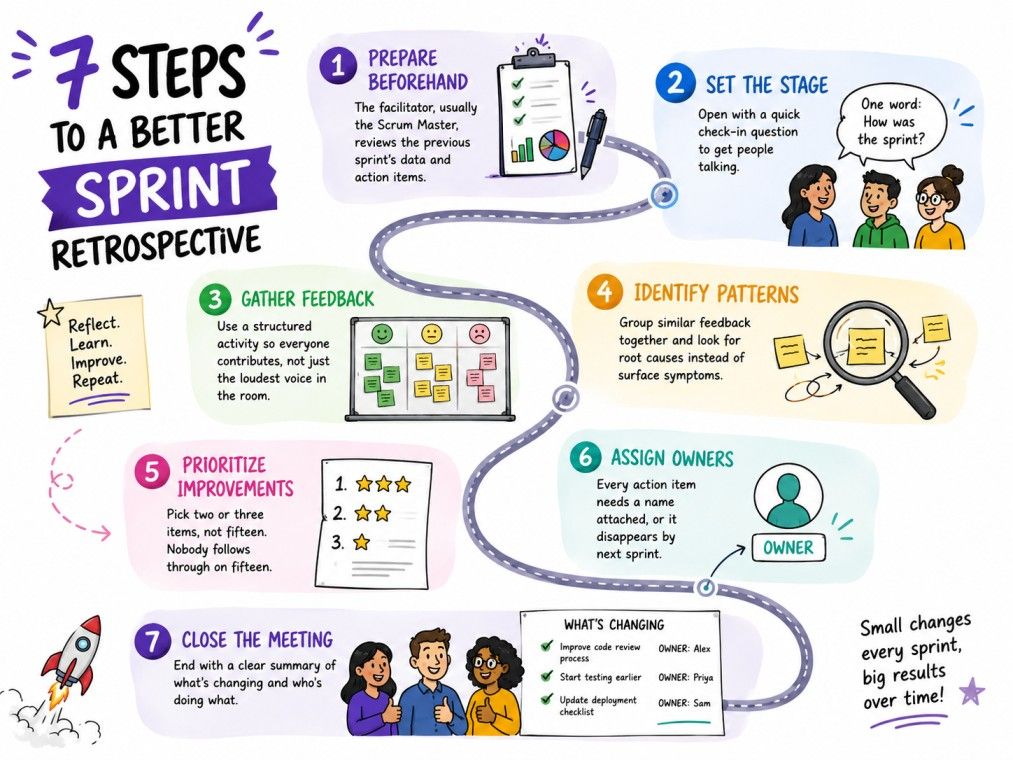
Teams shouldn’t try to fix everything in one sitting. A retrospective that produces two solid action items beats one that produces ten forgotten ones.
A clear agenda keeps discussions focused, prevents one topic from taking over the meeting, and gives everyone enough time to contribute. You can adjust the agenda based on sprint complexity, team size, or the retrospective activity you've chosen, but the overall flow should remain familiar so participants know what to expect.
A clear agenda keeps the meeting on track and respects everyone's time. Most retros run between 45 and 90 minutes depending on sprint length.
Stage |
Purpose |
Suggested Time |
| Check-in | Set a comfortable tone | 5 minutes |
| Review past actions | Follow up on last sprint's commitments | 10 minutes |
| Gather feedback | Collect input on what went well and what didn't | 20 minutes |
| Discuss and cluster | Group themes and dig into root causes | 15 minutes |
| Decide actions | Agree on next steps and owners | 10 minutes |
| Close | Recap and thank the team | 5 minutes |
Longer sprints, say three or four weeks, usually need the higher end of this range. Shorter one-week sprints can run a tighter 30-minute version without losing much value.
The quality of a sprint retrospective depends on the quality of the questions being asked. Generic questions usually produce generic answers. Thoughtful questions encourage team members to reflect, share practical insights, and suggest meaningful improvements. Keep them open-ended.
At the same time, avoid overwhelming the team with dozens of prompts. A focused discussion is far more productive than rushing through a long list of questions.
The questions you ask shape the quality of the conversation. Generic questions get generic answers.
Classic starting points include:
These work, but they can get stale after a few sprints. Rotate in variations like "what surprised you this sprint" or "what almost went wrong but didn't." Small changes keep the discussion fresh.
For distributed teams, add questions that surface communication gaps specifically, since remote work hides friction that's obvious in person. Something like "did you feel blocked waiting on someone else's response" often reveals issues async standups miss entirely.
Explore upGrad's IIM Kozhikode AI for Business Professionals Programme to build practical skills in AI strategy, Generative AI, Agentic AI, business transformation, enterprise AI adoption, AI governance, and data-driven decision-making through real-world case studies, hands-on workshops, and an industry-focused leadership capstone.
Management Courses to upskill
Explore Management Courses for Career Progression
IIIT-B & IIM, Udaipur
Chief Technology Officer & AI Leadership ProgrammeDifferent formats suit different team moods. Running the same activity every sprint gets tired fast, and people start going through the motions.
A simple and structured format that works well for most Agile teams, especially beginners. Team members identify new practices to start, ineffective habits to stop, and successful approaches to continue. It's quick to run and suitable for almost every sprint.
This activity focuses on how team members felt during the sprint rather than only discussing tasks. Participants group their experiences into three categories, Mad, Sad, and Glad. It's particularly useful after a challenging sprint because it helps uncover concerns that may not emerge in regular discussions.
Must read: What is the Agile Manifesto? Principles, Values, and Career Insights
Sailboat uses a visual exercise to explore team performance. The boat represents the team, the wind highlights factors driving progress, the anchors represent obstacles slowing the team down, and the rocks identify potential future risks. It encourages teams to think beyond completed work and prepare for upcoming challenges.
The Four Ls framework promotes balanced reflection by encouraging participants to discuss what they Liked, Learned, Lacked, and Longed For during the sprint. This format works especially well after complex projects or experimental sprints where teams want to capture both achievements and learning opportunities.
When a retrospective generates many ideas, Dot Voting helps the team prioritize them quickly. Each participant receives a limited number of votes and selects the improvements they believe deserve immediate attention. The highest-ranked ideas become the team's action items for the next sprint.
This activity shifts the focus from problems to recognition. Team members take turns acknowledging a colleague's contribution during the sprint. It strengthens trust, boosts morale, and helps build a more collaborative team culture.
A creative retrospective format that categorizes work into three levels. Straw houses represent weak practices, wooden houses represent acceptable practices, and brick houses represent strong, reliable processes. It's particularly effective for evaluating development workflows and identifying areas that need improvement.
Must read: How to Use Scrum Artifacts? Explained with Examples
A sprint retrospective creates value only when discussions turn into action. Without clear follow-up, teams often revisit the same problems sprint after sprint without making real progress.
Keep action items focused. Instead of trying to solve every issue, choose a few improvements that are realistic and achievable before the next sprint begins.
The success of a sprint retrospective depends on the quality of the action items it produces. Vague improvements rarely lead to change, while clear and measurable actions are much easier to complete and review in the next sprint.
A good action item should be:
Characteristic |
Description |
Example |
| Specific | Clearly states what needs to be done. | Poor: Improve communication. Better: Create a shared deployment checklist. |
| Assigned | Has one responsible owner. | Assign it to the DevOps Engineer. |
| Achievable | Can be completed in the next sprint. | Finish the checklist before the sprint ends. |
| Trackable | Easy to review in the next retrospective. | Check whether the checklist was created and used. |
Not every improvement needs immediate attention. Prioritize the actions that will have the biggest impact on your team's performance.
Ask questions like:
Limiting the list to two or three action items makes it easier for the team to complete them successfully.
Every sprint retrospective should begin by reviewing the action items from the previous sprint. This helps the team measure progress, discuss any unfinished work, and stay focused on continuous improvement.
Action Item |
Owner |
Due Date |
Status |
| Improve story refinement | Product Owner | Next Sprint | Completed |
| Reduce build failures | Development Team | Next Sprint | In Progress |
| Update testing checklist | QA Lead | Next Sprint | Pending |
Regularly reviewing action items keeps sprint retrospectives focused on measurable improvements instead of repeating the same discussions every sprint.
Must read: Scrum Master Roles and Responsibilities: The Secret to Agile Success!
Even experienced Agile teams make mistakes during retrospectives. Most aren't caused by poor intentions. They happen because teams lose focus, skip follow-up, or stop adapting their approach over time. Even experienced teams fall into these traps.
Common Mistake |
Why It Happens |
How to Avoid It |
| No follow-up | Action items aren't revisited. | Review previous action items in every retrospective. |
| Blame culture | Discussions focus on people instead of processes. | Focus on improving processes, not assigning blame. |
| Too many action items | Teams try to fix everything at once. | Limit action items to two or three priorities. |
| Using the same format every time | Repetitive meetings reduce engagement. | Rotate retrospective activities regularly. |
| Skipping psychological safety | Team members hesitate to speak honestly. | Create a safe and respectful discussion environment. |
The follow-up problem deserves extra attention. A retrospective without a check-in on last sprint's actions basically resets to zero every two weeks. That's wasted effort.
Must read: 12 Key Agile Principles: Core Concepts, Benefits, and Expert Tips
A few habits separate retros that drive real change from ones that just fill a calendar block.
None of this needs fancy tools. It needs consistency and a team willing to be honest about what isn't working.
A sprint retrospective isn't just another Scrum ceremony. It's the team's opportunity to pause, reflect, and improve before the next sprint begins.
The most effective teams don't aim for perfect retrospectives. They aim for consistent progress. Honest conversations, realistic action items, and regular follow-up help teams solve recurring problems before they become permanent habits.
Whether you're running your first sprint retrospective or refining an existing process, focus on one improvement at a time. Those small changes compound quickly, making every sprint a little stronger than the last.
Ready to start your journey? Book a free consultation with upGrad today to find the best path for your career.
The outcome of a sprint retrospective should be a small set of clear, actionable improvements for the next sprint. Instead of documenting every issue discussed, the team should prioritize two or three realistic actions, assign owners, and review their progress in the following retrospective.
Yes. Regular sprint retrospectives help teams identify recurring bottlenecks, improve collaboration, and refine their working practices. Even small process improvements made consistently across multiple sprints can lead to better productivity, fewer blockers, and more predictable sprint outcomes.
The Scrum Master usually facilitates the meeting because they help keep discussions constructive and focused. However, teams can rotate facilitators occasionally to encourage fresh perspectives, increase engagement, and develop facilitation skills across the Scrum team.
It's common for team members to have different opinions during a sprint retrospective. Instead of trying to solve every issue, teams can use simple prioritization methods like Dot Voting or consensus discussions to identify the improvements that will deliver the greatest impact in the next sprint.
Absolutely. A sprint retrospective isn't only for fixing problems. It's also an opportunity to recognize successful practices, strengthen collaboration, and identify habits that helped the team perform well so they can be repeated in future sprints.
A sprint retrospective happens after every sprint and focuses on improving the team's workflow during an Agile project. A project retrospective takes place after an entire project is completed and reviews overall project outcomes, lessons learned, and long-term improvements.
Generally, no. Sprint retrospective discussions often include internal feedback about team processes, communication, and collaboration. Sharing a summary of improvement actions may be helpful, but detailed discussions should remain within the Scrum team to encourage open and honest conversations.
Yes. New Agile teams often benefit the most because retrospectives help establish good collaboration habits early. They provide a regular opportunity to discuss challenges, clarify expectations, and improve team processes before small issues become recurring problems.
The biggest difference is the purpose of each meeting. In the sprint review vs retrospective, the sprint review evaluates the completed product with stakeholders, while the retrospective focuses on improving the team's workflow, communication, and collaboration before the next sprint begins.
Changing the retrospective activity every few sprints, asking different discussion questions, and reviewing previous action items can keep meetings engaging. Teams that continuously experiment with formats often uncover new insights instead of repeating the same conversations every sprint.
Teams often confuse these Scrum events because both occur at the end of a sprint. The sprint review vs sprint retrospective distinction becomes clear when you remember that the review focuses on the product and stakeholder feedback, while the retrospective focuses on team improvement and future ways of working.
972 articles published
We are an online education platform providing industry-relevant programs for professionals, designed and delivered in collaboration with world-class faculty and businesses. Merging the latest technolo...
Get Free Consultation
By submitting, I accept the T&C and
Privacy Policy
Top Resources
Certification
3 Months
Certification
6 Months
O.P. Jindal Global University
Masters in International Accounting and Finance (Accredited by ACCA, UK)Master's Degree
12 Months