Story Points in Agile: Meaning, Estimation Techniques, and Examples
By Sriram
Updated on Jul 10, 2026 | 6 min read | 1.78K+ views
Share:

All courses
Certifications
More
By Sriram
Updated on Jul 10, 2026 | 6 min read | 1.78K+ views
Share:
Table of Contents
Key takeaway
This blog walks you through what story points mean, how teams calculate them, and where most estimation attempts go wrong. You will also see real examples, a Fibonacci breakdown, and a practical comparison between story points and hours.
Explore upGrad's AI programs to build practical skills in generative AI, machine learning, deep learning, natural language processing, computer vision, and AI-powered automation. Gain hands-on experience through real-world projects, industry case studies, and practical applications to develop the expertise needed for high-growth careers in artificial intelligence.
Popular AI Programs
A story point in Agile is a unit of measure. It tells a team how much effort a user story will take compared to other stories, not how many hours it will consume.
Think of it like comparing the size of two tasks without a stopwatch. Is this feature roughly the same size as the last one? Bigger? Smaller by half? That comparison is the entire idea behind story points in agile.
Three things typically drive the number:
A story with unclear requirements often gets a higher score than a simple, well-defined one, even if both might take similar clock time. That is the part beginners usually miss.
Must read: What is Agile Software Development?
Teams use story points because hours lie. Two developers can take wildly different amounts of time on the same task, depending on skill, familiarity, or plain bad luck with a bug.
Story points sidestep that problem. They ask the team to agree on relative size instead of arguing over exact hours. This shift changes how sprint planning works.
A few real benefits of this are:
None of this makes estimation perfect. It just makes it less personal and more consistent, which is usually enough.
Also read: Agile Estimation Techniques
Free Courses
Estimating story points in agile starts with a shared reference story. Pick something the team has already built and knows well. Every new story gets compared against that baseline.
Here is a simple process teams actually use:
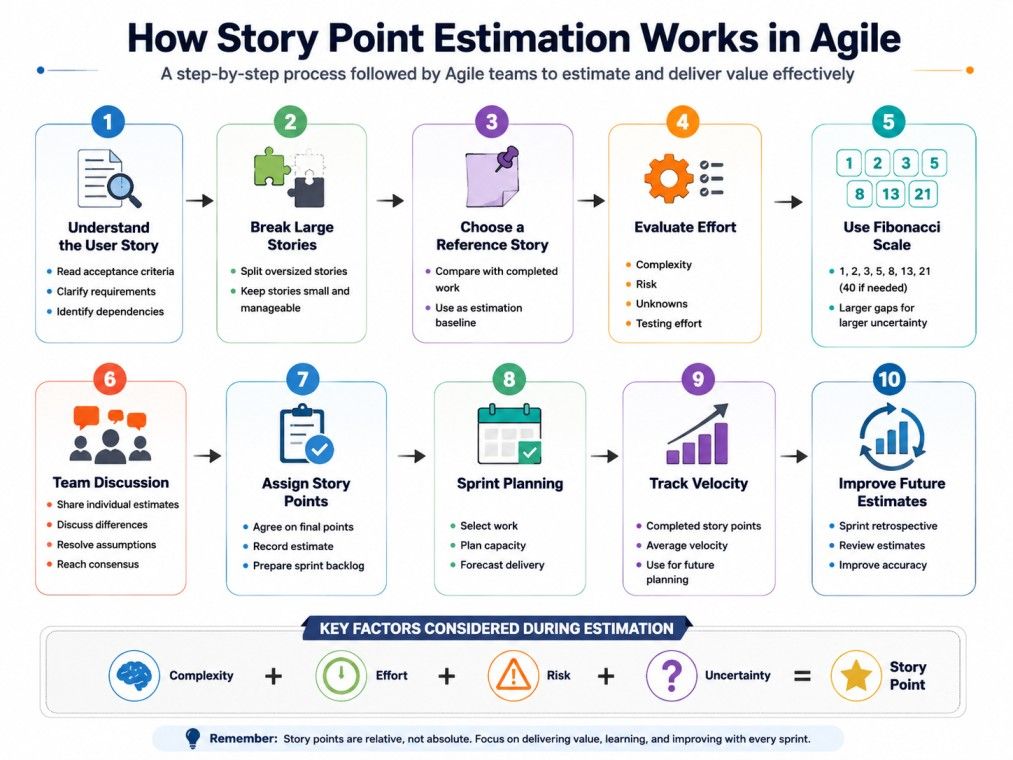
That last one is important. If one developer says 3 and another says 13, the gap usually means someone knows something the other does not. Talk it through before locking the number.
Knowing how to calculate story points in agile is less about a formula and more about a repeatable conversation. There is no equation that spits out a perfect score. It is a group decision anchored to past experience.
Most teams use a modified Fibonacci sequence for their scale: 1, 2, 3, 5, 8, 13, 21, and sometimes 40 for anything too big to estimate properly.
Why Fibonacci and not plain numbers? Because the gaps between small tasks need to be precise, while the gaps between large tasks can afford to be rough. Nobody needs to argue between a 19 and a 20. Nobody should.
An 8 story points in agile task usually signals real complexity. It might involve backend work, some testing overhead, and a few unknowns that make the team nervous. Compare that to a 2, which typically means a small, well-understood change with almost no surprises.
Here's a quick reference:
Points |
Typical Meaning |
| 1-2 | Very simple, low risk |
| 3-5 | Moderate effort, some unknowns |
| 8 | Complex, multiple moving parts |
| 13+ | High uncertainty, consider splitting |
If a story regularly lands above 13, it's probably too big. Split it.
Explore upGrad's Chief Technology & AI Officer (CTAIO) Programme to develop executive-level expertise in AI strategy, enterprise architecture, cloud platforms, technology governance, digital transformation, and boardroom leadership. Learn through real-world AI use cases, executive workshops, and a capstone CTO dossier to build the strategic capabilities needed to lead AI-driven business transformation at scale.
AI Courses to upskill
Explore Artificial Intelligence Courses for Career Progression
There isn't a single correct way to estimate story points. Different teams prefer different techniques depending on their size, project complexity, and level of experience. The goal stays the same. Reach a shared understanding of effort through collaboration rather than individual guesses.
Here are three widely used approaches:
Planning Poker is the most popular estimation technique in Scrum. Each team member receives a set of cards with story point values based on the Fibonacci sequence. After discussing a user story, everyone reveals their estimate at the same time.
If the numbers differ, the team discusses the reasons before voting again.
This method works well because it:
Planning Poker is especially useful when the work contains uncertainty or multiple technical approaches.
Must read: What is the Agile Manifesto? Principles, Values, and Career Insights
Affinity Estimation is faster than Planning Poker. Instead of discussing every story individually, the team groups similar user stories based on their relative size. Once the stories are arranged from smallest to largest, story points are assigned to each group.
This technique works well for:
It saves time without sacrificing consistency.
Must read: 12 Key Agile Principles: Core Concepts, Benefits, and Expert Tips
The Bucket System is designed to estimate many stories quickly. Several "buckets" are labelled with story point values such as 1, 2, 3, 5, 8, and 13. Team members place each user story into the bucket they believe best represents its effort. The group reviews any disagreements before finalising the estimates.
This approach is useful when:
Choosing the Right Technique. There's no universal winner.
Technique |
Best For |
Main Advantage |
| Planning Poker | Sprint planning | Strong team discussion |
| Affinity Estimation | Backlog refinement | Faster grouping of similar stories |
| Bucket System | Large backlogs | Quick estimation of many stories |
Whichever method your team chooses, consistency matters more than speed. The best estimation technique is the one your team understands, trusts, and applies in the same way across every sprint.
Do read: Difference Between Agile and Scrum: Agile vs Scrum, Key Comparisons and Insights
This comparison comes up in almost every retrospective, especially with teams new to agile. Story points measure relative effort. Hours measure literal time. They are not interchangeable, and treating them that way defeats the purpose.
Story Points |
Hours |
| Relative, team-based | Absolute, individual-based |
| Accounts for uncertainty | Assumes fixed pace |
| Stable across sprints | Varies by person and day |
| Hard to convert directly | Easy to misuse for pressure |
Managers sometimes ask for a direct hour conversion. The moment a team converts points to hours, people start gaming the numbers to avoid looking slow. That's the opposite of what estimation should do.
Hours still have their place though, mainly for short tasks with no ambiguity, like a config change or a one-line fix.
Seeing examples helps more than any definition. Here's how a team might score a few common user stories.
User Story |
Complexity |
Story Points |
Reason |
| Update profile picture | Low | 2 | Simple UI change, no backend logic |
| Add password reset flow | Medium | 5 | Validation, email trigger, edge cases |
| Integrate payment gateway | High | 8 | Backend, security, third-party API |
| Add multi-language support | Very High | 13 | Wide scope, high uncertainty |
Did you see, how the reasoning column matters as much as the number? A team that only writes down "8" without context will forget why they chose it three sprints later.
Also read: 23+ Best Agile Project Management Tools for 2025: Features and Benefits
Velocity is simply the total story points a team completes in a sprint. Track it over several sprints and you get a rough but genuinely useful forecasting tool.
Say a team logs 28, 31, and 30 points across three sprints. Average velocity sits near 30. That number helps plan how much work fits into the next sprint, nothing more precise than that.
A common mistake is comparing velocity between two different teams. Don't do it. Velocity is specific to a team's own scale and habits. A 30-point sprint for one team could mean something completely different for another.
Do read: Sprint Planning in Agile Methodology: Its Importance and Benefits
Subscribe to upGrad's Newsletter
Join thousands of learners who receive useful tips
Story points estimate the effort required for individual user stories, while sprint velocity measures how many of those story points a team completes during a sprint. Together, they help Agile teams plan future sprints based on historical performance rather than guesswork.
The relationship follows a simple workflow.
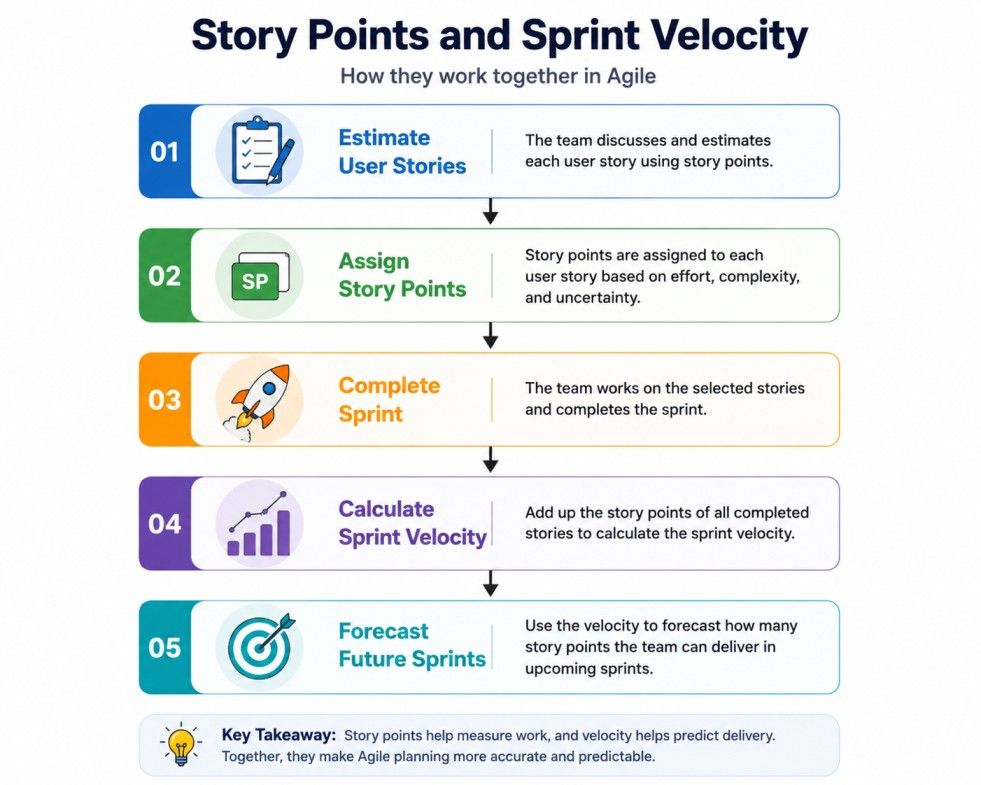
As teams complete more sprints, their average velocity becomes a reliable planning metric. Instead of estimating delivery timelines using hours, they can forecast future work based on the number of story points they typically complete in each sprint. This leads to more realistic sprint commitments and better release planning.
Must read: Scrum Master Roles and Responsibilities: The Secret to Agile Success!
Estimating user stories with story points is a collaborative process that focuses on relative effort rather than time. Instead of asking how many hours a task will take, Agile teams compare a new user story with previously completed work and assign a story point value based on its complexity, amount of work, risk, and uncertainty.
Follow these steps to estimate user stories effectively.
Understand the user story: Read the acceptance criteria and clarify any unclear requirements before estimating. A well-defined story leads to a more accurate estimate.
Choose a reference story: Select a completed user story that the team already understands. This acts as a benchmark for comparing new work.
Evaluate the effort:
Discuss the user story by considering:
Assign a story point value: Use the team's agreed estimation scale, such as the Fibonacci sequence (1, 2, 3, 5, 8, 13), and compare the new story with the reference story to determine the closest estimate.
Review the estimate as a team: Encourage discussion if team members have different estimates. These conversations often uncover hidden assumptions or missing requirements before development begins.
The goal isn't to predict the exact time required. It's to create consistent estimates that help the team plan sprints, measure velocity, and improve forecasting over time.
Must read: Agile Epic Explained: How to Manage Big Features Effectively
Story point estimation becomes more accurate with experience, but even mature Agile teams can develop habits that reduce its effectiveness. Most estimation problems don't come from the scoring system itself. They happen because teams drift away from the principles of relative estimation and collaborative discussion.
Here are some of the most common mistakes to avoid.
Mistake |
Why It Causes Problems |
Better Approach |
| Estimating individually | Misses different perspectives and hidden risks | Estimate as a team through discussion |
| Treating story points as hours | Defeats the purpose of relative estimation | Focus on effort, complexity, and uncertainty |
| Comparing velocity across teams | Every team has its own estimation baseline | Compare velocity only within the same team |
| Ignoring uncertainty | Leads to optimistic estimates and missed sprint goals | Include risk and unknowns in the estimate |
| Inflating estimates as a safety buffer | Makes sprint planning unreliable | Estimate honestly using reference stories |
The goal isn't to make estimates perfect. It's to make them realistic enough that the team can plan confidently and improve with every sprint.
Also read: Safe Agile vs Agile: Difference Between Agile and Safe Agile
Improving accuracy is less about better math and more about better habits. A few things genuinely help:
None of these guarantee a perfect number. They just shrink the gap between guess and reality over time, which is really all estimation can promise.
Also read: 12 Key Agile Principles: Core Concepts, Benefits, and Expert Tips
A short list worth pinning somewhere visible:
Consistency beats precision here. A team that estimates the same way every sprint will plan better than one chasing a perfect number that doesn't exist.
Story points in agile work best when treated as a planning tool, not a performance metric. Teams that remember this tend to argue less and ship more predictably.
Understanding story points in agile is less about memorising numbers and more about changing how you think about estimation. Instead of predicting exact hours, Agile teams compare work based on effort, complexity, risk, and uncertainty. This creates more reliable sprint planning and encourages better collaboration across the team.
As your team gains experience, estimates become more consistent because they're based on shared reference stories rather than individual assumptions. Whether you're estimating a two-point UI change or an eight-point integration, the goal remains the same. Build a common understanding of the work, learn from each sprint, and keep refining your estimation process over time.
Ready to start your journey? Book a free consultation with upGrad today to find the best path for your career.
No. There isn't a mathematical formula for how to calculate story points in Agile. Teams estimate relatively by comparing a new user story with previously completed work. They consider effort, complexity, uncertainty, and dependencies before agreeing on a story point value through discussion.
New teams usually begin by selecting one or two simple user stories as reference points. During estimating story points in Agile, every new story is compared against those references until the team develops a shared understanding and consistent estimation habits over several sprints.
8 story points in Agile generally indicate a feature with moderate to high complexity. It often involves multiple development tasks, testing, integrations, or technical uncertainty. The number doesn't represent hours. It simply reflects a larger effort than a five-point story while still being manageable within a sprint.
When teams aren't familiar with a feature, they discuss technical risks, unknown requirements, dependencies, and possible implementation approaches before estimating. Learning how to determine story points in Agile means accounting for uncertainty instead of assuming the best-case scenario.
Yes. Story points should represent all the work needed to complete a user story according to the team's Definition of Done. That usually includes development, testing, code review, bug fixing, documentation, and deployment activities required to deliver a finished feature.
If the scope changes significantly after estimation, the team can revisit the story points. Minor implementation changes usually don't require a new estimate. Re-estimating only when the scope genuinely changes helps maintain consistency and keeps sprint planning meaningful.
If most stories receive high estimates, they're probably too large or not clearly defined. Break them into smaller user stories before estimating again. Smaller backlog items are easier to understand, estimate, test, and complete within a single sprint.
Teams should review estimation accuracy during Sprint Retrospectives rather than after every user story. Looking back at completed work helps refine future estimates, improve consistency, and identify patterns that affected sprint planning without changing the team's estimation scale.
Yes. Story points are relative to each team's experience, reference stories, and estimation practices. A five-point story for one team might be an eight-point story for another. That's why story points and sprint velocity should never be compared across different teams.
The most common mistake is treating story points as hidden time estimates. During estimating story points in Agile, beginners often try converting points into hours instead of comparing relative effort. That approach reduces estimation accuracy and weakens the purpose of story points.
698 articles published
Sriram K is a Senior SEO Executive with a B.Tech in Information Technology from Dr. M.G.R. Educational and Research Institute, Chennai. With over a decade of experience in digital marketing, he specia...
Speak with AI & ML expert
By submitting, I accept the T&C and
Privacy Policy
Top Resources
Master's Degree
18 Months
Executive Diploma
12 Months
IIIT Bangalore
Executive Programme in Generative AI & Agentic AI for LeadersIndia’s #1 Tech University
Dual Certification
5 Months