How to Become a Service Desk Analyst: Skills, Responsibilities, and Career Path
By Sriram
Updated on Jul 09, 2026 | 9 min read | 7.2K+ views
Share:

All courses
Certifications
More
By Sriram
Updated on Jul 09, 2026 | 9 min read | 7.2K+ views
Share:
TL;DR
In this blog , you'll learn what a service desk analyst does, the skills required for the role, different types of service desk positions, common tools used in the job, salary trends, and the career path available in IT support.
Preparing for a service desk analyst career is just the first step. Build in-demand IT support, networking, cybersecurity, and IT service management skills with upGrad's Management programs through flexible online learning.
Popular Management Programs
A service desk analyst is an IT support professional responsible for handling technical issues, service requests, and user support. The role focuses on restoring normal service as quickly as possible while maintaining a positive support experience.
Think of the service desk as the central point of contact between users and the IT department. When something goes wrong, users usually create a ticket or call the service desk. The analyst then investigates the issue and either resolves it directly or routes it to the appropriate technical team.
Typical tasks include:
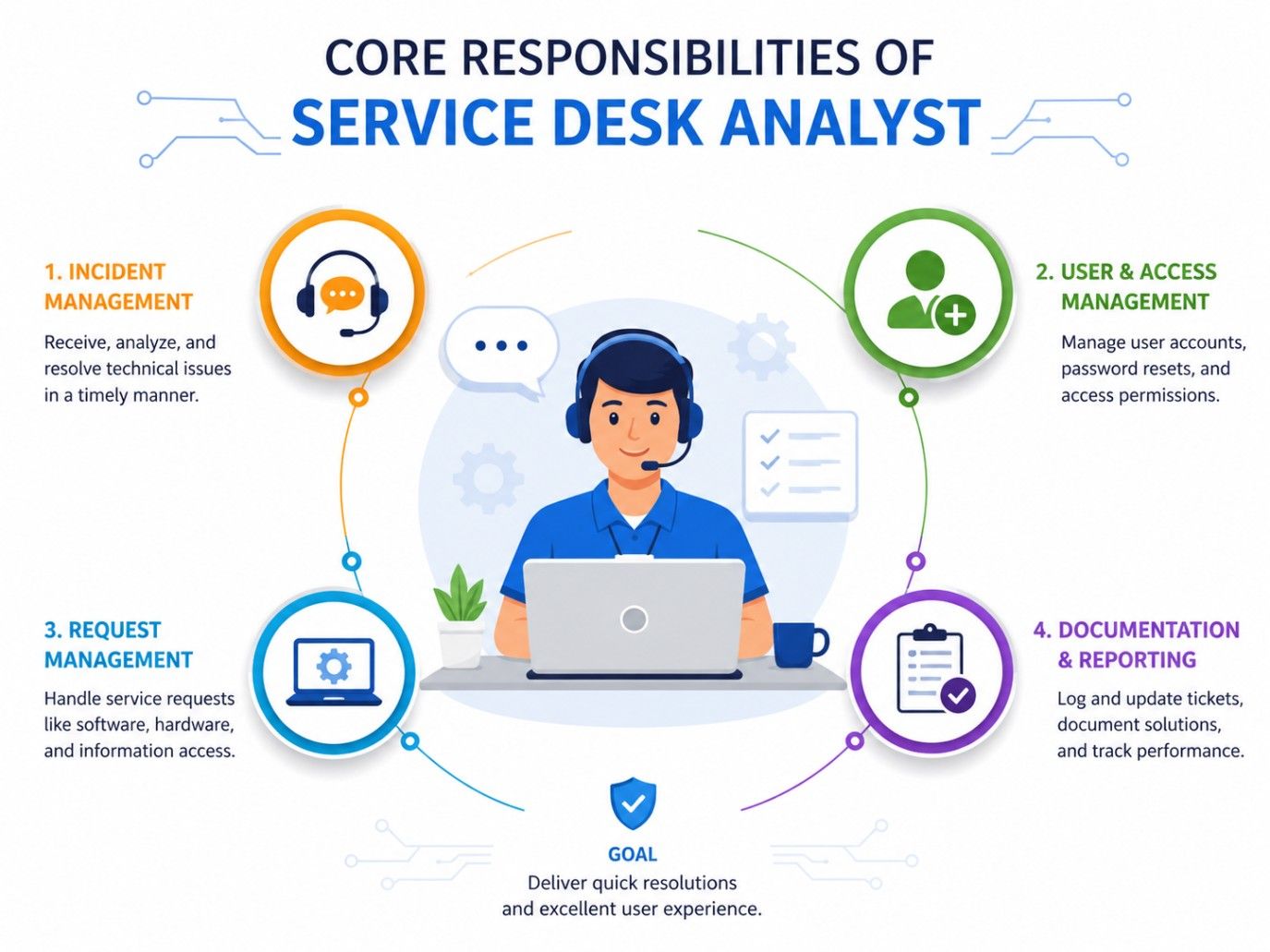
The service desk analyst responsibilities go beyond answering calls. Analysts manage incidents, communicate with users, document solutions, and help maintain IT service quality.
Free Courses
A service desk analyst works in a dynamic IT support environment where no two days are the same. The role involves assisting users, resolving technical issues, and collaborating with different IT teams to maintain smooth business operations.
Depending on the organization, a service desk analyst may work in:
Many organizations provide 24/7 IT support, so analysts may work:
A typical day in the service desk analyst role may include:
The variety of tasks and exposure to different technologies make this role an excellent starting point for building a long-term career in IT support.
A service desk analyst role is a strong starting point for an IT career. It builds practical skills in IT support, networking, cloud, cybersecurity, and customer service while helping you develop problem-solving and communication abilities. The experience gained also creates opportunities to progress into specialized and higher-paying IT roles.
A common career progression looks like this:
Career Stage |
Primary Responsibilities |
| Service Desk Analyst | Resolve basic incidents, handle service requests, and support end users |
| Senior Service Desk Analyst | Troubleshoot complex issues and mentor junior analysts |
| Service Desk Team Lead | Manage daily operations and monitor team performance |
| IT Support Lead | Oversee support teams across departments or locations |
| Incident Manager | Coordinate major incident responses and minimize downtime |
| Service Delivery Manager | Improve IT service quality and customer satisfaction |
| IT Service Manager | Plan and manage overall IT service operations |
Career growth isn't always linear. Some professionals move into networking, cloud computing, cybersecurity, system administration, or DevOps after gaining a few years of experience.
Employers often look beyond technical knowledge when promoting employees. They also value people who communicate well, take ownership of problems, and work effectively with different teams.
To move into senior positions, focus on building these skills:
Technology changes quickly, and staying curious helps you remain valuable throughout your career.
Management Courses to upskill
Explore Management Courses for Career Progression
IIIT-B & IIM, Udaipur
Chief Technology Officer & AI Leadership ProgrammeIIM Kozhikode
PCP in AI for Business ProfessionalsThe terms "service desk" and "help desk" are sometimes used interchangeably, but they don't always mean the same thing. Understanding the difference helps job seekers choose roles that match their career goals.
A help desk mainly focuses on fixing technical problems. A service desk supports broader IT services while following structured service management processes.
Feature |
Service Desk Analyst |
Help Desk Analyst |
| Primary Focus | End-to-end IT service support | Resolving technical issues |
| Scope | Incidents, requests, and service management | Incident resolution |
| ITIL Alignment | Commonly follows ITIL | Less structured in some organizations |
| Customer Interaction | Ongoing service relationship | Issue-based interaction |
| Documentation | Extensive | Usually limited to ticket updates |
| Career Growth | Broader opportunities in ITSM | Often progresses into technical support |
Also Read: How to Develop Analytical Thinking [A Complete Guide]
Although both roles provide technical support, their responsibilities differ in several ways.
A desktop support engineer usually works more closely with physical devices, while a service desk analyst often provides remote assistance through ticketing systems and support platforms.
Feature |
Service Desk Analyst |
Desktop Support Engineer |
| Support Method | Mostly remote | Mostly on-site |
| Primary Focus | Service requests and incidents | Hardware and workstation support |
| Hardware Repairs | Limited | Frequent |
| Ticket Management | Major responsibility | Shared responsibility |
| End User Support | Remote and phone-based | Face-to-face support |
| Infrastructure Exposure | Moderate | High for endpoint devices |
Also Read: What is a Business Management Degree?
Imagine an analyst starting a morning shift. Within the first hour, they might handle a locked account, troubleshoot a VPN issue for a remote employee, and escalate a server-related ticket to the infrastructure team.
Later in the day, they may update knowledge articles, follow up on pending incidents, and review SLA reports. No two days are exactly the same. That's one reason many people find the service desk analyst role engaging.
Also Read: How To Improve Your Career Skills for a Job and Employability
Typical Support Workflow
Receive Ticket → Prioritize → Diagnose → Resolve (or escalate) → Document Resolution → Close Ticket
Not all service desk jobs are identical. Organizations structure support teams differently depending on their size and technology environment.
Role Type |
Main Focus |
| L1 Service Desk Analyst | Basic troubleshooting and ticket logging |
| L2 Service Desk Analyst | More advanced technical issues |
| Application Support Analyst | Business applications |
| Enterprise Service Desk Analyst | Large-scale corporate support |
| Remote Service Desk Analyst | Virtual user support |
| MSP Service Desk Analyst | Support for multiple client companies |
Technical knowledge matters, but communication is equally important. A skilled analyst can explain technical issues in simple language and keep users informed throughout the support process.
Technical Skills |
Soft Skills |
Beginner Checklist |
| Windows & macOS basics | Clear communication | Troubleshoot basic PC issues |
| Networking fundamentals | Patience | Explain technical problems in simple language |
| Active Directory | Problem-solving | Document troubleshooting steps accurately |
| Microsoft 365 | Time management | Manage multiple support tickets |
| Remote desktop tools | Empathy | Use remote support tools |
| Ticketing systems | Prioritization | Prioritize incidents effectively |
| ITIL concepts | Attention to detail | Follow basic troubleshooting processes |
| Basic cybersecurity awareness | Teamwork | Escalate complex issues when needed |
Also read : A Complete Guide to a Career In Product Management
Most employers prefer candidates with a degree or diploma in computer science, information technology, or a related field. However, many successful analysts come from non-technical backgrounds after completing IT support training.
Common qualifications include:
Experience often matters more than formal education. A candidate who can demonstrate practical problem-solving skills may stand out even without a traditional IT degree.
Also Read: 15 Ways to Improve Your Time Management Skills [With Actionable Tips]
Many IT professionals begin their careers as a service desk analyst because the role offers hands-on exposure to different technologies, business processes, and customer interactions. It doesn't require years of experience, but it does require curiosity, patience, and a willingness to learn every day.
If you're wondering where to start, focus on building practical skills instead of trying to master everything at once. Employers value candidates who can troubleshoot common issues, communicate clearly, and adapt to new technologies.
A strong foundation makes troubleshooting much easier. Start by understanding how computers, networks, and operating systems work.
Key topics include:
Don't rush this stage. A clear understanding of the basics helps you solve problems faster later in your career.
The next step is learning the technologies you'll use every day.
Focus on skills such as:
These technical abilities form a large part of typical service desk analyst responsibilities.
Almost every organization uses a ticket management platform to track incidents
and service requests.
Popular tools include:
Understanding how tickets are created, prioritized, assigned, and closed gives you a clear picture of the service desk analyst role in day-to-day operations.
Also Read: A Comprehensive Guide to General Management: Roles, Skills, and Career Opportunities
Theory alone isn't enough. Employers want candidates who can apply their knowledge to real situations.
You can build experience by:
Even small projects demonstrate initiative and problem-solving skills.
Certifications strengthen your resume, but they shouldn't replace practical learning.
Popular beginner certifications include:
Certification |
Best For |
| CompTIA A+ | Hardware and software fundamentals |
| ITIL Foundation | IT service management concepts |
| Google IT Support Professional Certificate | Entry-level IT support skills |
| Microsoft Fundamentals Certifications | Microsoft technologies |
These certifications also help you understand industry terminology before entering the workplace.
Before applying, make sure your resume highlights:
A candidate with practical examples often stands out more than someone who only lists software names.
Also Read: Top 10 People Management Skills for Managers
Service desk analysts use a range of IT support tools to manage incidents, troubleshoot technical issues, monitor systems, and communicate with users. While the software varies across organizations, most analysts rely on five core categories of tools.
Ticketing systems help service desk analysts log, prioritize, track, and resolve support requests while ensuring SLA compliance.
Popular Tools |
Primary Use |
| ServiceNow | Enterprise IT service management (ITSM) |
| Jira Service Management | Incident and request management |
| Freshservice | Cloud-based IT service management |
| Zendesk | Customer and IT support |
| ManageEngine ServiceDesk Plus | Help desk and IT asset management |
Remote support software enables analysts to troubleshoot user devices without being physically present, making it essential for hybrid and remote workplaces.
Popular Tools |
Primary Use |
| Microsoft Remote Desktop | Remote Windows access |
| TeamViewer | Remote troubleshooting |
| AnyDesk | Secure remote support |
| BeyondTrust | Enterprise remote access |
Monitoring tools help IT teams detect system issues before they affect end users, reducing downtime and improving service availability.
Popular Tools |
Primary Use |
| SolarWinds | Network and infrastructure monitoring |
| PRTG Network Monitor | Performance monitoring |
| Nagios | Server and application monitoring |
| Datadog | Cloud infrastructure monitoring |
Knowledge management platforms provide centralized documentation that helps analysts resolve recurring issues consistently.
Effective communication tools help service desk analysts collaborate with users and internal IT teams throughout the support process.
Popular Tools |
Primary Use |
| Microsoft Teams | Team collaboration |
| Slack | Internal communication |
| Outlook | Email support |
| Zoom | Virtual meetings and remote assistance |
Ready to take your IT career beyond the service desk? As AI transforms IT support and service management, upskill with upGrad's IIM Kozhikode Strategic AI for Business Professionals – Leadership for an AI-First World program to develop AI, automation, and strategic decision-making skills for the next generation of technology roles.
The service desk analyst role involves handling multiple technical and customer service responsibilities every day. Understanding these common challenges can help you perform more effectively.
Unexpected system outages or software issues can lead to a surge in support requests. Prioritizing critical tickets helps maintain service quality.
Service Level Agreements (SLAs) define response and resolution timelines. Efficient ticket management is essential to meet these targets and ensure customer satisfaction.
Users may be stressed when technical issues disrupt their work. Staying calm, listening actively, and communicating clearly helps build trust.
Service desk analysts often manage several incidents at once. Good time management and timely escalations prevent delays and improve productivity.
Detailed ticket updates and resolution notes help teams resolve recurring issues faster, improve knowledge sharing, and maintain service records.
Also Read: Top 10 Books to Improve Communication Skills
Building a successful career as a service desk analyst requires a combination of technical expertise, communication, and continuous learning. Follow these best practices to improve your performance and deliver better IT support.
Also read : Best Business Management Courses in India [2026]
A service desk analyst plays a vital role in keeping IT operations running smoothly by resolving technical issues, managing service requests, and supporting users. The service desk analyst role also offers an excellent starting point for an IT career, providing hands-on experience, continuous learning, and a clear path to roles in networking, cloud computing, cybersecurity, and IT service management. With the right technical and communication skills, you can build a rewarding and long-term career in IT support.
Ready to start your journey? Book a free consultation with upGrad today to find the best path for your career.
Yes, a service desk analyst remains one of the best entry points into the IT industry. Organizations across banking, healthcare, retail, and technology continue to hire IT support professionals. The role also provides a strong foundation for advancing into cloud computing, cybersecurity, system administration, and IT service management.
Most people can prepare for an entry-level service desk analyst role within 6–12 months, depending on their background. Learning IT fundamentals, practicing troubleshooting, and gaining hands-on experience through internships, labs, or certifications can significantly improve your chances of securing your first job.
A service desk analyst provides first-line IT support by resolving technical issues, handling service requests, and assisting users with hardware, software, and network-related problems. Their daily work includes troubleshooting incidents, managing support tickets, documenting solutions, and escalating complex issues to specialized IT teams when needed.
No. A service desk analyst is an IT support professional who works directly with technology, users, and business systems. Although the role involves strong communication and customer service skills, it primarily focuses on diagnosing technical issues, managing IT services, and supporting organizational technology infrastructure.
The service desk analyst role can be demanding during major system outages or periods of high ticket volume. However, good time management, effective prioritization, and clear communication help analysts handle pressure while delivering quality support. Experience also makes managing challenging situations much easier over time.
Yes. Working in an IT service desk is considered a core IT profession. Service desk teams support business operations by resolving technical incidents, managing service requests, maintaining IT systems, and following IT service management practices that help organizations minimize downtime and improve productivity.
Yes. Many employers hire candidates from different educational backgrounds if they have the required technical knowledge and practical skills. Building a strong understanding of operating systems, networking, and troubleshooting, along with relevant certifications, can help you qualify for an entry-level service desk analyst role.
Several factors influence service desk analyst salary, including experience, location, technical expertise, certifications, and the industry you work in. Professionals with knowledge of cloud platforms, ITIL, Microsoft technologies, or cybersecurity often have better earning potential and stronger career growth opportunities.
Popular certifications include CompTIA A+, ITIL Foundation, Microsoft Fundamentals, and the Google IT Support Professional Certificate. While certifications strengthen your resume, employers also value hands-on troubleshooting experience and a solid understanding of service desk analyst responsibilities in real-world IT environments.
Most employers look for candidates who combine technical knowledge with strong communication and problem-solving skills. Understanding service desk analyst responsibilities, working with ticketing systems, documenting incidents accurately, and delivering excellent customer support are qualities that often make candidates stand out during the hiring process.
As IT environments evolve, service desk professionals should continue learning cloud computing, cybersecurity basics, automation, AI-assisted support tools, and IT service management practices. Combining these technical skills with communication, adaptability, and continuous learning helps a service desk analyst remain competitive and progress into senior IT roles.
724 articles published
Sriram K is a Senior SEO Executive with a B.Tech in Information Technology from Dr. M.G.R. Educational and Research Institute, Chennai. With over a decade of experience in digital marketing, he specia...
Get Free Consultation
By submitting, I accept the T&C and
Privacy Policy
Top Resources
Certification
3 Months
Certification
6 Months
O.P. Jindal Global University
Masters in International Accounting and Finance (Accredited by ACCA, UK)Master's Degree
12 Months