Rust vs Python: Which Language Should You Learn or Use?
By Rahul Singh
Updated on Jul 01, 2026 | 10 min read | 4.08K+ views
Share:

All courses
Certifications
More
By Rahul Singh
Updated on Jul 01, 2026 | 10 min read | 4.08K+ views
Share:
Table of Contents
Python and Rust are two popular programming languages designed for different goals. Python focuses on simplicity, readability, and rapid development, making it a top choice for artificial intelligence, data science, automation, and web development. Rust, on the other hand, prioritizes performance, memory safety, and concurrency, making it ideal for systems programming and high-performance applications.
This blog breaks down everything you need about rust vs python. You will see how they compare across ten key parameters, understand what each language was actually built for, explore where they genuinely overlap, and walk away knowing exactly which one fits your goals right now.
Want to turn your programming skills into real-world AI expertise? Explore upGrad's Artificial Intelligence Courses and build practical skills in machine learning, generative AI, and intelligent application development.
Popular AI Programs
Here is a direct look at rust vs python across the ten parameters that matter most when choosing a language for your next project or learning path.
Parameter |
Rust |
Python |
| Developed by | Graydon Hoare at Mozilla Research | Guido van Rossum |
| Year released | 2010 (stable in 2015) | 1991 |
| Memory management | Manual, ownership-based, no garbage collector | Automatic garbage collection |
| Performance | Near C/C++ level speed | Interpreted and significantly slower |
| Type system | Statically typed, strict at compile time | Dynamically typed |
| Learning curve | Very steep; ownership and borrowing take time | Gentle; one of the easiest languages to start with |
| Primary use cases | Systems programming, WebAssembly, embedded, CLI | Data science, ML, web development, scripting |
| Concurrency | Thread-safe by design through the ownership model | Global Interpreter Lock limits true multi-threading |
| Package ecosystem | Cargo and crates.io | pip and PyPI, one of the largest in the world |
| Job market | Growing fast in infrastructure and systems roles | Massive; consistently top three globally |
This table gives a quick snapshot, but the real differences run deeper. Let's look at each language on its own terms.
Also Read: The Ultimate Free Python Course: Learn & Get Certified Today!
Free Courses
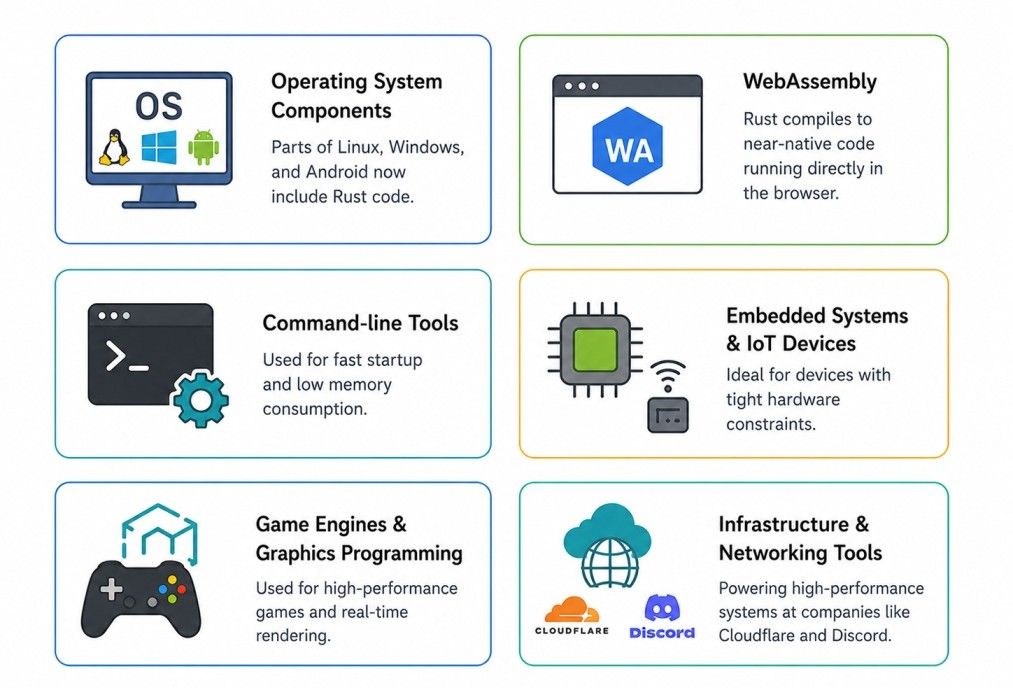
Rust is a systems programming language built to give developers full control over memory and performance without giving up safety. Graydon Hoare began working on it at Mozilla Research, and the language had its first stable release in 2015. Mozilla used Rust internally to build performance-critical parts of the Firefox browser before it became widely adopted across the industry.
The core idea behind Rust is straightforward: you should not have to choose between fast code and safe code. Traditional systems languages like C and C++ are fast, but they allow memory errors such as null pointer dereferences, buffer overflows, and data races. Rust eliminates those entire classes of bugs at the compiler level through its ownership system.
Also Read: AI Coding Agents: Complete Guide for Developers in 2026
Rust started in systems programming but has expanded significantly in recent years. You will find it in:
Details |
|
| Pros | Extremely fast, memory safe without GC, excellent concurrency support, growing industry adoption in high-performance domains |
| Cons | Very steep learning curve, longer compile times, smaller standard library than Python, fewer third-party packages overall |
Also Read: Artificial Intelligence Tools: Platforms, Frameworks, & Uses
AI Courses to upskill
Explore Artificial Intelligence Courses for Career Progression
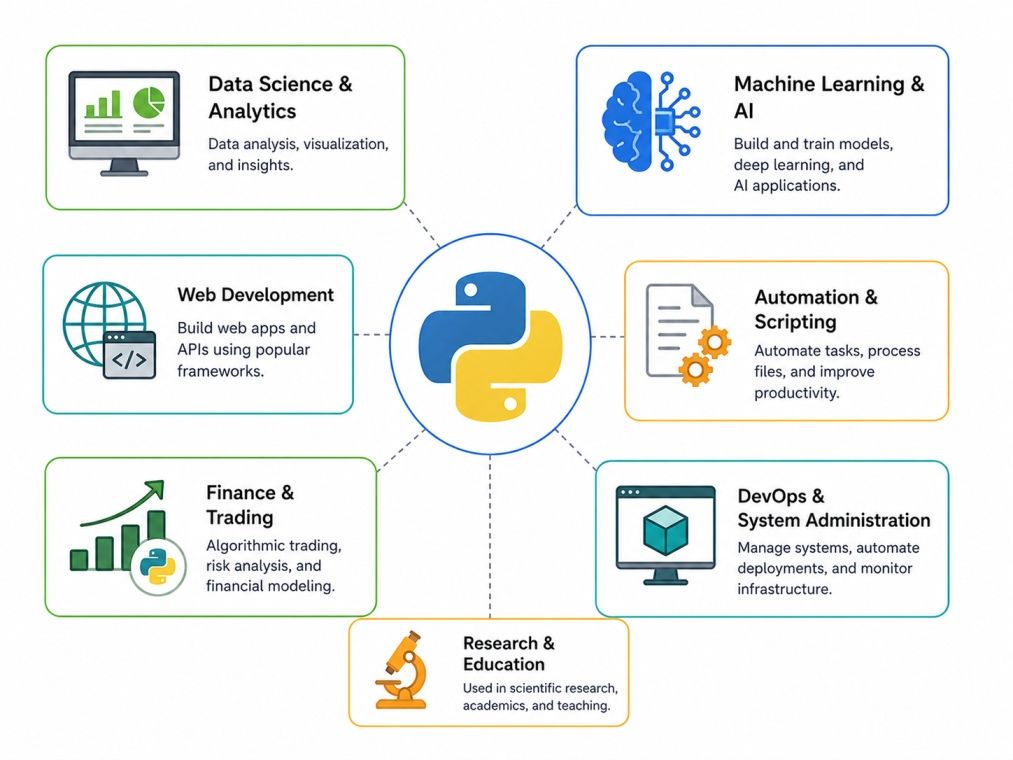
Python is a high-level, interpreted programming language built around clean, readable syntax and versatility across many domains. Guido van Rossum created it and released the first version in 1991. The language had one explicit design goal: write code that looks almost like plain English, so that programmers can focus on solving problems rather than fighting syntax.
That philosophy paid off enormously. Python became one of the most widely used programming languages in the world, powering everything from simple one-line automation scripts to the most sophisticated machine learning systems running in production today.
Want to build high-performance software and AI-powered applications? Take the next step with upGrad's IIT Kharagpur - Executive Post Graduate Certificate in AI-Native Software Engineering and Executive Diploma in Data Science & Artificial Intelligence from IIITB to develop industry-ready AI and software engineering skills.
Python is one of the most versatile languages available today. It appears heavily in:
Details |
|
| Pros | Easy to learn, enormous ecosystem, dominant in ML and data science, massive community and one of the strongest global job markets |
| Cons | Slow execution speed compared to compiled languages, Global Interpreter Lock limits true multi-threading, not suitable for memory-critical or systems-level work |
Also Read: 25+ TensorFlow Projects for Beginners to Explore Across Various Domains in 2026
The rust vs python comparison often focuses on what separates them. But there are real shared traits worth knowing, especially if you are thinking about using both together.
That last point matters more than people expect. A common real-world pattern is using Python for the developer-facing layer and high-level logic, then dropping into Rust for the performance-critical parts of the system where milliseconds or memory genuinely count.
The rust vs python decision usually comes down to three things: what you are building, what your constraints are, and how much time you can invest upfront in learning.
Choose Rust if:
Also Read: Python Libraries Explained: List of Important Libraries
Choose Python if:
There is also a productive middle ground. Many production systems combine both. A machine learning pipeline might use Python for model training and experimentation, then Rust for the inference server that handles live predictions at scale.
Rust and Python are both excellent languages built for very different purposes. Rust gives you speed, memory safety, and full control over how your program uses hardware. Python gives you simplicity, an enormous ecosystem, and the fastest path from idea to working code.
If your goal is data science, machine learning, or getting productive quickly as a developer, Python is the right starting point. If you are building systems software, high-performance infrastructure, or working in domains where memory control is a hard requirement, Rust is worth the significant investment in learning time.
Want personalized guidance on AI and upskilling? Speak with an expert for a free 1:1 counselling session today.
Python remains the preferred language for AI because of its mature ecosystem, including TensorFlow, PyTorch, and Scikit-learn. Rust is gaining attention for AI infrastructure and performance optimization, but it is not yet a replacement for Python in most machine learning workflows.
Rust is much closer to C++ than Python. Both Rust and C++ are compiled languages designed for systems programming and performance. Rust also introduces modern safety features that help prevent common memory-related bugs found in traditional C++ development.
No language is universally better than Rust. The right choice depends on your use case. Rust excels in systems programming and performance, while languages like Python, Java, Go, and C++ each have strengths in different areas of software development.
NASA uses both C++ and Python for different purposes. C++ is commonly used in performance-critical systems and simulations, while Python supports automation, scientific computing, data analysis, and research projects across various engineering teams.
The biggest differences in Rust vs Python are execution speed, memory management, concurrency, and learning curve. Rust prioritizes performance and memory safety, while Python focuses on simplicity, rapid development, and a rich ecosystem for AI, automation, and data science.
Rust is becoming increasingly popular for backend development because of its speed, low memory usage, and strong concurrency support. It is especially well suited for APIs, microservices, and cloud infrastructure where performance and reliability are top priorities.
Most beginners should start with Python because of its simple syntax and extensive learning resources. Once you understand programming fundamentals, learning Rust becomes easier and helps you build a deeper understanding of memory management and system-level programming.
Yes. Many developers view Rust vs Python as a trade-off between performance and development speed. Rust delivers faster execution and greater memory safety, while Python enables quicker prototyping, shorter development cycles, and easier maintenance for many applications.
Yes. Developers often combine Rust and Python in the same application. Python handles high-level application logic, while Rust is used to optimize performance-critical components through language bindings, giving projects the advantages of both languages.
Yes. Rust vs Python is becoming more common in interviews for backend, systems programming, and infrastructure roles. Interviewers often expect candidates to explain performance differences, memory management approaches, concurrency models, and practical use cases for each language.
Both languages offer excellent career opportunities. Python continues to dominate AI, machine learning, data science, and automation, while Rust is seeing growing demand in systems programming, cybersecurity, cloud infrastructure, blockchain, and high-performance backend development.
98 articles published
Rahul Singh is an Associate Content Writer at upGrad, with a strong interest in Data Science, Machine Learning, and Artificial Intelligence. He combines technical development skills with data-driven s...
Speak with AI & ML expert
By submitting, I accept the T&C and
Privacy Policy
Top Resources
Master's Degree
18 Months
Executive Diploma
12 Months
IIIT Bangalore
Executive Programme in Generative AI & Agentic AI for LeadersIndia’s #1 Tech University
Dual Certification
5 Months