Process Engineer Job Description: Roles, Responsibilities, Skills and Salary
By Sriram
Updated on Sep 18, 2026 | 12 min read | 4.22K+ views
Share:

All courses
Certifications
More
By Sriram
Updated on Sep 18, 2026 | 12 min read | 4.22K+ views
Share:
Table of Contents
Want to advance your engineering and management skills? Explore upGrad’s MBA programs and build the expertise to lead process improvements, optimise operations, and drive business growth.
Popular MBA Programs
A typical process engineer job description contains roles performed in process design, production control, troubleshooting, optimisation, documentation, and improvement. While every company may have slightly different job descriptions, the role generally entails the following responsibilities:
Process engineers develop or modify processes to meet production requirements. They may evaluate existing workflows, recommend new methods, or help introduce equipment and technologies.
The objective is to create processes that are efficient while meeting required quality and safety standards.
Engineers monitor production parameters and analyze data to find out whether the processes run smoothly and do not have a negative impact on the environment and the company’s profits. They can control production rates, cycle times, material consumption, defect rates, and equipment performance.
Monitoring of these parameters ensures that deviations are detected and eliminated in time to prevent serious production issues.
A bottleneck is a point in the production process where the workflow is slowed down and hinders the whole process. Process engineers should analyze the production process in order to detect and eliminate the causes of the slowdown.
They may recommend changes to equipment, staffing, layouts, operating procedures, or production sequences to improve process flow.
Process engineers work with quality and safety teams to ensure processes meet applicable standards and internal requirements.
They may help establish operating procedures, investigate quality deviations, and introduce controls designed to reduce process-related risks.
Process engineering is highly collaborative. Engineers regularly communicate with production operators, maintenance teams, quality professionals, equipment suppliers, and other engineers.
This collaboration helps ensure that proposed improvements are practical and can be implemented without unnecessarily disrupting production.
Also Read: Assistant Manager Job Description
Free Courses
A process engineer is a type of engineer that designs, supervises, analyses, and improves processes which are used to make goods or provide services. This type of engineer links engineering principles to everyday operations.
Process engineers study material, machinery, people, and procedures, and utilise production data and engineering knowledge in order to determine how to improve processes.
For instance, when a production line is not working as expected, for example, taking longer than planned to manufacture a given product, process engineers may determine the cause of the problem and modify equipment, procedures, or production methods.
The exact work depends on the industry and organisation. However, common activities include:
Efficient processes reduce costs and improve quality, while also creating safer workplaces. Process engineers assist companies in eliminating wasteful practices and unnecessary steps in their processes.
For example, they might reduce material waste, improve the utilization of equipment, shorten the production cycle, a prevent defects, and ensure that process conditions remain the same.
Depending on the industry, the duties of process engineers can differ significantly, with certain specializations being substantially more important than others. Thus, pharmaceutical process engineers often deal with questions of validating and verifying processes, while semiconductor engineers focus on yield, defects, and process control.
Elevate your career by enrolling in the IIM Bangalore General Management Certificate Programme for Young Leaders (YLP) designed to build core executive and managerial expertise.
Elevate your professional trajectory with IIM Bangalore's General Management Certificate Programme for Young Leaders (YLP), structured to foster essential executive and managerial capabilities.
MBA Courses to upskill
Explore MBA Courses for Career Progression
O.P.Jindal Global University
MBA (with Career Acceleration Program by upGrad)Become interview ready with Career Services
PSB MBA + IIML Certification
MBA from Paris School of Business with Certification from IIM LucknowThe process engineer job description may require technical and operational aspects. During many stages of the improvement project, the engineer is responsible for identifying the problem, proposing a solution, testing and applying it.
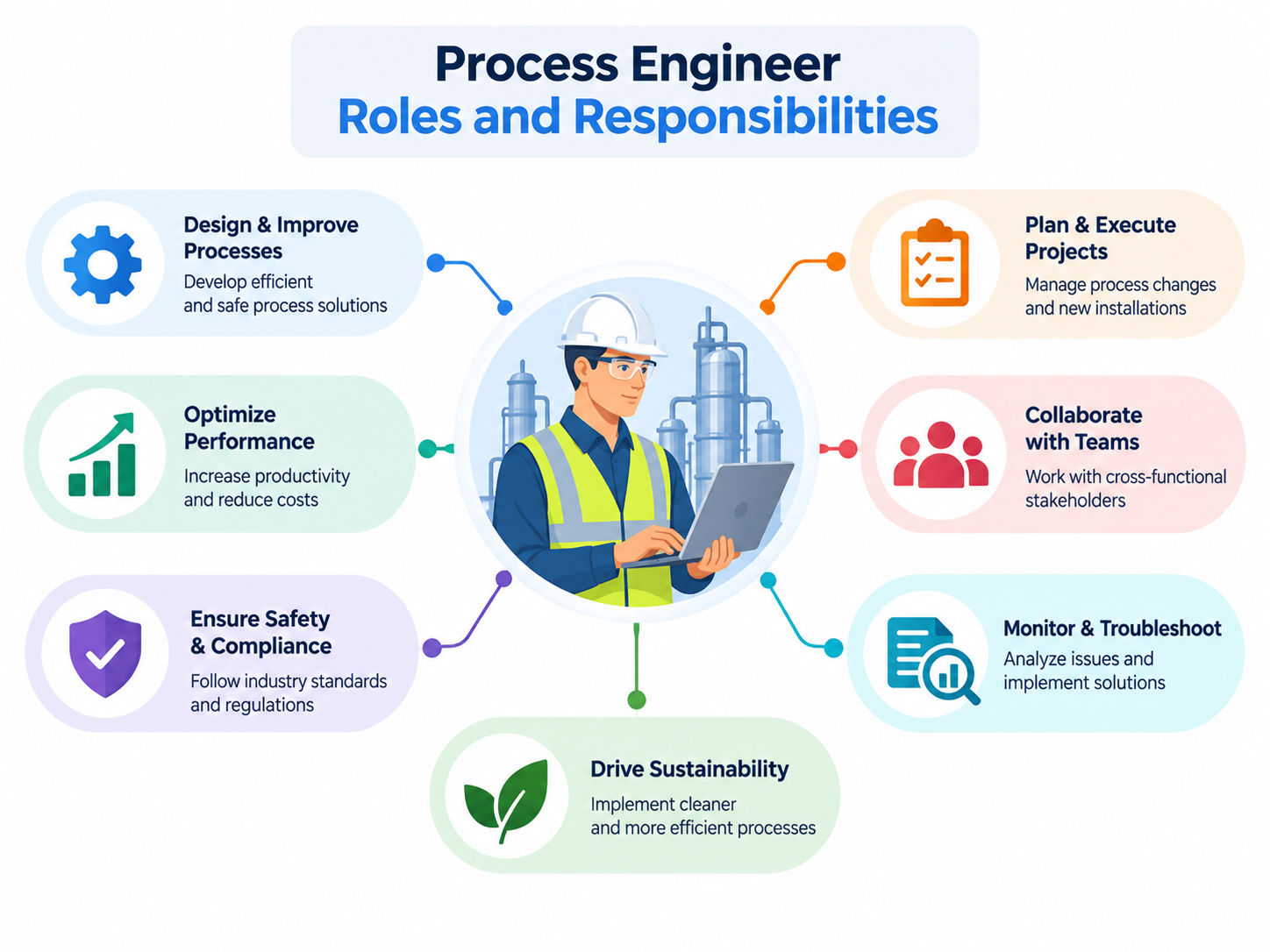
Among the main activities of the process engineer are:
The specific balance between these responsibilities depends on the organisation. Some engineers spend more time on the production floor, while others focus on process design, data analysis, modelling, or project implementation.
Process engineer should have combination of engineering knowledge, analytical ability, problem-solving skills and communication skills. What are the requirements depends on what industry they work in and what level is the position.
Important technical skills for process engineers include
Technical knowledge alone is not enough for many process engineering positions. Professionals also need strong interpersonal and analytical abilities.
These skills become particularly important when an engineer needs to implement a process change involving multiple teams.
Read: What Is Process Management? Types, Lifecycle, and Examples
Manufacturing is one of the major areas where process engineers apply their expertise. Here, the process engineer job description is often closely connected to production efficiency, product quality, equipment performance, and continuous improvement.
Manufacturing process engineers evaluate production methods and identify opportunities to improve them. They may modify process parameters, production sequences, equipment settings, or work methods.
They monitor production output and process metrics to determine whether manufacturing lines are meeting established targets.
Common measures include throughput, cycle time, downtime, yield, scrap, and defect rates.
Engineers examine material consumption, energy usage, equipment utilisation, and production losses to identify opportunities for reducing waste.
For example, reducing unnecessary machine downtime or material scrap can improve production efficiency without requiring a major change to the overall manufacturing system.
When a manufacturing process produces unexpected results, process engineers investigate the issue. They may collect production data, inspect equipment, interview operators, and conduct root cause analysis.
Once the cause is identified, they help develop and test corrective actions.
Process engineers continuously examine production workflows for opportunities to increase output or reduce cycle time.
Improvements may involve automation, equipment changes, workflow redesign, process parameter adjustments, or changes to operating procedures.
Manufacturing processes must operate within defined quality and safety requirements. Process engineers work with relevant teams to ensure that process changes do not compromise these requirements.
When a company introduces new machinery or production technology, process engineers may support equipment selection, installation, testing, commissioning, and process validation.
They may also train production personnel and document the updated process.
Also Read: Operations Manager Salary in India
A process engineering career can develop through increasing technical responsibility, project ownership, and leadership roles.
At the beginning of their career, professionals generally support experienced engineers with data collection, process monitoring, documentation, testing, and troubleshooting.
With experience, engineers may independently manage process improvement projects, analyse production problems, and work directly with cross-functional teams.
Senior engineers typically handle more complex processes and improvement projects. They may also guide junior engineers and provide technical input on major production changes.
A process engineering manager may oversee engineering teams, improvement programmes, budgets, and large-scale process initiatives.
also open to a process engineer with the necessary qualifications and experience. It is further determined by the individual’s technical expertise, industry experience, and level of project and people-management proficiency, as well as the company’s career-advancement policy.
A process engineer job description generally covers process design, production monitoring, troubleshooting, optimisation, quality, safety, and continuous improvement. While responsibilities vary by industry, the core purpose remains to make processes more efficient, reliable, and consistent.
Process engineers combine technical knowledge with data analysis and problem-solving to address production challenges. Developing relevant technical and soft skills can help professionals prepare for opportunities across manufacturing, semiconductor, pharmaceutical, and other process-driven industries.
Books a consultation call with upGrad experts to know which management program is best for you.
A process engineer designs, monitors, analyses, and improves industrial processes. They identify inefficiencies, investigate process problems, analyse production data, and implement improvements related to productivity, quality, cost, and safety.
Common responsibilities include process design and optimisation, production monitoring, root cause analysis, troubleshooting, documentation, quality and safety compliance, process improvement, and collaboration with production and engineering teams.
Important skills include process optimisation, data analysis, quality control, root cause analysis, process modelling, Lean manufacturing, and Six Sigma. Communication, teamwork, analytical thinking, problem-solving, and decision-making are also valuable.
A bachelor's degree in engineering is commonly relevant. Depending on the industry, employers may seek backgrounds in chemical, mechanical, industrial, manufacturing, or related engineering disciplines. Specific qualification requirements vary by employer and position.
Process engineers work across industries such as manufacturing, pharmaceuticals, semiconductors, chemicals, food processing, energy, and other industrial sectors where production or operational processes need to be designed and improved.
Process engineers generally focus on designing, analysing, and improving processes, while manufacturing engineers often focus more specifically on manufacturing systems, production methods, equipment, and the efficient production of goods. However, responsibilities can overlap considerably.
Industries that hire process engineers include manufacturing, semiconductor production, pharmaceuticals, chemicals, energy, food and beverage, automotive, aerospace, and consumer goods. The technical requirements can differ significantly between these sectors.
Process engineering offers opportunities to work on production systems, process improvement, technology implementation, and operational efficiency. Career prospects depend on factors such as industry, location, qualifications, experience, and individual career goals.
A process engineer in manufacturing develops, monitors, and improves production processes. They identify bottlenecks, reduce waste, troubleshoot process issues, improve productivity, and help maintain quality and safety standards.
Process engineers may use tools such as CAD software, process simulation software, statistical analysis tools, Excel, quality management tools, and data visualisation platforms. The specific tools depend on the industry and type of manufacturing process.
You can become a process engineer by earning a relevant engineering degree, developing technical and analytical skills, and gaining practical industry experience. Knowledge of process optimisation, data analysis, quality control, Lean, and Six Sigma can also support career development.
730 articles published
Sriram K is a Senior SEO Executive with a B.Tech in Information Technology from Dr. M.G.R. Educational and Research Institute, Chennai. With over a decade of experience in digital marketing, he specia...
Speak with MBA expert
By submitting, I accept the T&C and
Privacy Policy
From MBA to Dream Job - Explore Our Alumni Success Stories
Top Resources
Master's Degree
13 Months
Master's Degree
12 Months
Master's Degree
15 Months