Product Engineer Job Description: Skills,Roles and Career Guide
By Sriram
Updated on Sep 18, 2026 | 12 min read | 4.21K+ views
Share:

All courses
Certifications
More
By Sriram
Updated on Sep 18, 2026 | 12 min read | 4.21K+ views
Share:
Table of Contents
Key Highlights
Want to strengthen your technology and product development skills? Explore our MBA programs and build the expertise to drive innovation and create better digital products.
Popular MBA Programs
A product engineer is responsible for designing, developing, testing, and evaluating products. This professional works with technical and customer requirements to build and create products. In addition, he coordinates with various teams to address design problems and resolves issues that may arise.
The main responsibilities of a product engineer include:
Free Courses
A product engineer needs a combination of technical, product, and people skills besides programming knowledge. The skill set may differ for different companies, products or technologies. What Skills Does a Product Engineer Need? A product engineer needs a combination of technical, product and people skills besides programming knowledge. The skill set may differ for different companies, products or technologies.
Technical expertise is the foundation of the product engineer job description. Product engineers need to know how software is designed, developed, tested, deployed, and maintained.
These technical skills often appear in the job description of product engineer roles, although the specific technologies depend on the organisation.
Product engineers also need to understand the reason behind what they are building.
This combination of engineering and product thinking is an important part of the product engineer job description, especially in product-led technology companies.
Having technical knowledge is not enough to secure an effective product engineer. They are required to communicate and cooperate with various teams on a regular basis.
Critical thinking: Can assess distinct options and identify the best possible outcome.
MBA Courses to upskill
Explore MBA Courses for Career Progression
O.P.Jindal Global University
MBA (with Career Acceleration Program by upGrad)Become interview ready with Career Services
PSB MBA + IIML Certification
MBA from Paris School of Business with Certification from IIM LucknowDepending on the company, the responsibilities can vary, but they generally involve building and engineering features that will comprise a product, which satisfy the end-users’ requirements and contribute towards organizational objectives.
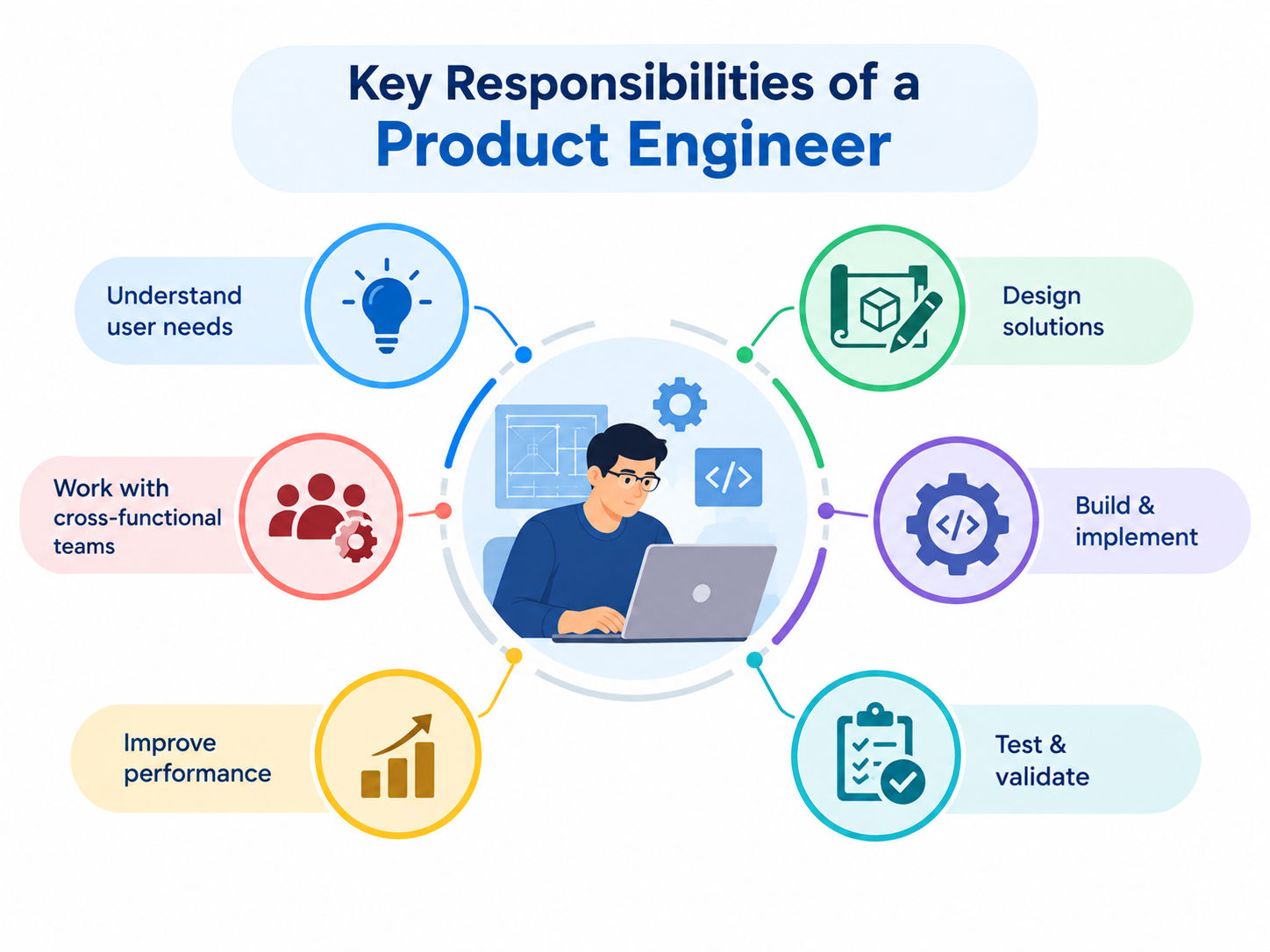
The key responsibilities typically included in a product engineer job description are as follows:
Product engineers work with product managers, designers, and other stakeholders to understand what needs to be built. They may also identify technical constraints and suggest alternative solutions.
Engineers translate requirements into technical solutions and write the code needed to build new features. They may contribute to architecture, development, integrations, and implementation decisions.
Product engineers regularly collaborate with product managers and designers. This helps ensure that technical implementation matches both user expectations and product requirements.
Testing helps identify defects before a feature reaches users. Engineers may write automated tests, perform debugging, review code, and improve existing functionality.
When users encounter technical problems, engineers investigate the root cause and develop suitable fixes. They may also work on performance and reliability issues.
User feedback can reveal problems that may not appear during development. Product engineers can use this information to improve existing features or suggest new technical solutions.
As a product grows, its technical requirements can change. Engineers may optimise code, improve infrastructure, manage technical debt, and make systems more scalable.
Therefore, the job description of product engineer roles generally goes beyond writing code. It covers the complete process of building and improving products.
Elevate your professional trajectory with IIM Bangalore's General Management Certificate Programme for Young Leaders (YLP), structured to foster essential executive and managerial capabilities.
There is no single qualification that every product engineer must have. Requirements vary based on the company, industry, and complexity of the product.
A bachelor's degree in computer science, software engineering, information technology, electronics, or a related field can provide a strong foundation.
Some employers may also consider candidates from other academic backgrounds if they have strong programming skills and relevant development experience.
Common educational backgrounds include:
A master's degree is not always necessary. Practical skills and relevant experience can be equally important for many product engineering roles.
Candidates should have a solid understanding of programming, data structures, algorithms, databases, APIs, version control, testing, and software development practices.
The technical requirements mentioned in a product engineer job description may become more specialised for senior positions.
Hands-on experience can help candidates understand how products move from an idea to a working solution. Experience with real-world applications, internships, open-source contributions, freelance projects, or previous software development roles can be valuable.
Certifications are not mandatory for every product engineer role. However, relevant certifications can demonstrate knowledge in areas such as:
The usefulness of a certification depends on the role and the technology used by the organisation.
A portfolio gives employers evidence of what a candidate can actually build. Projects can include web applications, mobile applications, APIs, automation tools, SaaS products, or other software solutions.
A strong project should explain the problem, solution, technologies used, your contribution, and the outcome. This can make your profile more meaningful than a list of technologies alone.
The job description of product engineer positions often highlights practical development experience because product engineering is strongly connected to hands-on problem-solving.
Also Read: Assistant Manager Job Description
Product engineers and product managers work closely together, but their primary responsibilities are different. A product engineer focuses more on technical development, while a product manager focuses on product direction, priorities, and strategy.
Factor |
Product Engineer |
Product Manager |
| Primary focus | Product development and technology | Product strategy and direction |
| Technical involvement | High | Moderate |
| Coding | Often required | Usually not required |
| Main responsibilities | Build and improve products | Plan and manage products |
| Key skills | Engineering + product thinking | Strategy + communication |
| Collaboration | Engineering, design, product | Engineering, design, marketing, business |
The roles can overlap in areas such as requirement discussions, user feedback, product improvements, and prioritisation. However, their day-to-day responsibilities remain different.
For example, a product manager may define what a new feature should achieve and why it matters. The product engineer may determine how to build that feature and help turn the requirement into a working product.
This difference is reflected in the product engineer job description, where technical implementation generally receives more attention than product ownership and business strategy.
Also read: Management Trainee Job Description: Roles & Skills
One would think that becoming a product engineer may necessitate a certain amount of education and experience. The following steps can help you learn product engineering skills:
Start with programming basics, data structures and algorithms, databases, application programming interfaces (APIs), software development, and version control. It is impossible to learn everything but having a fundamental understanding of each component will help you decide what areas to specialize in.
It is important to learn how products are conceived, designed, developed, tested, launched, and improved. You can start by learning product development fundamentals, Scrum and Agile methodologies, product development processes, project management, product design, and metrics.
Enhance your problem-solving skills by studying, practicing, and learning computer science and math. Always try to understand how a specific approach solves a problem.
You can build projects to demonstrate your talents and skills to your future clients and employers. Think about projects you would like to develop and how you want them to function. You can build a task manager, an online store, analytical applications, and much more. Projects can help you learn programming, databases, and application programming interfaces.
You can create a portfolio website to present your projects to potential clients and employers. Make sure to include all your projects and highlight the technologies used, problems encountered, and how you dealt with them.
You can gain experience through internships, entry-level software developer jobs, freelancing, and open-source projects. Software developers can also become product engineers by learning product specialization.
You rarely find product engineers who work alone. Collaboration with product managers, designers, testers, and representatives from other departments is essential.
A clear understanding of the responsibilities of a product engineer is critical to determining what skills to focus on while preparing for a career in product engineering.
Also read: Design Thinking – 6 Lessons in Innovation and Marketing Excellence
The tools used by product engineers depend heavily on the organisation and product. A typical technology stack may consist of the following:
Product engineering can offer several career progression opportunities. The exact path varies between organisations.
Career progression depends on technical expertise, leadership ability, product understanding, and the opportunities available within an organisation.
Product engineers combine software development with product thinking to build solutions that address real user needs. Strong programming, testing, database, API, and cloud knowledge forms the technical foundation, while problem-solving, communication, collaboration, and product understanding help engineers work effectively across teams.
A degree can provide a useful starting point, but practical projects and hands-on experience are equally important. Understanding the product engineer job description can help aspiring professionals identify the skills employers look for and prepare for different stages of a product engineering career.
Ready to start your journey? Book a free consultation with upGrad today to find the best path for your career.
A product engineer is a technology professional who designs, develops, tests, and improves digital products. The role combines software engineering with product thinking, requiring professionals to understand technical requirements as well as user and business needs.
Key skills include programming, software development, databases, APIs, testing, debugging, cloud fundamentals, product thinking, requirement analysis, problem-solving, communication, and collaboration. The exact skill set depends on the product and technology stack used by the employer.
Yes, coding is generally an important part of product engineering. Product engineers are usually involved in developing and improving software features. The amount and type of coding can vary depending on the organisation, product, seniority, and specific job description of product engineer.
A bachelor's degree in computer science, software engineering, information technology, electronics, or a related field can provide a strong foundation. However, employers may also consider candidates with other educational backgrounds when they demonstrate relevant technical knowledge and practical development experience.
Yes. Both roles involve software development, but product engineering generally places greater emphasis on the product and user experience. Product engineers often participate in product decisions and work closely with product and design teams, while software engineering roles can vary widely in scope and focus.
Yes. Software engineers already have many of the technical skills required for product engineering. To make the transition, they can develop product thinking, user research awareness, requirement analysis, product analytics, and stronger collaboration skills. Understanding a product engineer job description can also help identify skill gaps.
They do not necessarily need the full skill set of a product manager. However, understanding product requirements, customer needs, prioritisation, user experience, and product metrics can help engineers make better technical decisions.
There is no single required programming language. Python, JavaScript, TypeScript, Java, C#, Go, and C++ are commonly used across different products. The right language depends on the company's technology stack and the type of software being developed.
Certifications are generally not mandatory. They can supplement a candidate's profile by demonstrating knowledge of areas such as cloud computing, DevOps, software development, or Agile practices. Practical projects and relevant experience remain important considerations.
Daily work can include coding, reviewing requirements, designing solutions, debugging, testing features, attending team discussions, reviewing code, analysing technical issues, and collaborating with product and design teams. The exact activities depend on the project and seniority.
Include projects that demonstrate your ability to solve problems and build working products. Mention the problem you addressed, your role, technologies used, key features, technical challenges, and results. Links to working applications or code repositories can provide additional evidence of your practical skills.
730 articles published
Sriram K is a Senior SEO Executive with a B.Tech in Information Technology from Dr. M.G.R. Educational and Research Institute, Chennai. With over a decade of experience in digital marketing, he specia...
Speak with MBA expert
By submitting, I accept the T&C and
Privacy Policy
From MBA to Dream Job - Explore Our Alumni Success Stories
Top Resources
Master's Degree
13 Months
Master's Degree
12 Months
Master's Degree
15 Months