Marketing: What Is It and Why Do Companies Need It?
By upGrad
Updated on Oct 07, 2026 | 6 min read | 1.43K+ views
Share:

All courses
Certifications
More
By upGrad
Updated on Oct 07, 2026 | 6 min read | 1.43K+ views
Share:
Table of Contents
Key Highlights
Take your marketing knowledge a step further with upGrad’s digital marketing courses. Learn practical skills across SEO, social media, paid advertising, content marketing, analytics, and more to prepare for today’s digital marketing roles.
Marketing is how a business gets the right product in front of the right people and gives them a reason to care. So that ultimately they recall the product when needed and thus buy it. You understand the needs of the consumer, create value for them by building a relationship between consumers and the product or service, and make it relevant.
A good marketing campaign will not only try to trigger a consumer’s recall value but make the product so relevant that it gets installed in their subconscious mind. For example, every 90s kid will remember the jingle of “washing powder nirma”, or the ad of a “cute boy saying jalebi with wide eyes” for the brand “Dhara cooking oil”. These are great examples of how great marketing communication stays in people’s minds through decades.
Marketing has several connected objectives. A business might want to introduce a product, reach a new audience, increase sales, or keep existing customers.
Its main functions include:
Also read: What is Marketing Management? A Complete Guide
The 4 Ps of Marketing are Product, Price, Place, and Promotion. It was introduced by E. Jerome McCarthy in 1960. These 4 Ps together make the marketing mix.
It gives companies a simple framework for planning marketing activities.
This is the first and most important factor for marketing. The hero in your show of marketing. What you sell should also be something people actually want. It should either solve a problem or satisfy a need. It can be a physical item or a service or a subscription or a digital product.
For example, from a marketing point of view, Nike is not just sports shoes. It's equivalent to performance, comfort, design, and sports technology.
This is the second factor you need to consider before you come up with a marketing strategy. Price is what consumers pay for your product or service. So, you need to inspect the costs, competitors’ price points, customer expectations, and the value before determining the price of your product.
This is where your product will be available for the consumers. You have to identify the correct channels and ideal place for your product.
Your ideal place can be a retail store, website, marketplace, or an app.
Now the final factor is Promotion. How do you want to promote your product to create awareness and interest? Advertising, social media, email, content, public relations, and events all are included here.
Here are the key questions your four Ps should answer.
P |
Key question |
| Product | What problem does it solve? |
| Price | What will customers pay? |
| Place | Where will people buy it? |
| Promotion | How will people hear about it? |
Do read: Marketing Frameworks Explained for Better Business Growth
There are two different types of marketing, namely traditional and digital.
Traditional marketing includes the traditional methods of marketing. These include channels such as television, radio, print, direct mail, and events. This marketing targets a physical audience who are offline. This method of marketing helps reach the masses. Traditional marketing has been there from the beginning.
The major drawback of traditional marketing is that you cannot track the reach of your marketing campaign to the last digit. As they are vast and are made for the masses.
For example a billboard on the national highway can be seen by a lot of people. But you cannot tell exactly how many.
What is digital marketing? The type of marketing which uses digital platforms to market any product or service. These include channels such as SEO, content marketing, social media marketing, email marketing, influencer marketing, and online advertising.
The major benefit of digital marketing is that you can track and optimize your campaign according to the response you are getting. So tracking is the biggest advantage here.
For example, a brand started an awareness campaign. Now you can track reach, impressions, video views, engagement, and brand searches in real time and optimize your digital marketing strategy the way you see fit.
Must read: Fundamentals of Digital Marketing – What You Need to Know
Free Courses
For people to know you have a product or service you need marketing. Without it you may have a great product but if it doesn't reach people, no one will ever know about it. So a company needs to have marketing to make people aware of your product’s existence, its value and the reason why they should choose it.
Marketing is the glue which connects your products to the end goals of revenue. It's the middle part, marketing, which makes the whole difference of how good your product sells.
It also gives businesses a way to know, understand and listen to customers, test ideas, and adjust their approach when the market changes.
The more customers recognize and understand your brand, the more they will be interested in it.
Communication enables organizations to create an identity and reputation to hold. Though Reputation takes time. A company can't create it overnight through one advertisement. Its products, customer service, reviews, messaging, and public communication all contribute to its reputation over the time.
Most customers require information to make their decisions. Marketing enables them to find answers to practical questions regarding features, prices, usage, availability, and benefits.
Effective marketing communication is not one-sided only. Businesses use comments, feedback, questionnaires, and customer communication for that purpose. To build a communication between the brand and the consumers. This feedback then can be implemented to make their product or marketing better.
Marketing is what gets people interested in buying your product. An interesting blog may be what catches someone looking for answers. Email marketing can be used to bring interested buyers closer to the purchase.
It's unlikely that everyone visiting will become a buyer. This is expected. Successful marketing is about connecting with the right people.
The first main goal of marketing is to create awareness and demand. To enter a new market, introduce a product, or reach a different customer group you need a marketing strategy that helps with those goals.
There are other ways of measuring marketing success aside from sales. Sometimes, the campaign starts with creating awareness or leads before the revenue actually comes.
The relationship does not end after making a sale. Companies now use email, loyalty programs, valuable information, customer service, and customized messages to stay connected to their customers.
Retention is important since current customers are familiar with the brand. It may require less work to convince them compared to educating them. And further they may promote your product from their own experience which is the greatest form of marketing. Someone who tells others about a great product from their own experience obviously gains more attention and builds trust.
Market research gives you information about what consumers like or dislike before you can test your product in any market. So that's useful when developing products, changing prices, entering markets, or planning campaigns.
You can't predict what customers want? Customers aren't always predictable. But, research helps you through evidence so that you don't have to assume. But keep this in mind that no amount of research can guarantee you sales.
Do read: Importance of Digital Marketing: 10 Key Benefits for Businesses
Digital Marketing Courses to upskill
Explore Digital Marketing Courses for Career Progression
MICA Executive Alumni Status
In very simple words, marketing strategy is the plan someone uses to reach their marketing objectives or goals. Marketing strategy includes defining your audience, brand or product positioning, value proposition, use of correct marketing channels,choosing your priorities, and measuring success.
Strategy comes before you take an action. It guides you through it.
The different types of marketing strategies include:
Marketing Strategy |
Main Focus |
| Content marketing strategy | Creating useful content to attract and engage a target audience |
| SEO strategy | Improving visibility in search results and attracting organic traffic |
| Social media strategy | Building awareness and engagement through social platforms |
| Email marketing strategy | Nurturing leads and communicating with existing customers |
| Product marketing strategy | Positioning and promoting a specific product to the right audience |
| Brand marketing strategy | Building brand awareness, identity, and customer perception |
| Influencer marketing strategy | Partnering with creators to reach and influence their audiences |
Your company doesn't need all the strategies together. The choice of strategy will depend on its customers, goals, resources, product, and buying process.
Also read: A Beginner’s Guide to Developing a Digital Marketing Strategy
Strategy is all about planning while campaign is all about execution.
In order to fulfill a particular goal such as product awareness and generation of leads in a particular time period, you need to complete a series of actions which would help justify your goal and the series of action is known as marketing campaign.
A campaign requires goals, target market, the message it intends to communicate, the methods used and the KPIs needed to measure your campaign.
The goals may range from marketing a new product to lead generation, registration increases and awareness building.
For example, a company decided to start a coffee business for local consumers. You need to make people aware of it. So you run ads on Instagram, show product videos, give discounts on the first purchase and collaborate with a couple of local influencers. After which, the reach, engagement, website visits, and sales are tracked to determine success. All these combined make up a campaign that aims at raising awareness about the coffee brand.
A good marketing campaign can help a company to:
Also read: Digital Marketing Steps: A Step-by-Step Guide to Building an Effective Marketing Strategy
Here are the step by step process how marketing works:
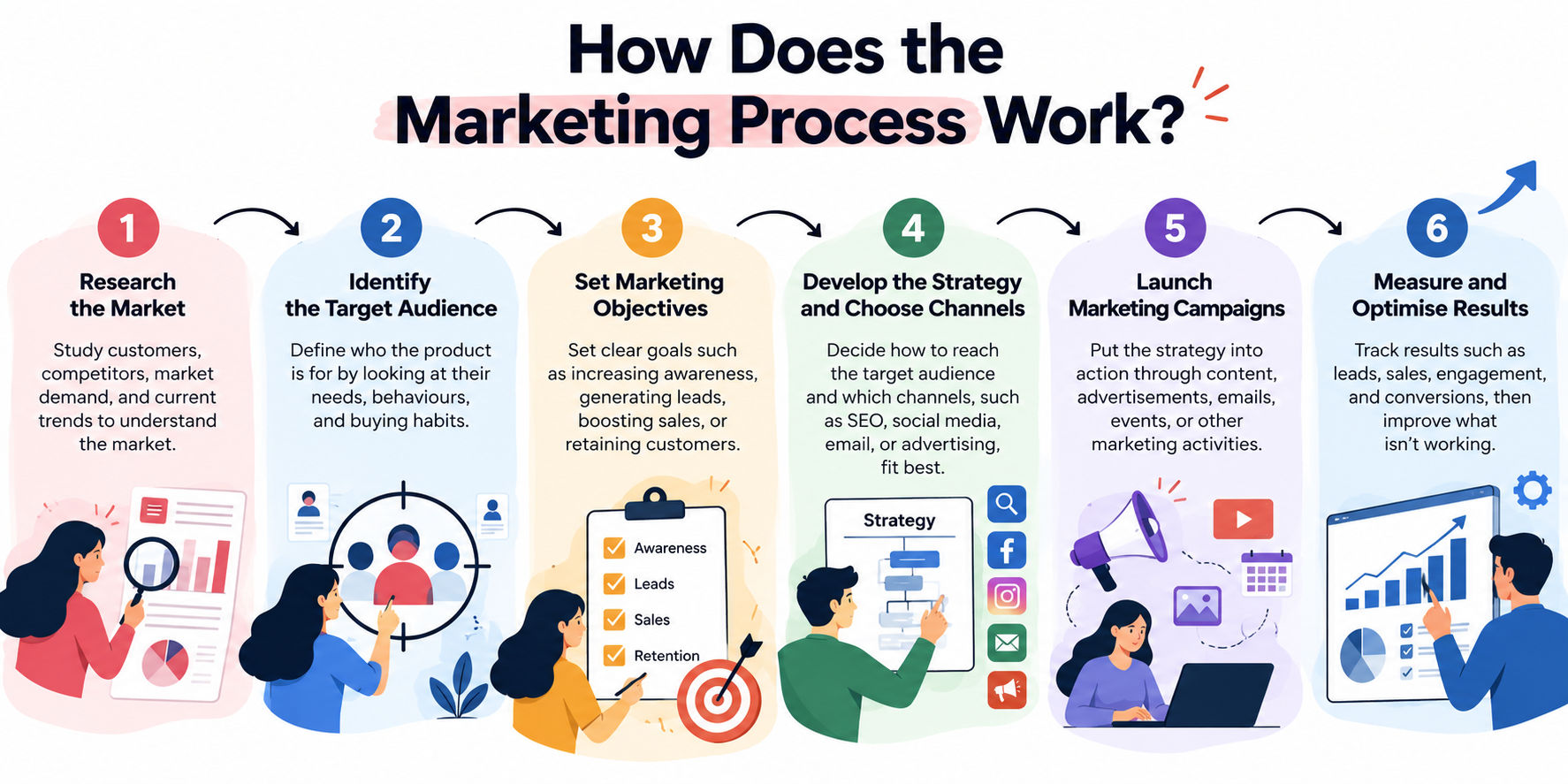
Must read: Digital Marketing Objectives: Full Guide with Types and Examples
These terms are all so close that people get confused. Marketing is the bigger umbrella term which means to plan a strategy to take your product to its customers. Advertising is a tool you can use to make it interesting and easier for the consumers to understand your product. And sales is the ultimate goal of any business.
Marketing |
Advertising |
Sales |
| Broad business function | Paid promotional activity | Customer conversion activity |
| Includes research and strategy | Focuses on communicating an offer | Focuses on prospects and purchases |
| Builds awareness and demand | Buys attention through media | Moves qualified prospects toward purchase |
For example,
Fogg Deodorant identified a flaw in traditional perfumes that they contain high amounts of propellant gas. Based on this insight, the brand positioned Fogg as a liquid-based spray with “more perfume, less gas” and kept it affordable for price-conscious customers.
Then advertising used these insights to create ads such as “Kya chal raha hai? Fogg chal raha hai” and “Bina gas waala spray” to help grab attention, and tell people about its main USP. This builds a higher recall value. Hence sales increased. So marketing and advertising together made the path for good sales.
Want to build a stronger understanding of business and management? Explore the IIM Bangalore General Management Certificate for Young Leaders and develop practical skills to make better business decisions and lead with confidence.
Some marketing problems start before the campaign even begins.
A campaign doesn't become successful just because it gets attention. The useful question is whether that attention moves the business toward its actual objective.
Also read : Starting A Career In Digital Marketing: All You Need To Know
Here are some great examples of marketing:
Conclusion
Marketing helps companies to know their customers, communicate their value, create demand, and develop relationships. Marketing is about a lot more than just advertising.
What is Marketing and why do companies need it? This question essentially connects the goods and services of a business to the needs of its customers. A good strategy, proper media, a useful campaign, and constant measurement are key components of achieving this connection.
Ready to start your journey? Book a free consultation with upGrad today to find the best path for your career.
Yes. Advertising is only one part of marketing. A business can also attract customers through SEO, useful content, referrals, social media, email, events, and good customer experiences. The right mix depends on the audience, product, budget, and goals.
A marketing strategy sets the overall direction. It defines who the business wants to reach, what it wants to achieve, and how it plans to compete. A marketing plan turns that strategy into specific activities, channels, timelines, budgets, and measurable goals.
Digital marketing means promoting products or services through online channels such as search engines, social media, websites, email, and online advertising. It helps businesses reach specific audiences, track campaign performance, and adjust their marketing based on customer behaviour and results.
The marketing mix is a framework businesses use to plan how they will market a product or service. The traditional model includes four Ps: Product, Price, Place, and Promotion. Together, they help businesses decide what to offer, how to price it, where to sell it, and how to promote it.
Start with the customer, not the channel. Find out where your target audience searches for information, spends time, and makes purchase decisions. A business can then choose channels that match those habits instead of trying to be present everywhere.
There isn't a fixed amount that works for every business. The budget depends on factors such as revenue, goals, industry, competition, and audience. A small business can start with a focused budget, track the results, and put more money into activities that actually work.
It depends on what you're doing. Paid advertising can bring traffic or leads quickly, while SEO, content marketing, and brand-building usually take longer. Businesses should give each activity a realistic timeframe and judge it against its goal instead of expecting instant sales.
Yes. A small business can handle activities such as social media, local SEO, email, content, and customer referrals in-house. Starting with a few relevant channels is often more practical than trying to manage every platform at once.
Inbound marketing focuses on attracting customers by giving them useful information when they're looking for it. Blogs, SEO, videos, guides, and newsletters are common examples. Instead of pushing a product at everyone, the approach aims to bring interested people towards the business.
Outbound marketing takes the message directly to a potential audience. Television ads, direct mail, display advertising, and cold outreach are common examples. It's useful when a business wants to reach people who may not be actively searching for its product.
B2B marketing targets businesses, while B2C marketing targets individual consumers. B2B purchases often involve several decision-makers and longer buying cycles. B2C purchases can happen faster and may be influenced by factors such as price, convenience, personal preferences, and brand familiarity.
1012 articles published
We are an online education platform providing industry-relevant programs for professionals, designed and delivered in collaboration with world-class faculty and businesses. Merging the latest technolo...
Get Free Consultation
By submitting, I accept the T&C and
Privacy Policy
Level Up Your Digital Marketing Career Today!
Top Resources
MICA
Advanced Certificate in AI-Powered Digital Marketing & Communication from MICAMICA Executive Alumni Status
Certification
5 Specialisation
Classroom
4 Months
Certification
2 Months