E-E-A-T in SEO: What Google's Guidance Actually Says About Trust
By upGrad
Updated on Nov 03, 2026 | 5 min read | 1.33K+ views
Share:

All courses
Certifications
More
By upGrad
Updated on Nov 03, 2026 | 5 min read | 1.33K+ views
Share:
Table of Contents
Key Highlights
Explore upGrad’s Digital Marketing Courses to learn SEO, social media marketing, paid advertising, content strategy, and analytics through practical projects and industry-relevant training. Take the next step towards building a career in digital marketing.
E-E-A-T in SEO refers to the guideline framework, which is the core guideline used in the Search Quality Rater Guidelines, the manual by Google. The E-E-A-T guidelines have been termed E-A-T in the past, which stands for expertise, authoritativeness, and trustworthiness. However, in December 2022, Google included another E to represent Experience.This framework is what the human reviewers at Google use to review content.
There is a lot of information on the internet. Not everything is true, and Google knows that. That's why, to make sure that the content that appears in Google search is trustworthy and not all bogus, Google gave this framework. So content should follow Experience, Expertise, Authoritativeness, and Trustworthiness as guidelines for all their content.
Though it is not a mandatory parameter. But still,this framework will help you to create content that is as per Google’s guidelines and build credibility.
Google uses human raters who read content to see if it's original content or not. If the content seems reliable and if the information is true against other reliable sources
Also Read: On-Page SEO Guide: Practical Tips, Factors & Checklist
Free Courses
Let's learn about the four components of E-E-A-T in detail:
Experience means that the author shows, through their content, that the author has experience with the product or service themselves. The author has used the product, visited the place or lived the situation.
For example, take a review of ski boots. One writer lists specifics copied from the brand's site. Another says the left boot pinched after three hours and shows photos of the liner after a season. By reading these reviews, you know which one you'd trust.
So when writing a content piece. It should come from actual experience.
Expertise is about skill and knowledge in the topic of your content. For writing on subjects like medicine, law or money, formal training matters. As these are sensitive topics which affects people. For a topic like knitting or home coffee brewing, everyday expertise from years of practice is fine.
Google's guidance accepts both kinds. What it doesn't accept is a writer with no idea to the topic.
Authoritativeness means the reputation of the author’s content, the website, or the organisation. Authenticating your content will mean that you have to link all your content from sources that have provided you with information. This could be through a news report, academic paper, or any authoritative industry organization.
When your content shows knowledge that is deep and not just general stuff, it shows authority.
For example, if your content is mentioned by another renowned website because of the deep knowledge of your content materials. It would show that your content has authority.
Trust means accuracy, honesty, and safety. Whether your content has facts or your page has cited reliable sources,
Look for practical signs such as:
Explore the Advanced Certificate in AI-Powered Digital Marketing and Communication by MICA offered through upGrad. Build expertise in AI-powered marketing, content strategy, digital communication, and emerging marketing technologies to prepare for evolving industry demands.
Digital Marketing Courses to upskill
Explore Digital Marketing Courses for Career Progression
MICA Executive Alumni Status
It is very important for SEO because Google checks your content on the basis of this framework. So if your content lacks in these four categories there is a high chance your content would not be pushed by Google's algorithm. Though it's not a deciding factor for ranking on google.
It also gives the content writers a wireframe for what kind of content they should be writing for the internet.
Google utilizes both automated and human inputs. Automated inputs include searching for factors that correspond with high-quality and useful content, such as the helpful content system, which has been incorporated into Google’s core ranking system. Human inputs involve the quality raters whose assessments allow Google to verify if their algorithms are functioning.
The raters analyze the content page, the author of the content, the reputation of the website and creation of the content itself. They also investigate information about the website and its authors from third party sources.
YMYL stands for Your Money or Your Life. This refers to those topics that might influence a person’s well-being, finances, security, or society in any way, such as medical information, taxes, or election results. They are highly sensitive issues, and nobody is supposed to cover them without appropriate information and guidelines.
A blog on cooking a recipe would not need this experience. But when you write about a drug or such medical cases or something. You should always take them from any reliable source.
Must read: What is SEO Content Writing? A Beginner’s Guide to Writing for Search Engines
If you see that your content is not aligned with E-E-A-T in SEO than here are some ways you can improve your content.
Here they are:
Strategy |
Key Actions |
Example |
| Creating Valuable and Unique Content | Personal stories, unique images, statistics, and insights. Answer frequently asked questions from readers. | An accounting firm can share an anonymised client case study with real figures. |
| Proving Authors' Expertise | Author names, credentials, experience, and other experts' inputs should be provided. | If a dentist provides professional insights about an article written by a marketing expert, it should be mentioned. |
| Establishing Authority for Brands | Publish original research, work with industry experts, and get credible mentions. | Gain recognition in the industry and add value through your resources. |
| Establishing Trust and Transparency | Add About and Contact pages, cite reliable sources, display update dates, and disclose affiliate links. | Inform readers about the process of researching, reviewing, and fact-checking of the content. |
| Maintain Content Quality | Outdated content, broken links, page speed, and intrusive advertisements should be avoided. | Update tax guides to meet the current tax thresholds. |
Google hasn't banned AI-written content. It just doesn't go along with the commercially produced, large scale AI content created only to manipulate rankings. AI obviously isn't very reliable on its ‘Experience’ factor from the E-E-A-T in SEO. As AI models can only mimic a review but can't write a review from their actual experience.
So if you really want to use AI for content creation use it as an assistant with your brain behind the main idea and AI being a helper. You can ask it to draft outlines, tidy grammar or suggest questions. But the human essence in any content can only be brought by a human.
Also tools like Google's AI Overviews, ChatGPT and Perplexity pull answers from pages and sometimes show sources. But the question is how reliable that fact or answer is. As it is easier for them to pull the answers with pages with clear answers, named authors and cited facts. But there is still no guarantee for the facts to always be true.
You don't need any special software for this audit. A spreadsheet is sufficient. Here is how you can conduct the audit:
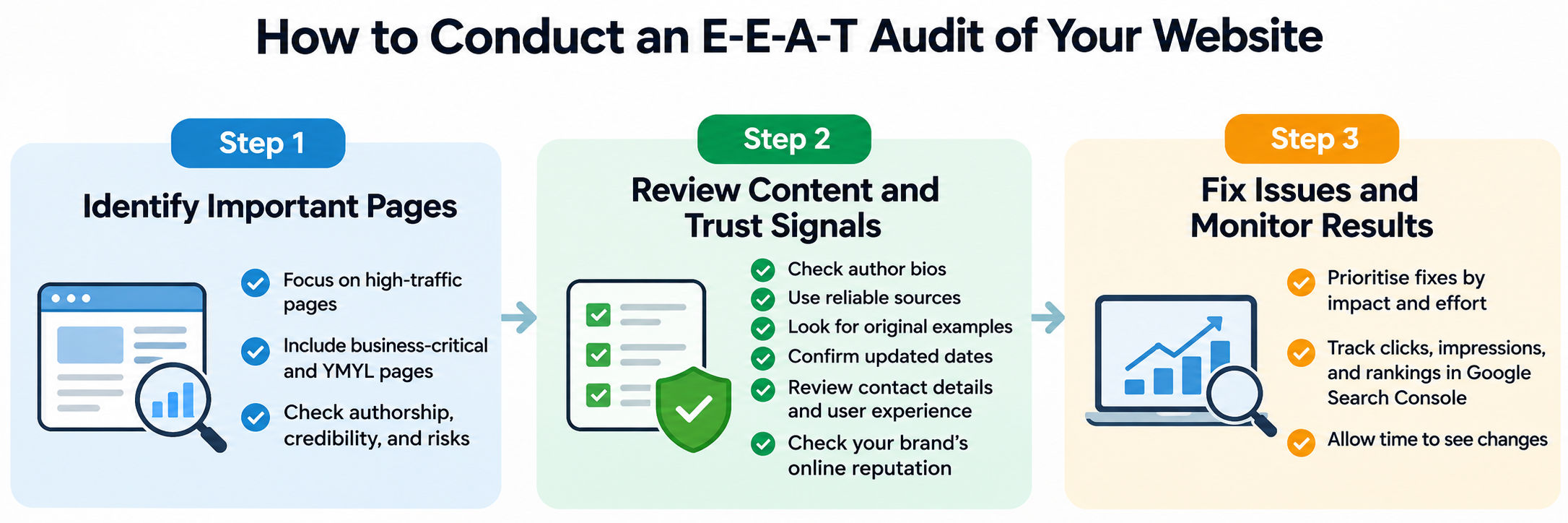
Conclusion
E-E-A-T in SEO is very important for content as it builds trust and credibility. This framework just gives people a wireframe to make their content trustworthy. Use this in a way that you can give the readers a quality piece of content. This is how you earn a long term trust from the readers.
Audit your content regularly and update it. Align the content to this framework to ensure SEO success.
Ready to start your journey? Book a free consultation with upGrad today to find the best path for your career.
Experience was launched in December 2022 and from that, E-E-A-T was born. Experience is the key to gaining practical knowledge, like the worth of any item or place when you use it. Experience was merged with trust, and trust continued to remain as the main factor, which is valued the most by Google.
It is partially possible. One can demonstrate experience, mention authors, provide references and publish the contact information. Backlinks are not the only way to build authority, and a new website has its chances to get a reasonable start.
It does, provided the bio is precise. It should include your actual work, education and links to your profiles, which the reader and the rater will be able to verify. A phrase such as "passionate writer" brings nothing at all. The bio should correspond to the article topic.
Tell about what you do in practice. Put up photos of completed projects, customer testimonials, licenses and profiles of your team members. Add an address and phone number and make reviews truthful. A local plumber with photos of completed jobs and a license number is worth more than a slogan-packed webpage.
No, because there is no score for E-E-A-T in SEO. Backlinks from credible websites, however, indicate that other people rely on your website, which adds to the authoritativeness. The number of backlinks does not matter; what counts is their quality. Buying backlinks may be harmful according to Google's spam policies.
There is no definite answer. You should update the information when laws change, products change, facts become outdated or when people pose new questions. Pages about health and finances require more frequent updates, maybe every couple of months. Evergreen content can remain unchanged for a longer time.
Yes, if it is legitimate and moderated. Customer reviews provide first-hand accounts and instill trust. Fake reviews and comments have an opposite effect on the users. Publicly address concerns raised by customers and ensure that all sorts of reviews are available for potential customers to see.
No. While Google guidelines require more from websites which may have some effects on consumers' health, finances or safety, there is no need to prove a medical background for cooking blog but there is for the one which discusses medication dosages.
Yes. It's one criterion among others; even a good E-E-A-T in SEO site might lose out to better matching content, faster load times, or better links. Poor matching with the user's intent, poor internal linking, or other technical issues can hurt it too.
It takes months, not days. The changes need to be recrawled by Google, and that takes time. Changes like adding authors and sources might help within weeks, while establishing brand authority can take half a year or more. Measure your organic traffic and search queries for those pages.
Don’t fake it. Interview experts, quote them and reference their sources. Clearly state what you have tested and what information you have received from someone else. Get an expert to review your sensitive pages. People will see the difference. Honesty is better than borrowing authority.
1339 articles published
We are an online education platform providing industry-relevant programs for professionals, designed and delivered in collaboration with world-class faculty and businesses. Merging the latest technolo...
Get Free Consultation
By submitting, I accept the T&C and
Privacy Policy
Level Up Your Digital Marketing Career Today!
Top Resources
MICA
Advanced Certificate in AI-Powered Digital Marketing & Communication from MICAMICA Executive Alumni Status
Certification
5 Specialisation
Classroom
4 Months
Certification
2 Months