CPC Full Form in Digital Marketing
By Sriram
Updated on Aug 13, 2026 | 10 min read | 7.05K+ views
Share:

All courses
Certifications
More
By Sriram
Updated on Aug 13, 2026 | 10 min read | 7.05K+ views
Share:
Key Highlights
Want to build stronger skills in paid advertising, SEO, and campaign performance? Explore the Digital Marketing Master Course and learn how to plan, execute, and measure digital marketing campaigns effectively.
CPC stands for Cost Per Click. It shows the average amount an advertiser pays for each click on a paid advertisement. For example, if an ad receives 100 clicks and costs ₹2,000, the average CPC is ₹20.
CPC helps advertisers understand traffic costs and compare campaigns, keywords, or audiences. However, it doesn't show whether clicks lead to conversions or sales, so it should be evaluated with metrics such as CTR, conversion rate, and CPA.
CPC is a pricing metric that shows the average amount paid for each ad click. For example, if a campaign spends ₹10,000 and receives 800 clicks, its average CPC is ₹12.50.
CPC helps measure traffic costs, but it doesn't show whether clicks lead to conversions. Metrics such as CTR, conversion rate, and CPA provide that additional context.
Free Courses
CPC links ad spend to user clicks. The advertizer builds an ad, chooses targeting, sets campaign preferences, and enters the advertising platform's auction or bidding system.
When a person searches for something or visits a page where an ad could be shown, eligible ads are entered into an auction for that display opportunity. The platform uses its auction rules, bids, ad quality, relevance and other signals to determine which ads are shown and where they are shown.
The process looks like this.
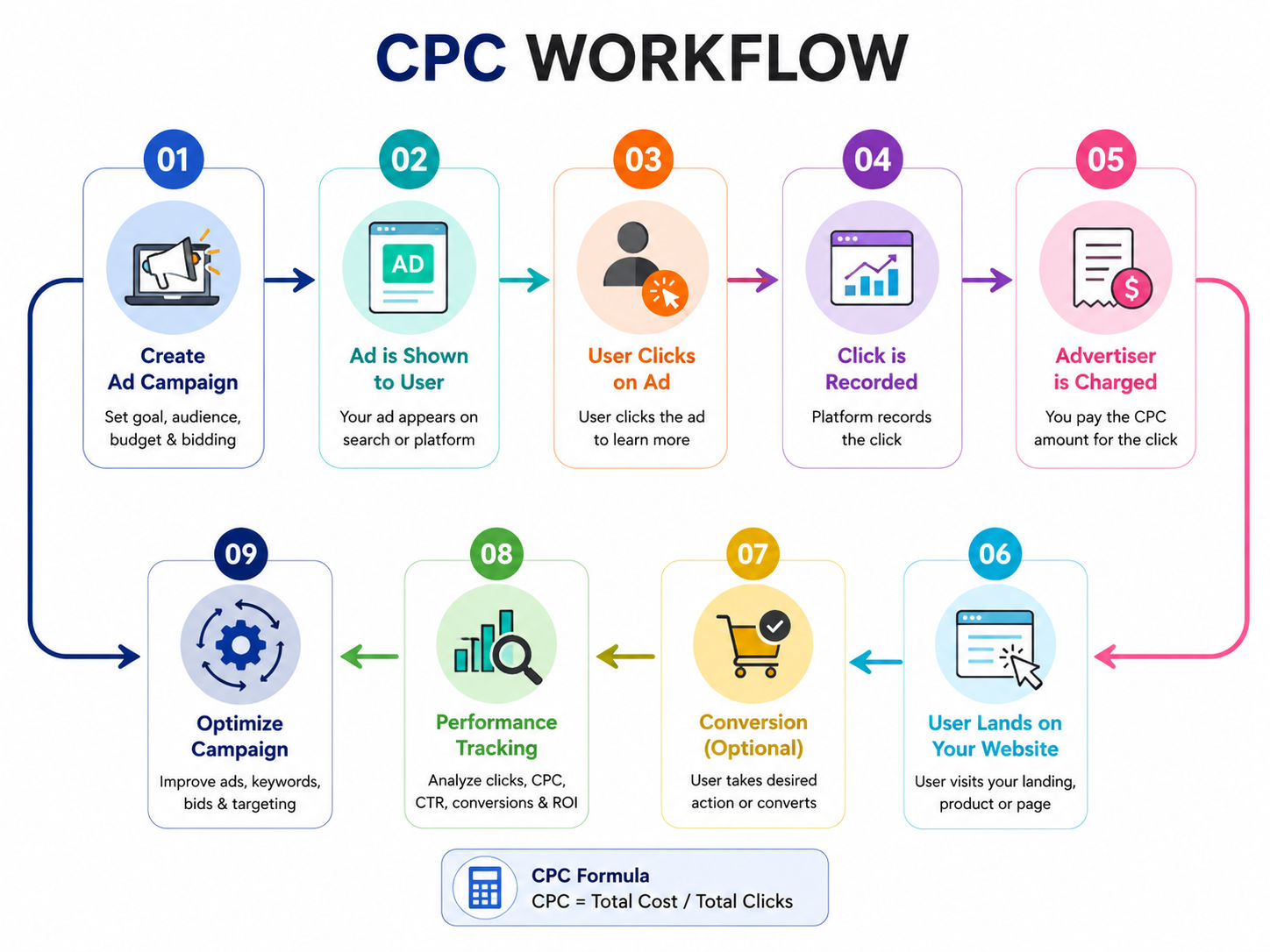
A click is when a user takes action on an advertisement and is taken to its linked destination, such as a website, landing page, product page or app. The advertising platform logs this interaction as a click. But a click isn’t a conversion.
One user may click and leave without taking action and another may purchase or submit a form. This is why you need to measure CPC against conversion rate, CPA and revenue to get a real sense of the value of your paid traffic.
Digital Marketing Courses to upskill
Explore Digital Marketing Courses for Career Progression
MICA Executive Alumni Status
How is CPC calculated in digital marketing? The calculation is straightforward.
CPC = Total Ad Spend ÷ Total Clicks
Suppose an advertiser spends ₹6,000 and receives 600 clicks.
CPC = ₹6,000 ÷ 600
CPC = ₹10
The average cost per click is therefore ₹10.
The same CPC formula in digital marketing can be used to assess different campaigns. An advertiser could compare a search campaign with a display campaign, provided the comparison makes sense for the goals and audiences involved.
Here's another example.
Metric |
Campaign A |
| Total ad spend | ₹15,000 |
| Clicks | 1,000 |
| Average CPC | ₹15 |
The CPC formula in digital marketing is useful because it turns raw spending and click data into a simple figure that can be compared over time.
However, don't confuse average CPC with the maximum CPC bid. They represent different things.
Maximum CPC is a bidding limit in certain campaign setups. Average CPC is the average amount paid for the clicks received.
Take the next step in your career with upGrad’s Certificate Programme in General Management for Young Leaders (YLP) from IIMB. Develop practical management skills and gain insights to make confident business decisions.
There isn't one fixed number that qualifies as a good CPC in digital marketing. A reasonable CPC depends on the industry, competition, audience, keyword, campaign objective, conversion rate, and value generated from each customer.
A ₹10 CPC might be expensive for one business and perfectly reasonable for another.
Consider two advertisers.
Metric |
Business A |
Business B |
| CPC | ₹10 |
₹40 |
| Conversion rate | 1% |
8% |
| Clicks | 1,000 |
1,000 |
| Conversions | 10 |
80 |
| Ad spend | ₹10,000 |
₹40,000 |
A higher CPC can still deliver better results if it generates more valuable conversions. So, a good CPC isn't necessarily the cheapest one. It should align with your campaign goals, conversion rate, and customer value.
CPC benchmarks vary by industry, market, and competition. Use them as reference points, not fixed targets.
Read : Digital Marketing for Startups
Several factors can affect CPC. Some are controlled directly by the advertiser, while others are shaped by competition and the advertising platform.
Popular keywords and audiences can draw in more advertisers. Click costs can increase as more advertisers bid for limited placements.
So a keyword that has a lot of commercial intent could be more expensive than a broad informational keyword.
An ad that is very related to the user's query might perform differently than an irrelevant ad. Platforms use a variety of quality and relevance signals as part of their advertising systems.
Better relevance can help advertisers compete better.
Keywords count. Commercial keywords can be very competitive and have a higher CPC. The level of competition and cost may vary for more specific search terms.
That’s why keyword research needs to look beyond just search volume.
The audience you're trying to reach can also affect costs. A narrow audience with strong commercial value may attract more competition than a broad audience.
Your campaign objective matters too.
CPC varies across industries because advertisers place different values on leads, sales, and customers. Industries where a single customer is worth a large amount can support higher advertising costs.
Search, display, social, shopping, and other advertising environments don't work in exactly the same way. Their audiences, auction systems, and campaign goals differ.
So, CPC shouldn't be compared blindly across every advertising format.
Do Read: Top 10 Digital Marketing Certifications To Enhance Your Skills in 2026
CPC advertising examples make the concept easier to understand because the calculation becomes practical rather than theoretical.
A digital marketing agency spends ₹12,000 on search ads and receives 800 clicks.
CPC = ₹12,000 ÷ 800
Average CPC = ₹15
The agency has spent ₹15 for each click on average.
Imagine an online store promoting a product through paid advertising. The campaign spends ₹20,000 and receives 2,000 clicks.
The average CPC is ₹10.
But there's another question to answer. How many of those 2,000 visitors purchased the product?
If only two people buy, the campaign needs attention even though the CPC looks low. If 100 people purchase, the same CPC could look much more attractive.
A brand spends ₹8,000 on a paid social campaign and receives 1,000 clicks.
Average CPC = ₹8
The brand shouldn't stop at that number. It should also examine what those visitors did after clicking.
These CPC advertising examples show why the metric is useful for understanding traffic costs, but not enough to judge business results by itself.
Do read: How To Become a Google Ads Specialist: A Step-by-Step Guide
CPC vs PPC in digital marketing is a common point of confusion because the terms are closely connected.
CPC means Cost Per Click. PPC means Pay Per Click.
CPC generally describes the cost associated with an individual click. PPC describes an advertising model where advertisers pay based on clicks.
CPC |
PPC |
| Cost Per Click | Pay Per Click |
| Focuses on click cost | Describes the advertising model |
| Used as a performance metric | Used to describe paid advertising |
| Expressed as a monetary amount per click | Describes how the advertiser is charged |
Think of PPC as the broader concept and CPC as the cost measurement within that environment.
For example, a company can run a PPC campaign and monitor its CPC throughout the campaign. If its average CPC is ₹18, that tells the advertiser what each click cost on average.
CPC vs PPC in digital marketing therefore isn't really a choice between two competing advertising methods. The two concepts work together.
CPC isn't the only metric worth watching.CTR measures how frequently people click after seeing an ad. Conversion rate measures the percentage of visitors who complete a desired action.
CPA measures the cost of acquiring a conversion, while ROAS compares advertising revenue with advertising spend.
Here's how they connect.
Metric |
What it tells you |
| CPC | Cost of clicks |
| CTR | Click engagement |
| Conversion rate | Percentage of clicks that convert |
| CPA | Cost of acquiring a conversion |
| ROAS | Revenue generated relative to ad spend |
This wider view prevents a common mistake. An advertiser might celebrate a falling CPC without noticing that conversion quality has also fallen.
Also Read: How to Use Google Analytics
CPC tells you how much each click costs, but it doesn't show whether those clicks are valuable. To understand campaign performance, evaluate CPC alongside other metrics that track engagement, conversions, and revenue.
Key Metrics to Evaluate With CPC
Metric |
What It Shows |
| CTR | How often users click an ad |
| Conversion Rate | How many clicks result in conversions |
| CPA | Cost of acquiring a conversion |
| ROAS | Revenue generated from ad spend |
For example, a campaign with a ₹10 CPC and 2% conversion rate may perform worse than one with a ₹20 CPC and 8% conversion rate. The second campaign costs more per click but can generate more conversions.
When evaluating CPC, ask:
CPC works best as part of a wider performance view, not as a standalone success metric.
Also Read: Top Google Ads Interview Questions & Answers
CPC can look straightforward, but the number doesn't tell the full story. A campaign may have a low CPC and still deliver poor results if the traffic doesn't convert.
CPC is easy to understand, but it can be misleading when viewed alone.
Avoid these common mistakes:
Lower CPC isn't always better. Focus on relevance first by aligning keywords, ad copy, audience targeting, and landing pages with user intent.
Review expensive keywords and ad performance individually. Before reducing CPC, check CTR, conversion rate, CPA, and revenue. A cheaper click isn't an improvement if it brings poor-quality traffic
CPC full form in digital marketing is Cost Per Click. It shows the average amount an advertiser pays for each click on a paid ad. CPC is calculated using total ad spend and total clicks, while factors such as competition, keywords, targeting, and ad relevance can influence the final cost.
A good CPC isn't always the lowest one. It should generate useful traffic and support conversions. Evaluating CPC alongside CTR, conversion rate, CPA, and ROAS helps businesses understand whether their advertising spend is delivering meaningful results.
Ready to start your journey? Book a free consultation with upGrad today to find the best path for your career.
In SEO discussions, CPC usually means Cost Per Click and is commonly used when researching keywords for paid search. A keyword's CPC can indicate advertiser competition and commercial interest, but it doesn't directly determine organic rankings or how well a page will rank in search results.
CPC is mainly associated with paid advertising rather than organic rankings. However, keyword CPC can still provide useful context during SEO research because advertiser spending may indicate commercial intent around certain searches. It shouldn't be treated as a direct ranking factor or guaranteed indicator of organic traffic value.
CPC measures the cost associated with getting a click, while CPA measures the cost associated with obtaining a completed action or acquisition. A campaign can have an efficient CPC but an expensive CPA if many visitors click the ad but few complete the desired conversion.
CPC measures the cost of clicks, while CTR measures how frequently people click an advertisement after seeing it. A campaign can have a strong CTR but an expensive CPC, so the two metrics should be interpreted together rather than treated as interchangeable measures of ad performance.
Yes. CPC can provide useful context during keyword research, particularly when assessing commercial intent. A keyword with advertiser competition and spending may indicate that businesses see value in reaching searchers for that term, although CPC alone shouldn't determine which keywords an SEO campaign targets.
CPC varies because advertisers place different values on clicks and conversions. Competition, customer value, keyword intent, audience demand, and available ad inventory all influence costs. Industries where a single customer can generate substantial revenue may support higher advertising costs than industries with lower customer values.
Yes. CPC can be used when evaluating paid social campaigns where clicks are a relevant billing or reporting event. The exact way platforms define and report clicks can differ, so advertisers should check which click type is included before comparing CPC across different channels.
CPC helps estimate how much budget is required to generate a certain volume of clicks. If the average CPC rises, the same budget may produce fewer visits. However, budgeting decisions shouldn't rely on CPC alone because conversion rates, customer value, and campaign goals also affect overall efficiency.
CPC measures the cost associated with clicks, while CPA measures the cost of acquiring a completed conversion. A campaign can have a low CPC but a high CPA if visitors rarely complete the desired action after clicking the advertisement.
CPC can affect campaign profitability because click costs contribute to overall advertising spend. However, ROI depends on more than CPC. Conversion rate, customer value, margins, repeat purchases, and other business factors determine whether the resulting traffic is financially worthwhile.
Yes. CPC can differ because advertisers may use different targeting, campaign settings, bids, ad quality, audiences, locations, and account structures. Competition also changes over time, so the same keyword doesn't guarantee an identical click cost for every advertiser.
No. A lower CPC isn't automatically better. If cheaper clicks produce weak traffic while more expensive clicks generate valuable customers, reducing CPC could hurt overall performance. The better goal is to achieve an efficient cost while maintaining traffic quality and useful conversions.
730 articles published
Sriram K is a Senior SEO Executive with a B.Tech in Information Technology from Dr. M.G.R. Educational and Research Institute, Chennai. With over a decade of experience in digital marketing, he specia...
Get Free Consultation
By submitting, I accept the T&C and
Privacy Policy
Level Up Your Digital Marketing Career Today!
Top Resources
MICA
Advanced Certificate in AI-Powered Digital Marketing & Communication from MICAMICA Executive Alumni Status
Certification
5 Specialisation
Classroom
4 Months
Certification
2 Months