Cold Email Templates: Proven Examples for Higher Response Rates
By Sriram
Updated on Jun 14, 2026 | 311 views
Share:

All courses
Certifications
More
By Sriram
Updated on Jun 14, 2026 | 311 views
Share:
Table of Contents
Successful cold emails are typically concise, personalized, and include a simple call-to-action that makes responding easy. Broad, generic outreach often generates poor engagement, while emails tailored to a recipient’s interests, activities, or needs tend to perform much better. Personalized approaches can significantly improve response rates and create more meaningful conversations.
In this blog, you'll learn how cold emails work, what separates effective outreach from ignored messages, and how to use different cold email templates for specific goals. You'll also see practical examples, common mistakes, and personalization strategies that improve reply rates without sounding overly promotional.
Looking to build in-demand digital marketing skills? Explore upGrad's Digital Marketing courses and learn how to create, manage, and optimize campaigns that drive measurable business results.
Cold email templates are pre-structured email formats designed for outreach to people who have no prior relationship with the sender. Instead of writing every email from scratch, professionals use templates as a foundation and customize them based on the recipient.
Most inboxes receive dozens or even hundreds of emails every day. A generic message gets ignored quickly. A structured template helps maintain clarity, consistency, and relevance while saving time.
A good cold email typically includes:
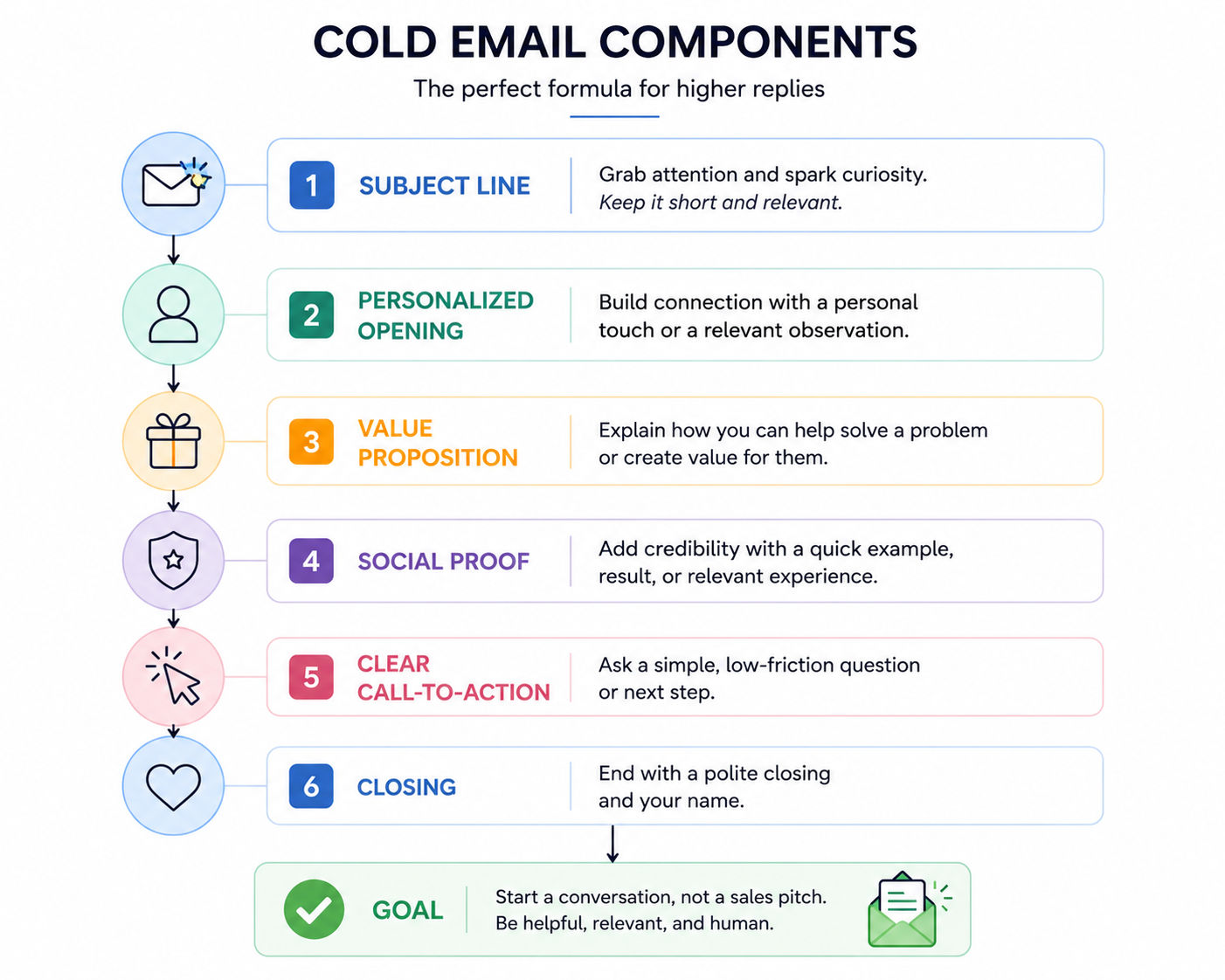
The main advantage of using cold email templates is scalability. Teams can reach hundreds of prospects while maintaining a consistent message.
However, templates only work when personalization remains part of the process. Sending the same email to everyone often produces poor results.
For example, a startup founder contacting investors should not send the exact same email used for partnership outreach. The structure may remain similar, but the message must reflect the recipient's interests and priorities.
Must read : Email Marketing Automation: How It Works and Why It Matters
Free Courses
Different objectives require different approaches. A sales email should not sound like a networking request, and an internship request should not resemble a partnership proposal.
The examples below demonstrate some of the best cold email templates for common use cases.
This template helps initiate conversations with potential customers.
Subject: Quick question about [Company Name]
Hi [First Name],
I noticed that your team is focused on [specific area].
Many companies in your industry face challenges with [problem]. We've helped similar organizations improve [result].
I thought it might be useful to share a few ideas that could help your team as well.
Would you be open to a brief conversation next week?
Best regards,
[Your Name]
This template works well for professional relationship building.
Subject: Enjoyed your insights on [Topic]
Hi [First Name],
I recently came across your work on [specific project, article, or presentation].
Your perspective on [topic] stood out to me because I'm currently exploring similar challenges.
I'd love to connect and learn more about your experience when you have time.
Thank you for your work and insights.
Best regards,
[Your Name]
This template introduces potential collaboration opportunities.
Subject: Exploring a potential collaboration
Hi [First Name],
I've been following your work at [Company].
I believe there may be opportunities for our teams to collaborate in ways that create value for both organizations.
I'd be happy to share a few ideas if you're interested.
Would a short discussion next week work for you?
Regards,
[Your Name]
These examples provide a strong starting point, but personalization remains essential for success.
Many students struggle with internship outreach because they focus too much on themselves and too little on the recipient. A strong cold email template for internship opportunities demonstrates genuine interest while showing potential value.
The goal is not simply to ask for an internship. The goal is to start a conversation.
The following example follows that principle.
Subject: Internship Inquiry – Interested in Learning from Your Team
Hi [First Name],
I hope you're doing well.
I'm currently studying [field or program] and have been following your company's work in [industry or project area].
I was particularly interested in [specific project, campaign, product, or initiative].
I'm looking for internship opportunities where I can contribute while gaining practical experience. My background includes [relevant skills or projects].
I'd appreciate the opportunity to learn more about your team and discuss whether there may be a suitable internship opportunity.
Thank you for your time and consideration.
Best regards,
[Your Name]
Many internship seekers send dozens of identical emails. Recruiters often recognize this immediately. Even a small amount of customization can significantly improve results.
Also Read : 7 Best Lead Generation Techniques That Work in 2025
Digital Marketing Courses to upskill
Explore Digital Marketing Courses for Career Progression
MICA Executive Alumni Status
The mindset for a b2b cold email template is different than consumer outreach. Business decision makers consider messages on relevance, business impact and credibility.
They usually care less about features and more about results.
A good B2B email is about solving problems, not selling products.
Subject: Helping [Company] improve [specific outcome]
Hi [First Name],
I noticed that your team is focused on expanding [initiative or goal].
Many organizations in your space encounter challenges around [specific problem].
We've helped companies achieve improvements in areas such as [result].
If relevant, I'd be happy to share a few ideas tailored to your situation.
Would a brief 15-minute discussion next week make sense?
Best regards,
[Your Name]
The following personalization methods often outperform generic outreach.
Key personalization techniques include:
For example, mentioning a prospect's recent interview shows research. Repeating generic praise like "I love your company" usually does not.
Many marketers believe personalization means adding a first name. In reality, meaningful personalization demonstrates understanding of the recipient's business context.
That difference often determines whether an email receives a reply.
Must know : Digital Marketing Subjects That Actually Shape Your Career
Even well-designed cold email templates fail when execution becomes careless.
Most low-performing emails share a few common characteristics.
The good news is that these mistakes are easy to avoid once you recognize them.
The following issues frequently reduce engagement.
Common mistakes to watch for:
The table below summarizes common problems and solutions.
Mistake |
Better Approach |
| Generic opening | Mention something specific |
| Long paragraphs | Use short, readable sections |
| Aggressive sales pitch | Focus on value |
| Multiple requests | Ask one clear question |
| No personalization | Include relevant context |
| Weak subject line | Create curiosity and relevance |
Another overlooked issue is timing.
Even excellent outreach can fail if it reaches recipients during busy periods, product launches, or major industry events.Testing different sending times often produces meaningful improvements.
Cold emailing also requires patience. Some recipients respond immediately. Others may reply weeks later. Consistent follow-up often generates better results than sending more initial emails.
The most effective cold email templates are not copied word-for-word. They evolve through testing and refinement.
Start with a simple framework:
Track important metrics such as:
Metric |
What It Measures |
| Open Rate | Subject line effectiveness |
| Reply Rate | Message relevance |
| Positive Reply Rate | Quality of responses |
| Meeting Rate | Conversion effectiveness |
| Bounce Rate | List quality |
Over time, these metrics reveal what’s working and what needs improvement.
Many high-performing outreach teams are constantly testing subject lines, opening sentences, calls to action, and personalization techniques. Small tweaks can make noticeable improvements.
Stop looking for the perfect template, and start knowing your audience. The emails that work the best usually feel relevant, helpful, and easy to reply to.
Cold email templates offer a practical framework for outreach, but success hinges on how well you adapt them to each recipient. If you’re looking for new customers, professional connections, partnerships or internship opportunities, relevance and personalization are more important than clever wording.
The best outreach is that which is clear in purpose, concise in message, and genuinely valuable. Utilizing the best cold email templates as a foundation and optimizing them through testing can increase response rates and help you develop valuable professional relationships over time.
Ready to start your journey? Book a free consultation with upGrad today to find the best path for your career.
Response rates vary by industry, audience, and email quality. Many professionals start seeing meaningful results after sending 50–100 well-targeted emails rather than a handful of generic messages. Focus on relevance and personalization instead of volume. Tracking open rates, replies, and follow-up performance helps you understand what works and where adjustments are needed.
A template provides structure, but personalization often determines whether someone responds. Most recipients can quickly recognize mass outreach. Referencing a recent achievement, project, article, or company update makes your message more relevant. Even small personalization efforts can improve engagement and help your email stand out in a crowded inbox.
Most successful cold emails stay between 75 and 150 words. Busy professionals rarely have time to read long introductions. Focus on why you're reaching out, what value you offer, and the specific action you'd like the recipient to take. Short emails are easier to scan and often generate more responses.
Yes. Many replies come from follow-up emails rather than the first message. People often miss emails because of busy schedules, meetings, or inbox overload. A polite follow-up sent a few days later can bring your email back to their attention without appearing pushy. Keep the message brief and respectful.
The best cold email templates focus on the recipient rather than the sender. They include a relevant opening, a clear reason for reaching out, and a simple call to action. Strong templates avoid unnecessary details and make it easy for the reader to understand the value of responding.
Including too many links can distract readers and sometimes affect deliverability. If a link supports your message, such as a portfolio, case study, or professional profile, include only one relevant link. Make sure it adds value rather than forcing the recipient to do extra work before deciding whether to respond.
Subject lines that feel relevant and natural tend to perform better than overly clever or sales-focused ones. Mentioning a shared interest, mutual connection, specific company initiative, or concise question can encourage opens. The goal is to create curiosity while accurately reflecting the content of the email.
Students should focus on demonstrating genuine interest, relevant skills, and willingness to learn. A strong cold email template for internship outreach highlights specific projects or experiences while showing familiarity with the organization. Recruiters often respond better to thoughtful messages than generic requests sent to multiple companies.
B2B outreach strategies change as markets, buyer behavior, and industry trends evolve. Reviewing your b2b cold email template every few months helps ensure messaging remains relevant. Teams should analyze response data regularly and update subject lines, value propositions, and calls to action based on performance insights.
AI tools can assist with research, personalization suggestions, subject line generation, and audience segmentation. However, successful outreach still requires human judgment. Relying entirely on automation can make emails feel generic. The best results usually come from combining AI efficiency with genuine understanding of the recipient's needs.
Look beyond open rates and focus on meaningful engagement metrics. Track replies, positive responses, booked meetings, and conversion outcomes. If recipients open emails but rarely respond, your messaging may need improvement. Consistent measurement helps identify which cold email templates and outreach approaches generate the strongest results.
730 articles published
Sriram K is a Senior SEO Executive with a B.Tech in Information Technology from Dr. M.G.R. Educational and Research Institute, Chennai. With over a decade of experience in digital marketing, he specia...
Get Free Consultation
By submitting, I accept the T&C and
Privacy Policy
Level Up Your Digital Marketing Career Today!
Top Resources
MICA
Advanced Certificate in AI-Powered Digital Marketing & Communication from MICAMICA Executive Alumni Status
Certification
5 Specialisation
Classroom
4 Months
Certification
2 Months