What Is a Brute Force Attack? Meaning, Types, and How to Prevent It
By Sriram
Updated on Jul 09, 2026 | 11 min read | 3.36K+ views
Share:

All courses
Certifications
More
By Sriram
Updated on Jul 09, 2026 | 11 min read | 3.36K+ views
Share:
Table of Contents
Quick Overview
In this guide, you will learn the brute force attack meaning in simple terms, what is brute force attack, the different types you should know about, how these attacks unfold in the real world, and what steps actually stop them. Whether you are a student learning cyber security basics, a developer securing an app, or someone who just wants to protect their own accounts, this is the one page you need to understand the topic fully.
If topics like password security, threat detection, and building systems that can spot attacks like a brute force attack in real time interest you, upGrad's Data Science courses can help you build the skills to work with the systems and data behind them.
Popular Data Science Programs
To define a brute force attack simply: it is a method of gaining unauthorized access to an account, system, or file by systematically trying every possible password or key combination until the correct one is found. It does not rely on tricking a person or exploiting a software bug. It relies purely on repetition.
The brute force attack meaning becomes clearer when you compare it to how a person might try to open a combination lock. Instead of guessing once, an attacker uses software that can try thousands, sometimes millions, of combinations every second. Given enough time and weak enough passwords, the lock eventually opens.
A brute force attack in cyber security context usually targets login pages, encrypted files, or API keys. It is considered one of the most basic yet persistent attack methods because it does not require the attacker to find a flaw in the system. It only requires patience and the right tools.
Also Read: Different Types of Cyber Security Threats Explained
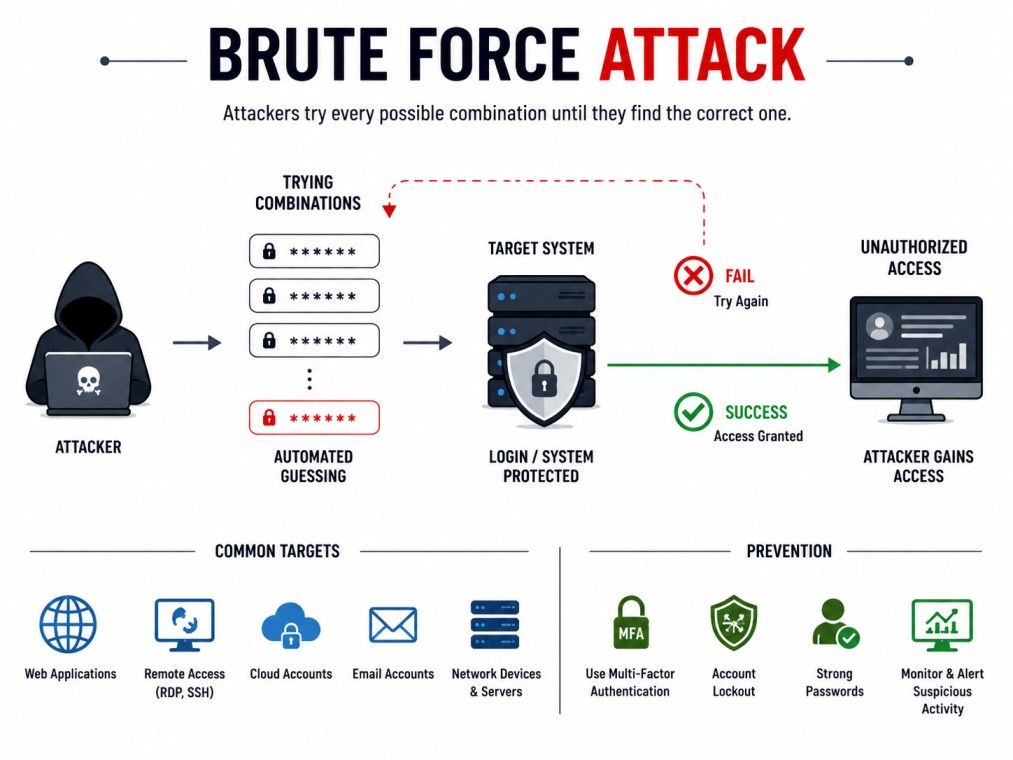
A brute force attack works by systematically trying countless password combinations until the correct one is found. It relies on automation and computing power rather than on exploiting software vulnerabilities.
The process is straightforward:
Modern brute force tools can test large volumes of passwords per second, especially when running on powerful hardware. This is why short or common passwords are quickly cracked, while long, random ones can take years to crack.
A common example is an attacker targeting a website's admin login page. Using a script, they attempt logins with common passwords like "admin123" or "password1" thousands of times within minutes. If the website has no lockout policy or rate-limiting, the attacker eventually stumbles upon valid credentials and gains access.
Another example is an attacker trying to crack a password-protected ZIP file by running every possible character combination through a cracking tool until the file unlocks.
Free Courses
Not all brute force attacks work the same way. Here is a quick breakdown of the main types.
Type |
How It Works |
| Simple brute force attack | Tries every possible character combination with no shortcuts |
| Dictionary attack | Uses a list of common words and known passwords instead of random guesses |
| Hybrid brute force attack | Combines dictionary words with numbers or symbols, like "password123" |
| Reverse brute force attack | Starts with a known password and tries it across many usernames |
| Credential stuffing | Uses leaked username and password pairs from previous data breaches |
This is the most basic form. The attacker tries every possible character combination without using any prior knowledge about the target. It is slow but works well against short or simple passwords.
Instead of trying random characters, the attacker runs through a list of commonly used passwords and real words. Since many people reuse weak, predictable passwords, this method often succeeds faster than a pure brute force attempt.
This blends dictionary words with brute force logic, adding numbers, symbols, or capital letters to common words. It targets people who think adding "123" to a password makes it secure.
Here, the attacker already has a password, often from a leak, and tries it against a large list of usernames or accounts, hoping someone reused it.
This uses username-password combinations stolen from one breach and tests them on other websites. It works because so many people reuse the same login details across multiple platforms.
An online brute force attack targets a live system or a login form and is often slowed down by rate limiting or lockouts.
An offline brute force attack happens on a stolen password hash or file, away from the target system, where the attacker can try unlimited guesses without triggering any alerts.
Understanding the motive helps explain why this attack method has not gone away.
These motives explain why brute force attacks target everything from personal social media accounts to enterprise servers.
Cyber threats like brute force attacks are just one reason skilled data professionals are in demand everywhere, from security teams to product analytics. If you're looking to break into this space or level up your career, the Master of Science in Data Science from Liverpool John Moores University, offered in collaboration with upGrad, gives you the credentials and skills to get there.
Data Science Courses to upskill
Explore Data Science Courses for Career Progression
IIIT Bangalore
Executive Post Graduate Certificate in Data Science & AIPlacement Assistance
Attackers rarely do this manually. They rely on automated software built specifically for the job.
Some widely known tools used in brute force attacks include Hydra, John the Ripper, Hashcat, and Aircrack-ng. These tools are also used by security professionals for legitimate penetration testing, which shows how the same technology can serve both attackers and defenders.
Graphics cards, or GPUs, are built to handle massive parallel calculations, which makes them ideal for brute force attacks. A single GPU can test millions of password combinations per second, far outpacing a regular computer processor. This is why password length and complexity matter so much today. What used to take years can now take hours with the right hardware.
The time it takes depends heavily on password length and complexity.
Password Type |
Estimated Time to Crack |
| 6 characters, lowercase only | Seconds to minutes |
| 8 characters, mixed case and numbers | A few hours to days |
| 12 characters, mixed case, numbers, symbols | Several years |
| 16+ characters, fully random | Centuries with current technology |
These numbers change as hardware improves, but the core lesson remains the same: longer, more random passwords are dramatically harder to crack.
Brute force attacks commonly target any system protected by passwords, with web applications, remote access services, cloud accounts, and enterprise networks often being the most frequent targets.
Brute force attacks are not limited to login pages. They show up across several different systems.
A brute force attack in cryptography targets encryption keys rather than login passwords. The attacker tries every possible key combination to decrypt data without authorization. As encryption key lengths increase, the number of possible combinations grows so large that a brute force attack in cryptography becomes practically impossible with current computing power.
A brute force attack on wifi typically targets the handshake process used when a device connects to a wireless network. Attackers capture this handshake and then run brute force attempts to guess the network password. Weak or default router passwords make a brute force attack on wifi far more likely to succeed.
A brute force attack apk refers to tools or modified applications designed to test or exploit login screens within Android apps. Some of these are used by security researchers for legitimate testing, but a brute force attack apk can also be misused to break into mobile accounts, which makes downloading such tools from unverified sources risky.
While brute force attacks rely on repeatedly guessing passwords, other cyberattacks use tactics such as deception, stolen credentials, or software vulnerabilities to gain unauthorized access. It is important to understand how and why brute force attacks differ from other common cybersecurity threats.
Attack Type |
Key Difference from Brute Force |
| Dictionary attack | Uses known words instead of every possible combination |
| Rainbow table attack | Uses precomputed hash tables instead of live guessing |
| Phishing | Tricks the user into giving up credentials rather than guessing them |
| Password spraying | Tries one common password across many accounts instead of many passwords on one account |
| Credential stuffing | Uses previously leaked credentials instead of random guesses |
Subscribe to upGrad's Newsletter
Join thousands of learners who receive useful tips
Catching an attack early can prevent serious damage. Watch for these warning signs.
If you notice these signs, change your password immediately, enable multi-factor authentication if you have not already, and check your account activity log for anything unfamiliar. On a server, block the offending IP addresses and review your firewall and rate limiting rules right away.
Also Read: What is Two Factor Authentication(2FA)
Prevention works best when it covers both individual habits and system-level defenses.
A brute force attack password checker estimates cracking time based on password length, character variety, and known attack speeds. Trying your own password through a brute force attack password checker is a simple way to catch weak choices before an attacker does.
Is CAPTCHA effective against brute force attacks? Yes, in most cases. It does not stop every attempt, but it significantly slows down automated scripts and forces attackers toward easier targets. Combined with rate limiting and account lockouts, it forms a strong first line of defense.
Also Read: Penetration Testing In Cyber Security:Types, Pros And Cons
An encryption key is a string of characters used by an algorithm to scramble and unscramble data. The longer and more random the key, the harder it becomes for an attacker to guess it through brute force. This is why modern encryption standards use very long keys, often 128 bits or more.
Also Read: What is Public Key Cryptography?
Brute force attacks are among the most common attack methods reported across industries. Login pages, remote access services, and IoT devices are frequently among the most targeted systems, largely because many still use weak default credentials. Security reports consistently show that a large share of breaches trace back to weak or reused passwords, which is exactly what brute force and credential stuffing attacks exploit.
Statistic |
Latest Figure (through June 2026) |
| Breaches caused by credential abuse (initial access) | 13% of breaches (2026 DBIR methodology) |
| Identity-related initial access (credential abuse + phishing + pretexting) | ≈35% of breaches |
| Software vulnerability exploitation as initial access | 31% of breaches |
| Basic web application attacks involving stolen credentials | 88% |
| Successful web application attacks beginning with brute-force/password attacks | ≈1 in 3 (33%) |
| Brute-force attacks against web applications (year-over-year growth) | Increased from ~20% to ~60% |
| Organizations affected in a major Microsoft 365 password-spraying campaign (June 12–26, 2026) | 64 organizations |
| Microsoft 365 login attempts during the June 2026 password-spraying campaign | 81 million login attempts |
| Accounts successfully compromised in that campaign | 78 Microsoft 365 accounts |
| System intrusion as overall breach pattern (2026 DBIR) | ~60% of breaches |
| Password reuse among users | 81% reuse passwords across multiple accounts |
| Weak passwords in malware-stolen password dataset | 98.5% classified as weak |
| Malware-stolen passwords analyzed | 1.08 billion passwords |
Conclusion
A brute force attack is one of the most effective tools in an attacker's arsenal. It does not need a software flaw or a clever trick, just a weak password and sufficient time. The good news is that the defense is just as straightforward. Strong, unique passwords, multi-factor authentication, rate limiting, and basic monitoring can stop the vast majority of these attempts before they succeed. Understanding the brute force attack meaning and how these attacks actually work puts you in a much stronger position to protect your accounts, your data, and your systems.
Security teams often ask new hires to define brute force attack risks as part of onboarding, since it remains one of the first concepts covered in any brute force attack in cyber security training program.
Want personalized guidance on Data Science and upskilling? Speak with an expert for a free 1:1 counselling session today.
Yes, using a brute force attack to access systems or accounts without permission is illegal in most countries and falls under computer fraud or unauthorized access laws. It is only legal when carried out by authorized security professionals during approved penetration testing.
A strong, long, and random password makes a brute force attack take an impractically long time to succeed, but it is not the only defense needed. Pairing it with multi-factor authentication and account lockout policies offers much stronger protection overall.
Hacking is a broad term covering many techniques, including exploiting software bugs or tricking users. A brute force attack is one specific method that relies purely on repeated guessing rather than finding a technical flaw or manipulating a person.
No, HTTPS only encrypts data in transit between a browser and a server. It does not stop an attacker from repeatedly submitting login attempts, which is why separate defenses like rate limiting and lockouts are still necessary.
It means trying every possible password or key combination until the right one is found, similar to trying every number on a combination lock until it opens. No special skill is required, just automated tools and time.
A brute force attack is a trial and error method used to gain unauthorized access to accounts, systems, or encrypted data by systematically testing every possible combination of characters.
It remains common because many people and organizations still use weak, short, or reused passwords, and not every system has proper rate limiting or lockout protection in place. As long as weak passwords exist, this method stays effective.
A brute force attack in cryptography targets the encryption key used to scramble data, while a login page attack targets a password directly. Cryptographic keys are usually far longer and more complex, making them much harder to crack.
Change your router's default password, use WPA3 encryption if available, and avoid short or common Wi-Fi passwords. Disabling remote router management and updating router firmware regularly also reduces the risk significantly.
It depends on intent and permission. Security researchers use such tools on systems they own or have explicit authorization to test. Using a brute force attack apk tool on someone else's app or account without consent is illegal.
Most checkers give a reasonable estimate based on password length and character variety, but actual cracking time depends on the attacker's hardware and method. Treat the result as a helpful guide rather than an exact guarantee.
730 articles published
Sriram K is a Senior SEO Executive with a B.Tech in Information Technology from Dr. M.G.R. Educational and Research Institute, Chennai. With over a decade of experience in digital marketing, he specia...
Speak with Data Science Expert
By submitting, I accept the T&C and
Privacy Policy
Start Your Career in Data Science Today
Top Resources
Master's Degree
18 Months
Executive Diploma
12 Months
Bootcamp
6 Months