Vroom’s Expectancy Theory: Meaning, Formula, Components and Process
By upGrad
Updated on Sep 10, 2026 | 8 min read | 2.47K+ views
Share:

All courses
Certifications
More
By upGrad
Updated on Sep 10, 2026 | 8 min read | 2.47K+ views
Share:
Table of Contents
Key Highlights
Take your leadership journey to the next level with a Doctor of Business Administration (DBA) and build skills to handle real businesses.
The Vroom’s Expectancy Theory was developed by Victor Vroom in 1964. It is a motivational theory that explains people do any kind of task when they believe their efforts will give them the desired outcome.
The theory is based on beliefs of people, that their actions will lead to good performance and that performance will give something they value.
The theory has three key elements:
It is a belief that putting more effort will lead to better performance. Expectancy depends on factors like:
If employees believe they have the right skills, resources to improve their performance, their expectancy is high. But, if employees believe they do not have knowledge, training, or time to complete a task, their expectancy is low.
Believing that good performance can lead to a specific reward or outcome.
If employees believe that good performance will not give them recognition or rewards, this is a low instrumentality. Organizations should clearly say to employees that performance is directly related to promotion, bonuses, recognition, salary increment, or other benefits.
Valence means how much value or importance a person is giving to the expected outcome. This is a subjective matter because money can motivate one person, while another may prefer recognition or work-life balance.
Also read: How to Increase the Productivity of your Employees?
The formula of Vroom’s Expectancy Theory is:
Motivation = Expectancy × Instrumentality × Valence
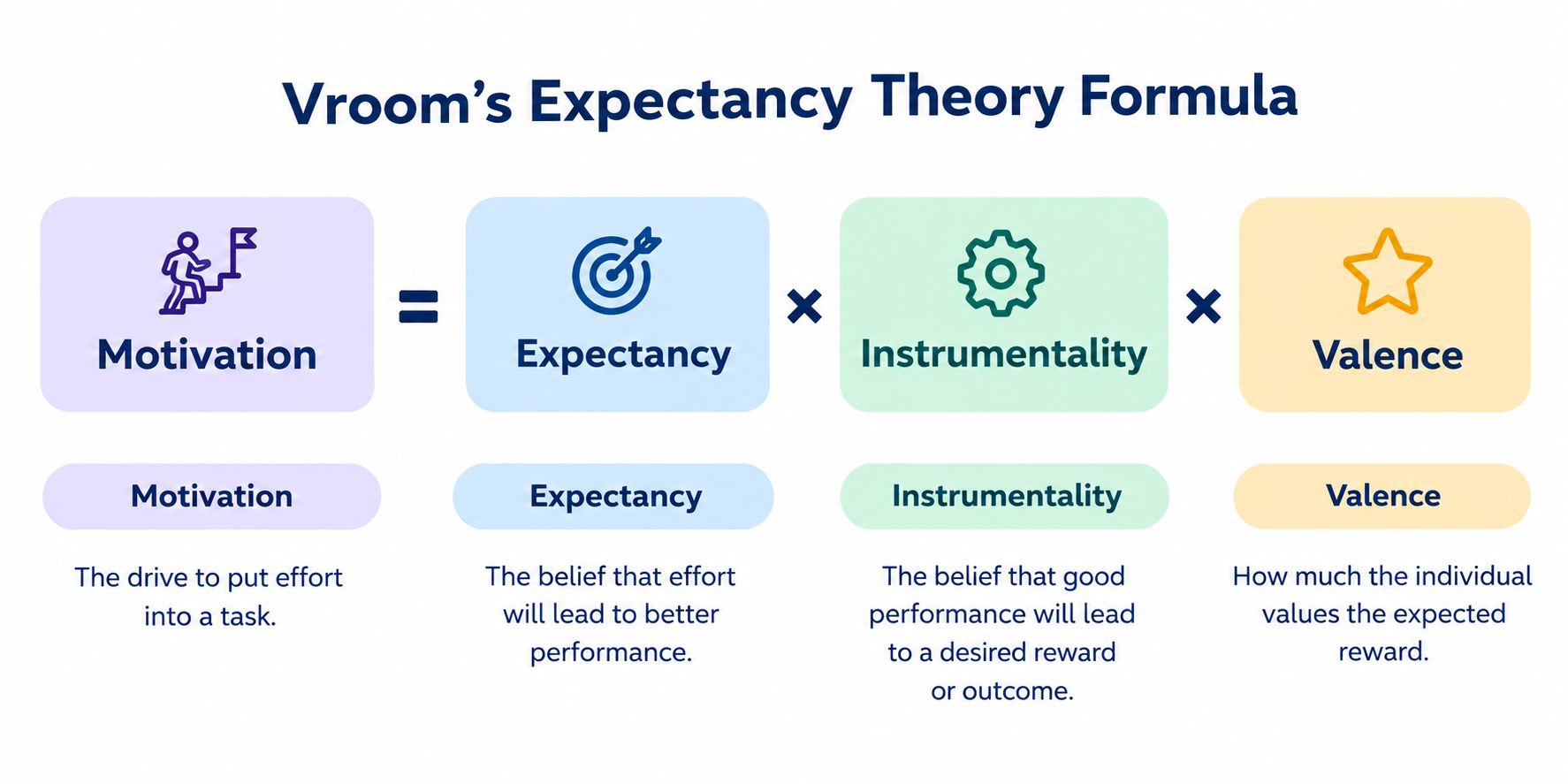
As the three factors are multiplied, if any one of them is zero, overall motivation becomes zero (no matter how high the other factors are).
Scenario |
Expectancy (E) |
Instrumentality (I) |
Valence (V) |
Result |
| Employee doubts their skills | Low | High | High | Low motivation |
| Employee excels but rewards are random/unfair | High | Low | High | Low motivation |
| Employee performs well, gets rewarded, but doesn't care about the reward | High | High | Low | Low motivation |
| All three are strong | High | High | High | High motivation |
Also read: What is Critical Thinking? How to Develop Critical Thinking Skills?
The employees do this as a mental calculation (often unconsciously) before deciding how much effort to put in a task. This is like a chain, where each answer depends on the one before it.
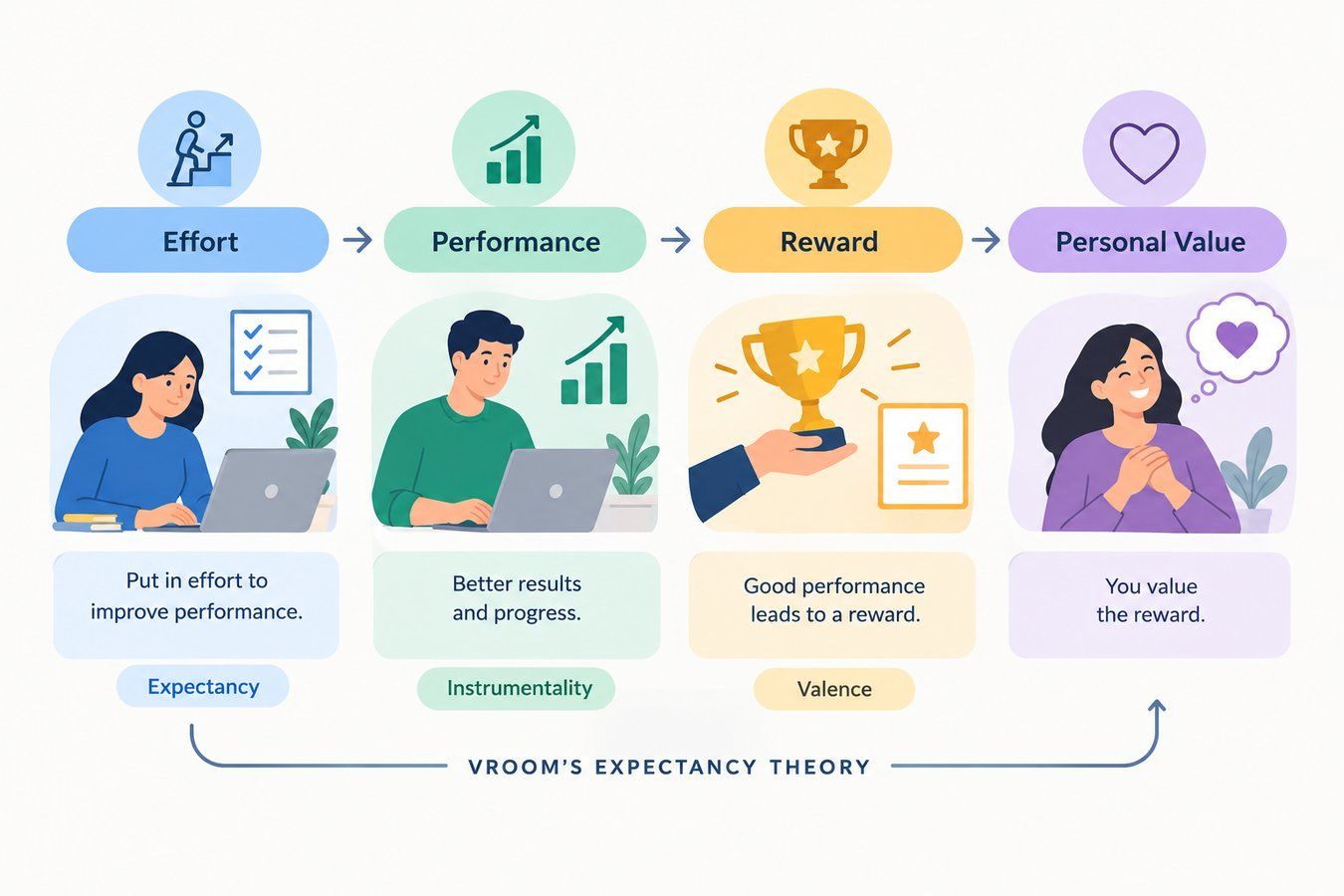
Step 1: Effort → Performance (Expectancy)
The person first asks: "If I put in effort, will it actually convert into good performance?"
This is not just about willpower. It depends on whether they have the right skills, enough time, tools, and support from others. If someone believes even maximum effort won't produce results (example - unrealistic targets, missing resources), the chain will break here.
Step 2: Performance → Outcome (Instrumentality)
If they believe effort will lead to good performance, they ask the next question: "If I perform well, will that actually get me the outcome I have been promised?"
A clear and reliable reward system increases motivation.
Step 3: Outcome → Value (Valence)
Finally: "Do I actually care about that outcome?"
A guaranteed reward cannot motivate someone if they do not value it. A promotion means little to someone who wants more free time, not more responsibility.
The three factors are multiplied, not added or averaged.
This means motivation is not a "some good, some bad, averages out" situation. It is a chain that can be broken at any link. If expectancy, instrumentality, or valence hits zero, the whole product becomes zero.
This point separates Vroom's model from other motivation theories because it can explain why a talented, well-rewarded employee can be completely unmotivated. It is because one link in the chain has quietly failed, but on paper everything looks well.
Because it's a chain, diagnosis works backward from low motivation:
Fixing the wrong link will not move motivation between employees. For example, adding more rewards when the real problem is the employee doubts their own ability.
Earn your Doctor of Business Administration online from Edgewood University with upGrad and turn real-world business challenges into original research. The program is built for working professionals.
DBA Courses to upskill
Explore DBA Courses for Career Progression
IIIT-B & IIM, Udaipur
Chief Technology Officer & AI Leadership ProgrammeThe following are the key advantages of Vroom’s Expectancy Theory:
1. Helps managers identify the causes of low motivation
On the basis of three components, the managers can check where the exact motivation problem the employees are facing. If an employee is facing issues with confidence, or skills it is a sign of low expectancy. If the employee does not believe good performance will be rewarded, it is a sign of low instrumentality. If the employee thinks reward is not valuable, it is a sign of low valence.
2. Encourages clear communication of expectations
Clearly communicate with employees, what is expected of them and how their performance will be checked. Managers should communicate the expected performance standards and reward criteria. When the employees have ideas about their actions, performance, and outcomes, then uncertainty gets reduced.
3. Can be applied to different workplace situations
This theory can be used for employee performance, sales incentives, promotions, goal setting, leadership, and compensation management. Also, by this companies can figure out why employees are responding positively or negatively to a new incentive program.
Also read: What are Problem Solving Skills? Definition, Examples and Steps to Learn
These are the disadvantages of Vroom’s Expectancy Theory:
Also read: What is Herzberg Two Factor Theory? How to Use It to Boost Productivity?
For employees the source of motivation are different and these are as follows:
Also read: Motivation Theory in Management: Theories, Workplace Applications, and Challenges
In Vroom's Expectancy Theory motivation is not automatic, it depends on whether an employee has a belief in good performance (Expectancy), whether that performance will give desired reward (Instrumentality), and whether that reward is actually valuable (Valence). As these factors are multiplied, one weak area can bring the overall motivation to zero.
With the help of this theory, the managers can identify the reasons for demotivation among employees. The theory has broad factors, which makes it a practical starting point for keeping employees engaged.
Book a free consultation call with upGrad and explore the right DBA program for your goals.
The main purpose of Vroom’s Expectancy Theory is to understand how people decide where to direct their effort. It explains how expected outcomes influence choices and the level of effort individuals are willing to invest.
Yes, the theory can apply to students. For example, a student may decide how much time to spend studying based on their expectations about academic results, future opportunities, or achieving personal educational goals.
Yes. It's commonly used to explain motivation in academic settings (why students study), sports performance, and healthcare compliance (why patients follow treatment plans), wherever effort, expected outcomes, and personal value intersect.
Clear communication can reduce uncertainty about tasks, expectations, and possible outcomes. When individuals receive accurate information, they can better understand what actions are required and make more informed decisions about where to direct their effort.
The theory can also be applied to situations beyond employment. Consumers may consider the results they expect from a particular choice before acting, especially when comparing alternatives and deciding whether a specific outcome is worth pursuing.
Trust can influence how confidently individuals make decisions about expected outcomes. When people trust that commitments will be honored, they may be more willing to base their actions on those expected results.
Extremely difficult goals may reduce motivation when individuals believe they have little chance of achieving them. More realistic goals can make the expected connection between individual effort and successful outcomes seem more achievable.
Yes, but applying it to teams requires recognizing that team members may have different expectations and priorities. Managers may need to consider these differences when establishing team goals, responsibilities, and desired outcomes.
The theory connects motivation with decision-making by suggesting that individuals consider possible outcomes when choosing where to direct their effort. Their expectations about different choices can influence which action they ultimately decide to take.
Vroom’s theory can support goal-setting by encouraging organizations to make desired outcomes understandable and meaningful. Employees should know what they are working toward and understand why achieving the goal is worthwhile to them.
Yes, the theory remains useful for understanding motivation because employees continue to make choices based on their expectations and desired outcomes. Its principles can be applied across different roles, workplaces, and changing organizational environments.
971 articles published
We are an online education platform providing industry-relevant programs for professionals, designed and delivered in collaboration with world-class faculty and businesses. Merging the latest technolo...
Speak with DBA expert
By submitting, I accept the T&C and
Privacy Policy