Complete Guide to Six Sigma Certification Cost: Fees, Duration, and Benefits
By upGrad
Updated on Sep 18, 2026 | 17 min read | 6.47K+ views
Share:

All courses
Certifications
More
By upGrad
Updated on Sep 18, 2026 | 17 min read | 6.47K+ views
Share:
Table of Contents
Key Takeaway
Explore the best management courses in India with upGrad and gain industry-relevant expertise through programs from leading universities. Build practical management, strategy, and leadership skills to stay ahead in today's competitive job market.
Popular Management Programs
Pursuing Six Sigma certification is a significant investment in both time and money. This section outlines the costs and durations of each certification level, from Green Belt to Master Black Belt.
Understanding the financial and time commitment is crucial if you're looking to advance in your current role or move into leadership.
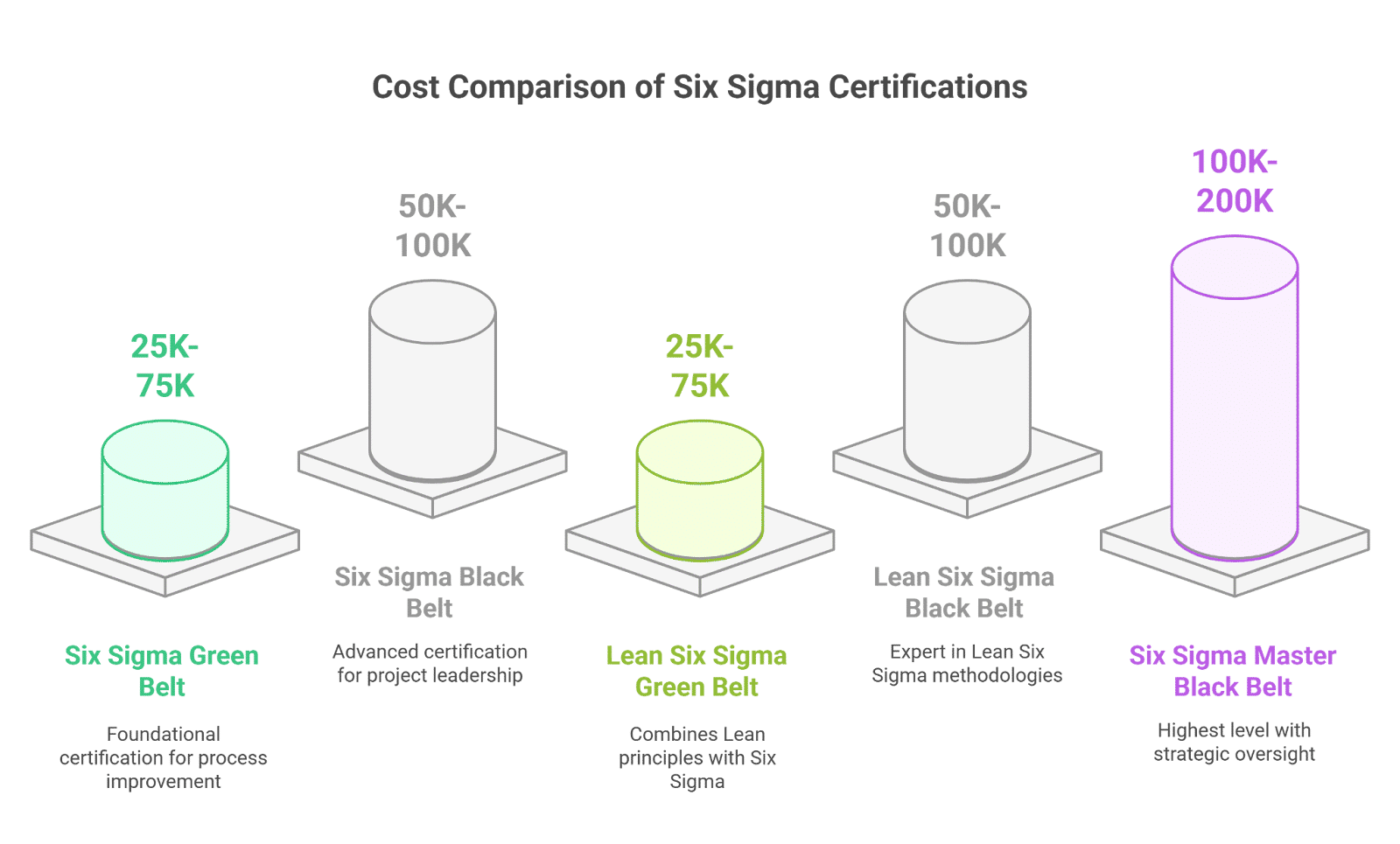
We’ll break down the prerequisites, exam formats, and costs for each level, helping you choose the certification that aligns with your career goals.
1. White Belt Certification
The White Belt certification introduces you to the basics of Six Sigma methodology. It’s designed to provide a foundational understanding of Six Sigma concepts, making it a great starting point for anyone new to the field.
2. Yellow Belt Certification
The Yellow Belt certification provides foundational knowledge of Six Sigma principles. It’s ideal for professionals who wish to understand the basics of process improvement and contribute to Six Sigma projects at a supportive level.
3. Six Sigma Green Belt Certification
Six Sigma Green Belt certification focuses on process improvement and data analysis. Green Belts often lead smaller improvement projects or support Black Belts in larger initiatives.
It’s perfect for those looking to deepen their knowledge of Six Sigma principles and contribute to key process improvements.
4. Six Sigma Black Belt Certification
The Black Belt certification emphasizes leadership in Six Sigma projects. Black Belts are responsible for leading complex projects, solving critical problems, and mentoring Green Belts. This certification is designed for those aiming to lead and manage process improvement initiatives.
5. Six Sigma Black Belt Certification – Level II
Level II is an advanced Black Belt certification that requires candidates to demonstrate mastery by completing a project. This certification is ideal for those looking to deepen their expertise and lead more complex initiatives.
6. Six Sigma Black Belt Certification – Level III
Level III is for professionals who want to enhance their Black Belt skills further. This certification demands additional project requirements and advanced knowledge in Six Sigma methodology.
7. Six Sigma Master Black Belt Certification
Master Black Belt certification is the pinnacle of Six Sigma certifications. It focuses on strategic leadership in Six Sigma initiatives and teaches professionals how to align Six Sigma projects with business goals.
Master Black Belts mentor other Black and Green Belts, guiding major organizational transformations.
After achieving a Master Black Belt in Six Sigma, many professionals opt for Lean Six Sigma certifications to incorporate efficiency-driven methodologies into their process improvement toolkit.
Lean Six Sigma focuses more on eliminating waste, while traditional Six Sigma emphasizes reducing defects. Both certifications can complement each other, but those in operational roles often prefer the Lean Six Sigma certifications focused on streamlining processes.
8. Lean Six Sigma White Belt Certification
Lean Six Sigma White Belt certification introduces the basics of Lean principles and Six Sigma methodologies. It’s ideal for beginners who want to understand the fundamentals of process improvement and waste reduction.
This certification provides an overview of Lean tools and Six Sigma techniques, setting the stage for further learning.
9. Lean Six Sigma Yellow Belt Certification
Lean Six Sigma Yellow Belt certification provides a foundational understanding of both Lean and Six Sigma methodologies. It is suitable for those who want to participate in process improvement projects at a team level, supporting Green Belts or Black Belts.
10. Lean Six Sigma Green Belt Certification
Lean Six Sigma Green Belt certification equips professionals with the skills to lead smaller process improvement projects using both Lean and Six Sigma tools.
This certification focuses on analyzing data, identifying inefficiencies, and driving improvements in operational performance.
11. Lean Six Sigma Black Belt Certification
Lean Six Sigma Black Belt certification is designed for professionals who wish to take leadership roles in process improvement projects, using Lean and Six Sigma tools. Black Belts manage and execute large-scale projects and mentor Green Belts.
12. Lean Six Sigma Black Belt Certification – Level II
This advanced certification level builds on Lean Six Sigma Black Belt expertise, requiring candidates to complete a project demonstrating their ability to implement improvements effectively.
13. Lean Six Sigma Master Black Belt Certification
Lean Six Sigma Master Black Belt certification is the highest level, focusing on strategic leadership and organizational transformation. Master Black Belts mentor other Six Sigma practitioners and drive process improvement initiatives across entire organizations.
These Lean Six Sigma certifications offer a clear pathway to mastering process efficiency and quality improvement. Now that you understand the costs and details better, it’s time to look at what you'll need to get certified: the training and materials that will support your journey.
Free Courses
This section provides a detailed, itemized breakdown of all the costs involved in Six Sigma certification, from training fees to exam costs, study materials, retakes, and certification renewals. Get a clear picture of the financial commitment required at each stage of the process.
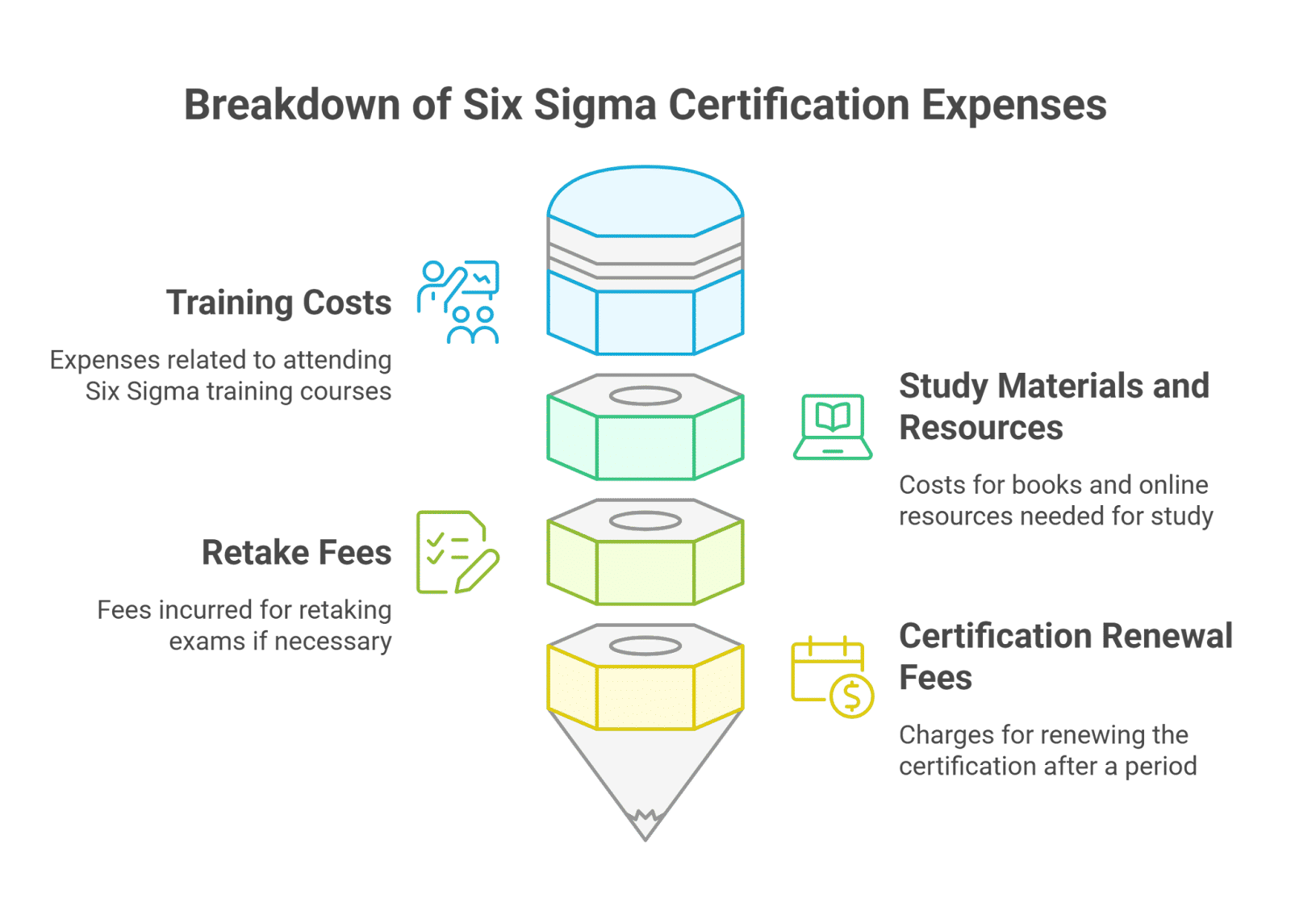
1. Six Sigma Training Costs
Online training for Green Belt typically costs between INR 25k - 75k, while in-person courses range from INR 50k - 1L. The cost varies based on the training format and the provider.
Factors Influencing Pricing:
2. Study Materials and Resources
Books and study guides typically range from INR 2k - 10k, depending on the depth and quality of the content.
3. Retake Fees
Most providers offer up to three attempts for the initial fee. After that, you'll need to pay a retake fee of approximately INR 5k - 10k.
4. Certification Renewal Fees
Six Sigma certifications are generally valid for 3 years. After this period, they need to be renewed.
Understanding the various costs involved in Six Sigma certification helps you prepare for the financial commitment ahead.
Now that you know the costs, let’s look at how to make this investment more affordable by cutting down on unnecessary expenses.
Six Sigma certifications can be a significant investment, but there are several ways to reduce costs without compromising the quality of your preparation.
1. Corporate Sponsorship and Employer Support
Many employers are willing to sponsor or fund Six Sigma certification to enhance their team's skills. To approach your company for funding, highlight how the certification can improve efficiency and drive business success. In industries like manufacturing and healthcare, employers are particularly keen on sponsoring certifications to improve process efficiency and quality standards.
Prepare a clear proposal outlining the benefits to the company and yourself.
2. Scholarships and Discounts for Certification
Some organizations offer scholarships or discounts for Six Sigma certifications. Look for promotions, especially through training providers or industry groups.
Keep an eye on seasonal offers or specific discounts for members of professional associations.
3. Choosing Cost-Effective Training Programs
When selecting a training program, compare prices and reviews to find affordable, high-quality options. Consider online courses, which often come at a lower cost than in-person training.
Look for packages that bundle training with study materials for added value.
4. Using Free Online Resources
Take advantage of free resources like forums, YouTube tutorials, and free study guides. While these may not be as comprehensive as paid options, they can provide valuable supplementary material to help you prepare for the exam without additional costs.
Now that you've saved on costs, let’s dive into how Six Sigma certification delivers solid returns on salary and career growth.
Investing in Six Sigma certification offers measurable returns, enhancing earning potential, career progression, and organizational impact. For instance, professionals who earn a Black Belt certification often transition into higher management roles, taking on responsibility for larger, more complex projects that drive significant cost savings and process improvements.
Similarly, those with a Green Belt certification often take on leadership roles in process improvement teams, where they lead initiatives that result in enhanced operational efficiency and are frequently recognized with career advancements and higher pay.
1. Salary Increase for Certified Professionals
Six Sigma certifications can significantly boost salaries:
These figures demonstrate the financial value of Six Sigma expertise.
2. Career Advancement Post-Certification
Earning a Six Sigma certification opens doors to:
These roles leverage Six Sigma skills to drive business success.
3. Enhanced Organizational Value
Certified professionals contribute to organizations by:
Also Read: Online Product Management Courses to Kickstart your Career
These contributions create a culture of continuous improvement that benefits both employees and employers. Now, let's focus on which Six Sigma certification level suits you best based on your goals and experience.
Step into executive technology leadership with the Chief Technology Officer & AI Leadership Programme from IIIT Bangalore and IIM Udaipur. Build expertise in AI strategy, platform engineering, business leadership, and boardroom decision-making through live learning, hands-on projects, and an industry-focused curriculum designed for experienced technology leaders.
Management Courses to upskill
Explore Management Courses for Career Progression
IIIT-B & IIM, Udaipur
Chief Technology Officer & AI Leadership Programme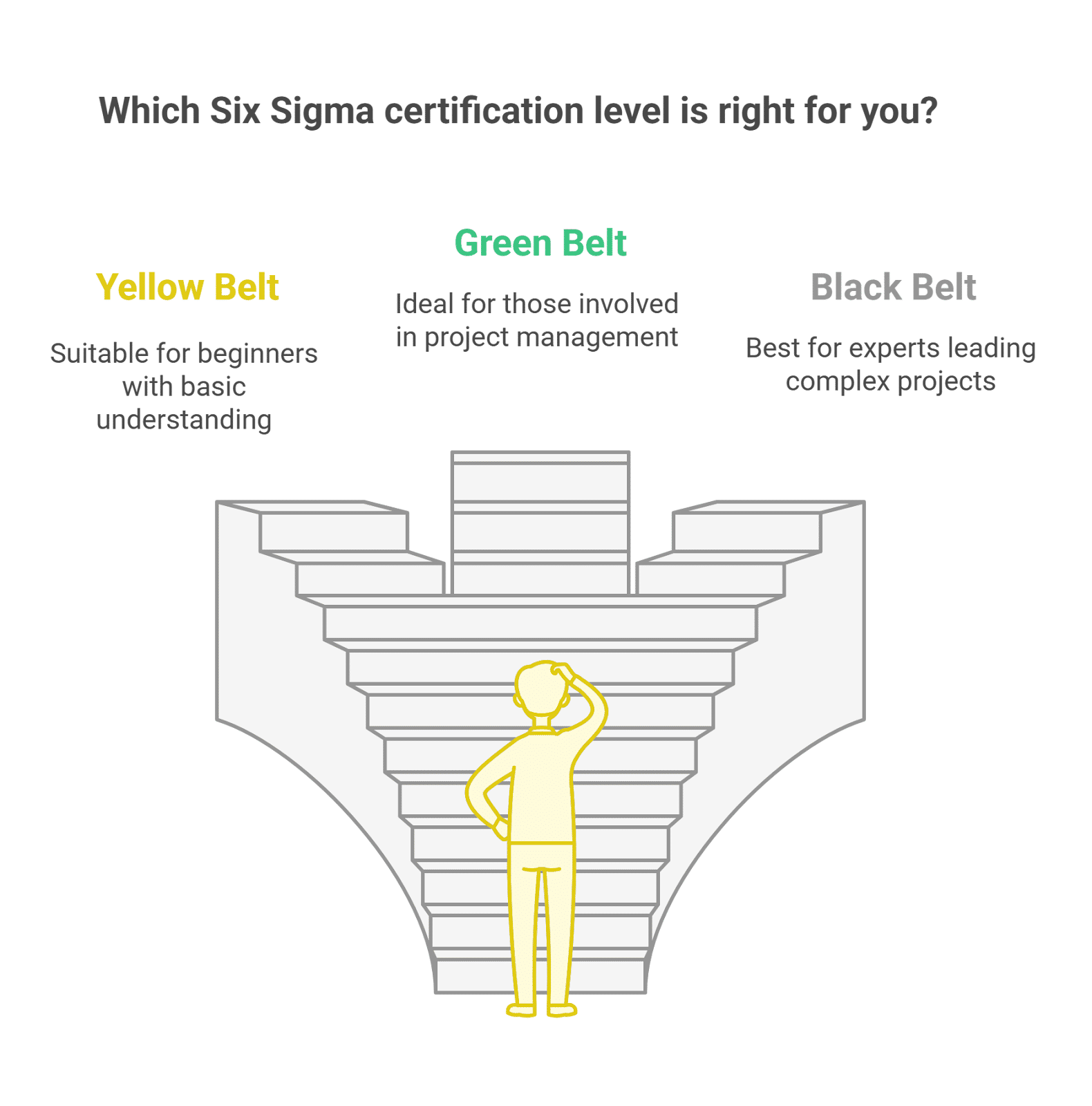
This section will break down the pros and cons of each Six Sigma certification level. You’ll go through when and why to choose each level based on your career goals, experience, and the impact you want to have within your organization.
Here’s a quick comparison to help you choose the right Six Sigma certification based on your goals and experience.
Certification Level |
Pros |
Cons |
Best For |
| Six Sigma White Belt | Free and easy introduction to Six Sigma basics. | Covers only fundamental concepts. | Beginners exploring process improvement. |
| Six Sigma Yellow Belt | Builds core Six Sigma knowledge for support roles. | Limited scope and leadership exposure. | Professionals supporting improvement projects. |
| Six Sigma Green Belt | Develops process improvement and data analysis skills. Affordable and practical. | Less focus on advanced leadership. | Professionals leading small to medium process improvement projects. |
| Lean Six Sigma Green Belt | Combines Lean methods with Six Sigma tools for greater efficiency. | Requires understanding of both approaches. | Professionals improving quality and operational efficiency. |
| Six Sigma Black Belt | Builds advanced project management and leadership skills. | Higher cost and longer learning commitment. | Professionals leading complex improvement initiatives. |
| Lean Six Sigma Black Belt | Covers advanced Lean and Six Sigma techniques. | More demanding and time-intensive. | Experienced professionals driving large-scale process improvements. |
| Six Sigma Master Black Belt | Focuses on strategic leadership and mentoring. | Requires extensive experience. | Senior leaders overseeing Six Sigma programs. |
| Lean Six Sigma Master Black Belt | Develops expertise in enterprise-wide Lean Six Sigma strategy. | Best suited for highly experienced professionals. | Executives leading organization-wide transformation initiatives. |
Whether you're aiming for a foundational role or a strategic leadership position, each certification level offers distinct benefits and challenges.
Also Read: Best Online Management Courses in India in 2025: Which One Should You Choose?
Now, let’s weigh the pros and cons of Six Sigma certifications to help you understand the full picture before taking the plunge.
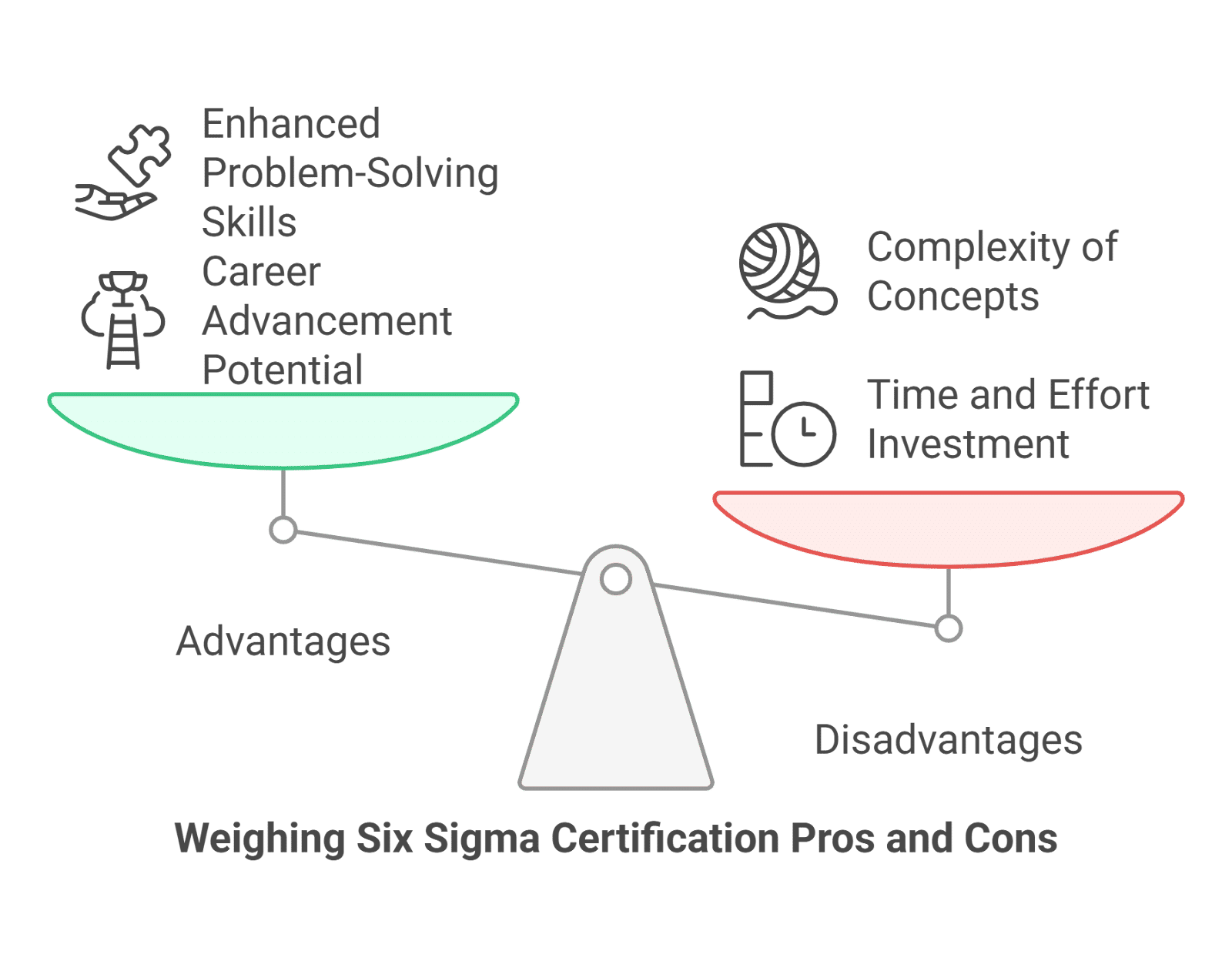
Before committing to a Six Sigma certification, it’s essential to understand both the benefits and potential drawbacks. You’ll look at the challenges you might face along the way, helping you decide whether Six Sigma certification is the right choice for you.
Advantages |
Disadvantages |
| Better Career Opportunities: Opens doors to new roles across industries. | Time Commitment: Advanced certifications require months of learning and project work. |
| Higher Salary Potential: Certified professionals often command better pay. | Higher Cost: Training, exams, and study materials can be expensive. |
| Practical Skill Development: Builds expertise in process improvement, data analysis, and leadership. | Experience Required: Higher-level certifications typically require prior work experience. |
| Globally Recognized Credential: Valued by employers worldwide. | Challenging Exams: Advanced certifications demand strong analytical skills and preparation. |
| Leadership Opportunities: Prepares you to manage improvement projects and teams. | Ongoing Maintenance: Some certifications require renewal or continuing education. |
| Improved Problem-Solving Skills: Helps solve business and operational challenges systematically. | Steep Learning Curve: Advanced concepts can be difficult for beginners. |
| Greater Job Security: Demand remains strong in quality, manufacturing, healthcare, and IT. | Balancing Work and Study: Training can be challenging alongside a full-time job. |
| Adds Business Value: Helps organizations reduce costs, improve quality, and boost efficiency. | Continuous Learning Required: Keeping skills current requires ongoing learning. |
| Professional Credibility: Demonstrates expertise in quality and process improvement. | Performance Expectations: Employers may expect measurable business impact after certification. |
Considering which certification level is right for you, consider your career goals, experience, and where you want to take your professional journey. Whether you're just starting with Green Belt or aiming for strategic leadership with a Black Belt or Master Black Belt, the right certification can propel you toward your aspirations.
Take the time to weigh the options, invest wisely, and start your journey toward becoming a Six Sigma expert.

Conclusion
The Six Sigma certification cost varies based on the certification level, training provider, learning format, and what's included in the program. While Green Belt certifications are generally more affordable, Black Belt and Lean Six Sigma certifications require a higher investment but often provide more advanced skills and broader career opportunities.
Understanding the complete cost, including training, exam fees, study materials, and any additional charges, can help you plan your budget more effectively.
By comparing your options carefully and choosing a certification that aligns with your career goals, you can make a well-informed investment in your professional growth.
Ready to start your journey? Book a free consultation with upGrad today to find the best path for your career.
Elevate your leadership and strategic thinking with our popular management courses, designed to shape you into a dynamic and effective leader in today's competitive business world.
Discover actionable insights and expert strategies in our top management articles, crafted to inspire and empower your journey to leadership excellence.
References
Lean Six Sigma certification cost is typically lower than traditional Six Sigma certifications due to its focus on efficiency and waste reduction rather than full-scale process improvement. Lean Six Sigma Green Belt certification cost is often more affordable compared to Six Sigma Black Belt certification cost, which involves deeper training in process control and data analysis.
Yes, Six Sigma certification is recognized across various industries, including manufacturing, healthcare, IT, and finance. The tools and principles learned during the certification process can be applied to any sector aiming for improved quality and operational efficiency. Whether you're in a service or product-based industry, Six Sigma methodologies remain relevant.
In India, Six Sigma certification significantly boosts job prospects, especially in fields like manufacturing, IT, and consulting. With a Six Sigma Green Belt certification cost in India starting at a lower price point, it’s accessible for entry-level professionals. Meanwhile, Black Belt holders see substantial career growth, often stepping into managerial and leadership roles.
After earning your Six Sigma certification, the ongoing costs primarily include certification renewal fees every 3 years. These fees typically range from ₹5,000 to ₹15,000. Additionally, continuing education and membership in professional organizations might incur some costs, especially for Master Black Belt certification holders who focus on advanced learning.
While it’s possible to self-study for a Six Sigma certification, formal training programs are highly recommended for a structured learning experience and higher exam success rates. Many candidates opt for a Six Sigma Green Belt certification before advancing to Black Belt, with Six Sigma Black Belt certification cost including both training and exam fees.
Even without formal Six Sigma certification, you can apply basic Six Sigma principles to your current role by focusing on process improvement, waste reduction, and data-driven decision-making. Start by using Lean Six Sigma tools like value stream mapping, root cause analysis, and the DMAIC methodology to identify inefficiencies and propose solutions.
Many employers offer to cover Six Sigma certification costs as part of professional development initiatives, especially for roles that directly impact process improvement and operational efficiency. It’s worth discussing the possibility of employer sponsorship for Six Sigma Black Belt certification cost or other certifications relevant to your current or future role.
Most Six Sigma certifications require renewal every 3 years. The Six Sigma certification renewal fees can vary depending on the level (Green Belt, Black Belt, Master Black Belt), and some providers may require you to complete continuing education or a specific number of professional development units (PDUs) before renewal.
Yes, Six Sigma certification is highly regarded in management roles, as it demonstrates the ability to drive process improvements and enhance operational efficiency. Six Sigma Black Belt certification is particularly useful for aspiring managers, as it prepares you to lead teams and implement large-scale projects that deliver significant organizational value.
Six Sigma professionals play a vital role in improving quality, reducing defects, and cutting costs, which directly impacts an organization’s bottom line. By applying Six Sigma principles, organizations can see a reduction in waste, improved customer satisfaction, and overall increased profitability, making the investment in Six Sigma certification worthwhile.
Several factors influence Six Sigma certification cost India, including the certification level, training provider, learning format (online or classroom), accreditation, and whether the fee covers study materials and the exam. For example, the Six Sigma Green Belt certification cost in India is typically lower than the Six Sigma Black Belt certification cost because of differences in course depth and duration.
It depends on the provider. Some programs bundle training, exam fees, study materials, and certification into one package, while others charge separately for the exam. Before enrolling, check whether the quoted Lean Six Sigma certification cost India includes exam registration, practice tests, and certificate issuance to avoid additional expenses.
The Six Sigma Green Belt certification cost is generally lower because it focuses on foundational process improvement skills. The Six Sigma Black Belt certification cost is higher as it covers advanced statistical methods, project leadership, and complex business problem-solving, making it suitable for experienced professionals.
Free Six Sigma certifications are useful for learning the basics, but they may not carry the same industry recognition as accredited paid programs. If you're looking for employer-recognized credentials, a paid Lean Six Sigma Green Belt certification cost often includes structured training, assessments, and an officially recognized certificate
Yes. Apart from the advertised course fee, you may need to pay for exam retakes, certification renewal, printed certificates, or additional study resources, depending on the provider. Reviewing what is included in the Lean Six Sigma certification cost beforehand can help you estimate the total investment accurately.
1011 articles published
We are an online education platform providing industry-relevant programs for professionals, designed and delivered in collaboration with world-class faculty and businesses. Merging the latest technolo...
Get Free Consultation
By submitting, I accept the T&C and
Privacy Policy
Top Resources
Certification
3 Months
Certification
6 Months
O.P. Jindal Global University
Masters in International Accounting and Finance (Accredited by ACCA, UK)Master's Degree
12 Months