Qualities of HR Manager: Skills, Roles and Key Traits
By upGrad
Updated on Sep 03, 2026 | 7 min read | 1.37K+ views
Share:

All courses
Certifications
More
By upGrad
Updated on Sep 03, 2026 | 7 min read | 1.37K+ views
Share:
Table of Contents
Key Highlights
Ready to build a career in HR? Explore upGrad’s Management Training Programs to strengthen your leadership, communication, and decision-making skills and prepare for real-world workplace challenges.
Popular MBA Programs
There’s no fixed personality type for a successful HR manager. However, certain qualities make it easier to work with people, handle sensitive situations, and make sound decisions at work.
Strong Communication Skills
HR managers speak with employees, managers, and candidates throughout the day. Being clear matters, but so does listening carefully.
For example, when employees complain about workload, an HR manager should understand what is actually causing the problem before suggesting a solution.
Emotional Intelligence and Empathy
Human resource managers frequently have to conduct challenging dialogues with employees about delicate issues.
Emotional intelligence enables HR managers to comprehend different viewpoints, whereas empathy helps them to conduct those conversations in a judgement-free manner.
Leadership Skills
HR managers must be able to lead and manage others effectively.
They must be able to make decisions, assign tasks, give crucial feedback, and serve as role models in the workplace. When an organisation adopts new policies and procedures, they need leaders who can assist employees in adopting the modifications and understanding why they were implemented.
Decision-Making Skills
Human resource managers make numerous decisions throughout their careers. Decisions about hiring and firing, disciplining, promoting, and even redistributing duties fall under their jurisdiction. It works best when decisions are data-driven, so it is critical to utilise objective evidence when authorising policies.
In a dispute settlement situation, for instance, listening to both sides before making a ruling can result in a more equitable decision.
Conflict-Resolution Skills
Managers must have conflict-resolution abilities since misunderstandings and disagreements between employees are inevitable at work.
To deal with conflicts, HR managers should identify the root causes first, ask probing questions, and remain emotionally detached. A competent conflict mediator, for example, would avoid rushing to conclusions or placing blame during the discussion.
Problem-Solving Ability
Most problems faced by human resource managers are not black and white.
There are various variables to consider before ruling on employee complaints, implementing new guidelines, or redistributing duties during organisational restructuring. For example, a rise in employee turnover may be attributed to a variety of causes, including inadequate compensation, poor management, insufficient opportunities for advancement, and a lack of workload management. Thus, before determining the cause of a problem, a competent HR manager considers all of the relevant variables.
Adaptability
Adaptability is critical for human resource managers in the current climate of rapid organisational changes.
When it comes to adapting to new trends, working arrangements, and ways of doing things, a competent HR manager is never found behind. However, they also don’t adopt every new initiative that goes viral in the corporate world. Instead, they identify the most appropriate initiatives to incorporate into the company.
Integrity and Confidentiality
Employees tend to share vital and sensitive information with human resource managers. As a result, it is critical for HR managers to utilise discretion when relaying the information to other departments or superiors. In addition, they must uphold the firm’s values and conduct themselves with integrity. This ensures equal treatment of all employees while enforcing organisational regulations, despite their influence or status within the firm.
Strategic Thinking
Strategic thinking and long-term planning are vital aspects of human resource management since the function has a direct influence on organisational goals.
Human resource managers are frequently involved in achieving organizational objectives by focusing on critical areas: recruitment, retention, and employee development. Thus, a competent HR manager always thinks strategically about the most appropriate initiatives to adopt in a bid to meet organisational goals. When a company grows, for example, HR managers must think about vacant positions, workforce expansion, and the competencies required for both existing and future roles.
Relationship-Building Skills
Human resource managers must have solid interpersonal connections with employees and other stakeholders. This may be achieved by being highly approachable, empathetic, and professional in all interactions. Maintaining appropriate relationships with employees enables managers to successfully address and resolve issues and concerns.
At the same time, managers may openly discuss worrisome issues and concerns with employees, enabling them to identify the causes and develop workable solutions.
Also read : Management process: Definition, Features & function
Free Courses
The qualities of HR manager are closely connected to the skills they develop through education and experience. Personal qualities such as empathy and integrity influence how an HR professional behaves, while technical skills help them perform specific responsibilities.
Some of the most useful soft skills include:
These skills become especially valuable when HR managers deal with situations that cannot be solved through a standard procedure.
HR managers also require knowledge of areas such as:
For example, HR analytics can help identify patterns in employee turnover or absenteeism. Recruitment technology can make candidate management more efficient, while HR management systems can simplify employee records and other routine processes.
A strong HR professional combines these capabilities with the personal qualities required to work effectively with people.
Build practical business and leadership skills with the Master of Business Administration from Paris School of Business with IIM Lucknow Certification. Explore the program to strengthen your understanding of management and prepare for real-world business challenges.
MBA Courses to upskill
Explore MBA Courses for Career Progression
O.P.Jindal Global University
MBA (with Career Acceleration Program by upGrad)Become interview ready with Career Services
PSB MBA + IIML Certification
MBA from Paris School of Business with Certification from IIM LucknowThe role and qualities of HR manager are closely connected. HR managers deal with people-related matters throughout the employee lifecycle, from hiring and onboarding to performance, workplace concerns, and future talent needs.
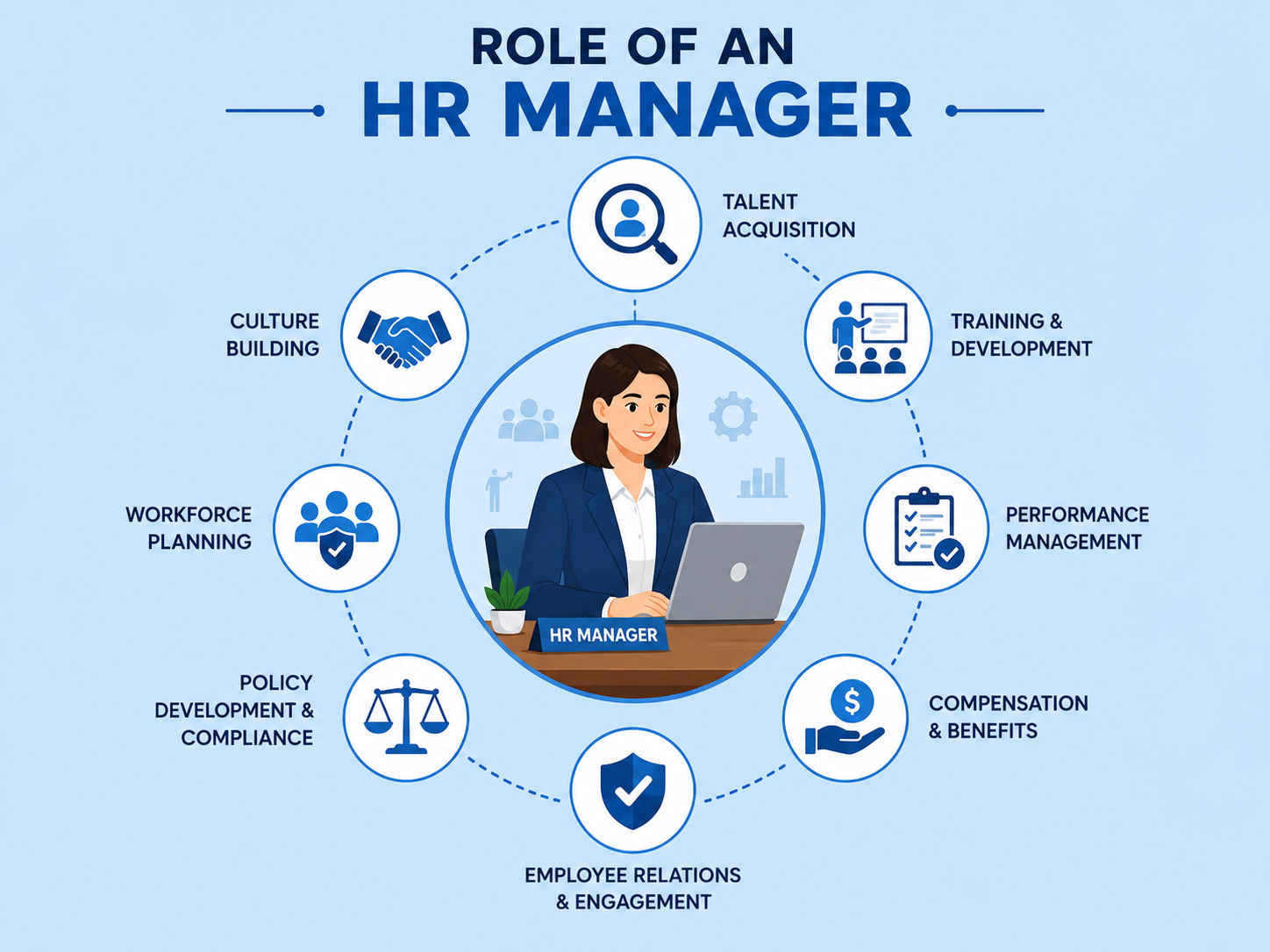
1. Recruitment and Talent Acquisition
HR managers help bring the right people into the organisation. They may plan hiring, coordinate interviews, assess candidates, and work with department managers during the selection process.
2. Employee Onboarding
Once someone joins, HR helps them understand their role, workplace policies, team, and expectations. A smooth onboarding experience can help new employees settle in faster.
3. Training and Development
HR managers identify where employees need to build their skills and arrange suitable learning opportunities. These can include workshops, mentoring, technical training, or leadership programmes.
4. Performance Management
HR supports managers in setting expectations, conducting reviews, giving feedback, and dealing with performance concerns. The aim is to help employees understand what they are doing well and where they can improve.
5. Employee Engagement
Understanding how employees feel about their workplace is another important part of HR. Feedback, recognition, career growth, and regular communication can all influence engagement.
6. Compensation and Benefits
HR managers may oversee salaries, incentives, benefits, leave, and other compensation matters. They also help ensure these practices are handled consistently and fairly.
7. Employee Relations
Workplace disagreements, grievances, and disciplinary issues often come to HR. Managers need to listen to everyone involved, understand the situation, and respond without jumping to conclusions.
8. HR Policies and Compliance
HR managers create and maintain policies covering areas such as attendance, leave, conduct, and workplace behaviour. They must also keep these policies aligned with applicable employment laws.
9. Workforce Planning
HR also looks ahead. By understanding future business plans, HR managers can identify skill gaps, estimate hiring needs, and prepare employees for larger responsibilities.
Also read: Complete Guide on Assistant Manager Salary in India (2026)
Leadership in HR is different from simply managing a team. HR managers often influence decisions without having direct authority over everyone involved.
Some important leadership qualities include:
A good HR leader also knows when to listen. Employees and managers may have useful information that is not visible from an HR dashboard or report.
These leadership capabilities strengthen the role and qualities of HR manager because HR leaders need to influence workplace culture while also meeting organisational requirements.
Also Read: Importance of Management in Every Organization
Becoming an effective HR manager takes a mix of knowledge, practical experience, and strong people skills.
Over time, the qualities of a good HR manager develop through continuous learning and real workplace experience.
Subscribe to upGrad's Newsletter
Join thousands of learners who receive useful tips
An HR manager’s role goes beyond recruitment and paperwork. Key qualities of an HR manager include communication, empathy, leadership, decision-making, problem-solving, adaptability, integrity, and strategic thinking.
The role and qualities of HR manager work together to create better employee experiences and support business goals. With practical experience, continuous learning, and strong interpersonal skills, professionals can grow into effective HR leaders. Over time, the qualities of a good HR manager show in how they handle people, workplace challenges, and important decisions.
Ready to start your journey? Book a free consultation with upGrad today to find the best path for your career.
The 10 commonly valued qualities include communication, accountability, adaptability, emotional intelligence, delegation, problem-solving, decision-making, organisation, integrity, and the ability to motivate others. The exact list can vary, but effective managers generally combine people skills with sound judgement and a clear understanding of business priorities.
The seven commonly discussed HR roles include staffing, employee development, performance management, compensation, employee relations, compliance, and workforce planning. Different organisations may group these responsibilities differently, but together they show how HR supports employees while also addressing wider organisational and workforce requirements.
There is no single universal version of the 7 C's of HR. Current frameworks use different terms, including competence, commitment, communication, compliance, creativity, collaboration, and culture. Another model includes compensation and career development, showing that the framework can vary according to the organisation and its HR priorities.
The seven pillars are commonly described around recruitment, onboarding, learning and development, performance management, employee engagement, compensation and benefits, and employee relations or workforce strategy. The terminology differs across frameworks, but the underlying idea is to cover the major areas that support an organisation's people strategy.
A long list of 35 characteristics may include qualities such as accountability, patience, confidence, fairness, resilience, organisation, curiosity, reliability, decisiveness, and openness to feedback. Rather than counting traits, it is more useful to develop behaviours that help managers earn trust, handle pressure, and support their teams effectively.
The 5 C's are commonly explained as clarity, communication, collaboration, commitment, and consistency. Together, they describe practical behaviours that help managers set expectations, work across teams, follow through on decisions, and build trust. However, different management frameworks may use alternative terms for the five C's.
An effective HR manager needs to respond to changing employee expectations, technology, business models, and workplace practices without losing sight of people. Adaptability matters, but so do judgement, curiosity, ethical decision-making, and the ability to understand how changes may affect employees and organisational goals.
HR managers build trust by being consistent, approachable, discreet, and fair in their interactions. Employees are more likely to share concerns when they believe they will be heard without unnecessary judgement. Following through on commitments and handling sensitive information responsibly also strengthens professional trust over time.
Business knowledge helps HR managers understand why workforce decisions matter beyond the HR department. Knowing how a company earns revenue, manages costs, serves customers, and plans growth allows HR professionals to connect people-related decisions with practical business needs rather than treating HR as a separate function.
HR qualities generally describe personal attributes and behaviours, such as empathy, integrity, patience, and fairness. HR skills are capabilities that can be learned and improved, such as recruitment, HR analytics, negotiation, and workforce planning. In practice, both work together to make an HR professional more effective.
Yes, it can be possible, depending on the organisation and role requirements. Professionals may move into HR through business, psychology, management, or related backgrounds and build relevant experience through recruitment, employee relations, operations, or HR certifications and practical learning.
1141 articles published
We are an online education platform providing industry-relevant programs for professionals, designed and delivered in collaboration with world-class faculty and businesses. Merging the latest technolo...
Speak with MBA expert
By submitting, I accept the T&C and
Privacy Policy
From MBA to Dream Job - Explore Our Alumni Success Stories
Top Resources
Master's Degree
13 Months
Master's Degree
12 Months
O.P.Jindal Global University
MBA (with Career Acceleration Program by upGrad)Become interview ready with Career Services
Master's Degree
12 Months