Public Financial Management System: Meaning, Uses & Benefits
By upGrad
Updated on Jun 11, 2026 | 6 min read | 2.62K+ views
Share:

All courses
Certifications
More
By upGrad
Updated on Jun 11, 2026 | 6 min read | 2.62K+ views
Share:
Table of Contents
If you've ever wondered how the government makes sure your tax money actually reaches the right places, the right departments, the right schemes, the right people, that's exactly what a public financial management system is designed to do.
It's not just software. It's a combination of financial rules, digital tools, reporting systems, and accountability processes that keep public spending on track. And in India, the public financial management system PFMS has become the backbone of that effort.
This blog breaks it all down in plain language how PFMS works, what makes it useful, where it still struggles, and where it's headed next.
Build a career in public finance and digital governance? Explore upGrad's Management Courses to deepen your understanding of Public Financial Management Systems and develop the skills that government bodies and financial institutions are actively looking for.
Popular Management Programs
At its core, a public financial management system is how governments plan, manage, monitor, and control public funds. The goal is straightforward: make sure taxpayer money is used properly and actually reaches whoever it's meant for.
That sounds simple. But across hundreds of departments, thousands of schemes, and millions of beneficiaries, it gets complicated fast. The system ties together financial rules, technology platforms, and reporting tools to bring some order to that complexity.
In India, the pfms public financial management system is widely used across ministries, state governments, and agencies to manage public money digitally tracking payments, monitoring scheme spending, and reducing the delays that once came with manual processes.
Also Read: Financial Management: Objectives, Scope, and Importance
A well-built public management financial system focuses on a handful of core goals:
Also Read: Budget Management: A Guide to Effectively Manage Your Money
Component |
Purpose |
| Budget Management | Plans and allocates public funds |
| Treasury Operations | Handles government receipts and payments |
| Accounting System | Records financial transactions |
| Reporting Tools | Generates expenditure reports |
| Audit Mechanism | Checks misuse and compliance |
| Digital Payment Tracking | Monitors fund transfers |
Also Read: The Impact of Digital Transformation: Market Growth & Industry-Wide Data
Free Courses
Here's a practical example. Before digital systems became standard, a student waiting for a government scholarship might wait months not because the money wasn't allocated, but because it had to pass through layers of paperwork and intermediaries before it arrived.
The public financial management system PFMS changed that. Payments now go directly to bank accounts; approvals happen digitally, and the entire trail is recorded. That's the kind of shift a well-implemented financial system makes possible.
Also Read: Essential Functions of Financial Management for Effective Business Strategy
The public financial management system PFMS portal brings several practical features to the table:
Less paperwork, faster decisions, and a much cleaner audit trail.
Also Read: Digital Marketing KPIs: What to Track and Why It Actually Matters
Transparency isn't just a buzzword, here it's one of the most tangible benefits of the pfms public financial management system. Because every transaction is digitally recorded, it becomes possible to trace exactly how money moves from the central government all the way to individual beneficiaries.
That traceability helps cut down on:
Management Courses to upskill
Explore Management Courses for Career Progression
IIIT-B & IIM, Udaipur
Chief Technology Officer & AI Leadership ProgrammeThe public financial management system PFMS runs on a centralized online platform that connects ministries, banks, departments, and implementing agencies. Every rupee that moves through a government scheme gets captured from the moment the budget is approved to the moment it lands in a beneficiary account.
Also Read: Financial Management Course: Learn Finance, Risk & Strategy in 2025
Step-by-Step Working Process
One of the stronger aspects of the public financial management system PFMS portal is how deeply it connects with the banking system. Major banks are integrated into the platform, which makes real-time fund transfers possible across a wide range of payment types:
Because the process runs automatically, payments arrive faster and with fewer errors than older manual methods allowed.
The pfms public financial management system sits at the heart of India's Direct Benefit Transfer program. DBT lets the government send subsidies and welfare payments straight into citizens' bank accounts, cutting out the middlemen that once slowed everything down.
Some well-known examples include:
The direct transfer model makes it much harder for funds to get diverted along the way and easier to verify that the right person received the right amount.
One of the most practical upgrades PFMS brought was live financial visibility. Traditional reporting systems meant officials were often looking at data that was days or weeks old. That lag made it hard to catch problems early.
With a modern public financial management system, officials can check at any point:
That kind of visibility doesn't just improve monitoring; it helps governments respond faster when something isn't working.
Technology is now what keeps the whole public management financial system running. Key tools include cloud-based infrastructure, secure banking APIs, digital signatures, data analytics, and automated reconciliation systems. As governments push further into digital transformation, these platforms are only going to become more capable.
The public financial management system PFMS portal isn't just for one type of user. It serves a wide ecosystem:
That interconnected structure is part of what makes it work.
Also Read: AI in Banking and Finance Explained: Trends, Uses, & Impact
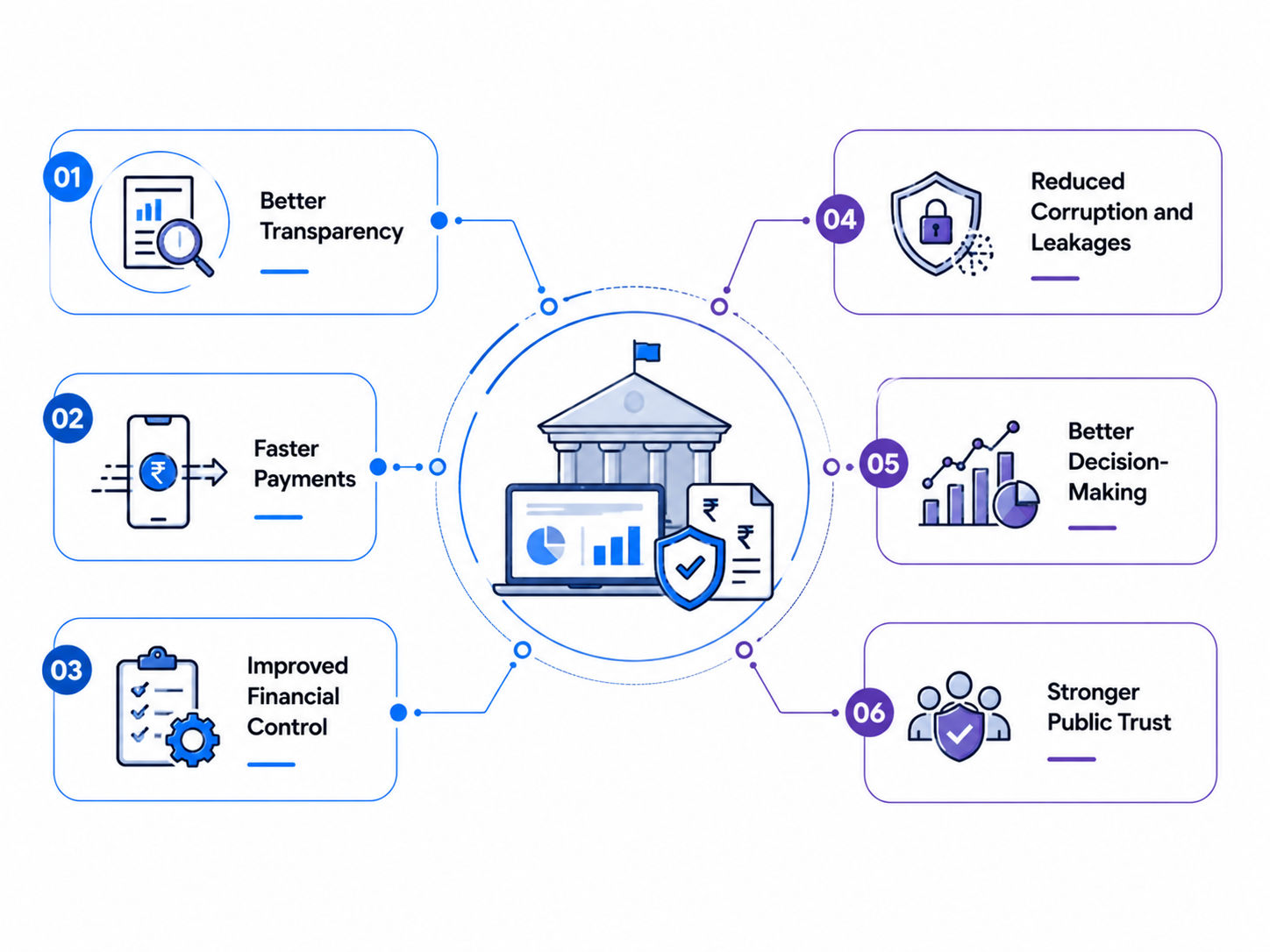
Ask anyone who's worked in public finance about the shift from manual to digital systems, and you'll likely hear the same thing there's no going back. The public financial management system doesn't just improve efficiency. It changes how accountability works at every level.
Every transaction in the PFMS leaves a digital record. That creates an audit trail that makes it far easier to spot irregularities before they become bigger problems.
Manual fund releases used to take weeks. With a public management financial system handling approvals and transfers automatically, the timeline shrinks considerably. For beneficiaries, especially those depending on welfare payments, that difference is real and significant.
Departments can measure actual spending against approved budgets as it happens, not after the fact. That prevents overspending and builds better financial habits across the system.
Before digital systems became common, duplicate payments and fund diversion were persistent problems. The public financial management system PFMS addresses this directly. With every transaction digitally linked, fake beneficiary records are easier to catch, duplicates can be cleaned up systematically, and unauthorized payments are harder to slip through.
The public financial management system PFMS portal generates reports that give policymakers a much clearer picture of financial performance. Officials can quickly identify underutilized schemes, high-spending departments, delayed projects, and unused allocations. That kind of data makes budget planning more grounded in reality.
People are more likely to trust government spending when they know it's being monitored. A reliable public management financial system supports that trust particularly during welfare programs, emergency relief, infrastructure projects, and subsidy distribution, where public scrutiny tends to be high.
Also Read: Power of Big Data in Banking: Top 10 Use Cases and Applications
It would be misleading to suggest everything works perfectly. Yet challenges are not the reasons to step back from digital financial systems, but they are problems worth solving honestly.
Real implementation challenges remain:
The direction is clear: public financial management systems are going to keep getting smarter, faster, and more connected. As government spending scales up, the need for better financial visibility only grows.
Newer PFMS platforms are starting to incorporate analytics tools that go beyond basic reporting. These help governments predict spending patterns, flag unusual transactions, improve budgeting accuracy, and track project performance in more meaningful ways. Data-driven governance is no longer a future concept; it's already being built into these systems.
AI is beginning to find real applications in public financial management, and the potential is significant:
AI Application |
Possible Benefit |
| Fraud Detection | Identifies suspicious transactions early |
| Predictive Analysis | Forecasts budget requirements |
| Automation | Reduces manual approvals |
| Chatbots | Improves citizen support |
The public financial management system PFMS portal is also moving toward being more accessible to everyday citizens. Future improvements are likely to include mobile-first dashboards, faster grievance resolution, real-time payment notifications, and simpler beneficiary verification.
This matters especially in rural areas where smartphone access is growing but navigating complex portals remains a challenge.
Greater digitization brings greater risk. A secure public management financial system has to protect banking data, citizen information, government financial records, and payment infrastructure. Strong encryption and regular security audits aren't optional rather they are foundational.
India isn't alone in this push. Countries across Asia, Europe, and Africa are investing in modern public financial management systems. The World Bank has highlighted how digital public finance reforms cut down on financial leakages and improve delivery of welfare programs. India's PFMS model is frequently referenced internationally as an example of large-scale financial digitization done at serious scale.
As these systems become more complex, the demand for professionals who understand both finance and digital governance keep growing. Certain key skills opens genuine career paths for finance graduates and public administration professionals who are willing to build those capabilities.
Key skills include:
A public financial management system does something that sounds simple but is genuinely hard to pull off: it makes sure public money goes where it's supposed to go, and that someone is watching every step of the way. As automation, data analytics, and digital banking continue to evolve, PFMS platforms will keep playing a central role in how public finance works.
For anyone in finance, public administration, or governance, understanding the public financial management system (PFMS) isn't just useful for background knowledge. In today's digital governance landscape, it's becoming a core part of the job.
Want personalized guidance on public financial management system? Speak with an expert for a free 1:1 counselling session today.
A public financial management system helps governments manage public money efficiently. It supports budgeting, fund tracking, payments, accounting, and reporting. The main goal is to improve transparency and ensure funds are used correctly across government schemes and departments.
PFMS stands for Public Financial Management System. It is a digital platform developed by the Government of India to monitor fund flow, process payments, and track financial transactions related to government schemes and welfare programs.
The public financial management system PFMS portal connects ministries, departments, banks, and agencies through a centralized digital platform. It tracks financial transactions in real time and supports direct payments to beneficiaries through integrated banking systems.
The pfms public financial management system is used by government ministries, departments, educational institutions, implementing agencies, banks, auditors, and beneficiaries. It helps different stakeholders manage and monitor government financial activities more efficiently.
PFMS improves transparency, reduces delays, supports faster digital payments, and strengthens financial accountability. It also minimizes manual paperwork and helps governments monitor fund utilization more accurately through real-time reporting tools.
The public financial management system PFMS specifically refers to India’s digital public finance platform. However, many countries use similar public financial systems to improve governance, budgeting, and financial transparency in public administration.
PFMS helps governments transfer subsidies and welfare benefits directly into beneficiary bank accounts. This reduces intermediaries, minimizes leakages, and improves the speed and accuracy of payments under welfare schemes and public programs.
Common challenges include cybersecurity risks, poor digital infrastructure, lack of staff training, and data accuracy issues. Some departments may also face difficulties integrating older financial systems with modern digital platforms like PFMS.
Yes. Careers in public finance, digital governance, auditing, and policy analysis are growing steadily. Knowledge of the public management financial system can help professionals work in government departments, consulting firms, NGOs, and financial institutions.
Transparency helps governments build public trust and reduce misuse of funds. A public financial management system creates digital records for every transaction, making audits easier and improving accountability across departments and welfare schemes.
The future of the public financial management system PFMS will likely include AI-based monitoring, predictive analytics, mobile access, and stronger cybersecurity measures. Governments are expected to invest more in digital financial governance systems over the coming years.
972 articles published
We are an online education platform providing industry-relevant programs for professionals, designed and delivered in collaboration with world-class faculty and businesses. Merging the latest technolo...
Get Free Consultation
By submitting, I accept the T&C and
Privacy Policy
Top Resources
Certification
3 Months
Certification
6 Months
O.P. Jindal Global University
Masters in International Accounting and Finance (Accredited by ACCA, UK)Master's Degree
12 Months