Nandan Nilekani Pushes Back Against AI Fears: "AI Will Amplify, Not Replace" IT Services
By Vikram Singh
Updated on Jun 24, 2026 | 5 min read | 1.13K+ views
Share:

All courses
Certifications
More
By Vikram Singh
Updated on Jun 24, 2026 | 5 min read | 1.13K+ views
Share:
Table of Contents
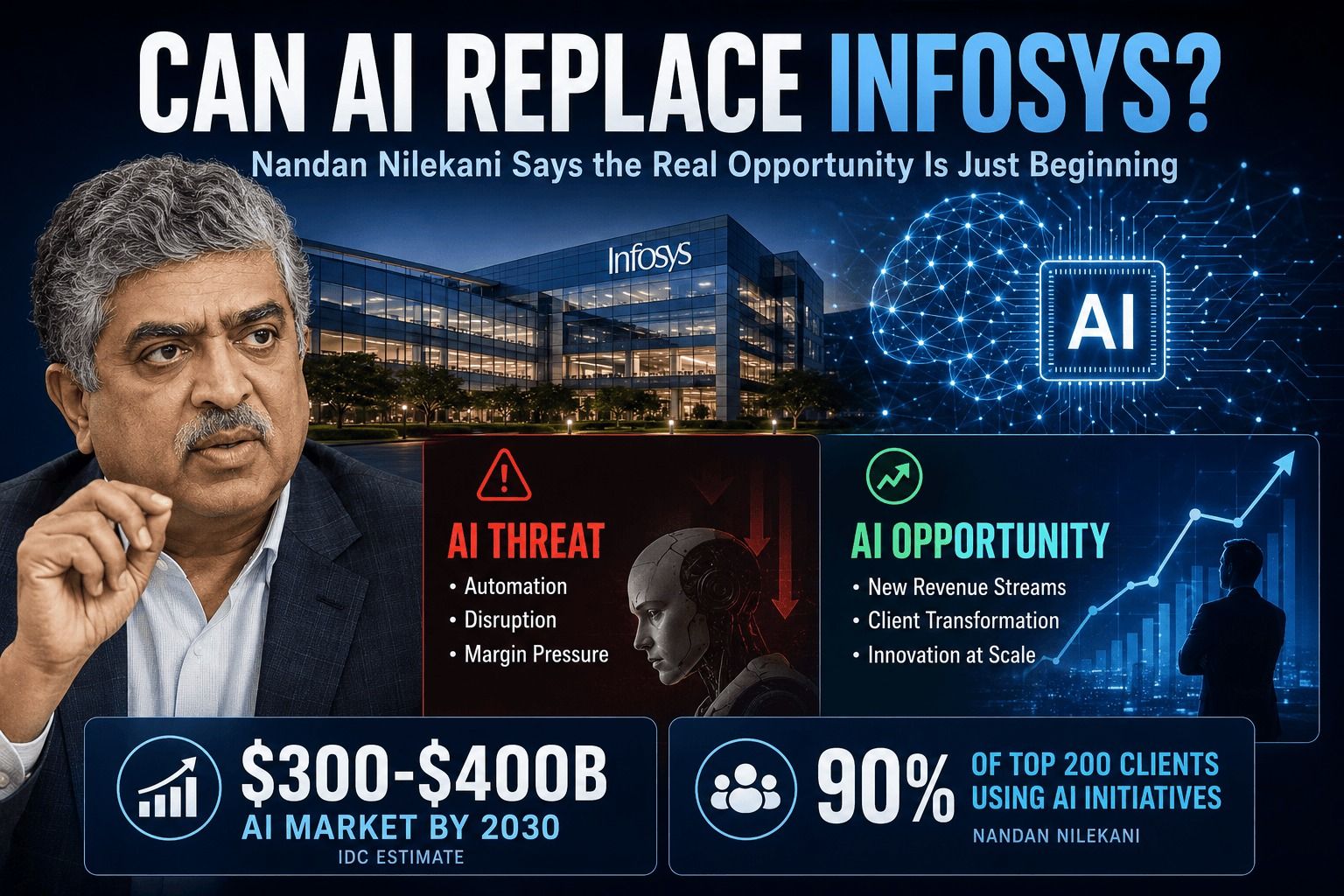
At Infosys' 45th Annual General Meeting (AGM), Chairman Nandan Nilekani addressed one of the biggest fears facing the technology industry: Will AI make IT services companies irrelevant? His answer was unequivocal, no. Nilekani argued that AI will act as a force multiplier for companies that adapt quickly, creating a new AI-first services market worth $300-$400 billion by 2030 rather than replacing firms like Infosys.
Popular AI Programs
The rise of generative AI has triggered intense debate across the technology sector.
As AI systems become increasingly capable of writing code, automating workflows, and handling complex business processes, investors and employees alike are asking a difficult question:
Will AI eventually replace traditional IT services companies?
Speaking at Infosys' 45th Annual General Meeting, Nandan Nilekani directly addressed what he described as the industry's "existential question." His response was clear: AI is not a replacement for IT services firms, it is an opportunity to reinvent them.
The timing of Nilekani's remarks is significant.
Over the past few months, concerns have intensified about whether AI could reduce demand for traditional outsourcing, software development, and consulting services.
Investors are increasingly worried that:
However, Nilekani argues that this perspective misses a much larger opportunity.
According to Nilekani, AI is best viewed as a force multiplier.
Companies that embrace AI, retrain talent, and redesign services around AI workflows could become significantly more valuable than before.
Rather than replacing IT firms, AI could increase the scale and complexity of transformation projects that enterprises need help implementing.
AI Courses to upskill
Explore Artificial Intelligence Courses for Career Progression
One of the most interesting insights from Nilekani's comments is that he sees the biggest opportunity not in AI creation, but in AI implementation.
Many organizations have already invested in AI tools and pilots.
What they often lack is:
Nilekani believes helping companies bridge this deployment gap could become one of the largest growth opportunities for IT services firms.
According to Infosys, the next wave of AI spending may focus less on experimentation and more on operationalization.
That transition could create significant demand for consulting, implementation, cloud migration, cybersecurity, and AI governance services.
Nilekani's confidence isn't based solely on future projections.
Infosys is already positioning itself aggressively for an AI-first future.
The company revealed that it is working on AI-related initiatives with approximately 90% of its top 200 clients.
This suggests that AI adoption is moving beyond experimentation and becoming part of mainstream enterprise technology strategies.
Infosys has also outlined plans to invest around $1 billion in AI initiatives, including:
The investment signals that Infosys sees AI as a long-term growth engine rather than a short-term trend.
Perhaps the boldest claim from Infosys' leadership is the size of the opportunity ahead.
Nilekani estimates that the emerging AI-first services market could reach $300-$400 billion by 2030.
That market could include:
If that forecast proves accurate, the AI era could expand the IT services market rather than shrink it.
Subscribe to upGrad's Newsletter
Join thousands of learners who receive useful tips
Nilekani's comments arrive at a time when investors are questioning the future of the IT services industry.
Just days ago, Accenture's earnings report triggered a sharp selloff in IT stocks after the company lowered its growth outlook.
That decline reignited fears that:
Nilekani's message offers a contrasting view.
Instead of seeing AI as a threat to the industry, he sees it as the next major growth cycle for companies that evolve quickly enough to capture it.
The most important takeaway from Nilekani's remarks is that the debate around AI may be shifting.
The question is no longer:
"Will AI replace IT services companies?"
The more important question may be:
"Which IT services companies can reinvent themselves fastest?"
Companies that successfully combine AI capabilities with consulting expertise, enterprise relationships, and implementation experience may be positioned to benefit from the next phase of technology spending.
Nandan Nilekani's message to investors and employees is clear: AI is not the end of the IT services industry. Instead, it represents one of the largest transformation opportunities the sector has ever seen. With Infosys already working on AI initiatives across most of its largest clients and targeting a potential $300-$400 billion AI-first services market, the company is betting that adaptation, not disruption, will define the industry's future.
Nandan Nilekani said that AI will not replace companies like Infosys but will instead amplify their capabilities. Speaking at Infosys' 45th AGM, he argued that AI should be viewed as a force multiplier that helps technology companies deliver services faster, more efficiently, and at greater scale.
According to Nilekani, businesses that successfully integrate AI into their operations are likely to emerge stronger rather than become obsolete.
Infosys believes that while AI can automate repetitive tasks, enterprises still need partners to implement, manage, secure, and scale AI solutions. The company sees significant demand emerging around AI deployment, modernization, governance, and transformation projects. This creates new revenue opportunities for IT services firms rather than eliminating the need for them.
The AI deployment gap refers to the difference between experimenting with AI and successfully implementing it across an organization. Many businesses have launched AI pilots but struggle to integrate AI into workflows, systems, and business processes. Nilekani believes helping enterprises close this gap could become one of the largest growth opportunities for IT services companies over the next decade.
Infosys revealed that it is already working on AI-related projects with approximately 90% of its top 200 clients. This indicates that AI adoption has moved beyond experimentation and is becoming a core part of enterprise technology strategies across industries such as banking, healthcare, retail, manufacturing, and telecommunications.
Nandan Nilekani estimates that the emerging AI-first services market could be worth between $300 billion and $400 billion by 2030. This market includes AI consulting, implementation, deployment, governance, modernization, and operational services that help enterprises integrate artificial intelligence into their business processes.
Infosys has announced plans to invest approximately $1 billion in AI-related initiatives. The investment will focus on developing AI platforms, building AI talent, creating industry-specific solutions, and helping clients accelerate their AI transformation journeys. The company sees AI as a long-term strategic growth area.
AI is expected to automate certain coding, testing, and support functions, but industry leaders like Nilekani believe it will also create new roles and opportunities.
Professionals who learn to work alongside AI tools, manage AI systems, and develop AI-enabled solutions are likely to remain in high demand as organizations continue their digital transformation efforts.
Investors are debating whether AI will create more business opportunities or reduce demand for traditional IT services. Some fear that automation could lower billable hours and reduce outsourcing requirements. Others believe AI will drive a new wave of transformation projects that could expand the overall IT services market. This uncertainty has become a key topic for investors evaluating technology stocks.
Accenture's recent guidance cut sparked concerns about slowing enterprise technology spending and the future growth of IT services companies. Nilekani's perspective is more optimistic. He argues that while the industry may face short-term challenges, AI will ultimately create a much larger opportunity by increasing demand for implementation, integration, and transformation services.
According to Infosys, IT services companies will act as the bridge between AI technology and business adoption. Their role will include helping organizations deploy AI systems, modernize infrastructure, manage data, ensure compliance, strengthen cybersecurity, and measure business outcomes. This positions IT firms as key enablers of enterprise AI adoption.
139 articles published
Vikram Singh is a seasoned content strategist with over 5 years of experience in simplifying complex technical subjects. Holding a postgraduate degree in Applied Mathematics, he specializes in creatin...
Speak with AI & ML expert
By submitting, I accept the T&C and
Privacy Policy
Top Resources
Master's Degree
18 Months
Executive Diploma
12 Months
IIIT Bangalore
Executive Programme in Generative AI & Agentic AI for LeadersIndia’s #1 Tech University
Dual Certification
5 Months