SMOTE in Machine Learning: How It Fixes Imbalanced Datasets
By Sriram
Updated on Jun 24, 2026 | 4 min read | 2.79K+ views
Share:

All courses
Certifications
More
By Sriram
Updated on Jun 24, 2026 | 4 min read | 2.79K+ views
Share:
Table of Contents
SMOTE in machine learning is one of the most widely used techniques for handling imbalanced datasets. When one class has significantly fewer examples than another, machine learning models often struggle to identify the minority class correctly. This can lead to poor predictions, especially in fraud detection, medical diagnosis, and risk assessment.
Class imbalance is one of the most common problems in real-world machine learning. When your dataset has 95% of one class and 5% of another, your model doesn't actually learn the minority class. It just learns to predict the majority and still looks accurate on paper. SMOTE in machine learning directly addresses this by generating synthetic samples for the underrepresented class.
This blog covers how SMOTE works, when you should use it, what its limitations are, and how it compares to other techniques. You'll walk away with a practical understanding you can apply immediately.
Explore upGrad's Machine Learning programs to master essential machine learning techniques such as data preprocessing, handling imbalanced datasets, feature engineering, model evaluation, and predictive modeling.
Popular AI Programs
SMOTE stands for Synthetic Minority Over-sampling Technique. It's an algorithm introduced in 2002 by Chawla et al. to handle class imbalance without simply duplicating existing minority samples.
Here's why duplication doesn't work well. If you copy the same minority samples ten times, your model just memorizes those exact data points. It doesn't actually learn the pattern. SMOTE takes a smarter approach.
It creates new, synthetic data points by interpolating between existing minority class samples. Not copying. Interpolating.
How the algorithm works:
The result is a synthetic sample that's plausible, not a duplicate. This exposes the model to a wider variety of minority class examples during training.
Say you're building a fraud detection model. Out of 10,000 transactions, only 200 are fraudulent. Without balancing, your model will likely predict "not fraud" for almost everything and still get 98% accuracy. SMOTE generates new synthetic fraud examples so the model actually learns what fraud looks like.
Term |
Meaning |
| Majority Class | The class with more samples (e.g., non-fraud) |
| Minority Class | The class with fewer samples (e.g., fraud) |
| Synthetic Sample | A new data point created by SMOTE, not from real data |
| K Nearest Neighbors | The closest data points used to generate new samples |
| Oversampling | Increasing the minority class size |
SMOTE is one of the most widely referenced techniques for handling imbalance. That said, it's not a silver bullet. Knowing when and how to apply the smote technique in machine learning matters just as much as understanding the algorithm itself.
Do read: Discover How Classification in Data Mining Can Enhance Your Work!
Free Courses
Not every imbalanced dataset needs SMOTE. Before you apply it, ask yourself what the ratio actually looks like.
A 60-40 split doesn't need intervention. A 99-1 split almost certainly does. The sweet spot where SMOTE adds clear value is typically in the 80-20 to 99-1 range for binary classification.
SMOTE Works Well When |
SMOTE Is Less Effective When |
| Binary or multi-class imbalance | Very few minority samples (2–3) |
| Minority class has 5–10+ samples | Mostly categorical features |
| Features are numerical | Minority samples are widely scattered |
| Model favors the majority class | High noise or outliers in minority data |
One scenario worth flagging is that SMOTE can introduce noise if the minority class samples themselves are noisy or mislabeled. Synthetic points generated from bad data will just give you more bad data, spread across a larger space.
SMOTE is applied only to the training set. Never apply it to your test data. Your test set should reflect real-world distribution.
Master the concepts behind machine learning, deep learning, predictive modeling, data preprocessing, and AI-driven decision-making with Liverpool John Moores University's Master's Degree in AI & Machine Learning. Learn through hands-on projects, industry-relevant tools, and real-world applications that prepare you for high-growth AI careers.
AI Courses to upskill
Explore Artificial Intelligence Courses for Career Progression
The original SMOTE algorithm has been extended in several ways. Different problems call for different variants.
Standard SMOTE generates samples from all minority points. Borderline-SMOTE focuses only on minority samples near the decision boundary, where misclassification is most likely. It's more targeted and often performs better on harder classification problems.
Also read: What are Sampling Techniques? Different Types and Methods
ADASYN assigns more synthetic samples to minority points that are harder to learn, based on their local neighborhood density. It's adaptive, meaning it focuses effort where the model struggles most. Think of it as SMOTE with a priority system.
This combines SMOTE with Tomek Links, which removes ambiguous samples near the decision boundary after oversampling. You oversample first, then clean up the noise. The result is a cleaner boundary between classes.
Similar to SMOTE-Tomek, but uses Edited Nearest Neighbors instead of Tomek Links for cleaning. It removes any sample whose class label differs from the majority label among its neighbors. This tends to produce a smoother decision boundary.
Variant |
What It Does Differently |
| Borderline-SMOTE | Focuses on samples near class boundaries |
| ADASYN | Generates more samples in harder-to-learn regions |
| SMOTE-Tomek | Oversamples, then removes borderline noise |
| SMOTE-ENN | Oversamples, then applies ENN cleaning |
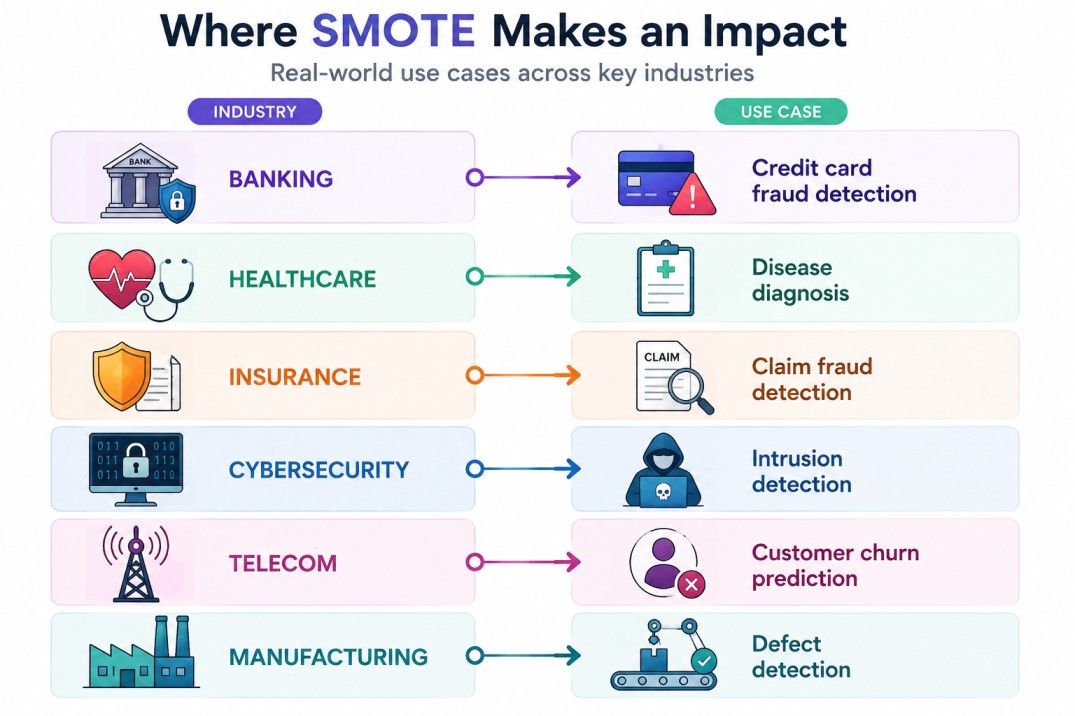
SMOTE appears across industries. Some common examples include:
Must read: Step-by-Step Guide to Learning Python for Data Science
Python's imbalanced-learn library makes this straightforward. It's built to work alongside scikit-learn.
from imblearn.over_sampling import SMOTE
from sklearn.model_selection import train_test_split

X_train, X_test, y_train, y_test = train_test_split(X, y, test_size=0.2, random_state=42)

smote = SMOTE(k_neighbors=5, random_state=42)
X_resampled, y_resampled = smote.fit_resample(X_train, y_train)
A few things to get right:
You don't need a perfect ratio. Aiming for a 70-30 or 80-20 split after SMOTE is often enough and avoids over-generating synthetic points.
What to evaluate after resampling:
Don't rely on accuracy. Use metrics that account for class imbalance.
If your model's recall on the minority class improves significantly after SMOTE, the technique is working.
Also read: Exploratory Data Analysis: Role & Techniques for Business Insights
SMOTE isn't perfect. Knowing its weaknesses saves you from chasing false improvements.
The biggest issue is the overfitting risk. Since SMOTE creates synthetic points between real ones, if the original samples are tightly clustered, the new points won't add much variety. Your model can still overfit.
SMOTE doesn't work well with high-dimensional data either. When you have hundreds of features, the "nearest neighbor" concept becomes unreliable due to the curse of dimensionality. Points that appear close in high-dimensional space may not actually be similar.
Another real concern is that SMOTE generates samples based on feature space, not on actual domain knowledge. It doesn't know that some combinations of features are impossible in the real world. That can produce synthetic samples that look valid statistically but don't make sense practically.
Advantages of SMOTE |
Limitations of SMOTE |
| Improves minority class learning | Can create noisy samples |
| Reduces overfitting vs. duplication | Ignores the majority-class distribution |
| Generates synthetic data points | May create class overlap |
| Works with most ML algorithms | Less effective for complex data patterns |
| Easy to implement with libraries | Performance depends on data quality |
| Improves recall and F1-score | May amplify existing outliers |
There are alternatives worth considering alongside SMOTE. Class weights in your model are sometimes enough. Undersampling the majority class works well when you have enough data. Ensemble methods like EasyEnsemble or BalancedRandomForest handle imbalance internally and can outperform SMOTE in some scenarios.
Scenario |
Why SMOTE Struggles |
| Very few minority samples | Not enough neighbors to generate meaningful synthetic data |
| Severe class overlap | Synthetic samples may increase confusion between classes |
| Domain-specific data generation needed | Statistical interpolation can't capture domain knowledge |
| Highly scattered minority samples | Generated points may not represent real patterns |
| Mostly categorical features | Standard SMOTE is designed for numerical data |
Must read: Python Libraries Explained: List of Important Libraries
SMOTE in machine learning solves a real, practical problem. Imbalanced datasets are everywhere, and models trained on them without intervention often fail the people who matter most, the ones in the minority class.
The algorithm is approachable. The implementation is clean. But it works best when you understand the data first. Check your class distribution, choose the right variant, apply it only to training data, and measure the right metrics.
Don't treat SMOTE as a magic fix. Treat it as a tool you understand well enough to use wisely.
Ready to start your journey? Book a free consultation with upGrad today to find the best path for your career.
SMOTE and class weighting solve imbalance differently. SMOTE changes the training data by creating synthetic minority samples, while class weighting changes how prediction errors are penalized during training. Testing both approaches is often worthwhile because performance varies depending on the dataset, algorithm, and imbalance severity.
Yes, SMOTE can be applied before training neural networks and deep learning models. By increasing minority-class representation, it helps the model learn patterns that might otherwise be overlooked. However, for image and text data, domain-specific augmentation techniques often produce better results than standard SMOTE.
Yes. The primary purpose of SMOTE is to generate additional minority-class samples, which increases the overall training dataset size. The final size depends on the sampling strategy selected. Larger datasets may improve minority-class learning but can also increase training time and computational requirements.
Accuracy alone isn't enough when dealing with imbalanced data. Metrics such as precision, recall, F1-score, ROC-AUC, and PR-AUC provide a clearer picture of model performance. These metrics help determine whether the minority class is actually being identified more effectively after resampling.
Yes, SMOTE supports multiclass classification tasks. It can oversample one or more minority classes to create a more balanced training dataset. This makes it useful for applications such as medical diagnosis, document classification, and fault detection where multiple classes exist.
SMOTE isn't guaranteed to improve every model. If the minority class contains noise, outliers, or overlapping patterns with other classes, synthetic samples may increase confusion. In these situations, model performance can decline despite having a more balanced dataset.
The SMOTE technique in machine learning generates synthetic samples through interpolation between existing minority data points. Data augmentation modifies existing samples using domain-specific transformations such as image rotation, cropping, or text paraphrasing. Both increase data diversity but use different approaches.
The k-nearest neighbors parameter determines how synthetic samples are generated. A value of five is commonly used as a starting point. Smaller values focus on local patterns, while larger values create broader interpolation. The best setting usually comes from experimentation and cross-validation.
Yes, fraud detection is one of the most common applications of SMOTE in machine learning. Fraudulent transactions are typically rare compared to legitimate ones. SMOTE helps create additional minority-class examples, allowing models to learn suspicious transaction patterns more effectively during training.
Several alternatives exist, including random oversampling, random undersampling, ADASYN, Balanced Random Forest, EasyEnsemble, and cost-sensitive learning. The right choice depends on dataset characteristics, model type, computational resources, and the business objective of the machine learning project.
Compare model results before and after applying SMOTE using the same validation strategy. Improvements in recall, F1-score, minority-class precision, and confusion matrix results are strong indicators. Looking only at accuracy can be misleading because it may hide poor minority-class performance.
730 articles published
Sriram K is a Senior SEO Executive with a B.Tech in Information Technology from Dr. M.G.R. Educational and Research Institute, Chennai. With over a decade of experience in digital marketing, he specia...
Speak with AI & ML expert
By submitting, I accept the T&C and
Privacy Policy
Top Resources
Master's Degree
18 Months
Executive Diploma
12 Months
IIIT Bangalore
Executive Programme in Generative AI & Agentic AI for LeadersIndia’s #1 Tech University
Dual Certification
5 Months