Kotter Change Model: A Guide to Transformational Organization
By upGrad
Updated on May 14, 2026 | 8 min read | 2.4K+ views
Share:

All courses
Certifications
More
By upGrad
Updated on May 14, 2026 | 8 min read | 2.4K+ views
Share:
Table of Contents
Kotter Change Model is an 8-Step Change Model, developed by Harvard professor Dr. John Kotter. It is one of the most widely adopted frameworks for guiding organizations through successful transformation. It provides a clear, structured roadmap that helps leaders overcome resistance, build momentum, and drive change that sticks.
This blog will explain the Kotter change model in a simple and practical way. You will learn how the framework works, why organizations use it, and how each step helps businesses manage transformation successfully. The guide also covers real-world examples, key benefits, common challenges, and practical tips to implement change effectively.
Leading successful organizational change starts with the right knowledge and tools. Exploring Management Courses from upGrad can equip you with the frameworks to apply Kotter's 8-Step Change Model, build compelling change coalitions, and design structured transformation strategies that deliver measurable, lasting results across your organization.
Popular Management Programs
Organizations today operate in a fast-changing environment. Technological advancements, evolving customer needs, rising competition, and internal business changes push companies to adapt continuously. However, managing change is often challenging. Employees may resist new processes, teams can lose direction, and leaders may struggle to keep everyone aligned.
The model follows a deliberate progression beginning with establishing urgency and forming a strong leadership coalition, then shifting focus toward empowering employees and embedding new behaviors into the organization's culture for long-term impact.
Also Read: Change Management Framework: A Complete Guide to Leading Successful Organizational Transitions
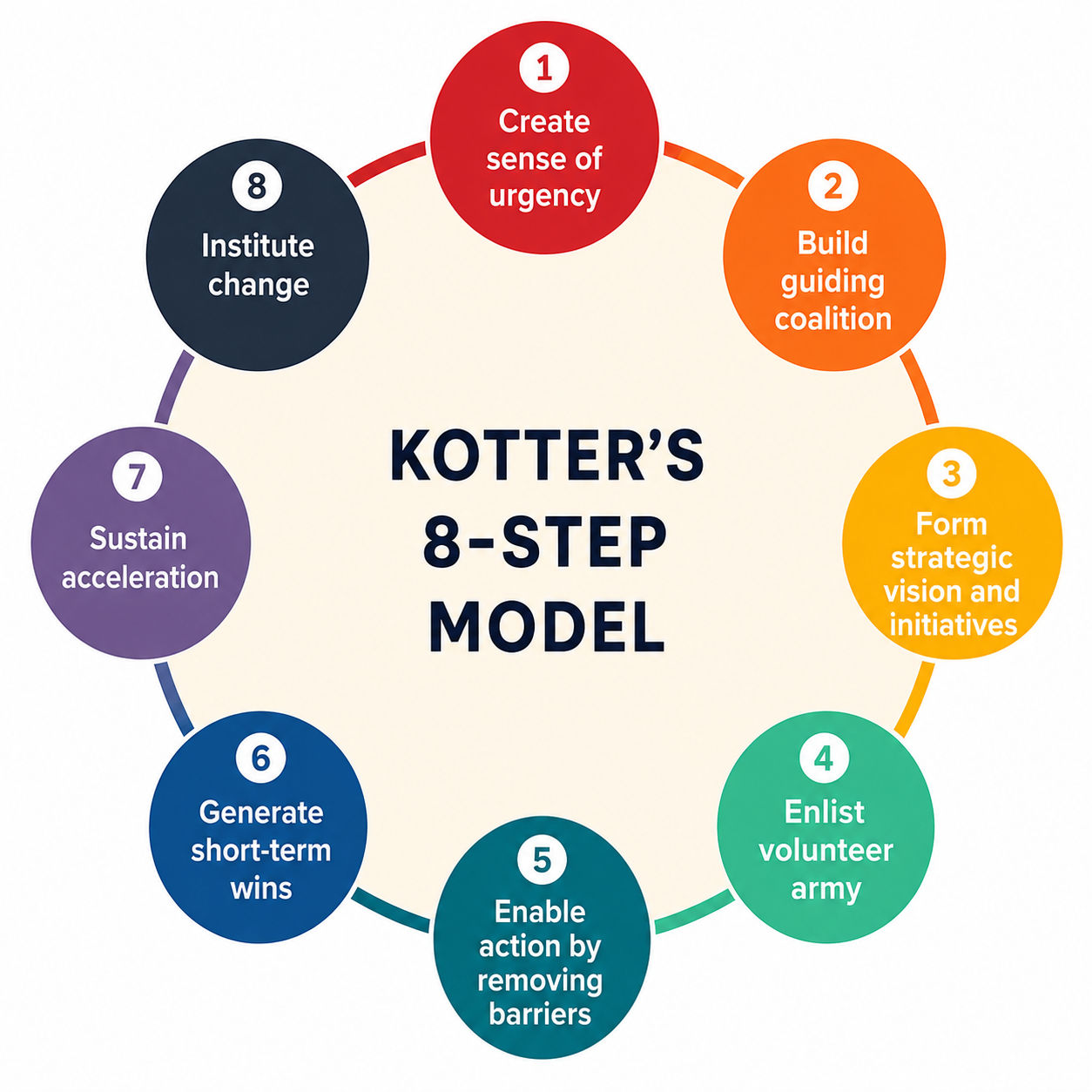
The Kotter change model follows a step-by-step approach that helps organizations manage change more effectively. Instead of focusing only on systems and processes, the framework gives importance to people, communication, and leadership. Each stage plays a critical role in reducing resistance and building long-term organizational success.
Free Courses
The Kotter change model remains popular because it combines leadership, communication, and employee engagement. However, like every framework, it also has limitations.
1. Clear Step-by-Step Structure: The framework provides a logical sequence for managing change. This reduces confusion and improves execution.
2. Strong Focus on People: Many transformation strategies fail because they ignore employee emotions. This model prioritizes communication and involvement.
3. Encourages Leadership Participation: The framework requires active leadership involvement throughout the process. This improves accountability.
4. Builds Long-Term Adoption: The final stages focus on cultural integration. This helps organizations sustain change over time.
5. Reduces Resistance: Employees are more likely to support transformation when they understand its purpose and benefits.
Management Courses to upskill
Explore Management Courses for Career Progression
IIIT-B & IIM, Udaipur
Chief Technology Officer & AI Leadership ProgrammeWhile the Kotter change model is widely used for managing organizational transformation, it also comes with certain limitations. Businesses may face difficulties during implementation if the process is not managed carefully. Understanding these challenges helps organizations prepare better and improve the chances of successful change.
Strong leadership commitment is essential throughout the process. Organizations can improve outcomes by:
Also Read: Change Management: Meaning, Process & Models (2026)
Practical examples help organizations understand how the Kotter change model works in real business situations. Many companies use this framework to manage transformation more effectively and reduce employee resistance.
A banking company introduced digital services to improve customer experience. Employees initially resisted the change due to concerns about technology and job security. As a result, digital adoption increased and customer satisfaction improved.
The organization addressed this by:
A hospital implemented electronic medical records to improve operational efficiency and patient care. The hospital successfully reduced paperwork errors and improved coordination between departments.
The leadership team focused on:
A retail company used the Kotter change model to respond to changing consumer buying behavior and declining sales. These efforts helped the business improve online sales and adapt to market changes successfully.
The company focused on:
Also Read: Top 10 Workplace Management Theories Every Leader Should Know
The Kotter change model is one of the most practical and widely used frameworks for managing organizational transformation. Its step-by-step structure helps businesses handle resistance, improve communication, and create lasting cultural change.
Organizations often struggle with change because employees fear uncertainty. This model solves that problem by involving people throughout the process and reinforcing long-term adoption. From creating urgency to embedding new behaviors into company culture, each stage plays an important role in successful transformation.
Whether you are managing a digital transformation, organizational restructuring, or process improvement initiative, the Kotter change model provides a reliable framework for leading change effectively.
The Kotter change model focuses on leadership, communication, employee involvement, and long-term cultural adoption. The framework reduces resistance by helping employees understand why change is necessary. It also ensures that organizations maintain momentum during transformation initiatives.
The Kotter change model was developed by John Kotter, a leadership professor and organizational change expert. He introduced the model after studying why many businesses fail during transformation projects. His framework became popular because it provides practical and actionable guidance.
Organizations often fail because they ignore employee concerns, communicate poorly, or rush implementation. Employees may resist change if they do not understand the benefits. The Kotter change model addresses these issues by emphasizing communication, leadership involvement, and gradual implementation across all stages.
The implementation timeline depends on the size and complexity of the organization. Some projects may take a few months, while large-scale transformations can take several years. The framework focuses on sustainable change rather than quick fixes. Organizations must allow enough time for cultural adoption and employee alignment.
Industries such as healthcare, banking, IT, education, manufacturing, and retail commonly use the Kotter change model. It is useful in environments where organizations must manage complex operational, technological, or cultural transformations while minimizing resistance from employees.
Yes, small businesses can also benefit from the framework. The principles of communication, leadership, and employee involvement apply to organizations of all sizes. Smaller companies may adapt to the steps based on available resources and organizational structure while maintaining the core approach.
One major advantage is its strong focus on people and communication. Many change initiatives fail because organizations focus only on systems and processes. The Kotter change model ensures that employees remain informed, involved, and motivated throughout the transformation process.
The model can sometimes feel slow in rapidly changing industries. It also requires strong leadership support and continuous communication. If organizations skip stages or fail to maintain momentum, the transformation may lose effectiveness before long-term adoption occurs.
The Kotter change model focuses on organizational transformation and leadership-driven change. The ADKAR model focuses more on individual employee behavior and adaptation. Both models are effective, but organizations choose based on the scale and type of transformation they are managing.
Yes, many companies use the Kotter change model during digital transformation initiatives. Technology adoption often creates fear and resistance among employees. The framework helps organizations communicate benefits, provide training, and build long-term support for digital changes across teams.
Communication helps employees understand the purpose, benefits, and impact of organizational change. Without clear messaging, confusion and resistance increase. The framework encourages leaders to communicate consistently across all stages, so employees remain aligned and engaged throughout the process.
973 articles published
We are an online education platform providing industry-relevant programs for professionals, designed and delivered in collaboration with world-class faculty and businesses. Merging the latest technolo...
Get Free Consultation
By submitting, I accept the T&C and
Privacy Policy
Top Resources
Certification
3 Months
Certification
6 Months
O.P. Jindal Global University
Masters in International Accounting and Finance (Accredited by ACCA, UK)Master's Degree
12 Months