Integrated Marketing Communications
By Sriram
Updated on Aug 21, 2026 | 4.32K+ views
Share:

All courses
Certifications
More
By Sriram
Updated on Aug 21, 2026 | 4.32K+ views
Share:
Table of Contents
Key Highlights
Ready to turn marketing concepts into real campaigns? Explore the Digital Marketing Postgraduate program and build practical skills for a career in digital marketing.
Integrated marketing communications (IMC) combines the many different marketing channels into one clear message. These can cover advertising, social media, email, PR, content and personal selling.
For example, if a company is launching a product, a customer might see an ad, watch a video on social media, read an email, then visit the website. The brand feels consistent and connected when every touchpoint delivers the same core message
IMC is not about broadcasting the same thing everywhere. The format may differ for each channel, but the brand message and marketing goal are the same
Free Courses
Customers engage with brands via multiple channels. They might see an ad, hit social media, visit a website, then get an email. If these messages are not aligned, the brand can feel confusing.
Integrated marketing communications connects these touchpoints. It helps businesses:
But consistent doesn’t mean sending the same content to all places. Each channel should be tailored to its audience, but still convey the same core message.
A clear message makes it easier to remember a brand. A software company that prides itself on simplicity might, for example, share product features on its website, conduct quick demos on social media and respond to frequently asked questions via email
Digital Marketing Courses to upskill
Explore Digital Marketing Courses for Career Progression
MICA Executive Alumni Status
The components of integrated marketing communications are the communication methods a business coordinates to reach and influence its target audience. Traditional components include advertising, public relations, sales promotion, direct marketing, and personal selling.
Modern campaigns can also include content marketing, social media, email, events, influencer partnerships, and digital experiences.
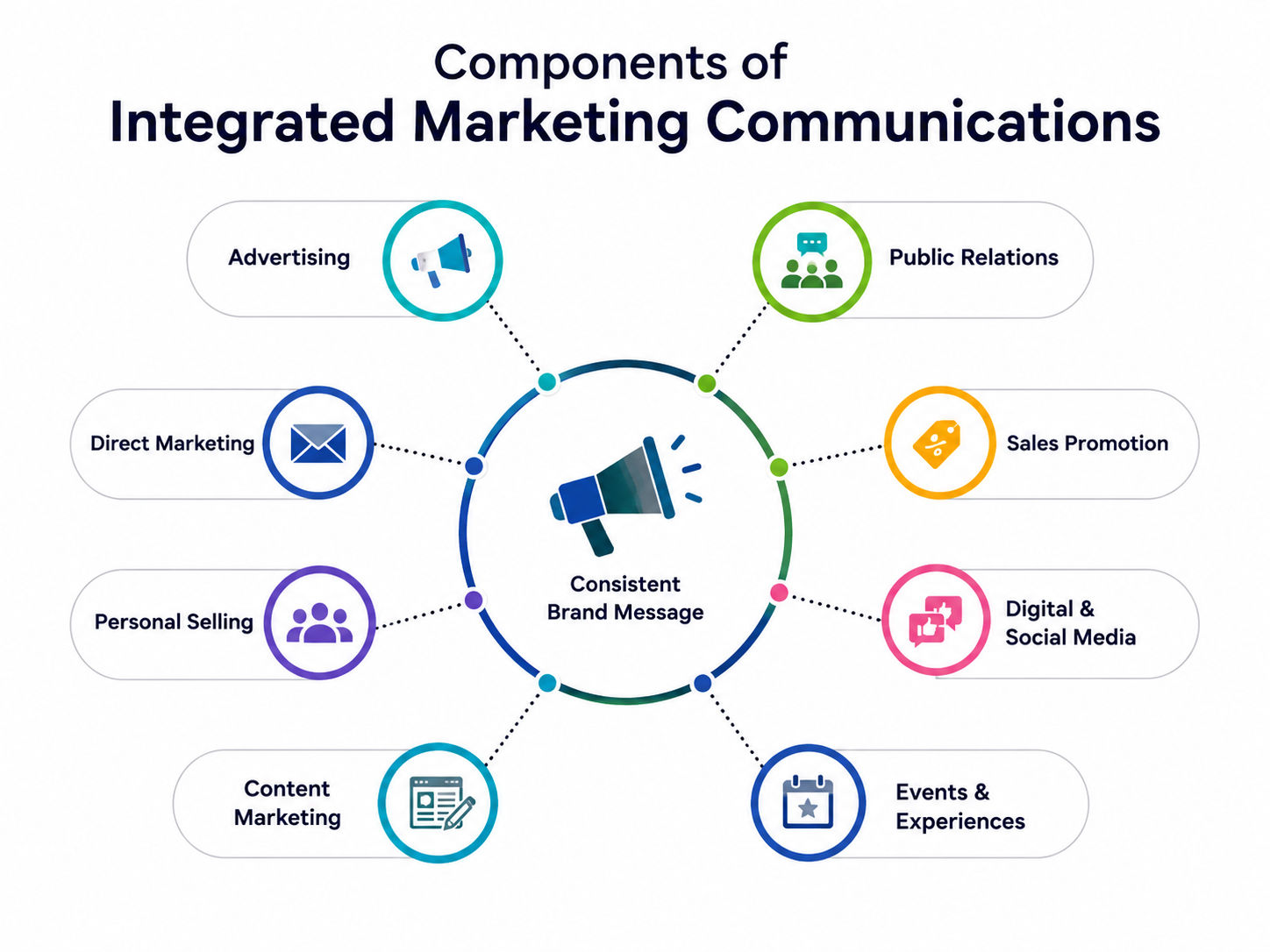
Advertising is a way for brands to reach large audiences through paid media. It can include television, search advertising, display ads, outdoor media, video, print and sponsored social content.
Advertising typically plays a strong awareness role. It can also support consideration or conversion when the campaign has a specific response goal.
Public relations is about reputation, credibility, media relations and communicating with the public.
A product announcement, expert interview, press coverage or corporate communication can be used to support the same campaign message used in advertising and digital content
PR is more than publicity. It also influences how organizations are perceived by their audiences.
Sales promotions encourage specific action through offers or incentives. Discounts, limited-time deals, samples, bundles, and loyalty rewards are common examples.
The promotion should support the wider campaign rather than operate as an isolated offer. That's where integration matters.
Direct marketing communicates with specific customers or prospects. Email, SMS, direct mail, and personalized offers are common examples.
It's particularly useful when a business has customer information that allows messages to become more relevant.
Must Read: Digital Marketing Types: Top 12 Digital Marketing Types You Should Know
Personal selling involves direct interaction between a salesperson and a potential customer.
This component becomes especially important for products that require explanation, consultation, demonstrations, or negotiation.
Digital channels give brands opportunities to communicate, respond, educate, and build engagement.
Social media, websites, search, email, video, and content can all support an integrated campaign. Their roles shouldn't be identical.
A useful IMC plan defines what each channel is supposed to accomplish.
Ready to build AI-powered software solutions? Explore the Executive Post Graduate Certificate in AI-Native Software Engineering and develop practical skills to stay ahead in modern software development.
The integrated marketing communication process turns a business objective into coordinated communication activities. It starts with understanding the audience and ends with measuring results and improving the campaign.
The process can be broken into six practical stages.
Start with customer needs, behaviours, motivations, objections, and preferred communication channels. You can't build useful communication without knowing who you're addressing. Research might include customer interviews, surveys, website behaviour, sales feedback, or existing customer data.
A clear understanding of the audience also helps marketers identify what influences purchasing decisions and what problems customers are trying to solve. These insights can guide messaging, content formats, offers, and channel selection, making communication more relevant and effective.
Decide what the campaign needs to achieve. The objective could be awareness, consideration, engagement, lead generation, sales, or retention. A clear objective also makes measurement easier later.
Objectives should be specific enough to guide decisions throughout the integrated marketing communication process. For example, a brand may aim to increase product awareness among a new audience or generate qualified leads within a particular period. Defining the expected outcome prevents teams from creating communication without a clear purpose.
Develop one central communication idea to support the campaign objective. The message should tell the audience why it is important. It should also provide enough guidance to different teams to communicate consistently but not produce identical content.
A strong core message creates consistency across advertising, social media, email, sales conversations, public relations and other touchpoints. The wording and presentation may vary from channel to channel but the core value proposition should be recognizable. This lets customers experience a connected brand experience and understand the brand more easily at any point in their journey.
Must read: Who is a Content Marketing Manager? [Skills, Roles & Responsibilities]
Choose channels based on the audience and objective rather than popularity.
A campaign might use paid advertising for reach, social media engagement, email for retention, and sales teams for conversion. These combinations also provide useful integrated marketing communications examples, showing how different channels can work together instead of operating as separate activities.
The best channel mix depends on where customers spend time and how they prefer to interact with the brand. Using too many channels can also make a campaign difficult to manage. Focus on platforms that can effectively support the intended customer journey and campaign goals.
Must Read: Branding: When’s the Right Time to Start
Coordinate content, creative assets, promotions, media activity, public relations and customer communications.
Timing is everything here. If a campaign is deployed across multiple channels at different times for no apparent reason, customers may receive an incomplete message.
Teams should work from a shared campaign plan, which sets out responsibilities, deadlines, messaging and publishing schedules. Consistent execution helps to prevent conflicting information and ensures that customers experience the campaign as a connected experience, not a series of unrelated activities. The idea behind the campaign should be the same in every customer contact.
Track performance against the original objectives. Look at reach, engagement, leads, sales, conversions, retention, and other relevant measures. Don't measure everything simply because the data exists.
The right metrics depend on what the campaign is trying to achieve. Reviewing results regularly can reveal which channels, messages, and content formats are performing well. Marketers can then adjust underperforming activities, allocate resources more effectively, and use campaign insights to improve future communication. This makes the integrated marketing communication process more responsive and results-focused over time.
An integrated marketing communications strategy is a planned approach to making different marketing channels work together around the same audience, message, and business goal. Instead of treating advertising, social media, email, public relations, and other activities as separate efforts, it connects them to create a consistent customer experience.
In simple terms, what is integrated marketing communication comes down to one idea: making sure every customer interaction supports the same overall marketing direction.
A good strategy helps answer practical questions such as:
The integrated marketing communication process brings these decisions together, from understanding the audience and setting objectives to selecting channels, executing campaigns, and measuring performance.
The goal is not to use every available channel. It is to choose the right combination and make each one contribute meaningfully to the campaign.
Do read: Social Media Manager Job Description: Salary, Top Companies, and Future
Subscribe to upGrad's Newsletter
Join thousands of learners who receive useful tips
Start with the business objective. Then define the target audience and customer journey. Identify the problem, motivation, or need that your communication should address.
Next, develop the central message and supporting proof points. Decide how that message should appear across different channels.
Finally, establish a campaign timeline and measurement framework.
A practical strategy document might include
Area |
What to define |
| Audience | Who the campaign targets |
| Objective | What the campaign should achieve |
| Core message | What customers should understand |
| Channels | Where communication will appear |
| Channel roles | What each channel should accomplish |
| Timing | When activities will run |
| KPIs | How performance will be measured |
Keep it practical enough for creative, media, sales, and customer teams to reference during execution.
Also Read: Social Media Advertising
Integrated marketing communications examples are useful because they show how different channels work together around one campaign idea.
A good example isn't simply a company using television, Instagram, email, and a website. Integration exists when those activities support a shared objective and reinforce the customer's understanding of the campaign.
Share a Coke connected personalised packaging with advertising, social participation, digital communication, and customer-generated content.
The campaign encouraged people to find names on bottles and share the experience. Different channels supported the same central idea of personal connection.
The important lesson isn't the number of channels. It's the consistency of the campaign idea across customer interactions.
Apple product launches typically combine events, advertising, website content, public relations, retail communication, email, and digital channels.
Each touchpoint serves a different purpose. The event creates attention, product pages provide detail, advertising builds awareness, and retail experiences support evaluation.
That's a practical illustration of coordinated communication.
Imagine a bakery launching a new festive cake range. The business could publish a short social video, send an email to existing customers, display the products on its website, offer an introductory promotion, and encourage customers to share their purchases.
The content wouldn't need to be identical. The central campaign message would simply remain consistent.
These integrated marketing communications examples show why channel selection alone doesn't create integration. The planning behind the channels matters just as much.
Also Read: Advertising vs Public Relations: Differences Between Advertising & Public Relations
Measurement should start with the campaign objective rather than a long list of available metrics.
For an awareness campaign, reach, impressions, video views, and brand recall may matter. A lead-generation campaign needs different measures, such as enquiries, qualified leads, conversion rate, and acquisition cost.
Campaign objective |
Useful measures |
| Awareness | Reach, impressions, brand recall |
| Engagement | Interactions, shares, comments, content engagement |
| Consideration | Website visits, enquiries, product views |
| Conversion | Leads, sales, conversion rate |
| Retention | Repeat purchases, retention, customer value |
A customer might see an advertisement, read a blog, receive an email, and later purchase through a sales representative. Assigning that purchase to only one touchpoint can give an incomplete picture. That's why businesses should look at the full customer journey where reliable data is available.
Must Read: A Guide To Grow Your Business With Influencer Marketing
An IMC campaign can look well planned on paper and still struggle during execution.
Teams may use different messages. Channels may compete for attention. Data may sit in separate systems. A campaign can also become too complicated when marketers add channels without defining their roles.
Common problems include
The fix isn't always another platform or more content. Sometimes the better answer is simpler planning. Create one campaign brief, define the core message, assign a purpose to each channel, establish shared KPIs, and review performance together.
Good IMC planning starts with the customer rather than the channel.
Don't begin by asking which platforms the campaign should use. Begin by asking
what the audience needs to know, feel, or do.
Keep these practices in mind
Your message should feel recognisable across channels, but the execution should respect how people use each channel.
Integrated marketing communication brings different marketing efforts together, so customers get a clear and consistent brand message. From knowing the audience and setting goals to choosing channels and checking results, each step helps make campaigns more effective.
When these activities work together, businesses can avoid mixed messages, connect better with customers, and get more value from their marketing efforts. A well-planned integrated marketing communication process keeps the brand message simple, relevant, and consistent.
Ready to start your journey? Book a free consultation with upGrad today to find the best path for your career
The 4 C’s are commonly described as coherence, consistency, continuity, and complementary communication. Together, they help different messages support one another across channels and over time. This framework is different from the customer-focused 4 C’s model of consumer, cost, convenience, and communication.
Yes, IMC remains relevant because customers now move between digital, social, email, websites, advertising, and offline touchpoints before making decisions. Recent marketing guidance continues to emphasise unified messaging and coordinated customer experiences, showing that integration remains useful even as channels and formats change.
The five traditional forms are advertising, public relations, direct response or direct marketing, sales promotion, and personal selling. Modern campaigns can include digital media, content, social platforms, and events as well, but these five remain a commonly taught foundation for understanding the promotional mix.
IMC focuses mainly on coordinating marketing messages, communication activities, and channels around shared objectives. Omnichannel marketing focuses more heavily on creating a connected customer experience across channels. The two approaches overlap, but IMC is centred on communication integration, while omnichannel thinking extends further into the overall customer experience.
IMC can connect communication across different stages of a customer's journey. Someone might discover a brand through advertising, seek information through content, receive personalised communication later, and interact with sales before purchasing. Each touchpoint can serve a different purpose while reinforcing the same overall brand position.
Customer data helps marketers understand audience behaviour, preferences, interactions, and responses across touchpoints. It can guide message personalisation, channel decisions, timing, and campaign evaluation. The goal isn't simply to collect more data, but to use useful insights to make communication more relevant and connected.
Brands can keep their core positioning, visual identity, and key message consistent while adapting content to different audiences and channels. For example, one campaign idea might use educational content for prospects and personalised offers for existing customers without changing the underlying brand promise.
Message integration means keeping the central idea and brand positioning aligned across communication. Channel integration goes further by coordinating how those channels work together. A campaign can have consistent messages but still feel disconnected if its channels operate independently without clear timing, roles, or connections.
Responsibility usually involves several teams rather than one person. Marketing, advertising, PR, content, social media, sales, and customer teams may all contribute. Strong coordination requires shared campaign objectives, clear responsibilities, and a common understanding of the brand message so individual teams don't work in isolation.
Yes. Small businesses don't need a large media budget or dozens of channels to apply IMC. A business could coordinate its website, social media, email, customer referrals, and local promotions around one campaign idea. A focused channel mix is often easier to manage and keep consistent.
An integrated campaign feels connected when customers encounter a recognisable brand idea across different touchpoints without seeing repetitive content. The channels should support one another, timing should make sense, and each communication should have a clear role. The result should feel like one campaign, not several unrelated activities.
730 articles published
Sriram K is a Senior SEO Executive with a B.Tech in Information Technology from Dr. M.G.R. Educational and Research Institute, Chennai. With over a decade of experience in digital marketing, he specia...
Get Free Consultation
By submitting, I accept the T&C and
Privacy Policy
Level Up Your Digital Marketing Career Today!
Top Resources
MICA
Advanced Certificate in AI-Powered Digital Marketing & Communication from MICAMICA Executive Alumni Status
Certification
5 Specialisation
Classroom
4 Months
Certification
2 Months