GRU Vs LSTM: Key Differences, Architecture & Which One to Choose
By upGrad
Updated on Sep 18, 2026 | 8 min read | 3.25K+ views
Share:

All courses
Certifications
More
By upGrad
Updated on Sep 18, 2026 | 8 min read | 3.25K+ views
Share:
Table of Contents
Key Highlights
Want to build models like GRU and LSTM from scratch? Explore our Machine Learning courses in India and turn concepts into real world skills.
Popular AI Programs
Both GRU and LSTM are the types of recurrent neural networks. They are built to handle sequential data like text, speech, or time series. They both help neutral networks remember information over long sequences without losing track of what mattered earlier on.
In the table below GRU and LSTM comparison points are shared:
Feature |
GRU |
LSTM |
| Number of gates | 2 (update, reset) | 3 (input, forget, output) |
| Memory cell | No separate memory cell | Has a separate memory cell |
| Parameters | Fewer parameters | More parameters |
| Training speed | Faster to train | Slower to train |
| Computational cost | Lower | Higher |
| Performance on long sequences | Good, but can struggle with very long sequences | Generally better at handling long term dependencies |
| Best suited for | Smaller datasets, quicker experiments | Larger, more complex datasets |
| Risk of overfitting | Lower, due to simpler structure | Higher, due to more parameters |
| Model complexity | Simpler architecture | More complex architecture |
| Ease of tuning | Easier to tune | Requires more tuning effort |
Also read: How to Learn Machine Learning – Step by Step
Free Courses
GRU is a type of recurrent neural network and it was introduced in 2014 as a simpler alternative to LSTM by Cho et al.
The goals behind this were simple, researchers wanted to keep the strengths of LSTM but avoid the vanishing gradient problem. So, the Gated Recurrent Unit has an ability to capture patterns over time. Its streamlined gating mechanism makes it a better choice over traditional RNNs and Long Short-Term Memory (LSTM) networks.
Key Characteristics of GRU
Some key characteristics of GRU are as follows:
At any given time step, like reading the fifth word in a sentence, the GRU takes two inputs.
Here is exactly how the GRU processes these two inputs.
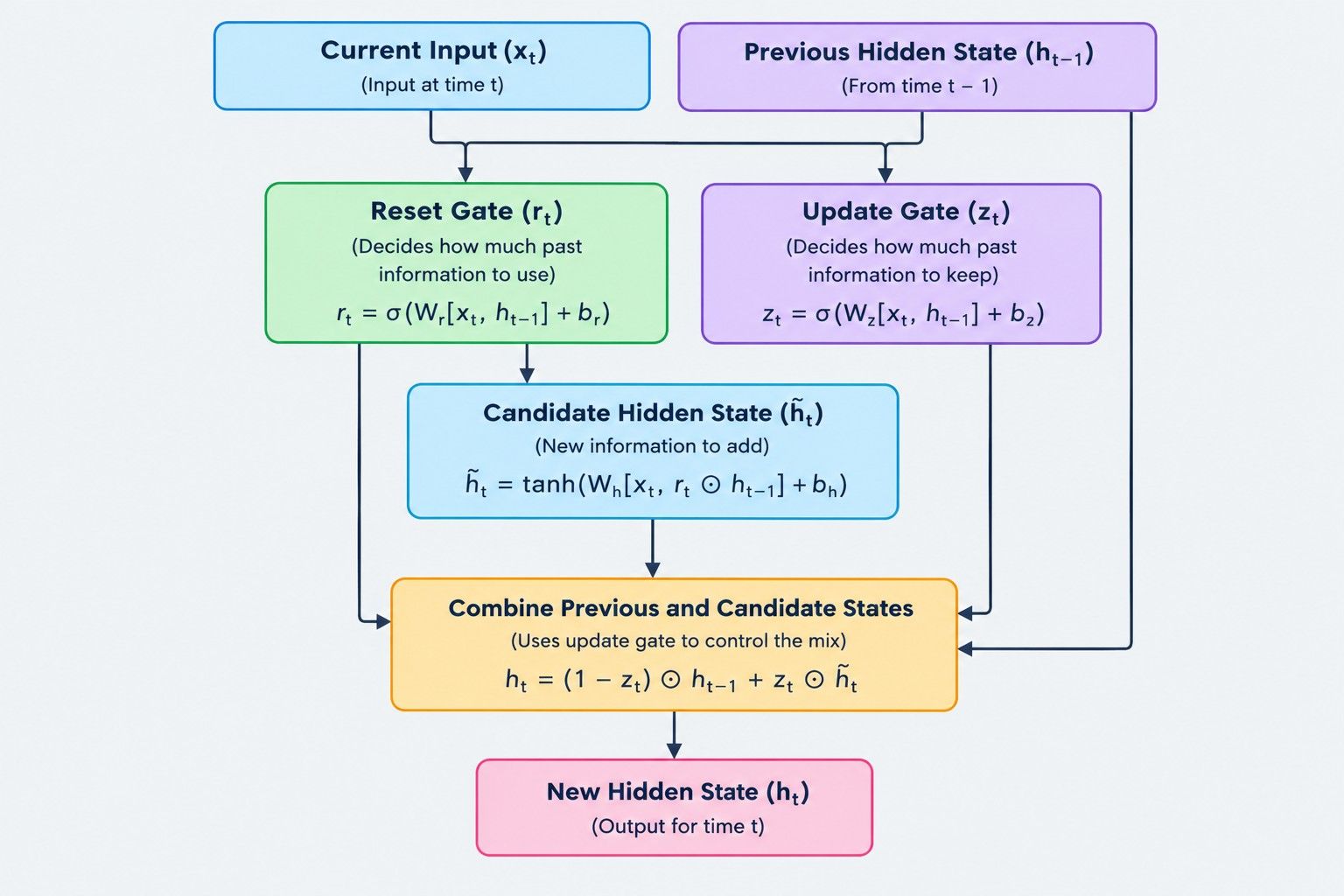
This gated structure is what makes GRU good at handling long sequences. Since the update gate can let old memory pass through with little change, information does not fade out too quickly. This also helps avoid the vanishing gradient problem, a common issue in simpler recurrent networks.
Ready to lead enterprise AI? Join the Executive Programme in Generative AI & Agentic AI for Leaders from IIIT Bangalore and learn to architect and scale GenAI systems that matter.
AI Courses to upskill
Explore Artificial Intelligence Courses for Career Progression
LSTM was introduced in 1997, and it was designed to solve a major problem with traditional RNNs. These networks struggled to remember information over long sequences, also known as the vanishing gradient problem.
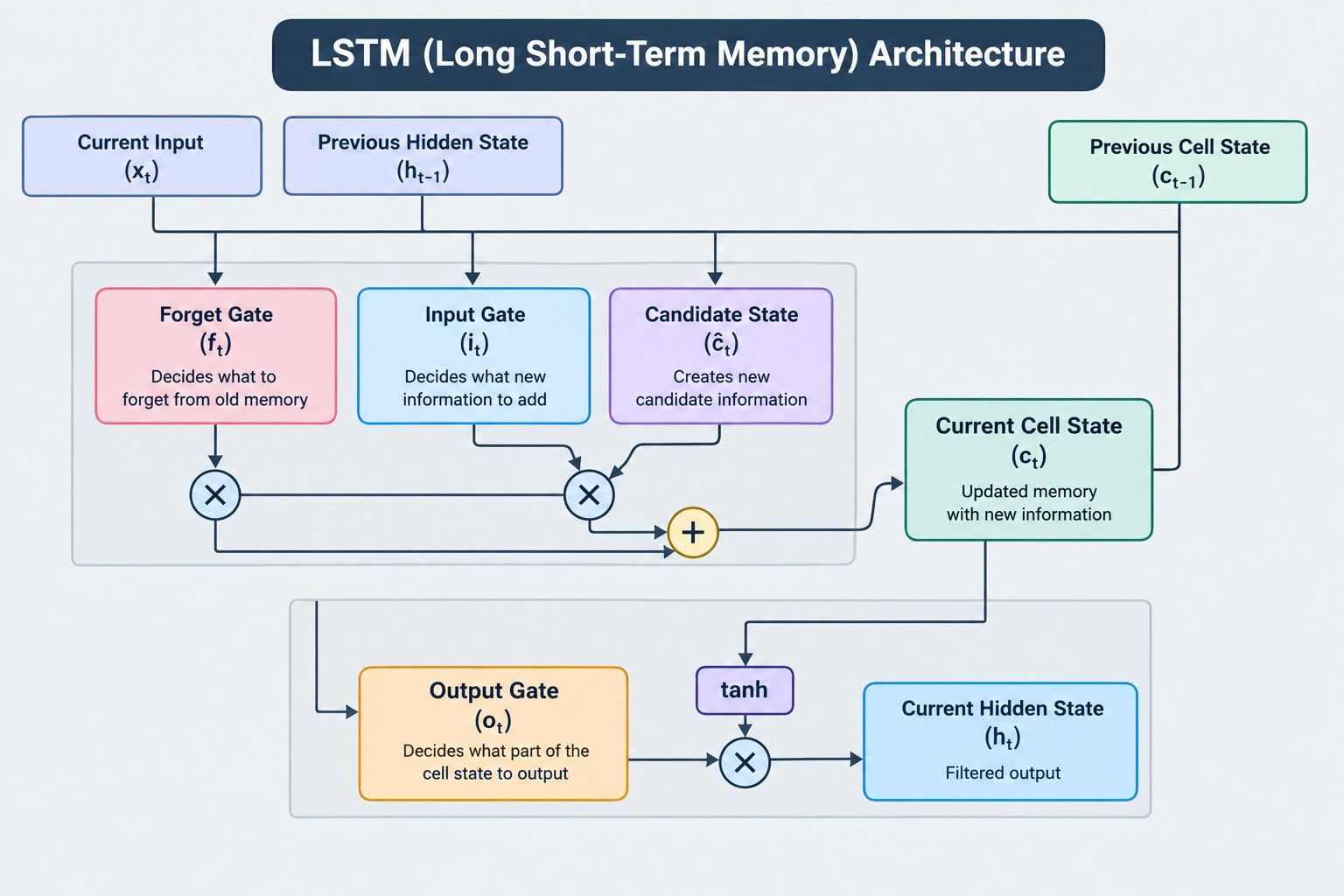
Long Short-Term Memory solves this by using a more detailed structure. It has three gates instead of two. It also uses a separate memory cell that runs through the entire sequence. This memory cell acts like a conveyor belt. It carries important information forward, only changing it when needed.
Because of this design, LSTM is very good at handling long term dependencies. It can remember information from many steps earlier, even if a lot has happened in between.
Key Characteristics of LSTM
Some key characteristics of LSTM are:
LSTM keeps two separate states running at every step, unlike GRU, which combines everything into a single hidden state.
To manage these two states, LSTM uses three separate gates.
Also read: Foundations of Machine Learning: What You Actually Need to Know
Choosing GRU vs LSTM usually comes down to a trade-off between speed and the ability to handle complex sequences. Since GRU is a newer, simplified version of LSTM, the two often perform similarly on many tasks. The real difference lies in how much time, data, and computing power each one needs.
Choose GRU when |
Choose LSTM when |
| Hardware resources or time are limited | The dataset is massive and deeply complex |
| The training dataset is small to medium sized | Sequences contain long range, intricate dependencies |
| You need rapid prototyping and quick iterations | The order of information needs strict, structured gating |
| Deploying to low power edge devices like mobile or IoT | You need maximum control over isolated memory states |
Other Detailed Factors
1. Dataset size and overfitting risk
2. Training speed and computational cost
Also read: 5 Breakthrough Applications of Machine Learning
The choice GRU vs LSTM depends on what you are building, how much data you have, and how much time and computing power you can spare. GRU is a solid starting point for most projects because it is quick to train and simple to work with. If your results fall short, moving to LSTM gives you more control and often better accuracy on harder problems.
A good approach is to start small. Build a GRU model first, check how it performs, and only switch to LSTM if you need to capture more complex patterns in your data. This way, you save time without giving up on accuracy where it truly matters.
Have doubts about your career path? Book a free consultation with our experts today.
Both models often deliver similar accuracy on many tasks, but performance can vary depending on the dataset. GRU tends to perform well on smaller or simpler datasets, while LSTM often edges ahead on tasks involving longer sequences or more complex patterns.
It depends on the length and complexity of your time series data. GRU works well for shorter sequences and when you need faster training. LSTM is often preferred for longer time series where capturing patterns across many time steps matters more.
Yes, some architectures combine both by stacking GRU and LSTM layers, or by testing both separately and choosing the one that performs better on a given dataset.
In most cases, yes. GRU has fewer parameters and a simpler structure, which generally leads to faster training and lower computational cost. However, actual speed can also depend on hardware, batch size, and how the model is implemented.
Not always. LSTM tends to perform better on complex tasks with long dependencies, but on smaller or simpler datasets, GRU can match or even outperform LSTM while using fewer resources.
GRU is generally easier to understand and implement because it has a simpler structure with fewer gates. This makes it a good starting point before moving on to LSTM.
No, both are used across many types of sequential data, including speech recognition, time series forecasting, sensor data, and even video analysis, not just text.
Not necessarily. GRU can perform reasonably well with smaller datasets due to its simpler structure, while LSTM often needs larger datasets to make full use of its additional parameters.
In many cases, yes. Since both are supported by common deep learning libraries, switching from LSTM to GRU is usually straightforward and mainly involves testing performance on your specific data.
GRU was introduced later than LSTM, in 2014 compared to LSTM's introduction in 1997, and was designed to offer similar benefits with a simpler structure, but it is not considered an upgraded replacement, just an alternative approach.
Yes, it can. GRU's lower computational needs make it a better fit for mobile or IoT devices with limited processing power, while LSTM may require more resources to run efficiently on such devices.
975 articles published
We are an online education platform providing industry-relevant programs for professionals, designed and delivered in collaboration with world-class faculty and businesses. Merging the latest technolo...
Speak with AI & ML expert
By submitting, I accept the T&C and
Privacy Policy
Top Resources
Master's Degree
18 Months
Executive Diploma
12 Months
IIIT Bangalore
Executive Programme in Generative AI & Agentic AI for LeadersIndia’s #1 Tech University
Dual Certification
5 Months