Doctorate for Working Professionals: Eligibility, Career Benefits, and Growth Opportunities
By Sriram
Updated on Aug 11, 2026 | 7 min read | 4.61K+ views
Share:

All courses
Certifications
More
By Sriram
Updated on Aug 11, 2026 | 7 min read | 4.61K+ views
Share:
A doctorate for working professionals is designed to help experienced individuals pursue advanced research while continuing their careers. Most programs take between three and six years to complete and offer flexible learning options such as online, hybrid, weekend, or modular classes. Many institutions also require a No Objection Certificate (NOC) from the employer to support participation in the program.
This blog explains what a doctorate for working professionals is, covers program types and eligibility, explores career opportunities, and helps you decide if pursuing a doctoral degree is the right choice.
Explore upGrad's Doctor of Business Administration (DBA) for working professionals and build advanced research, leadership, and strategic decision-making skills.
Popular upGrad Programs
A doctorate for working professionals is a doctoral-level program specifically designed for individuals who wish to continue their careers while pursuing advanced education.
These programs combine academic rigor with practical industry applications. Instead of focusing solely on theoretical research, many professional doctorate programs encourage students to solve real-world business, technology, healthcare, education, or engineering challenges.
Traditional PhD programs are primarily research-oriented and often prepare students for academic careers.
Professional doctorate programs, on the other hand, emphasize:
A professional doctorate may be suitable for:
Many industries now offer doctoral opportunities, including:
Must read : Best PhD Programs in India in 2026: Which One Should You Choose?
Free Courses
Working professionals often pursue a doctorate to deepen their expertise, strengthen leadership skills, and unlock new career opportunities. It can help them stay competitive, gain industry recognition, and contribute meaningful solutions to real-world challenges while continuing to advance in their careers.
Organizations increasingly value employees who demonstrate advanced expertise and strategic thinking. A doctoral qualification can support promotion into senior leadership positions.
Doctoral programs help professionals develop leadership capabilities, research skills, and business acumen required for executive-level responsibilities.
Holding a doctoral degree often establishes credibility within an industry and demonstrates commitment to continuous learning and innovation.
Professionals can conduct meaningful research that addresses industry challenges and contributes practical solutions to organizations and communities.
Recommended Courses to upskill
Explore Our Popular Courses for Career Progression
IIIT Bangalore
Executive Diploma in Machine Learning and AI360° Career Support
O.P.Jindal Global University
MBA from O.P.Jindal Global UniversityLive Case Studies and Projects
Several doctoral pathways are available depending on career goals and professional interests.
Program Type |
Focus Area |
Ideal For |
| PhD | Academic Research | Researchers and Academics |
| DBA (Doctor of Business Administration) | Business Strategy and Leadership | Managers and Executives |
| EdD (Doctor of Education) | Educational Leadership | Educators and Administrators |
| Doctor of Engineering | Applied Engineering Solutions | Engineers |
| Professional Doctorate | Industry-Focused Research | Experienced Professionals |
Must read: Doctor of Business Administration Course Fees 2026: India & Global Costs, Scholarships, EMI Options
These programs are structured to balance academic rigor with professional commitments, making advanced education more accessible.
Flexible Learning Formats
Most programs offer flexible schedules that allow students to balance work, study, and personal commitments.
Online and Hybrid Delivery
Many universities now provide online and hybrid learning models that reduce travel requirements while maintaining academic quality.
Weekend and Modular Classes
Weekend classes and intensive learning modules help professionals continue working without major disruptions.
Industry-Relevant Research Projects
Students often conduct research based on real workplace challenges, making their studies directly applicable to their careers.
Eligibility requirements for doctoral programs vary depending on the university, specialization, and program format. However, most institutions assess a candidate's academic background, professional experience, and research potential before granting admission.
Most universities require:
Professional doctorate programs typically prefer candidates with several years of industry experience.
Some institutions require:
Applicants may need to submit a preliminary research proposal outlining their intended area of study.
Also read : Why Senior Executives Are Turning to Doctor of Business Administration (DBA) for Career Growth?
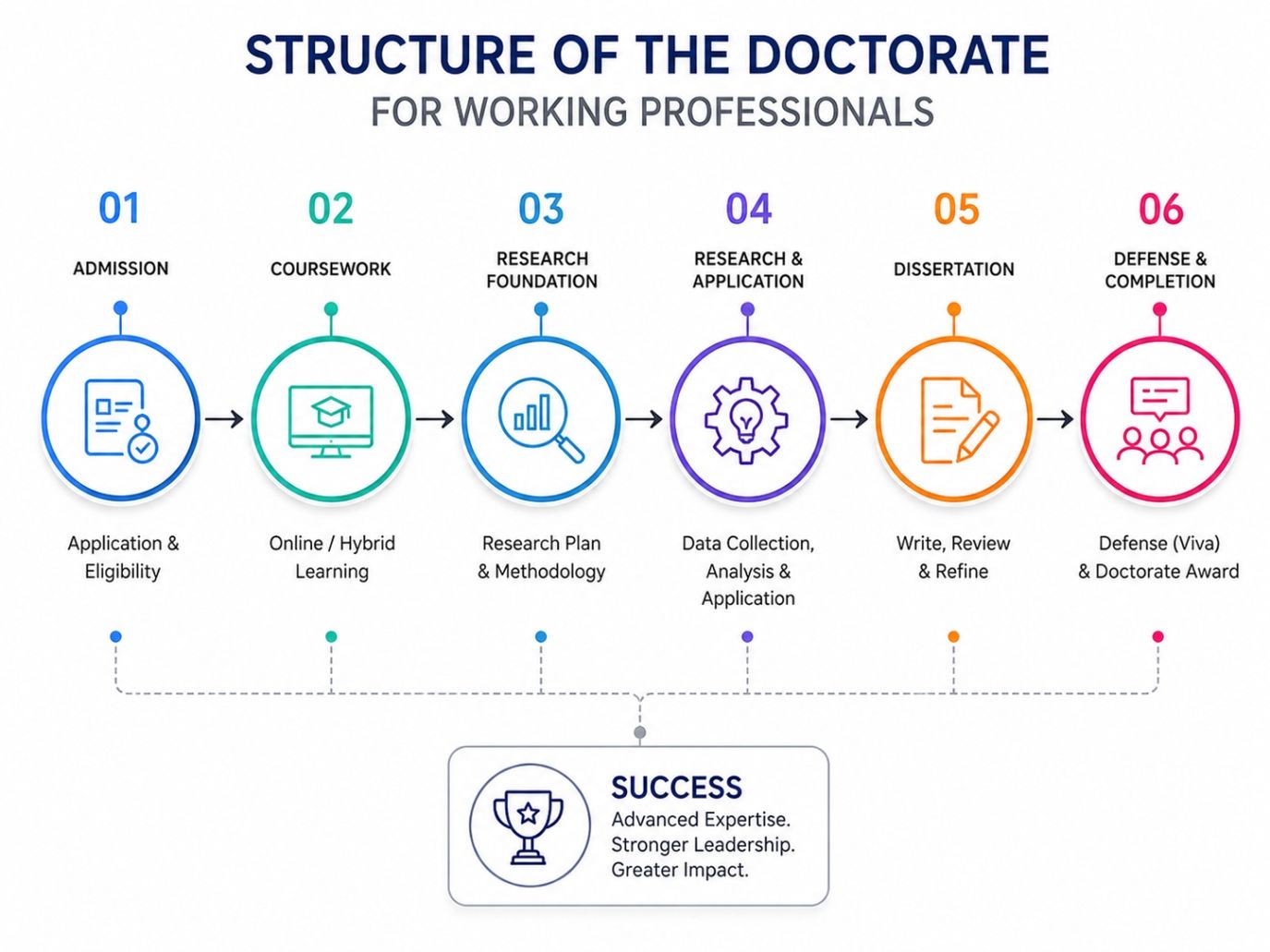
A doctorate for working professionals follows a structured path of coursework, research, dissertation development, and defense while supporting career commitments.
Read : Online Doctor of Business Administration (DBA) Eligibility
A doctoral qualification can create opportunities across multiple industries.
Industry |
How a Professional Doctorate Adds Value |
| Business and Management | Helps executives and managers strengthen leadership, strategic thinking, and organizational decision-making skills. |
| Healthcare | Supports research aimed at improving patient care, healthcare operations, and policy development. |
| Education | Enhances expertise in educational leadership, curriculum design, and academic research. |
| Technology and Artificial Intelligence | Enables professionals to drive innovation in AI, cybersecurity, cloud computing, and digital transformation initiatives. |
| Engineering | Contributes to advancements in product design, manufacturing processes, sustainability, and infrastructure projects. |
| Public Policy and Government | Helps professionals develop evidence-based policies and improve public administration effectiveness. |
A doctoral degree can significantly enhance your professional profile by opening access to senior leadership, consulting, research, and academic roles. It demonstrates advanced expertise, strategic thinking, and the ability to solve complex industry challenges.
For many professionals, earning a doctorate is not just an academic achievement but a pathway to greater influence, higher-level responsibilities, and long-term career growth across multiple sectors.
Here the table shows the role based on the Career path :
Career Path |
Potential Role |
| Corporate Leadership | Director, Vice President, Chief Executive Officer |
| Consulting | Industry Consultant |
| Academia | Professor, Lecturer, Researcher |
| Public Policy | Policy Advisor |
| Entrepreneurship | Founder, Business Strategist |
Choosing the right doctorate program requires evaluating accreditation, flexibility, faculty expertise, research support, and alignment with your career goals.
1. Accreditation and Recognition
Choose programs offered by accredited institutions with strong academic reputations.
2. Faculty Expertise
Review faculty qualifications, research interests, and industry experience.
3. Flexibility and Learning Format
Ensure the program accommodates your professional responsibilities and lifestyle.
4. Research Support
Evaluate access to supervisors, research resources, libraries, and academic support services.
5. Return on Investment
Consider tuition costs, career outcomes, networking opportunities, and long-term professional value.
Read : Are Online DBA Degrees Valued by Employers?
For professionals seeking career advancement, leadership opportunities, and specialized expertise, a doctorate can be a valuable long-term investment. Its true value depends on how well the program aligns with your professional goals, industry demands, and desired career trajectory.
Career Growth Potential
A doctoral degree can enhance leadership opportunities and increase professional visibility.
Leadership and Executive Opportunities
Many executives pursue advanced education to strengthen strategic thinking and organizational leadership skills.
Research and Industry Impact
Professionals can create meaningful contributions through applied research and innovation.
Long-Term Return on Investment
For many individuals, the benefits of a doctorate for working professionals extend beyond salary increases and include credibility, influence, and career satisfaction.
A doctorate for working professionals allows individuals to earn the highest academic qualification while continuing their careers. Flexible schedules, industry-focused research, and practical learning make it easier to balance professional responsibilities with advanced education.
Whether you aim to move into leadership, consulting, academia, or entrepreneurship, the right doctoral program can accelerate career growth. It helps develop specialized expertise, strengthens professional credibility, and prepares you to make a greater impact in your industry.
Ready to start your journey? Book a free consultation with upGrad today to find the best path for your career.
Yes, many universities offer doctoral programs specifically designed for working professionals. These programs often include online classes, weekend sessions, hybrid learning formats, and flexible research schedules. This allows you to continue earning an income while progressing toward your doctoral degree. Success depends on effective time management and a clear commitment to balancing work and academic responsibilities.
A traditional PhD focuses heavily on academic research and preparing candidates for research or teaching careers. A professional doctorate emphasizes applied research that addresses real-world industry challenges. It is often preferred by experienced professionals who want to improve leadership capabilities, solve workplace problems, and advance within their industries rather than pursue a purely academic path.
Yes, provided the program is offered by an accredited and recognized institution. Employers generally value doctoral qualifications because they demonstrate advanced expertise, research skills, and commitment to professional growth. In many industries, a doctorate can strengthen your profile for leadership, consulting, and specialized technical roles.
The workload varies by institution and research requirements, but many working professionals spend between 10 and 20 hours per week on coursework, research, reading, and assignments. During dissertation phases, the time commitment may increase. Planning your schedule early can help prevent conflicts between professional and academic responsibilities.
There is no universally "easy" doctorate. The right program depends on your experience, educational background, and career goals. Professional doctorates such as DBA, EdD, or Doctor of Engineering often offer flexible structures that may be more manageable for working professionals compared to traditional full-time research programs.
In many cases, yes. Professional doctorate programs often encourage students to explore research topics connected to their organizations or industries. This approach allows you to apply academic concepts directly to practical challenges while creating value for your employer. It can also make your research more relevant and easier to manage alongside your job.
Both are doctoral-level qualifications, but they serve different purposes. A DBA focuses on business leadership, strategic decision-making, and applied research, while a PhD emphasizes theoretical and academic research. Neither is inherently better. The right choice depends on whether your goals are industry-focused or academic.
Requirements vary across institutions, but most programs expect applicants to hold a bachelor's or master's degree and demonstrate relevant professional experience. Some universities may also require entrance examinations, interviews, research proposals, or employer support documents. Reviewing program-specific criteria before applying can help you prepare effectively.
Yes, many universities now offer online doctoral programs with virtual classes, digital research support, and remote supervision. However, some programs may require occasional campus visits, workshops, or dissertation defenses. Before enrolling, verify whether the program is fully online or follows a hybrid model to ensure it matches your schedule and location preferences.
A doctorate does not automatically guarantee a salary increase, but it can improve access to higher-level roles and specialized positions. Industries such as education, healthcare, engineering, consulting, and business leadership often reward advanced qualifications. The financial return depends on your field, experience, and how effectively you leverage your expertise after graduation.
A doctorate for working professionals can be worthwhile if it aligns with your long-term goals. It may help you qualify for leadership positions, strengthen industry credibility, expand professional opportunities, and develop expertise that differentiates you in a competitive market. A doctorate for working professionals is most valuable when pursued with a clear career objective in mind.
727 articles published
Sriram K is a Senior SEO Executive with a B.Tech in Information Technology from Dr. M.G.R. Educational and Research Institute, Chennai. With over a decade of experience in digital marketing, he specia...
Get Free Consultation
By submitting, I accept the T&C and
Privacy Policy
Top Resources
Certification
3 Months
Certification
6 Months
O.P. Jindal Global University
Masters in International Accounting and Finance (Accredited by ACCA, UK)Master's Degree
12 Months