Cost of Artificial Intelligence: A Practical Breakdown
By Sriram
Updated on Jun 22, 2026 | 6 min read | 1.76K+ views
Share:

All courses
Certifications
More
By Sriram
Updated on Jun 22, 2026 | 6 min read | 1.76K+ views
Share:
Table of Contents
The real cost of artificial intelligence comes from four areas: compute power, data, talent, and time. Each one compounds the others. Most people assume AI costs are software licensing fees. That's only a fraction of the picture.
Artificial intelligence isn't cheap. The final cost depends on factors such as development complexity, infrastructure requirements, data quality, talent costs, and ongoing maintenance. A chatbot for customer support costs far less than a healthcare AI system that analyses medical images and supports clinical decisions.
This blog breaks down exactly where the money goes. You'll learn what drives AI costs, what different types of projects typically spend, how to reduce expenses without cutting corners.
Explore upGrad's Data Science, AI, and Machine Learning programs to develop practical skills in large language models (LLMs), generative AI, machine learning, model evaluation, NLP, and data-driven decision-making.
Popular AI Programs
Recent reports in 2026 show that some companies like Uber, Microsoft, Meta, and OpenAI have exhausted their annual AI budgets within months due to rising token usage and API costs. As AI adoption grows, understanding the cost of artificial intelligence has become essential for businesses, professionals, and students looking to make informed investment and learning decisions.
The cost of artificial intelligence varies widely depending on the purpose. A student learning AI may spend a few thousand rupees, while a company building a custom AI platform could spend several crores. There's no single price tag.
As we discussed earlier, the real cost of artificial intelligence comes from four areas: compute power, data, talent, and time.
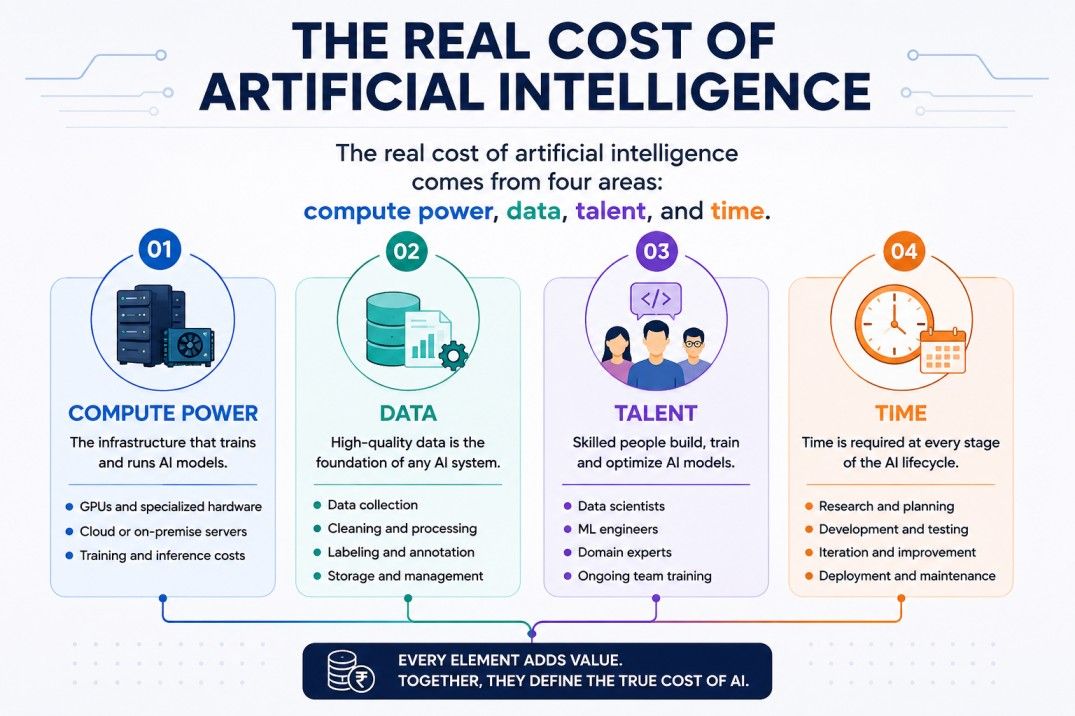
AI models, especially deep learning ones, need serious processing power. GPUs from NVIDIA, like the A100 or H100, are the industry standard, and they don't come cheap.
Cloud options from AWS, Google Cloud, and Azure let you rent compute by the hour. A single GPU instance can run anywhere from $2(₹189) to $35(₹3,308) per hour, depending on the spec. A mid-size training run might consume 500 to 2,000 GPU hours, so you can do the math yourself.
On-premise hardware is even steeper upfront. A single NVIDIA H100 GPU card costs around $25,000(₹23.62 lakh) to $35,000 (₹33.07 lakh)at market rates.
Raw data isn't ready to use. It needs to be cleaned, labeled, and structured. This is one of the most underestimated costs in any AI project.
Data labeling alone can cost $0.01(₹0.95) to $0.30(₹28.35) per label, depending on complexity. A dataset with 100,000 items adds up fast. And if you're working with medical, legal, or financial data, you'll need domain experts to label it, not just general annotators.
This is where budgets really stretch. A machine learning engineer in India earns between ₹ 12 lakh and ₹ 25 lakh per year, according to AmbitionBox, depending on experience and company. In the US, the same role runs $130,000(₹1.23 crore) to $250,000(₹2.36 crore) annually.
You don't always need a full team. But you need at least one person who understands model behavior, not just deployment.
AI models drift over time. The real world changes, and your model's performance degrades if it isn't retrained. This is an ongoing cost, not a one-time expense.
Also read: Applications of Artificial Intelligence and Its Impact
Many businesses assume AI is a one-time technology investment. In reality, the cost of artificial intelligence comes from several interconnected expenses that continue long after deployment.
A typical AI project involves data preparation, model development, cloud infrastructure, software integration, testing, security, and ongoing monitoring. Even when pre-trained models reduce development effort, organizations still need resources to manage performance, reliability, and compliance.
It's also important to separate one-time costs from recurring costs.
One-Time Costs |
Recurring Costs |
| Data preparation | Cloud computing |
| Model training | API usage |
| System integration | Model retraining |
| Initial development | Maintenance |
| Testing and deployment | Security updates |
For example, an AI solution that costs ₹20 lakh to build may require an additional ₹3 lakh to ₹10 lakh annually for infrastructure, monitoring, and model updates. That's why long-term planning matters as much as the initial budget.
Do read: Deep Learning Models: Types, Creation, and Applications
Free Courses
Not every AI project is the same. A chatbot isn't a self-driving module. Costs vary dramatically based on what you're actually building.
Project Type |
Estimated Cost Range (INR) |
Notes |
| Simple chatbot (rule-based) | ₹ 50,000 to ₹ 2,00,000 | Low complexity, limited capabilities |
| ML model (custom) | ₹ 5,00,000 to ₹ 25,00,000 | Requires data prep and iteration |
| NLP-based product | ₹ 10,00,000 to ₹ 50,00,000 | Depends on language model used |
| Computer vision system | ₹ 15,00,000 to ₹ 1 crore+ | Hardware and labeling intensive |
| LLM fine-tuning | ₹ 3,00,000 to ₹ 20,00,000 | Based on model size and dataset |
| Enterprise AI platform | ₹ 1 crore to ₹ 10 crore+ | Full-stack development and deployment |
Small businesses often start with pre-built AI APIs from OpenAI, Google, or AWS. These are usage-based, so you pay per API call rather than building from scratch. That keeps the entry cost low, sometimes under ₹ 10,000 per month for light use.
The high cost of artificial intelligence in enterprise contexts usually comes from customization. Off-the-shelf models don't fit every use case, and adapting them requires both engineering effort and proprietary data.
Must read: Job Opportunities in AI: Salaries, Skills & Careers in 2026
AI Courses to upskill
Explore Artificial Intelligence Courses for Career Progression
If you're thinking about entering the AI field, the cost of an artificial intelligence course is a real consideration.
Courses vary widely in quality and price. Here's a rough guide:
Platforms like Coursera, edX, and YouTube offer strong foundational content at no cost. Andrew Ng's Machine Learning course on Coursera is genuinely useful and free to audit. You'll learn the concepts, but you won't get mentorship or career support.
Mid-tier programs from platforms like upGrad typically run between ₹ 50,000 to ₹ 2,50,000. These include industry projects, mentor access, and placement support. That's a meaningful difference if you're targeting a career switch.
Here are some programs from upgrad in AI to choose from:
Postgraduate programs in AI and ML from reputed institutions cost ₹ 1,50,000 to ₹ 5,00,000 or more. Duration ranges from six months to two years. They go deeper into model development, research applications, and real-world deployments.
Is the cost worth it? Depends on your goal. If you're building AI products, structured learning accelerates your path considerably. Self-learning works, but it's slower and harder to validate for employers.
Do read: AI Course Fees and Career Opportunities in India for 2026
Smart teams don't spend less by doing less. They spend less by spending money more smartly.
Cost Reduction Strategy |
How It Helps Reduce AI Costs |
| Use Pre-Trained Models | Fine-tune existing models like GPT, Gemini, or LLaMA instead of spending heavily on training a model from scratch. |
| Start With a Proof of Concept | Validate the idea with a small prototype before committing significant resources to full-scale development. |
| Optimize Your Data Pipeline | High-quality data reduces errors, retraining expenses, and long-term maintenance costs. |
| Choose the Right Cloud Tier | Avoid paying for unnecessary computing resources by matching infrastructure to actual workload requirements. |
| Monitor Model Drift Actively | Regular performance checks help identify issues early and prevent costly fixes or declining user experience. |
What's the actual cost of artificial intelligence for a small business trying these strategies? Often between ₹ 2 lakh and ₹ 8 lakh per year for moderate usage, including tools, APIs, and some engineering time. That's manageable if the output justifies it.
AI costs aren't going down as fast as hype suggests. Compute is still expensive. Good data is still hard to collect. Skilled engineers are still in high demand.
What has changed is access. Small teams can now build real AI products using APIs, open-source models, and cloud infrastructure that didn't exist five years ago. The barrier to entry has dropped. The cost of doing it well hasn't.
Know what you're paying for. Separate the necessary costs from the avoidable ones. And if you're building skills to work in this field, treat the cost of an artificial intelligence course as an investment with a measurable return.
Ready to start your journey? Book a free consultation with upGrad today to find the best path for your career.
The average cost varies based on project complexity and business size. Small companies may spend ₹50,000 to ₹10 lakh on basic AI solutions, while larger organizations often invest several crores in custom platforms, infrastructure, and long-term maintenance.
AI costs in India vary significantly by use case. Small businesses can start with AI tools for under ₹10,000 per month, while custom machine learning applications may cost ₹5 lakh to ₹1 crore or more. Talent, cloud usage, and project complexity are the biggest cost drivers.
Several AI tools offer free plans, including ChatGPT, Google Gemini, Microsoft Copilot, Claude, and Perplexity. Free versions are useful for learning and basic productivity tasks. However, advanced features, higher usage limits, and premium models usually require paid subscriptions.
Yes. Students can begin learning artificial intelligence immediately after completing Class 12. Many undergraduate programs now offer AI, machine learning, and data science specializations. Online certifications, bootcamps, and foundation courses are also available for beginners with no prior experience.
ChatGPT is a form of Generative AI built on large language models (LLMs). It belongs to the category of narrow or weak AI because it performs specific language-related tasks rather than demonstrating human-level intelligence across all domains and activities.
The four commonly accepted types of AI are Reactive Machines, Limited Memory AI, Theory of Mind AI, and Self-Aware AI. Most AI systems used today, including recommendation engines and chatbots, fall into the Limited Memory category and rely on historical data.
A broader classification divides AI into seven categories based on capabilities and functionality. These include Reactive Machines, Limited Memory, Theory of Mind, Self-Aware AI, Artificial Narrow Intelligence (ANI), Artificial General Intelligence (AGI), and Artificial Superintelligence (ASI). Most current systems remain within ANI.
Using pre-trained models through APIs is usually the most affordable option. Businesses can access capabilities from providers such as OpenAI, Google, and Meta without spending heavily on model training, infrastructure, or specialized machine learning teams from the start.
The biggest cost challenges include poor-quality data, unclear business objectives, infrastructure overruns, model maintenance, and talent shortages. Many organizations underestimate these factors and focus only on development expenses, which often leads to budget overruns later.
Several AI projects have failed because of biased training data, inaccurate predictions, privacy concerns, weak governance, or unrealistic expectations. In many cases, the technology worked as designed, but poor planning, flawed data, or business misalignment caused disappointing outcomes.
Jobs that depend heavily on human judgment, creativity, leadership, and interpersonal skills remain relatively resilient. Examples include healthcare professionals, skilled tradespeople, strategic business leaders, teachers, and mental health practitioners. AI is more likely to augment these roles than fully replace them.
724 articles published
Sriram K is a Senior SEO Executive with a B.Tech in Information Technology from Dr. M.G.R. Educational and Research Institute, Chennai. With over a decade of experience in digital marketing, he specia...
Speak with AI & ML expert
By submitting, I accept the T&C and
Privacy Policy
Top Resources
Master's Degree
18 Months
Executive Diploma
12 Months
IIIT Bangalore
Executive Programme in Generative AI & Agentic AI for LeadersIndia’s #1 Tech University
Dual Certification
5 Months