Components of Digital Marketing: Types, Advantages, and Scope
By Sriram
Updated on Sep 12, 2026 | 10 min read | 4.2K+ views
Share:

All courses
Certifications
More
By Sriram
Updated on Sep 12, 2026 | 10 min read | 4.2K+ views
Share:
Table of Contents
Key Highlights
Ready to strengthen your digital marketing skills? Explore upGrad Digital Marketing Postgraduate program and build practical expertise in SEO, content marketing, social media, analytics, and digital strategy.
The components of digital marketing are all the online tools at the disposal of a company to advertise its products and services. They enable the companies to attract the attention of potential customers and make them purchase their products.
For example, an online clothing boutique can use search engine optimization , social media, advertisements and emails to advertise their products.
Main components are:
Businesses have to choose among several key components of digital marketing based on their requirements, audience, industry, and budget.
Free Courses
The key component of digital marketing covers all the avenues of digital promotion, each offering different benefits. Some help to attract new audiences, some are more suitable for engagement, lead generation, conversions, and retention.
Digital marketing has several major components, including:
SEO refers to optimizing the website so that it ranks higher on organic searches. Therefore, when a person searches for a specific service, product, or information using Google search or other search engines, the business website shows up on the topmost results.
SEO deals with the back-end of the websites and affects all other elements such as content, type of content, technical aspects, keywords, website structure, internal links, and backlinks.
For example, a bakery might optimise one of its webpages to be the first search result for people searching for “birthday cakes Bangalore” so that any individual looking for it will stumble upon their page and avail their services.
Common SEO activities are
SEO generally takes time to produce results, but it can provide a steady source of organic traffic when implemented consistently.
Also Read: How to do Competitor Analysis? Step by Step Guide
Content marketing is a strategy in which a company creates and publishes materials to attract traffic and engage the audience. The emphasis is put on disseminating valuable information that will help the customer in the decision-making process rather than hard-selling and overt promotion of the brand.
The content that is being created and shared can be in various forms, such as:
For example, a fitness brand could publish articles about workout routines, create videos demonstrating exercises, and share healthy meal ideas on social media. This content can help the brand reach people who may eventually become customers.
Content marketing also supports other key components of digital marketing. Blog content can support SEO, videos can strengthen social media campaigns, and downloadable guides can be used for lead generation.
It works to help businesses market products or brands on platforms like Instagram, Facebook, LinkedIn, YouTube, and X. The marketing is done through organic posts, ads or a combination of both.
An example would be a clothing brand using both Instagram and YouTube to promote its new line of clothes.
It can help businesses:
Choose platforms based on where your target audience is most active.
Must read: What is Digital Marketing Funnel? How to Create One?
SEM uses paid ads to increase a business’s visibility on search engines. PPC is a common SEM method where advertisers pay when someone clicks their ad.
Imagine a person searching for “online MBA courses” may see a paid ad at the top of the results. SEO focuses on organic traffic, while SEM uses paid advertising.
Email marketing involves sending targeted messages to customers or potential customers through email. It can be used at different stages of the customer journey.
Businesses commonly use email for:
For example, an online retailer may send a welcome email after a customer creates an account. It may later send personalised product recommendations or reminders based on the customer's activity.
Email marketing can be particularly useful for maintaining relationships with existing customers because businesses can communicate with people who have already shown interest in the brand.
Affiliate marketing is a performance-based method where companies pay affiliates for driving sales or traffic. The affiliates promote the products on their blogs, media platforms, or websites.
For instance, a tech-affiliated marketer might review a certain laptop and provide a link to purchase it. In this case, every purchase made through the link entitles them a share of commission.
Influencer marketing entails collaborating with influential members of a community or an online platform to market a particular brand’s products and services. For instance, a company dealing with beauty products might collaborate with a social media influencer on a paid basis to advertise their products. At the same time, the influencer has the ability to target their niche audience.
Mobile marketing is a powerful technique that entails connecting to individuals or customers through their mobile phones. It is essential for companies to optimize their campaigns and consider their mobile counterparts due to the high percentage of people accessing the internet via their gadgets.
Mobile marketing can include:
For example, a food delivery application may send a push notification about a limited-time discount during lunch hours.
A mobile campaign works best when the message is relevant and easy to act on. Businesses should also ensure that landing pages and websites work properly on smaller screens.
Online Reputation Management (ORM) focuses on how people see a brand online. It includes monitoring reviews, ratings, social media mentions, and customer feedback.
Imagine a restaurant responding to a negative review professionally and addressing the customer’s concern.
Key activities are:
A positive online reputation can build trust and support other key components of digital marketing.
Ready to build AI-powered software solutions? Explore the Executive Post Graduate Certificate in AI-Native Software Engineering and develop practical skills to stay ahead in modern software development.
Digital Marketing Courses to upskill
Explore Digital Marketing Courses for Career Progression
MICA Executive Alumni Status
The components of digital marketing help businesses reach customers, promote their offerings, and track campaign performance. Key advantages include:
Do read: Top Digital Marketing Channels for Maximum Reach and ROI
Digital marketing is used across industries such as retail, banking, healthcare, education, travel, and technology. Businesses use different channels based on their audience and goals.
For example, an e-commerce brand may focus on SEO, social media, ads, email, and content, while a B2B company may use LinkedIn, SEO, webinars, and email to generate leads.
Digital marketing also offers careers in:
As AI, automation, and analytics continue to grow, marketers need to keep learning and adapting their skills.
Subscribe to upGrad's Newsletter
Join thousands of learners who receive useful tips
The real strength of digital marketing often comes from combining different channels rather than using each one separately.
Consider an e-commerce brand launching a new collection.
The process could work like this:
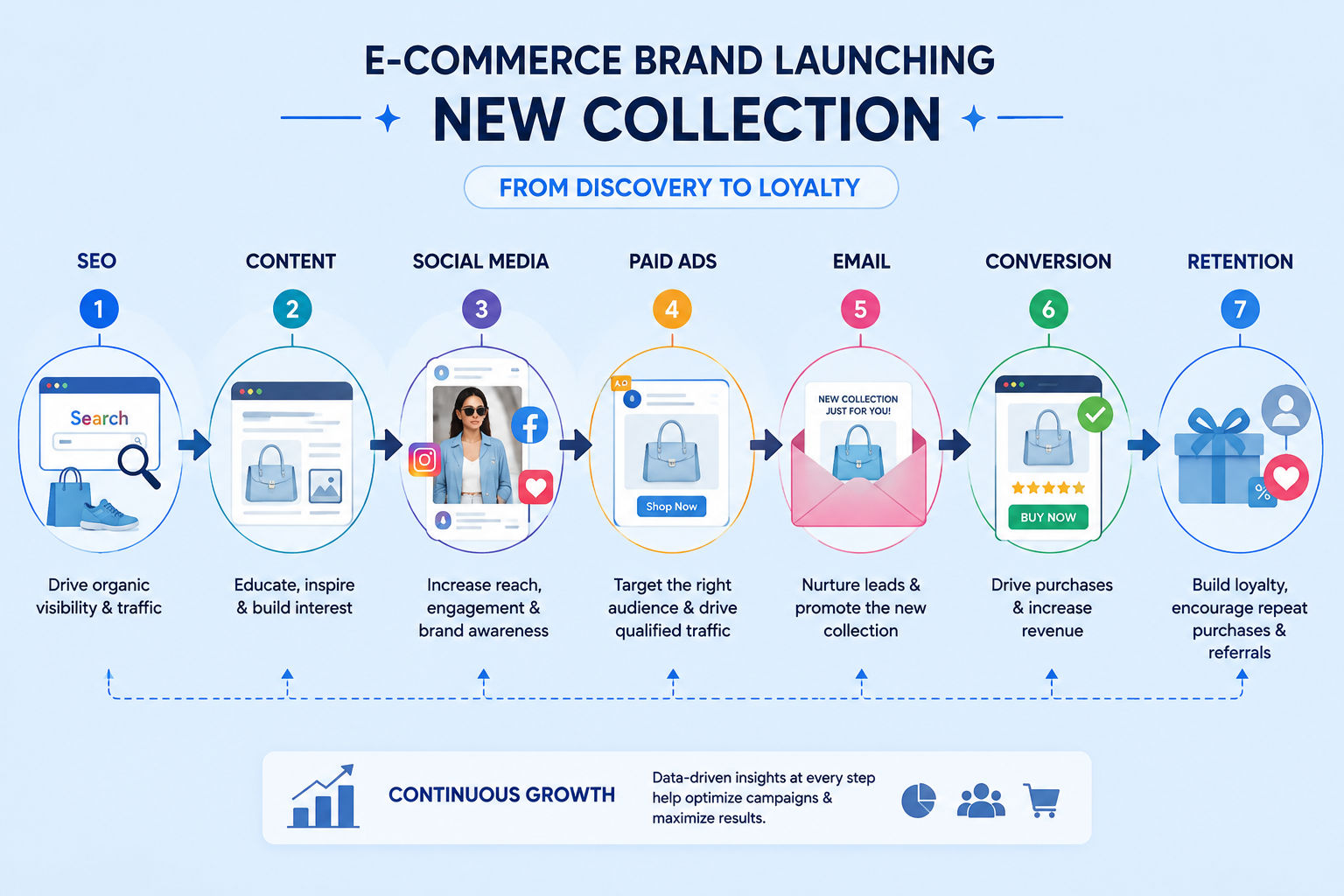
This connected approach allows different channels to support one another. Instead of treating SEO, content, social media, email, and advertising as completely separate activities, businesses can use them as parts of one customer journey.
The components of digital marketing help businesses reach, engage, convert, and retain customers online. SEO brings organic traffic, content informs audiences, social media builds engagement, paid ads attract potential buyers, and email helps maintain customer relationships.
The right mix depends on the audience, goals, industry, and budget. Understanding the key components of digital marketing helps businesses create focused campaigns and get more from their online presence.
Ready to start your journey? Book a free consultation with upGrad today to find the best path for your career
The seven broad components of marketing can be viewed as product, price, place, promotion, people, process, and physical evidence. These elements help businesses plan how an offering is created, positioned, delivered, promoted, and experienced by customers across different markets and touchpoints.
The 7 C's are commonly explained as customer, content, context, community, convenience, conversion, and credibility. Together, they provide a customer-focused way to think about online marketing, from understanding audience needs and creating useful content to building trust and encouraging action.
The seven key elements can be organised around audience, goals, strategy, channels, content, data, and optimisation. These elements help marketers move beyond simply using online platforms and instead build campaigns that have a clear purpose, reach the right people, and improve through performance insights.
A marketing plan generally includes an executive summary, situation analysis, target market, marketing objectives, strategy, budget, and measurement or control. These sections give businesses a structured way to understand their market, decide what they want to achieve, allocate resources, and track progress.
Start by identifying the ideal customer, business objective, competitors, and available budget. Next, select suitable online channels and define the content, offers, and campaigns to use. Set measurable targets from the beginning, then review performance regularly and adjust the strategy based on customer response.
A beginner should first understand customers, marketing objectives, basic SEO, content, social media, paid advertising, email, and analytics. It is better to learn how these areas connect than memorise individual tools. Practical projects, campaign analysis, and small experiments can make the concepts easier to understand.
The right channel depends on where your audience spends time, what they search for, how they make decisions, and what your business wants to achieve. Study customer behaviour and competitors first. Then test promising channels with clear goals instead of investing heavily based only on popularity.
Customer experience affects how people interact with a brand before, during, and after a purchase. Slow websites, confusing navigation, irrelevant messages, or difficult checkout processes can weaken otherwise strong campaigns. A smooth digital experience can make it easier for visitors to trust the brand and take action.
Gen Z refers to the generation that follows Millennials and has grown up with smartphones, social platforms, and digital-first communication. For marketers, reaching this audience often means creating authentic, mobile-friendly, visual, and community-oriented experiences rather than relying only on traditional promotional messages.
There is no single universally accepted list of 12 types, because classifications differ between marketers. Commonly identified areas include SEO, content, social media, SEM, email, affiliate, influencer, mobile, video, display advertising, native advertising, and marketing automation. The exact grouping depends on the framework being used.
AI is making digital marketing more data-driven and personalised by helping marketers analyse customer behaviour, generate ideas, automate repetitive tasks, improve targeting, and tailor experiences. However, marketers still need human oversight to check accuracy, maintain brand consistency, understand context, and make strategic decisions.
725 articles published
Sriram K is a Senior SEO Executive with a B.Tech in Information Technology from Dr. M.G.R. Educational and Research Institute, Chennai. With over a decade of experience in digital marketing, he specia...
Get Free Consultation
By submitting, I accept the T&C and
Privacy Policy
Level Up Your Digital Marketing Career Today!
Top Resources
MICA
Advanced Certificate in AI-Powered Digital Marketing & Communication from MICAMICA Executive Alumni Status
Certification
5 Specialisation
Classroom
4 Months
Certification
2 Months