Top 10 Artificial Intelligence Thesis Ideas for Students in 2026
By Sriram
Updated on Jun 25, 2026 | 7 min read | 4.55K+ views
Share:

All courses
Certifications
More
By Sriram
Updated on Jun 25, 2026 | 7 min read | 4.55K+ views
Share:
Table of Contents
Artificial intelligence continues to reshape industries, research, and innovation worldwide. As AI technologies evolve rapidly, students and researchers are exploring new ways to contribute to this dynamic field. Choosing the right artificial intelligence thesis can help students develop valuable technical expertise while addressing real-world challenges. From machine learning and natural language processing to autonomous systems and generative AI, there are countless opportunities for impactful research.
In this blog, we'll explore top thesis ideas, explain how to select a suitable topic, examine emerging research areas, and discuss future directions in AI.
Ready to build a standout AI thesis? Explore upGrad’s AI course and strengthen your research expertise.
Popular upGrad Programs
Selecting the right artificial intelligence thesis topic can shape the quality, relevance, and impact of your research. These ideas explore emerging AI applications and current industry challenges.
Here are ten promising ideas:
Develop models that provide understandable explanations for AI-generated predictions, particularly in healthcare, finance, and legal applications.
Research how machine learning algorithms can improve disease detection through medical imaging and patient data analysis.
Investigate the effectiveness of generative models in creating text, images, videos, and personalized content.
Study advanced computer vision and reinforcement learning techniques that enhance self-driving vehicle performance.
Explore intelligent systems capable of identifying malware, phishing attacks, and network intrusions in real time.
Research language models that improve translation accuracy and multilingual conversational systems.
Develop AI-driven solutions for crop monitoring, disease detection, and yield prediction.
Analyze sensor data to predict equipment failures before they occur, reducing operational costs.
Create adaptive learning systems that customize educational content based on student performance.
Build intelligent systems capable of detecting suspicious financial transactions and preventing fraud.
Do Read : Artificial Intelligence Applications
Free Courses
An artificial intelligence thesis is an academic research project that investigates a specific AI-related problem, technology, or application. It typically involves identifying a research gap, reviewing existing literature, designing experiments, analyzing data, and presenting findings.
The purpose of a thesis is not only to demonstrate technical knowledge but also to contribute original insights to the field. Common areas of research include:
A strong thesis combines theoretical understanding with practical implementation and measurable results.
Read : The Future Scope of Artificial Intelligence in 2026 and Beyond
Recommended Courses to upskill
Explore Our Popular Courses for Career Progression
IIIT Bangalore
Executive Diploma in Machine Learning and AI360° Career Support
O.P.Jindal Global University
MBA from O.P.Jindal Global UniversityLive Case Studies and Projects
Writing a strong artificial intelligence thesis requires a clear structure that demonstrates technical knowledge, research skills, and practical application. While the exact format may vary by university, most AI thesis projects include the following essential components:
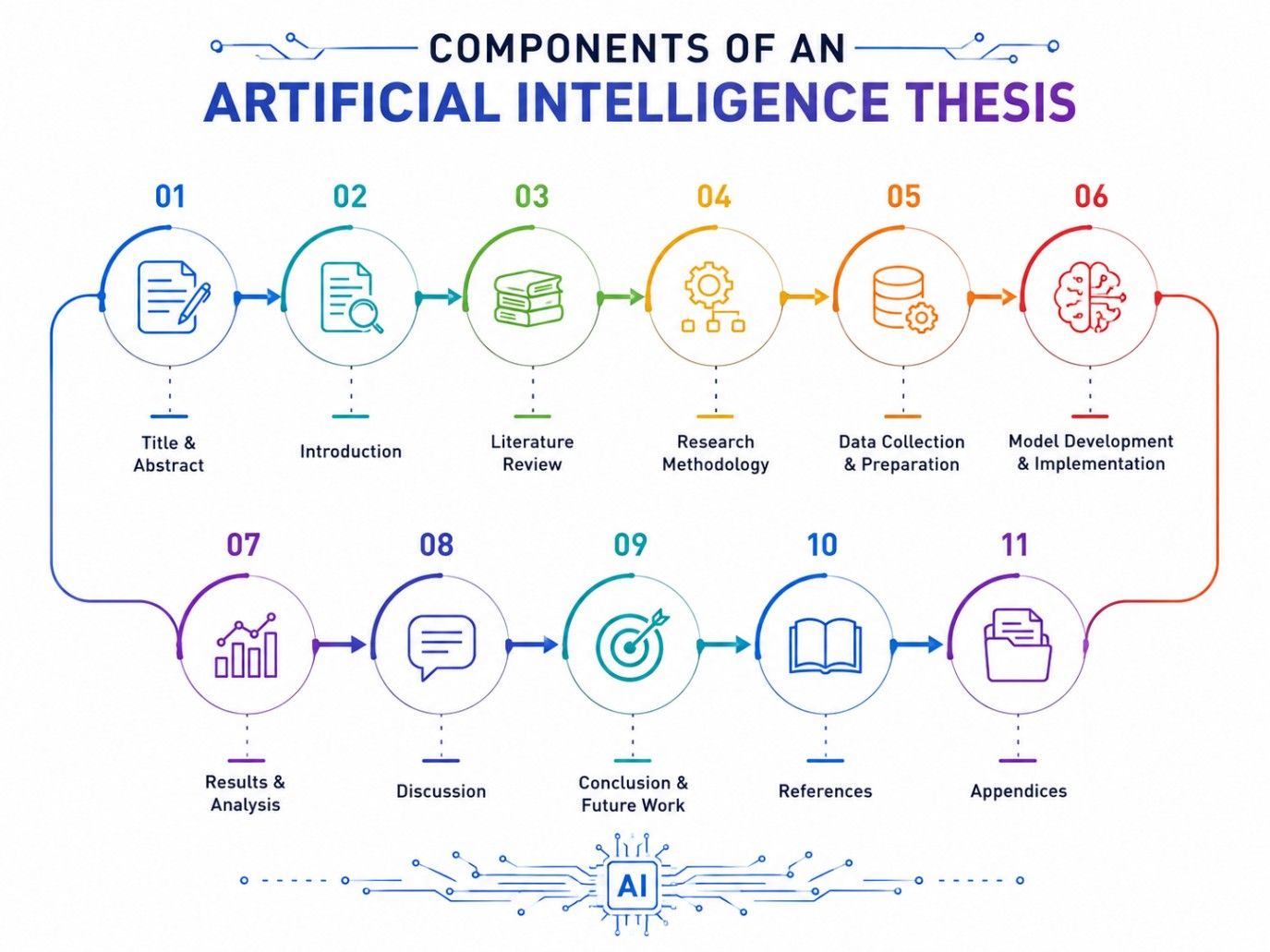
Selecting an effective thesis topic requires careful planning and evaluation.
Identify Your Area of Interest
Choose a domain that genuinely interests you, such as healthcare AI, autonomous systems, cybersecurity, or language processing.
Review Existing Research
Analyze recent academic papers and industry reports to identify gaps that require further investigation.
Evaluate Data Availability
Ensure that relevant datasets are accessible for experimentation and model training.
Consider Technical Feasibility
Your topic should match your available resources, computing power, and project timeline.
Focus on Real-World Impact
The most successful artificial intelligence thesis topics often solve practical problems faced by industries, businesses, or society.
Read : Top Artificial Intelligence Project Ideas & Topics for Beginners
The AI landscape changes rapidly, creating new research opportunities every year. Students looking for innovative topics can explore the following areas.
Latest AI Thesis Idea |
Research Focus |
| Large Language Models (LLMs) | Research model optimization, fine-tuning techniques, bias reduction, and enterprise deployment challenges. |
| AI Agents and Autonomous Systems | Investigate intelligent agents capable of planning, reasoning, decision-making, and completing complex tasks independently. |
| Multimodal Artificial Intelligence | Study AI systems that process and integrate text, images, audio, and video data simultaneously. |
| Retrieval-Augmented Generation (RAG) | Explore methods for enhancing AI responses through external knowledge retrieval and contextual reasoning. |
| Synthetic Data Generation | Research how artificially generated datasets can improve model performance while maintaining privacy and reducing data limitations. |
| AI for Climate Sustainability | Develop AI models for environmental monitoring, energy optimization, carbon reduction, and climate risk prediction. |
These emerging areas provide excellent opportunities for an innovative artificial intelligence thesis that aligns with current industry demand.
Also Read: How to Learn Artificial Intelligence and Machine Learning
Artificial intelligence is rapidly evolving, creating new opportunities for innovative research.
These emerging trends can help students choose impactful artificial intelligence thesis topics with strong future relevance.
Explainable AI (XAI) - Focuses on making AI decisions more transparent and understandable.
Responsible and Ethical AI - Addresses fairness, accountability, privacy, and bias in AI systems.
Human-AI Collaboration - Explores how humans and AI can work together more effectively.
Edge AI- Enables real-time AI processing on devices while improving privacy and efficiency.
Quantum AI - Combines quantum computing and AI to solve complex problems faster.
Autonomous AI Agents - Develops intelligent systems capable of independent decision-making and task execution.
These trends are shaping the future of AI research and provide promising directions for an artificial intelligence thesis.
An artificial intelligence thesis helps students develop in-demand AI and analytical skills, leading to rewarding careers across technology-driven industries.
AI Research Scientist : Develop innovative AI algorithms and contribute to cutting-edge research advancements.
Machine Learning Engineer: Build and deploy machine learning models for real-world applications and automation.
Data Scientist: Analyze complex datasets to generate insights and support data-driven decision-making.
AI Consultant and Product Specialist: Guide to organizations in implementing AI solutions and managing AI-powered products.
Do Read: Career Opportunities in Artificial Intelligence
Choosing the right artificial intelligence thesis is one of the most important steps in an AI research journey. Whether you focus on explainable AI, generative models, cybersecurity, healthcare, or autonomous systems, selecting a topic with practical relevance and research potential can significantly improve the value of your work. By understanding current trends, exploring innovative ideas, and aligning research with future industry needs, students can develop a thesis that contributes meaningfully to the rapidly evolving field of artificial intelligence.
Ready to start your journey? Book a free consultation with upGrad today to find the best path for your career.
Start by identifying a real-world problem that AI can help solve. Look at industries such as healthcare, finance, education, cybersecurity, or logistics. A strong artificial intelligence thesis topic should balance academic depth with practical application. Before finalizing your topic, check whether quality datasets, research papers, and evaluation methods are readily available to support your work.
Several AI tools can support thesis research, but each serves a different purpose. Tools like ChatGPT can help with brainstorming, literature summaries, and outlining ideas. Research-focused platforms such as Semantic Scholar and Google Scholar are better for finding academic sources. The best approach is to use AI as a research assistant while relying on peer-reviewed studies and original analysis for your thesis.
Yes. Many successful artificial intelligence thesis projects use publicly available datasets from sources such as Kaggle, UCI Machine Learning Repository, and government open-data platforms. What matters most is how you analyze the data, apply AI techniques, and generate meaningful insights. A unique research angle can make even a widely used dataset valuable.
The best topic depends on your interests, technical skills, and career goals. Areas gaining attention include explainable AI, generative AI, AI ethics, healthcare diagnostics, cybersecurity automation, autonomous systems, and AI-powered education tools. Choose a topic that solves a clear problem and allows you to demonstrate both research and implementation skills.
Industry relevance can significantly improve the impact of your research. Employers often value projects that address current business challenges or emerging technologies. If your artificial intelligence thesis topic aligns with market trends, it may strengthen your portfolio, support job applications, and create opportunities for internships or industry collaborations.
A good thesis statement clearly defines the problem, proposed solution, and expected outcome. For example, a thesis statement might focus on improving medical image classification accuracy using deep learning models or enhancing customer support efficiency through AI-driven chatbots. The statement should be specific, measurable, and aligned with your research objectives.
The coding requirements vary by topic. Some projects involve building machine learning models, neural networks, or AI applications from scratch. Others focus more on analysis and optimization using existing frameworks. Most AI theses require a working understanding of programming languages such as Python and familiarity with libraries like TensorFlow, PyTorch, or Scikit-learn.
A topic is usually too broad if it covers multiple complex problems without a clear research focus. For example, "Artificial Intelligence in Healthcare" is broad, while "Using Deep Learning to Detect Diabetic Retinopathy from Retinal Images" is more manageable. Narrowing the scope helps improve research quality and keeps the project achievable within academic timelines.
AI can assist with brainstorming, organizing chapters, generating outlines, summarizing research papers, and improving readability. However, the research design, analysis, interpretation, and final conclusions should come from you. Universities increasingly use plagiarism and AI-detection tools, so it is important to use AI for support rather than replacing original research and critical thinking.
Yes. Combining AI with another field often creates unique research opportunities. Examples include AI in healthcare, agriculture, climate science, law, education, and finance. Interdisciplinary projects can help you explore practical challenges while demonstrating your ability to apply artificial intelligence concepts across different domains and industries.
Common mistakes include choosing overly ambitious topics, ignoring data quality issues, relying too heavily on model accuracy as the only metric, and neglecting literature review research. Another frequent problem is starting implementation before clearly defining objectives. A successful artificial intelligence thesis requires a balance between technical execution, research rigor, and practical problem-solving.
730 articles published
Sriram K is a Senior SEO Executive with a B.Tech in Information Technology from Dr. M.G.R. Educational and Research Institute, Chennai. With over a decade of experience in digital marketing, he specia...
Get Free Consultation
By submitting, I accept the T&C and
Privacy Policy
Top Resources
Certification
3 Months
Certification
6 Months
O.P. Jindal Global University
Masters in International Accounting and Finance (Accredited by ACCA, UK)Master's Degree
12 Months