Top 10 Machine Learning Thesis Ideas for Students in 2026
By Sriram
Updated on Jun 25, 2026 | 5 min read | 7.42K+ views
Share:

All courses
Certifications
More
By Sriram
Updated on Jun 25, 2026 | 5 min read | 7.42K+ views
Share:
Table of Contents
A successful Machine Learning thesis begins with selecting a relevant research problem and developing a clear methodology to address it. Students must combine theoretical concepts with practical implementation, use reliable datasets, and evaluate model performance using appropriate metrics. Whether pursuing undergraduate, postgraduate, or doctoral research, a well-structured thesis demonstrates technical expertise, critical thinking, and real-world problem-solving abilities.
In this blog, we'll explore top thesis ideas, discuss how to select the right topic, examine emerging research areas, and highlight future trends shaping machine learning research.
Ready to build a standout Machine Learning thesis? Explore upGrad's Machine Learning courses and strengthen your research expertise.
Popular upGrad Programs
Selecting the right topic can significantly influence the quality and impact of your research. The following thesis topics in machine learning reflect current industry needs and emerging technological developments.
Research techniques that make machine learning predictions easier to understand and interpret, especially in healthcare, banking, and insurance applications.
Develop models that predict diseases, patient risks, or treatment outcomes using electronic health records and medical datasets.
Create intelligent systems capable of identifying suspicious financial activities and reducing fraudulent transactions in real time.
Study personalized recommendation algorithms that improve customer engagement and product discovery.
Build models that detect cyber threats, phishing attacks, malware, and abnormal network behavior before significant damage occurs.
Analyze customer opinions, reviews, and social media conversations using natural language processing and machine learning techniques.
Develop machine learning models that predict crop yield, detect plant diseases, and optimize irrigation systems.
Use sensor data and machine learning algorithms to predict equipment failures and reduce downtime.
Research methods that help businesses identify customers likely to leave and develop retention strategies.
Build predictive models that improve energy efficiency and support sustainable resource management.
Also Read: Machine Learning Tutorial: Basics, Algorithms, and Examples Explained
Free Courses
A Machine Learning thesis is an academic research project that focuses on solving a specific problem using machine learning techniques, algorithms, and data-driven approaches. It involves identifying a research question, reviewing existing studies, conducting experiments, evaluating results, and presenting findings.
Common research areas include:
A successful Machine Learning thesis combines strong research methodology with measurable outcomes and practical relevance.
Recommended Courses to upskill
Explore Our Popular Courses for Career Progression
IIIT Bangalore
Executive Diploma in Machine Learning and AI360° Career Support
O.P.Jindal Global University
MBA from O.P.Jindal Global UniversityLive Case Studies and Projects
Writing an effective thesis requires a structured approach. Most universities expect students to include the following sections:
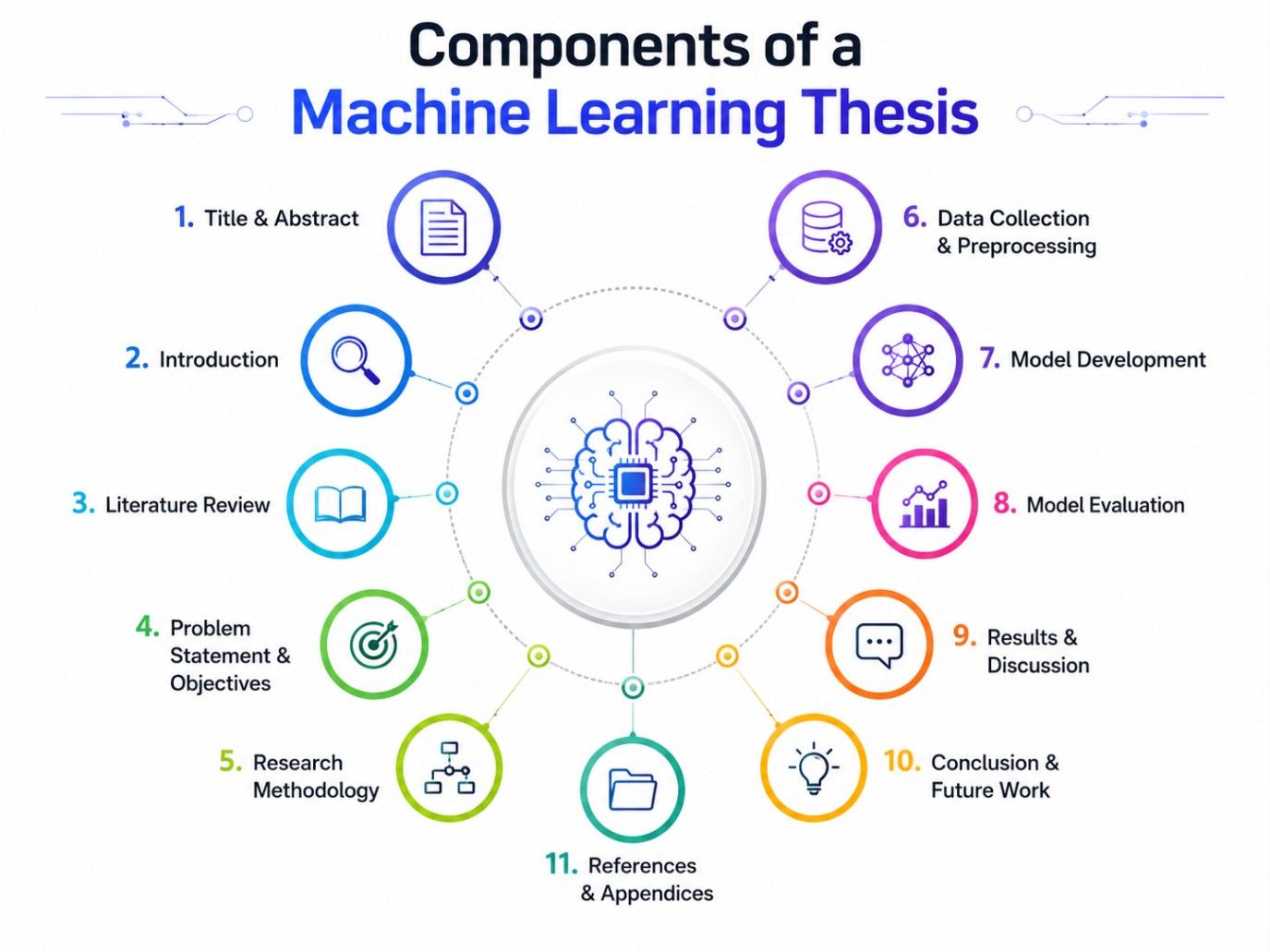
Each section plays an important role in demonstrating research quality and technical understanding.
Also Read: 12 Issues in Machine Learning: Key Problems in Training, Testing, and Deployment
Choosing the right topic requires balancing personal interests with practical considerations.
1. Identify Your Interest Area
Focus on industries or domains that genuinely interest you, such as healthcare, finance, education, retail, or cybersecurity.
2. Review Existing Research
Study recent journals, conference papers, and industry publications to identify research gaps.
3. Assess Data Availability
Quality data is essential for machine learning research. Verify that relevant datasets are accessible before selecting a topic.
4. Evaluate Technical Requirements
Consider the computing resources, tools, and time needed to complete your project successfully.
5. Focus on Real-World Problems
The best thesis topics in machine learning often solve practical challenges faced by businesses, governments, or consumers.
Also Read: 30+ Artificial Intelligence Project Ideas With Source Code in 2026
Machine learning continues to evolve rapidly. Students looking for innovative thesis topics in machine learning can explore the following emerging areas.
Latest Machine Learning Thesis Topic |
Research Focus |
| Large Language Models | Fine-tuning, optimization, and responsible deployment of advanced language models |
| Federated Learning | Privacy-preserving machine learning across distributed devices |
| Multimodal Learning | Combining text, images, audio, and video within a single learning framework |
| Synthetic Data Generation | Creating artificial datasets to improve model training and privacy |
| Edge Machine Learning | Running machine learning models directly on devices with minimal latency |
| Sustainable Machine Learning | Reducing computational costs and environmental impact of model training |
These topics provide opportunities to develop a future-ready Machine Learning thesis aligned with industry trends.
Also Read: Deep Learning: Dive into the World of Machine Learning!
Machine learning research is moving beyond traditional prediction models toward more intelligent and efficient systems.
Explainable Machine Learning
Researchers are developing methods that improve transparency and trust in machine learning predictions.
Privacy-Preserving Learning
Techniques such as federated learning help organizations use data while protecting user privacy.
Human-Centered Machine Learning
Focuses on creating systems that work effectively alongside human decision-makers.
Edge Intelligence
Enables real-time processing directly on devices without relying heavily on cloud infrastructure.
Automated Machine Learning (AutoML)
Simplifies model development by automating algorithm selection, feature engineering, and optimization.
Responsible Machine Learning
These trends are shaping the future of machine learning research and creating exciting opportunities for students.
A Machine Learning thesis helps students develop analytical, programming, and problem-solving skills that are highly valued across industries.
Machine Learning Engineer-Design, build, and deploy machine learning systems for business applications.
Data Scientist -Analyze complex datasets and generate insights that support strategic decisions.
AI Research Scientist-Develop advanced algorithms and contribute to cutting-edge machine learning research.
Business Intelligence Analyst-Use predictive models and data analysis to improve organizational performance.
Machine Learning Consultant-Help organizations implement and optimize machine learning solutions.
Choosing the right Machine Learning thesis can significantly influence your academic success and career growth. Whether you focus on healthcare analytics, cybersecurity, recommendation systems, predictive maintenance, or emerging technologies such as federated learning, selecting a topic with practical relevance and strong research potential can create meaningful impact.
By exploring current trends, identifying real-world problems, and building strong technical expertise, students can develop research that contributes to the growing field of machine learning.
Want personalized guidance on AI and upskilling? Speak with an expert for a free 1:1 counselling session today
A strong Machine Learning thesis topic solves a real problem and offers room for experimentation. Start by exploring industries such as healthcare, finance, cybersecurity, or education. Review recent research papers and identify gaps where machine learning can provide better predictions, automation, or decision-making. A focused topic is usually more valuable than a broad one.
The best dataset depends on your research objective. Platforms such as Kaggle, UCI Machine Learning Repository, Google Dataset Search, and government open-data portals offer quality datasets. Before selecting a dataset, check its size, quality, completeness, and relevance to your research question to ensure meaningful results.
Yes. Many successful thesis projects improve existing models, compare multiple algorithms, optimize performance, or apply machine learning to new use cases. Originality often comes from the research problem, methodology, evaluation process, or practical application rather than inventing an entirely new algorithm.
Python remains the most widely used language because of its extensive ecosystem. Libraries such as Scikit-learn, TensorFlow, PyTorch, and XGBoost simplify model development and evaluation. Many students choose Python for their Machine Learning thesis because it offers strong community support and abundant learning resources
Model evaluation is critical because accuracy alone does not tell the complete story. Metrics such as precision, recall, F1-score, ROC-AUC, and mean squared error help measure performance from different perspectives. Proper evaluation allows you to compare models fairly and justify your research conclusions.
Current thesis topics in machine learning include large language models, federated learning, AI agents, predictive healthcare, cybersecurity analytics, recommendation systems, synthetic data generation, and sustainable machine learning. These areas continue to attract attention because they address practical business and research challenges.
You do not need expert-level programming skills to begin. However, you should understand data handling, model training, and basic programming concepts. Building small machine learning projects before starting your Machine Learning thesis can help you gain confidence and avoid technical roadblocks later.
Both approaches can be valuable. Industry-focused projects often solve practical business problems and improve employability. Research-focused topics may contribute new insights to the academic community. The right choice depends on your career goals, interests, available resources, and the scope of your program.
Start by reviewing recent journal articles, conference papers, and technical reports. Look for limitations, unanswered questions, or areas where results remain inconsistent. Many thesis topics in machine learning emerge from improving existing methods, applying models to new datasets, or addressing performance challenges in specific industries.
Yes. A well-executed Machine Learning thesis demonstrates technical knowledge, analytical thinking, and problem-solving ability. Employers often value projects that involve real datasets, measurable outcomes, and practical applications. Your thesis can become a strong portfolio piece during interviews for machine learning and data science roles.
Common mistakes include selecting overly broad topics, using poor-quality data, skipping thorough literature reviews, and focusing only on model accuracy. Many students also underestimate data preparation time. A successful Machine Learning thesis requires clear objectives, careful planning, strong evaluation methods, and realistic project expectations.
730 articles published
Sriram K is a Senior SEO Executive with a B.Tech in Information Technology from Dr. M.G.R. Educational and Research Institute, Chennai. With over a decade of experience in digital marketing, he specia...
Get Free Consultation
By submitting, I accept the T&C and
Privacy Policy
Top Resources
Certification
3 Months
Certification
6 Months
O.P. Jindal Global University
Masters in International Accounting and Finance (Accredited by ACCA, UK)Master's Degree
12 Months