AI Space Exploration: How AI Is Transforming the Future of Space Missions
By Sriram
Updated on Jun 17, 2026 | 7 min read | 2.47K+ views
Share:

All courses
Certifications
More
By Sriram
Updated on Jun 17, 2026 | 7 min read | 2.47K+ views
Share:
Table of Contents
AI space exploration is changing how humans explore the universe. Artificial intelligence is used for autonomous Mars rovers to intelligent satellites and advanced astronomical discoveries; artificial intelligence is helping scientists solve problems that were once hard for humans to figure out. As space missions become more complex and travel farther from Earth, AI is becoming a critical tool for navigation, decision-making, and scientific research.
In this blog, you’ll learn about AI space exploration, how it works, where people are using it now, benefits, challenges, and what we might see in the future. If you are a student or technology enthusiast, or space lover, this article will help you understand how AI and space exploration are working together in a most exciting way.
Curious how AI is powering space exploration from autonomous rovers to satellite data analysis? Explore upGrad's Artificial Intelligence Courses and learn the skills shaping the next era of space tech.
Popular AI Programs
AI space exploration uses artificial intelligence technologies in space missions, spacecraft operations, astronomy, satellite systems, and planetary exploration. Instead of relying entirely on human instructions, AI systems can look at data, make choices, and find patterns. They can also react to changes on their own.
This capability is really important because there are communication delays in space. It can range for minutes or even hours. It depends on the distance of the spacecraft from Earth.
AI is good at helping spacecraft and robotic systems operate independently. This is how AI helps spacecraft and robotic systems overcome the limitations that normally hold them back.
Space exploration creates unique challenges:
Example
Imagine a Mars rover while driving on Mars encounters an unexpected obstacle. The Mars rover might not be able to move if it needs instructions from humans, on Earth. But if the Mars rover has AI technology, it can analyze the terrain and choose a safe route right away. The Mars rover can do this because the AI helps the Mars rover make decisions.
Read: The History of AI: A Chronology of Key Innovations and Milestones in Artificial Intelligence
Free Courses
According to NASA, artificial intelligence is already being used across mission planning, Earth observation, planetary science, autonomous navigation, and scientific discovery. Recent demonstrations have even enabled AI models to run directly in orbit rather than relying entirely on Earth-based processing.
AI Technology |
Purpose in Space |
| Machine Learning | Pattern recognition and predictions |
| Computer Vision | Image and terrain analysis |
| Natural Language Processing | Data interpretation and communication |
| Robotics AI | Autonomous movement and actions |
| Generative AI | Mission planning and route optimization |
| Predictive Analytics | Equipment health monitoring |
Also Read: What Is Robotics? Definition, Uses, and Career Scope
Human teams cannot manually analyze every image and signal. Whereas telescopes, satellites, and space probes continue to collect data and are increasing rapidly. AI acts as a force multiplier. It helps scientists focus on discoveries instead of spending thousands of hours processing raw data.
As missions travel deeper into the solar system, AI space exploration will become less of an advantage and more of a necessity.
Also Read: Applications of Artificial Intelligence and Its Impact
AI Courses to upskill
Explore Artificial Intelligence Courses for Career Progression
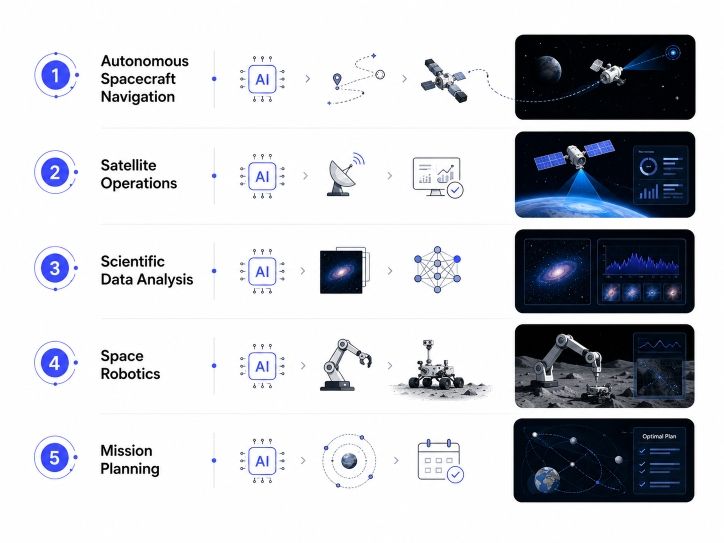
AI is already playing an active role in some of the world's most advanced space programs.
One of the important uses of AI in space exploration is that it helps autonomous navigation. Spacecraft has to work in places where it's not possible for humans to control them at that exact moment.
So, they need to be able to navigate by themselves, which is why autonomous navigation of spacecraft is very important for space exploration and, for spacecraft.
One major example is that when the NASA Perseverance rover completed drives on Mars that were AI-planned. This meant the NASA Perseverance rover could make routes without people having to plan the route.
AI systems can:
Related Article: Applied Computer Vision: Core Techniques & Applications
Modern satellites use AI to make them work better and cut down the money they cost to run. AI helps the modern satellites do their job.
Recent advances have enabled satellites to identify objects of interest directly in orbit using onboard AI models.
AI-powered satellites can:
Space missions generate enormous amounts of information.
In astronomy, machine learning models are really important for looking at sky surveys. They help find objects in space that we might not see otherwise. These models are super helpful for spotting things like stars, planets, and galaxies.
AI helps process:
Also Read: What is Data Analytics: Definition, Types, Applications & Challenges
Robots that use AI can perform tasks with very minimal help from people.
Examples include:
Also Read: Applications of Robotics: Industrial & Everyday Use Cases
AI helps researchers optimize:
Read: Why AI Is The Future & How It Will Change The Future?
We notice a change in the current space industry, with AI being used increasingly in launching systems, spacecraft, ground infrastructure and mission operations. This is one of the significant technological shifts in the space industry. AI is really changing how things operate in the space industry.
Application |
AI Function |
| Mars Rovers | Navigation and obstacle avoidance |
| Satellites | Data processing and monitoring |
| Telescopes | Object detection and classification |
| Space Stations | Resource management |
| Deep Space Missions | Autonomous decision-making |
| Robotics | Exploration and sample collection |
AI has given us tremendous benefits in the space industry.
1. Faster Decision-Making: AI systems can analyze situations and respond much faster than waiting for instructions from Earth.
2. Improved Mission Efficiency: Autonomous systems reduce operational delays and allow missions to accomplish more with limited resources.
3. Better Scientific Discoveries: AI excels at finding hidden patterns in large datasets.
For example, machine learning researchers identify candidates and other objects, in space that they might have missed before.
4. Lower Operational Costs: Automated systems reduce the need for continuous human oversight.
5. Enhanced Safety: AI can detect potential failures before they become mission-threatening issues.
AI also introduces new technical and ethical challenges.
1. Reliability Issues: Space is unpredictable. AI models must function accurately under extreme conditions.
2. Limited Computing Resources: Spacecraft has strict power and hardware limitations.
3. Data Quality Problems: AI systems are only as good as the data used to train them.
4. Ethical Concerns: Questions remain about:
5. Cybersecurity Risks: As spacecraft becomes more software-driven, protecting systems from cyber threats becomes increasingly important.
Benefits |
Challenges |
| Faster decisions | Reliability concerns |
| Greater autonomy | Limited onboard computing |
| Improved discoveries | Data quality issues |
| Lower costs | Cybersecurity risks |
| Better mission efficiency | Ethical considerations |
Subscribe to upGrad's Newsletter
Join thousands of learners who receive useful tips
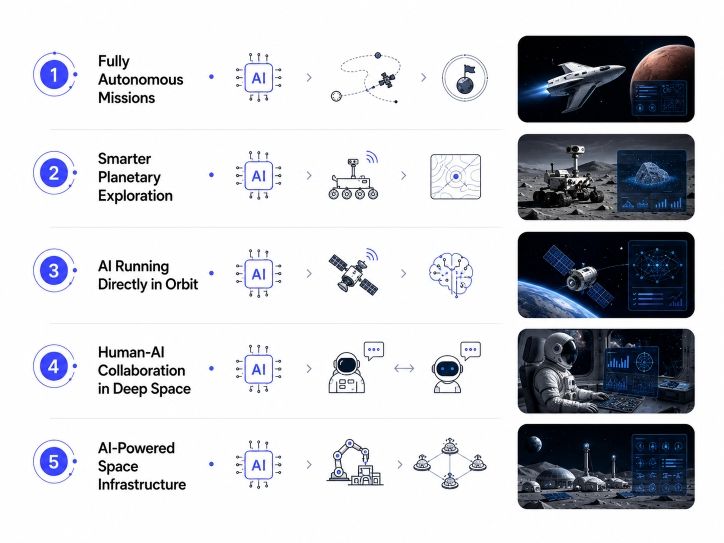
AI is expected to become increasingly integrated into every stage of mission planning and execution. The next 10 years will redefine how humanity explores the realm of space.
Future spacecraft may operate for years without significant intervention from Earth.
Potential capabilities include:
Trips to Mars, Europa, Titan, and other places in the future may heavily rely on robots that are powered by AI.
These systems could:
A major milestone occurred when NASA's Prithvi geospatial foundation model became the first AI foundation model deployed in orbit. This development opens the door to more advanced onboard intelligence for future spacecraft.
Long-duration missions will likely depend on AI assistants.
Possible applications include:
An emerging trend involves building AI computing capabilities directly in space. Several companies are exploring orbital data centers and AI-powered satellite networks to support future space operations.
Many analysts expect strong growth in the AI-driven space sector over the coming decade as governments and private companies invest heavily in autonomous technologies.
The long-term vision is simple: AI will help humanity explore farther, faster, and more efficiently than ever before.
Future Area |
Expected Impact |
| Deep Space Missions | Greater autonomy |
| Space Habitats | Intelligent life-support systems |
| Planetary Colonization | Resource management |
| Space Manufacturing | Automated production |
| Astronomy | Faster discoveries |
| Orbital Infrastructure | Space-based computing |
AI space exploration is transforming the way humans explore the universe. From autonomous Mars rovers and intelligent satellites to advanced scientific discoveries and future deep-space missions, artificial intelligence is becoming a foundational technology for modern space programs. While challenges remain, the benefits are already visible in real-world missions and scientific breakthroughs.
As technology continues to evolve, AI space exploration will play a central role in humanity's journey beyond Earth. The future of space exploration will not be powered by rockets alone. It will also be powered by intelligent systems capable of learning, adapting, and discovering.
Want to explore more about AI space exploration? Book your free 1:1 personal consultation with our expert today.
AI helps space exploration by enabling spacecraft, satellites, and robots to make decisions without waiting for human instructions. It improves navigation, data analysis, mission planning, and equipment monitoring. This allows missions to operate more efficiently, especially in distant locations where communication delays are significant.
Yes. NASA uses AI across multiple missions and research programs. Applications include autonomous rover navigation, Earth observation, scientific data analysis, mission planning, and spacecraft operations. AI has become an important part of modern space exploration efforts.
AI can manage certain spacecraft functions autonomously, including navigation and hazard detection. However, most missions still involve human oversight. Current systems are designed to assist human operators rather than completely replace them.
Examples include machine learning systems, computer vision, autonomous robotics, predictive maintenance software, intelligent satellites, and AI-powered scientific analysis tools. These technologies help improve mission efficiency and scientific outcomes.
AI helps Mars rovers navigate terrain, avoid obstacles, analyze images, and prioritize scientific targets. This reduces dependence on constant instructions from Earth and enables more productive exploration activities.
Yes. AI can analyze large astronomical datasets to identify patterns that suggest the existence of exoplanets. Researchers have already used machine learning techniques to find planetary candidates hidden within telescope observations.
Key challenges include limited computing power, harsh environmental conditions, communication constraints, data quality issues, and ensuring reliable performance. Engineers must carefully design systems to handle these difficulties.
Future astronauts are expected to work closely with AI assistants. These systems could help with scheduling, equipment monitoring, health tracking, scientific analysis, and mission planning during long-duration space travel.
AI helps satellites process data more efficiently, detect important events, optimize communications, and reduce the need for constant ground control intervention. This improves both speed and operational effectiveness.
AI may become essential for planetary settlements. Intelligent systems could manage resources, support life-support infrastructure, monitor habitats, and assist with construction and maintenance activities in remote environments.
The future of AI space exploration includes autonomous missions, intelligent robotic explorers, AI-powered space stations, advanced astronomy tools, and space-based computing infrastructure. As AI capabilities improve, space missions are expected to become more independent and scientifically productive.
727 articles published
Sriram K is a Senior SEO Executive with a B.Tech in Information Technology from Dr. M.G.R. Educational and Research Institute, Chennai. With over a decade of experience in digital marketing, he specia...
Speak with AI & ML expert
By submitting, I accept the T&C and
Privacy Policy
Top Resources
Master's Degree
18 Months
Executive Diploma
12 Months
IIIT Bangalore
Executive Programme in Generative AI & Agentic AI for LeadersIndia’s #1 Tech University
Dual Certification
5 Months