Agent to Agent Protocol: Guide to AI Agent Communication
By Sriram
Updated on Jul 01, 2026 | 7 min read | 2.49K+ views
Share:

All courses
Certifications
More
By Sriram
Updated on Jul 01, 2026 | 7 min read | 2.49K+ views
Share:
Table of Contents
The Agent-to-Agent (A2A) protocol is an open standard that gives AI agents a common language as a way to find each other, talk to each other, and work together, even if they were built by different teams or run on completely different platforms. AI systems are getting better than single chatbots and helpers; they can share work details and finish jobs as a team. This change creates the importance of agent-to-agent protocol.
In this blog, you’ll learn what an agent-to-agent protocol is, why it matters, how it works behind the scenes, where it is used, and challenges organizations face while adopting it.
The future of AI is collaborative. Explore Agentic AI Courses Online and build smarter systems with upGrad now.
Agentic AI Courses to upskill
Explore Agentic AI Courses for Career Progression
IIIT Bangalore
EPGP in Applied AI and Agentic AIIIIT Bangalore
Executive Diploma in Machine Learning and AI360° Career Support
An agent to agent protocol provides the ability for two or more AI agents to share information and work together. They can assign tasks to each other. Make decisions together. The main goal of an agent-to-agent protocol is to help artificial intelligence agents work together toward a shared objective. Thus, they are very useful for AI agents.
Think of it like a common language between AI systems.
Imagine a customer ordering a laptop from a store. Instead of one AI program handling everything, several specialized AI programs or agents work together to help the customer buy the laptop. These agents are, like a team that works together to make sure the customer gets the laptop they want. The agents may come from different platforms or vendors, without proper communication they will not be able to understand each other, here, an agent-to-agent protocol is like a rule book that explains how messages are put together and how requests are and ultimately how agents get answers, from other agents.
Also Read: How to Build Your Own AI System: Step-by-Step Guide
Artificial intelligence applications are getting really good at things. Instead of making one massive AI model that does everything, companies usually use many different artificial intelligence agents.
Without a standardized communication, they can have problems such, as:
An agent to agent protocol solves these issues by creating consistent communication rules.
These core components allow communication to be predictable, reliable, and scalable.
Component |
Purpose |
| Message format | Defines how information is packaged and exchanged |
| Identity management | Helps agents recognize who is sending and receiving messages |
| Task coordination | Assigns responsibilities between agents |
| Security layer | Protects communication through authentication and encryption |
| Error handling | Helps agents recover from failed or incomplete requests |
Think about a travel website that uses AI to help people book trips.
A user asks: "Can you please book the flight for me and find a hotel that is close to the city center?"
This website will not have one AI doing all the work. Instead, it has different AI agents working together to get the job done.
AI Agent |
Responsibility |
| Search agent | Finds available flights |
| Pricing agent | Compares ticket prices |
| Hotel agent | Searches hotels |
| Payment agent | Processes payment |
| Notification agent | Sends booking confirmation |
Each agent exchanges structured messages using an agent-to-agent protocol, ensuring every step happens in the correct order without confusion.
These characteristics make agent protocols very important, for AI systems that use many agents. Agent protocols help modern multi-agent AI systems work well.
Most agent communication protocols are designed around a few important principles:
Also Read: Agentic AI Learning Path: A Complete Guide for Developers and AI Professionals
Aspect |
Model Context Protocol (MCP) |
Agent-to-Agent (A2A) Protocol |
| Primary purpose | Connect an AI model to tools, data sources, and services | Allow autonomous AI agents to communicate and collaborate |
| Interaction | Model ↔ Tool | Agent ↔ Agent |
| Standardized by | Anthropic | Google (with ecosystem contributors) |
| Focus | Tool invocation and context sharing | Multi-agent coordination |
| Communication style | Request/response with tools | Negotiation, delegation, messaging, task handoff |
| Typical users | AI assistants, IDEs, desktop apps | Multi-agent platforms and enterprise workflows |
Explore the future of autonomous AI systems with the Executive Programme in Generative AI & Agentic AI for Leaders and learn how Generative AI is reshaping decision-making and business operations.
An agent to agent protocol defines not only what AI agents say to each other but also when they communicate, how they validate information, and how they complete shared tasks.
At a high level, communication happens through structured messages rather than natural conversation.
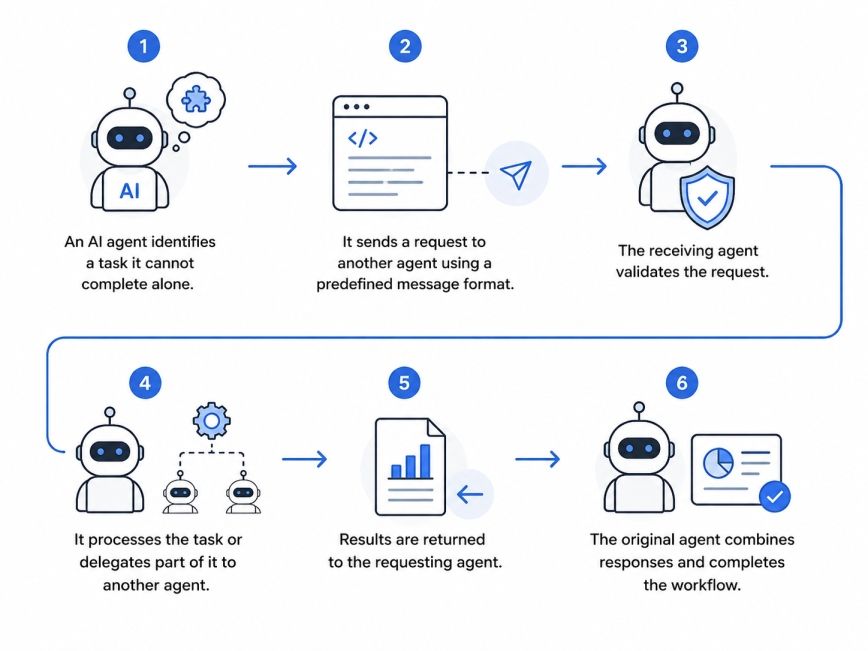
An agent to agent protocol is a set of rules. These rules are a direction on what AI agents can talk to each other about, when an agent should talk to each other. AI agents use messages to talk to, these messages are structured.
Most implementations follow a similar sequence.
This entire exchange happens in milliseconds.
The information is set up in a way so that agents can understand each other. This is true even if different teams developed the agents. The agents can still understand each other because the information follows predefined formats.
Agents typically exchange structured information such as:
Different applications require different communication styles.
Pattern |
Description |
Example |
| Request-response | One agent asks another for information | Flight search |
| Broadcast | One agent notifies several agents | Fraud alert |
| Event-driven | Agents react when an event occurs | Payment completed |
| Negotiation | Agents discuss possible solutions | Resource allocation |
| Collaboration | Multiple agents solve one problem together | Healthcare diagnosis |
Without standardized communication, each AI seller would have to make custom connections for every other system. This approach gets fast and is hard to keep up with.
A common agent to agent protocol offers several benefits:
Agent communication protocols provide the foundation that makes this collaboration possible.
Also Read: Agentic Workflows: A Guide to AI-Powered Autonomous Execution
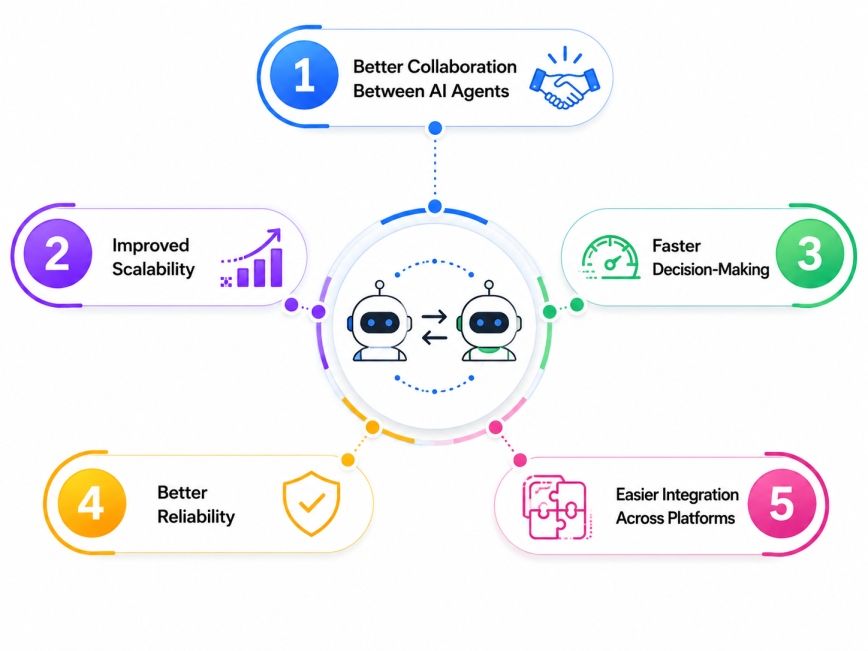
As AI systems become more capable, they are also becoming more specialized. One AI agent may be excellent at searching for documents, while another is better at analyzing data or generating reports. An agent-to-agent protocol lets these special agents work together. They do not have to work.
This way of working is really good. It makes things more efficient. It also reduces the amount of work that needs to be done. It makes AI-powered applications more reliable. Instead of using one big model to do every task, organizations can build groups of AI agents that talk to each other easily. In this way, AI agents can work together and make things better.
The biggest advantage of an agent to agent protocol is that it enables collaboration.
Each agent works on one job and shares what it does with other agents using simple messages. This way of dividing work helps get tasks done quicker and more accurately.
For example, in an insurance company:
As businesses grow artificial intelligence systems need to handle users, data and workflows. A good agent-, to-agent protocol makes it simple to add agents without rebuilding the whole system.
For example, an online store might start with three AI agents:
Later, it can introduce additional agents for:
Since all agents follow the rules, for communication, adding new features becomes much easier.
AI agents can handle lots of things at the time. They do not have to wait for one task to finish before starting another. Let's think about a company that delivers packages every day. They have thousands of deliveries to manage.
Different agents can work in parallel to:
The combined results help businesses make faster and smarter decisions.
When we are talking about distributed AI systems, things are going to go wrong sometimes. A server might just stop working, or an agent might not give us all the information we need.
An agent-to-agent protocol helps manage these situations by defining how agents should:
Companies usually get Artificial Intelligence tools from different companies. The problem is that these systems do not talk to each other in the language. So, when we want to connect these systems, we must create connections that are very costly to make and to keep working.
If we have a way for these Artificial Intelligence systems to talk to each other than different Artificial Intelligence platforms can share information more easily. This means we do not have to work hard to make them talk to each other, and Artificial Intelligence platforms work better together.
Benefit |
How It Helps |
| Collaboration | Multiple AI agents work together efficiently |
| Scalability | New agents can be added without major redesign |
| Speed | Parallel processing reduces response times |
| Reliability | Better handling of failures and retries |
| Interoperability | Supports communication across different AI platforms |
| Maintainability | Simplifies updates and long-term system management |
Explore the article: How to Learn Artificial Intelligence: A Step-by-Step Roadmap
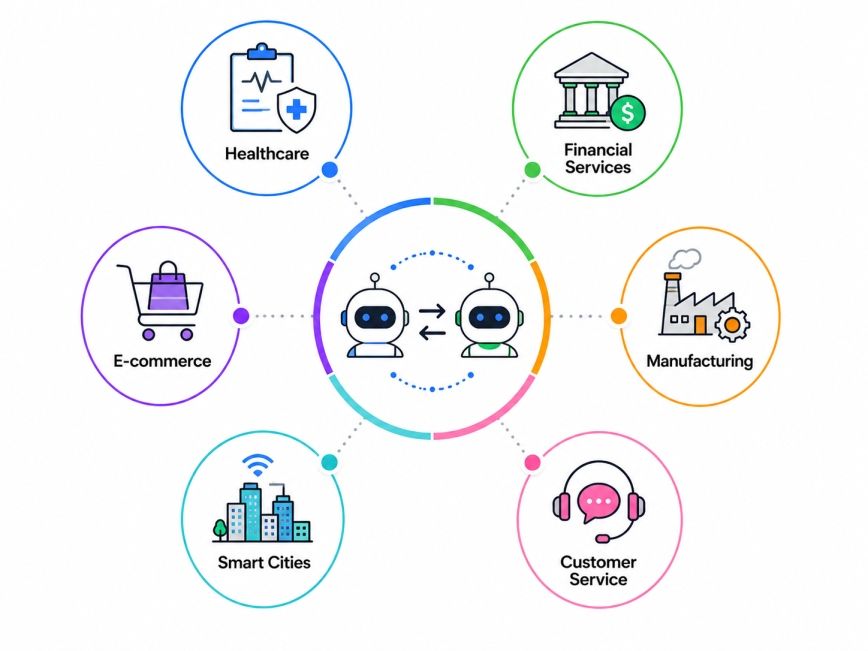
The agent-to-agent protocol is really useful when you see it in action. Many industries already use AI systems that need to work together to share information and react fast to changes.
The communication rules are the same even if the technology behind it is different.
Healthcare makes a lot of data. This includes images, laboratory reports, and treatment records. The Healthcare system has a lot of information. Different AI agents do things. Some AI agents are good at one task while other AI agents are good at another task. The AI agents in healthcare often work on their separate tasks
For example:
Using an agent-to-agent protocol, these agents exchange relevant information while maintaining a structured workflow. Doctors receive faster insights without manually gathering information from multiple systems.
Banks and financial institutions are using Artificial Intelligence for things, like finding fraud helping customers process loans and figuring out risks.
A typical workflow may involve:
Suppose when demand suddenly increases for a popular product, the inventory agents can notify pricing agents, which the pricing agent may further adjust promotions, at the time logistics agents update the time it will take to deliver things. The customer gets the information and does not even know that all these things are happening at the same time.
Online retailers use AI throughout the customer journey.
Different agents may handle:
Factories these days rely on systems to keep an eye, on equipment to manage production, and make things more efficient.
AI agents can work together to:
Cities are using intelligence to manage the things they do for people.
When something bad happens, traffic management can alert navigation systems, the emergency services, and public transport networks instantly. This coordinated response improves efficiency and public safety.
Different AI agents may oversee:
Many businesses now combine multiple AI agents to provide better customer experience. Rather than asking customers to repeat information, these agents share context using an agent-to-agent protocol, creating smoother interactions.
For example:
AI Agent |
Responsibility |
| Support agent | Understands customer questions |
| Knowledge agent | Retrieves relevant information |
| Billing agent | Accesses payment records |
| Escalation agent | Transfers complex issues to human teams |
Explore this article: Applications of Artificial Intelligence and Its Impact
As AI technology continues to evolve, agent communication protocols are expected to support even more advanced systems, including:
An agent to agent protocol enables AI agents to communicate, share tasks, and work together efficiently. As AI systems become more interconnected, standardized communication will play a key role in improving scalability, reliability, and interoperability. An agent to agent protocol makes collaboration possible by providing a standardized way for agents.
Understanding these protocols today helps businesses build smarter, more collaborative, and future-ready AI solutions. The technology is still evolving, but its importance is already clear. Rather than replacing existing AI systems, an agent to agent protocol helps them work together more effectively.
Want to explore more about management accounting? Book your free 1:1 personal consultation with our expert today.
An agent to agent protocol is a standardized communication framework that allows AI agents to exchange information, assign tasks, and collaborate effectively. It defines how messages are structured, transmitted, and interpreted so different AI systems can work together reliably, even if they are built using different technologies.
An agent to agent protocol helps AI agents communicate consistently, reducing errors and improving coordination. It also simplifies system integration, supports scalability, and enables organizations to build complex multi-agent workflows without creating custom communication methods for every AI application.
An agent to agent protocol works by defining rules for communication between AI agents. One agent sends a structured request, another processes it, and the response is returned in a predefined format. This standardized exchange ensures smooth collaboration and minimizes misunderstandings between systems.
An agent to agent protocol is used across industries such as healthcare, finance, e-commerce, manufacturing, logistics, and customer service. It enables multiple AI agents to coordinate tasks like fraud detection, inventory management, appointment scheduling, and automated customer support more efficiently.
No. An API allows software applications to communicate, while an agent to agent protocol focuses on intelligent collaboration between autonomous AI agents. It includes task coordination, context sharing, negotiation, and decision-making capabilities that go beyond traditional API-based communication.
The main benefits include better interoperability, faster task execution, improved scalability, enhanced reliability, and easier integration across AI systems. By enabling specialized AI agents to collaborate, an agent to agent protocol helps organizations build more efficient and flexible AI applications.
Yes. One of the primary goals of an agent to agent protocol is interoperability. If different AI models or platforms follow the same communication standard, they can exchange information and collaborate effectively without requiring extensive custom integrations.
Most modern agent to agent protocol implementations include security features such as authentication, encryption, authorization, and secure message validation. These measures help protect sensitive information and ensure that only trusted AI agents participate in communication and task execution.
Organizations may face challenges such as maintaining security, ensuring compatibility across platforms, handling communication failures, and managing complex workflows. Careful planning, standardization, and monitoring are essential for successfully implementing an agent to agent protocol in production environments.
As multi-agent AI systems become more common, the adoption of agent to agent protocol standards is expected to increase. Future developments will likely focus on better interoperability, stronger security, improved governance, and seamless collaboration between AI agents across different organizations and platforms.
Beginners should first understand AI agents, APIs, distributed systems, and workflow automation. Learning about emerging frameworks, open standards, and real-world use cases will make it easier to understand how an agent to agent protocol enables collaboration between intelligent systems in practical applications.
724 articles published
Sriram K is a Senior SEO Executive with a B.Tech in Information Technology from Dr. M.G.R. Educational and Research Institute, Chennai. With over a decade of experience in digital marketing, he specia...
Speak with AI & ML expert
By submitting, I accept the T&C and
Privacy Policy