Germany's top universities for engineering are the Technical University of Munich (TUM), RWTH Aachen University, and Karlsruhe Institute of Technology (KIT), all ranked among the world's best in the QS Engineering & Technology 2027 rankings. Most public universities still charge close to zero tuition, only a semester fee of €150–300 (₹16,225–₹32,451).
That fee change is the biggest shift in the German engineering landscape this year, and it's easy to miss if you're going off older articles that still list TUM as tuition-free. Beyond that, the country's core appeal hasn't moved: strong public universities, direct industry ties with names like Siemens, BMW, and Volkswagen, and an 18-month post-study visa that gives you real time to find work after graduation.
In this article, we'll walk through the current rankings, break down fees properly (including exactly what changed at TUM), map out programs by degree level, and cover eligibility, scholarships, and expected salaries. If you're specifically comparing the best universities in Germany for mechanical engineering or automobile engineering, those get their own dedicated sections too.
Why Engineering in Germany Still Makes Sense
Germany's pitch hasn't really changed: strong public universities, low fees compared to the US or UK, and an economy built around the exact industries you're studying for. A few things worth knowing before you commit:
Public university fees stay low for most programs. Outside TUM's new non-EU fee and Baden-Württemberg's flat €1,500 (₹1,62,255) charge, most public universities in Germany still run on a semester contribution of a few hundred euros rather than tuition in the traditional sense.
Industry access is built in. Companies like Siemens, BMW, Volkswagen, and Bosch recruit directly out of German engineering programs, and a lot of coursework leans practical rather than purely theoretical.
English-taught master's programs are common. Bachelor's degrees mostly need German at B1/B2 level, but you'll find plenty of English-medium master's options, especially at the TU9 universities.
Post-study work stay has real teeth. Graduates get an 18-month residence permit to look for a job, which is enough runway to actually land something in your field.
Study in Germany covers the country-level picture in more depth if engineering isn't the only thing on your mind yet.
Top Universities in Germany for Engineering
There are actually two different QS rankings floating around for German universities, and it's easy to mix them up. The QS World University Rankings 2027 (overall, released June 2026) ranks universities across everything like research, employability, sustainability, global engagement. The QS Engineering & Technology subject ranking (a separate list, last published March 2026) ranks them specifically for engineering.
The overall ranking is the one with hard, verified numbers right now, so that's what we're using below. Where a subject-specific rank exists too, it's called out separately so you're not comparing apples to oranges.
Best Universities for Specific Engineering Streams
Not every German university leads in every field, so if you already know your specialization, this narrows things down faster.
Best Universities in Germany for Mechanical Engineering
A few names come up consistently once you filter by mechanical engineering specifically, and each brings something slightly different to the table:
RWTH Aachen: Direct pipeline into the automotive sector, with strong industry ties to Siemens, BMW, and Bosch.
University of Stuttgart: Same automotive strength, with coursework built closely around manufacturing and mechanical systems.
TUM: Strong mechanical program with a lean toward robotics-adjacent work rather than pure mechanical design.
TU Berlin: Mechanical engineering here leans more toward transport systems than automotive manufacturing.
Best Universities in Germany for Automobile Engineering
If automobile engineering is the specific target rather than mechanical engineering broadly, the shortlist narrows further:
University of Stuttgart: The standard answer here, sitting close to Mercedes-Benz, Porsche, and Bosch, with coursework built directly around the automotive supply chain.
RWTH Aachen: Runs a dedicated automotive engineering track with strong placement records into the same industry cluster.
TU Darmstadt: Also offers automotive-focused engineering programs, with solid recruiter presence from the same regional cluster.
Best Universities for Engineering Management in Germany
For students who want a management layer on top of a technical degree rather than a pure engineering program, two options dominate the searches:
TUM's MSc in Management & Technology: Sits at the intersection of an MBA and a core engineering degree, built for students who want technical credibility alongside a management track.
RWTH Aachen's business-engineering hybrid programs: Similar positioning, drawing students who want both an engineering foundation and management skills in one degree.
Top Engineering Programs by Degree Level
Once you've picked a university, the next filter is degree level, since program length, language of instruction, and specialization options all shift depending on whether you're going in for a bachelor's, master's, or diploma track.
Bachelor's Programs (3 Years)
Bachelor's engineering degrees in Germany typically run three years, and here's what to expect going in:
Language: Mostly taught in German, though a growing number of English-taught bachelor's tracks now exist at TU9 universities.
Where to look: TUM, KIT, and TU Berlin all offer bachelor's routes in civil, chemical, electrical, and mechanical engineering.
Reality check: If your German isn't at B1/B2 yet, factor in prep time before you can realistically start a bachelor's here.
Master's Programs (2 Years)
Master's programs are where most international students land, and the structure looks like this:
Duration: Two years or four semesters at most universities, with RWTH Aachen offering some three-semester options.
Language: This is where English-medium instruction is most common, so it's the easier entry point if you don't speak German.
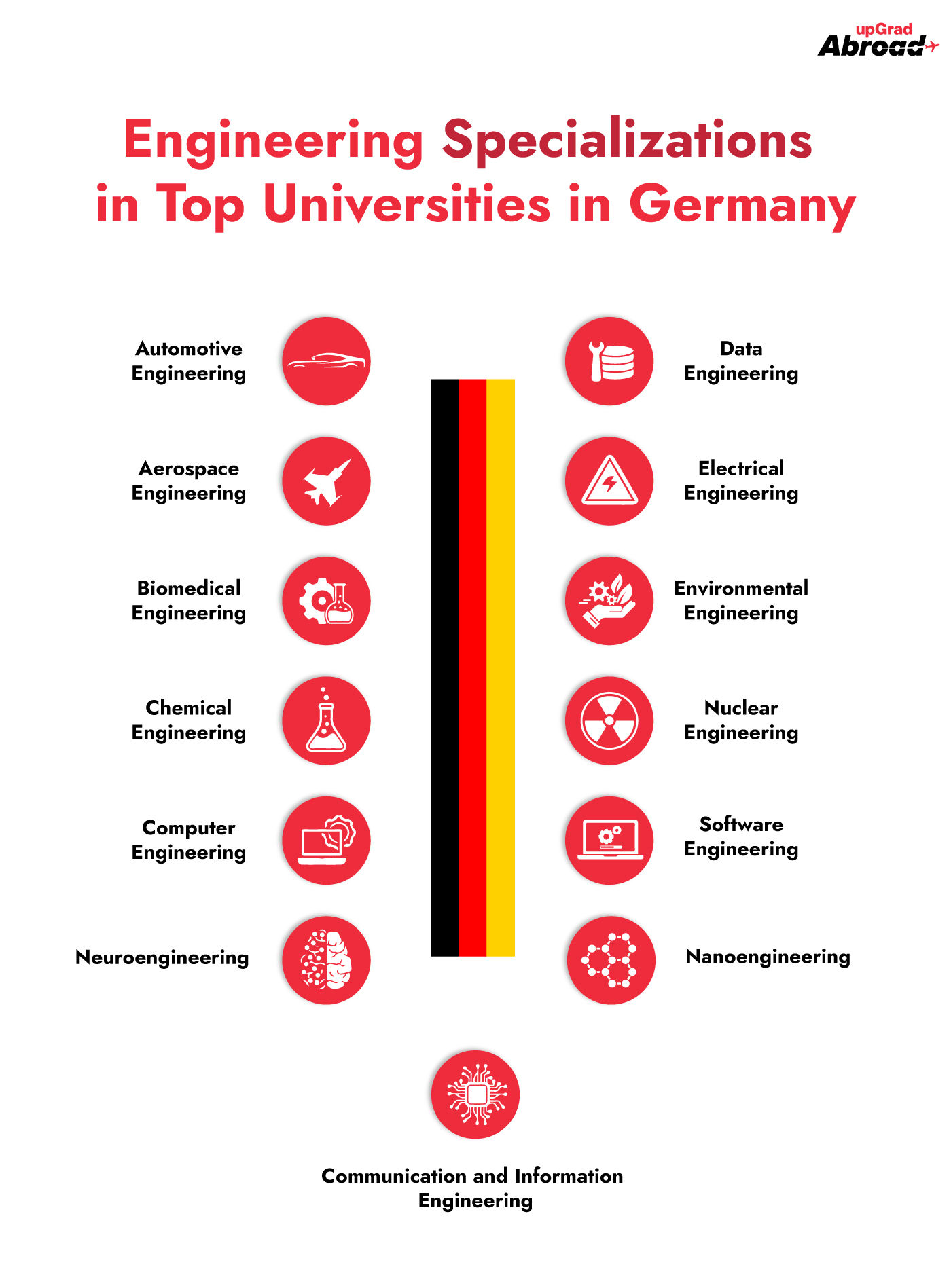
Specializations available: Covers a wide spread, from aerospace and biomedical engineering to data engineering and renewable energy.
Diploma Programs
A smaller, more specific option worth knowing about if the standard bachelor's/master's route doesn't fit:
Where: TU Dresden still runs postgraduate and undergraduate diploma tracks in mechanical engineering and process engineering.
Duration: Anywhere from five to ten semesters, depending on whether you choose the on-campus or distance-learning route.
Before you start shortlisting programs, it helps to know exactly what German universities expect from applicants, since the requirements shift a bit depending on whether you're applying for a bachelor's or a master's.
Academic and Language Requirements
Here's how the requirements break down by degree level and language of instruction:
Bachelor's applicants: Need 12 years of secondary schooling with a minimum of 50%.
Master's applicants: Generally need a three- or four-year bachelor's degree plus a year of work experience. If your bachelor's is only three years, expect to complete a preparatory Studienkolleg year first.
Standardized tests: Some programs still ask forGRE or SAT scores, though this is increasingly program-specific rather than universal, so check before assuming it applies to you.
Once you've confirmed you meet the academic and language bar, here's the paperwork you'll need ready before you apply:
Updated resume or CV
Letters of recommendation
Valid passport
Statement of purpose
Academic transcripts
Work experience letter, where applicable
Scorecards for whichever exam applies to your program
Intakes and Deadlines
Germany runs two main intake cycles for engineering programs, and knowing these upfront helps you work backward to a realistic application timeline.
Intake
Month
Typical Application Deadline
Summer
April
January
Winter
October
July
Exact deadlines shift by university and program, so treat this as a planning baseline rather than a fixed date.
Scholarships for Engineering Students
Funding can meaningfully change the cost equation, especially if you're looking at TUM's new tuition fee. A few scholarships specifically worth knowing about if you're heading into an engineering degree:
Deutschlandstipendium: Eligibility: strong academic record plus demonstrated social or extracurricular engagement. Coverage: €300 (₹32,451) per month, split between federal funding and private sponsors.
DAAD scholarships: Eligibility: enrolled or admitted master's/PhD candidates in a research-oriented field. Coverage: €934–1,300 (₹1,01,031–₹1,40,621) monthly stipend plus travel allowance and health insurance.
TUM merit waivers: Eligibility: top-performing master's applicants facing TUM's new non-EU tuition fee. Coverage: full or partial waiver of the €4,000–6,000 (₹4,32,680–₹6,49,020) per semester charge.
Rankings and fees matter going in, but what you can actually earn coming out is just as important when you're comparing options. Here's what the data shows on salaries and hiring.
What You Can Expect to Earn
Based on Payscale data, here's the rough annual salary band by role:
Role
Annual Salary Range
Mechanical Engineer
€37,000–71,000 (₹40.0L–₹76.8L)
Software Engineer
€41,000–74,000 (₹44.3L–₹80.0L)
Civil Engineer
€30,000–71,000 (₹32.4L–₹76.8L)
Electrical Engineer
€36,000–74,000 (₹38.9L–₹80.0L)
A couple of things worth keeping in mind with these numbers:
Source caveat: These are Payscale self-reported figures, so treat them as directional rather than exact.
Regional variation: Munich and Stuttgart both run higher than the national average, largely because cost of living there is higher too.
Who's Hiring
Once you're through the degree, here's where German engineering graduates typically end up:
Established manufacturers: Mercedes-Benz, BMW, Siemens, Volkswagen, and Bosch remain the biggest recruiters out of German engineering programs.
Aerospace: Airbus continues to be a major recruiter, especially for graduates from Stuttgart, TUM, and RWTH Aachen.
Newer players: A growing set of automotive-adjacent tech and EV startups are hiring too, alongside the traditional manufacturing names.
Once you land a role, the18-month post-study work visa gives you enough runway to convert an internship or entry-level offer into a longer-term position.
Our Take: Is Germany Still Worth It for Engineering?
Short answer: yes, but check the fine print before you assume it's free.
If you're targeting TUM specifically, budget for the new non-EU tuition fee, it's no longer the cheapest option on this list.
If cost is the deciding factor, RWTH Aachen, TU Berlin, TU Dresden, and TU Darmstadt still run on the low semester-fee model.
If you're set on Baden-Württemberg (KIT or Stuttgart), the flat €1,500 (₹1,62,255) fee applies regardless of program, so factor that in early.
If your focus is mechanical or automobile engineering, Stuttgart and RWTH Aachen have the strongest industry pipelines.
If management is part of the plan, TUM and RWTH both run engineering-management hybrids worth a closer look.
Rankings matter, but they shouldn't be the only thing driving your shortlist, program-level fit, city cost of living, and now, fee structure, all deserve equal weight when you're comparing top universities in Germany for engineering.
Technical University of Munich (TUM) holds the top spot in Germany for engineering going by the QS Engineering & Technology 2026 rankings, though it's also the only major TU9 university now charging non-EU students tuition. If cost matters more than the top rank, RWTH Aachen is the closer runner-up without the added fee.
Which is the best university for mechanical engineering in Germany?
RWTH Aachen and University of Stuttgart lead specifically for mechanical engineering, thanks to their direct ties to Germany's automotive and manufacturing sector. TUM comes close behind with a stronger lean toward robotics and applied mechanics.
Which university is best for engineering in Germany?
TUM ranks highest overall, but "best" really depends on your specialization, budget, and city preference. RWTH Aachen, KIT, TU Berlin, and Stuttgart all lead in specific engineering fields and cost noticeably less than TUM for non-EU students.
Which university is best for aerospace engineering in Germany?
University of Stuttgart is generally regarded as Germany's strongest option for aerospace engineering, with TUM also running a well-established aerospace program through its Department of Aerospace and Geodesy.
Is JEE accepted in Germany?
No. German universities don't consider JEE scores for admission. What they look at instead is your Class 12 academic record, and for master's programs, your bachelor's degree along with any required English or German language scores.
How much is BTech fees in Germany?
There's no direct "BTech" equivalent in Germany, the closest match is a BSc or BEng in engineering. At most public universities, non-EU students pay only the standard semester contribution of a few hundred euros, except at TUM (€2,000–3,000 per semester for new bachelor's enrolments) and Baden-Württemberg universities like KIT and Stuttgart (flat €1,500 per semester).
Is 20 lakhs enough to study in Germany?
For most public universities outside TUM, yes, 20 lakhs comfortably covers a full year of tuition-equivalent fees, living costs, and health insurance for a bachelor's or master's program. If you're specifically applying to TUM as a non-EU student, budget higher to account for its new tuition fee on top of living expenses.
Do I need to know German to study engineering in Germany?
Not for most master's programs, many are fully taught in English. Bachelor's programs are the exception and usually require German at B1 or B2 level, since a large chunk of coursework and campus life still runs in German at that stage.
Is the GRE compulsory for engineering programs in Germany?
It depends on the university and program rather than being a blanket requirement. Several German universities have dropped the GRE altogether, so it's worth checking the specific program page before assuming you need to take it.
Can international students work while studying engineering in Germany?
Yes, international students can work up to 140 full days or 280 half days per year alongside their studies, which helps offset living costs without affecting your student visa status.
What happens after I finish my engineering degree in Germany?
Graduates get an 18-month residence permit specifically to search for a job related to their qualification. Once you land a role, you can switch to a work visa or the EU Blue Card, depending on your salary and contract type.
Anupriya Mukherjee is a passion-driven professional working as a Content Marketer and earlier worked as a Digital Marketeer. With around 6 years of work experience, she has experience creating high-qu...
Refer Your Friend & Earn upto ₹15000
Help your friend upgrade to a Global Career and earn rewards together.