What is Neuromorphic Computing?
By Rahul Singh
Updated on Jun 01, 2026 | 10 min read | 2.86K+ views
Share:

All courses
Certifications
More
By Rahul Singh
Updated on Jun 01, 2026 | 10 min read | 2.86K+ views
Share:
Table of Contents
Neuromorphic computing is a computing approach that takes inspiration from the human brain. It uses networks of artificial neurons and synapses to process information in a way that resembles biological neural systems, helping machines learn, adapt, and respond more efficiently.
Unlike traditional computers that follow sequential processing methods, neuromorphic computing supports parallel information processing with lower energy consumption. This makes it a promising technology for artificial intelligence, robotics, edge devices, and other applications that require fast and intelligent decision-making.
This guide covers everything you need to know about neuromorphic computing. By the end, you will have a solid, end-to-end understanding of one of the most exciting areas in computing today.
Build practical AI and ML skills with upGrad’s Artificial Intelligence Courses. Learn machine learning, generative AI, and emerging technologies while working on real-world projects.
Popular AI Programs
Think of a traditional computer as a single cashier processing customers one by one in a queue. Every task waits for the previous one to finish before moving forward.
Neuromorphic computing works more like the human brain. Imagine a busy city where millions of people can communicate and react at the same time. Messages are sent only when needed, decisions happen instantly, and countless activities occur in parallel. In the same way, neuromorphic chips use artificial neurons and synapses to process information simultaneously, respond in real time, and consume far less energy than conventional systems.
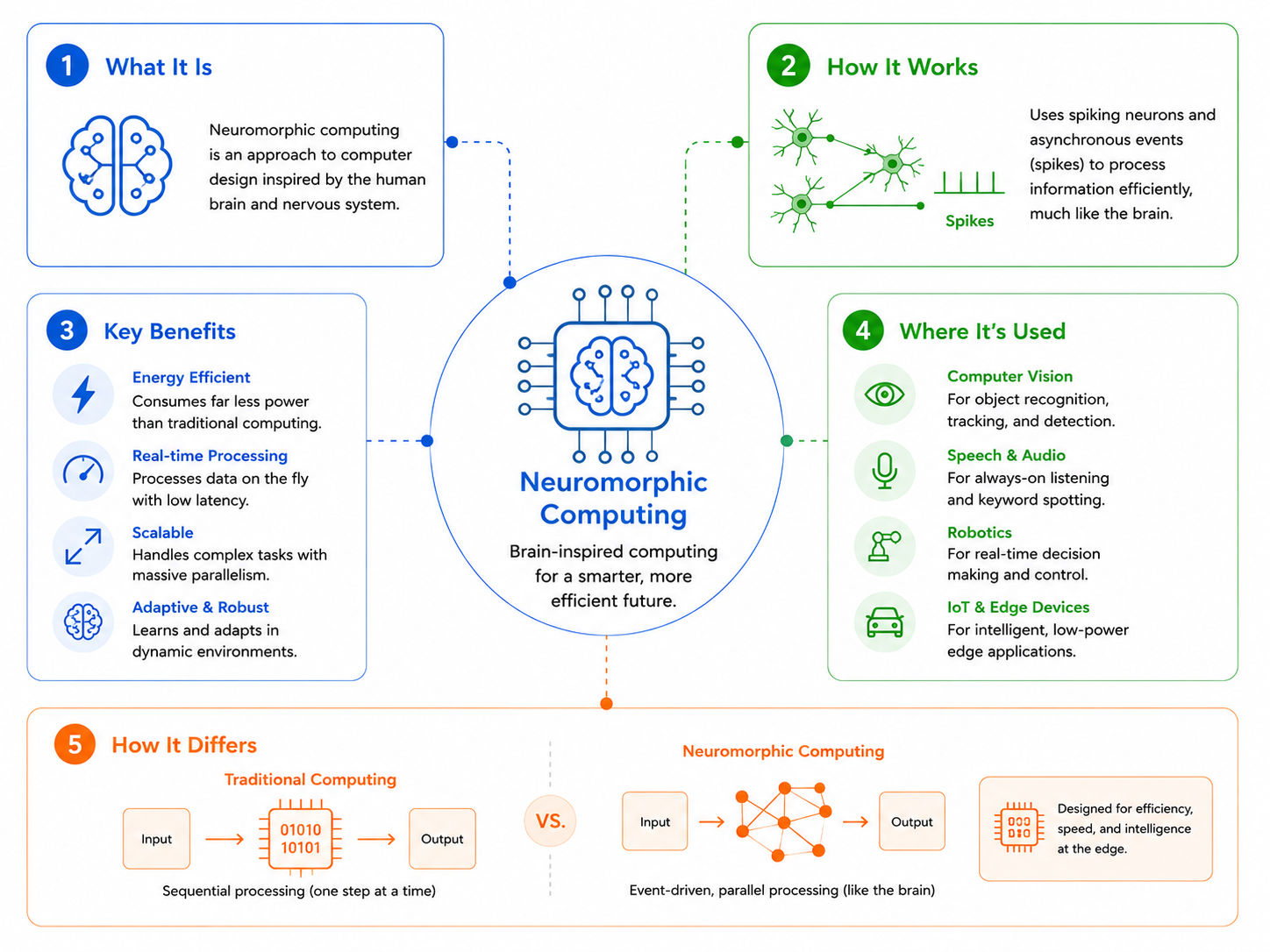
The term was coined by Carver Mead, a Caltech professor, in the late 1980s. His idea was simple but radical: instead of programming software to simulate intelligence, why not build hardware that already works like a brain?
Also Read: Artificial Neural Networks Explained
Feature |
Traditional Computer |
Human Brain |
Neuromorphic Chip |
| Processing style | Sequential | Parallel | Parallel |
| Energy consumption | High | ~20 watts | Very low |
| Learning ability | Requires retraining | Continuous | On-chip learning |
| Response to input | Clock-driven | Event-driven | Event-driven |
| Data storage | Separate from processing | Integrated | Integrated |
Traditional computers separate memory from processing. Your CPU handles the calculations, and your RAM stores the data. Every time the CPU needs something, it fetches it from memory. This back-and-forth is called the von Neumann bottleneck, and it wastes both time and energy.
The brain has no such bottleneck. Memory and processing happen in the same place, at the same time.
Neuromorphic chips try to replicate that design. They use artificial neurons and synapses built directly into silicon. These components fire signals only when triggered by new information, just like biological neurons do.
Also Read: 9 Key Types of Artificial Neural Networks for ML Engineers
The key technology inside neuromorphic systems is called a Spiking Neural Network (SNN). Unlike conventional artificial neural networks that process data in continuous values, SNNs communicate through discrete electrical pulses called "spikes."
Think of it this way. In a regular neural network, every neuron sends a signal at every step. In an SNN, a neuron only fires when the input crosses a certain threshold. This means most neurons are silent most of the time. The result: far less energy consumed, and processing that happens in response to real events rather than on a fixed clock.
This is the same principle your brain uses. Right now, only a fraction of your neurons are actively firing. The rest are waiting.
Free Courses
Building a chip that behaves like a brain is not just a software challenge. It requires rethinking hardware from the ground up. Neuromorphic chips use a completely different architecture than the processors you find in your laptop or phone.
1. Artificial Neurons: These are the processing units of the chip. Each neuron receives input signals, accumulates charge, and fires a spike when a threshold is reached. After firing, it resets and waits for the next input.
2. Artificial Synapses: Synapses connect neurons. In a biological brain, synapses can strengthen or weaken over time based on experience. Neuromorphic chips replicate this using components like memristors, which can store variable resistance levels and act as tunable connections between neurons.
3. On-Chip Learning: One of the most powerful features of neuromorphic hardware is the ability to learn locally. A rule called Spike-Timing Dependent Plasticity (STDP) allows synaptic weights to update based on the timing of spikes. This means the chip learns from new data without needing to be retrained centrally.
Also Read: Artificial Intelligence Tools: Platforms, Frameworks, & Uses
Chip |
Developer |
Key Spec |
Status |
| Intel Loihi 2 | Intel | 1 million neurons | Available for research |
| TrueNorth | IBM | 4,096 cores, 1M neurons | Research use |
| BrainScaleS-2 | Heidelberg University | Analog, real-time | Active research |
| SpiNNaker 2 | University of Manchester | 10 million neurons | In development |
| Akida | BrainChip | Edge AI focused | Commercial |
Intel's Loihi 2, released in 2021, is one of the most advanced research chips available today. It can solve certain optimization problems up to 1,000 times more efficiently than a conventional processor doing the same task. IBM's TrueNorth has been used in image recognition tasks while consuming only a fraction of the energy a GPU would require.
Neuromorphic chips are often used as accelerators alongside traditional processors. You might have a standard CPU handling general tasks, while the neuromorphic chip handles specific workloads like sensor data processing, pattern recognition, or real-time inference. This hybrid approach is the most practical path to deployment today.
Also Read: How to Build Your Own AI System: Step-by-Step Guide
AI Courses to upskill
Explore Artificial Intelligence Courses for Career Progression
Neuromorphic computing is not just a laboratory concept. Researchers and companies are actively deploying it in areas where energy efficiency, speed, and real-time response matter most.
Most AI today runs in large data centers. That works fine when you have a fast internet connection and time to wait. But in scenarios where a device needs to react instantly and cannot always connect to the cloud, edge AI becomes critical.
Neuromorphic chips are built for this. They consume very little power, which makes them ideal for:
A neuromorphic chip in a hearing aid, for example, can process sound in real time, filter out noise, and adapt to different environments, all while using a fraction of the battery that a traditional processor would drain.
Also Read: What Are IOT Devices?: Definition, Uses, Types
Robots need to react quickly to their surroundings. A robot arm on a production line, a self-driving car, or a prosthetic limb all need to process sensory data and respond in milliseconds.
Neuromorphic computing is well-suited to this because it processes information the moment it arrives, without waiting for a clock cycle. Researchers at Intel Labs have demonstrated neuromorphic systems that can solve path-planning problems for robots significantly faster and with lower energy than GPU-based systems.
One of the most medically significant applications is in brain-computer interfaces (BCIs). These devices sit between a human brain and an external device, allowing paralyzed patients to control robotic limbs or communicate through computers.
Neuromorphic chips are a natural fit here because they speak the same electrical language as the brain: spikes. They can process neural signals directly, respond to them in real time, and even adapt to changes in brain patterns over time.
Neuroscientists use neuromorphic hardware to simulate large-scale brain activity. Running simulations of even a small section of the brain on traditional hardware requires enormous power and time. Neuromorphic systems can run these simulations much faster and at far lower cost.
The Human Brain Project in Europe has used BrainScaleS and SpiNNaker platforms to simulate neural circuits that help researchers better understand conditions like epilepsy and Alzheimer's disease.
Also Read: How to Learn Artificial Intelligence and Machine Learning
A common question is how neuromorphic computing compares to GPUs and TPUs, which are the workhorses of modern AI. The answer is: they serve different purposes, and in some cases, neuromorphic chips do the job better.
GPUs are powerful but power-hungry. Training a large language model can consume as much electricity as hundreds of homes use in a year. Neuromorphic chips use event-driven processing, so they consume energy only when input arrives. For inference tasks at the edge, this is a massive advantage.
Intel has shown that its Loihi chip can perform certain tasks at an energy efficiency that is orders of magnitude better than GPU implementations.
Also Read: Introduction to Cloud Computing: Concepts, Models, Characteristics & Benefits
GPUs excel at batch processing and parallel matrix operations. They are ideal for training large models on massive datasets.
Neuromorphic chips shine on latency-sensitive tasks where the system needs to react immediately. If you are processing a stream of sensor signals and need a response in under a millisecond, neuromorphic hardware has an edge.
This makes neuromorphic systems better suited for environments that change over time, such as monitoring a patient whose health patterns shift gradually.
Comparison |
GPU / TPU |
Neuromorphic Chip |
| Best for | Training large models | Edge inference, real-time response |
| Power use | High | Very low |
| Learning | Offline | On-chip, continuous |
| Maturity | Very mature | Emerging |
| Programmability | Very high | Moderate |
Also Read: Why AI Is The Future & How It Will Change The Future?
Neuromorphic computing has real promise, but it is not without hurdles. Understanding these challenges is important for anyone following the space closely.
Writing software for neuromorphic hardware is very different from writing code for a CPU or GPU. Developers need to think in terms of spike timing, neural populations, and synaptic weights. There are frameworks like Intel's Lava and IBM's PyNN that make this easier, but the learning curve is steep compared to PyTorch or TensorFlow.
There is no universal neuromorphic chip architecture. Intel, IBM, BrainChip, and research institutions each build chips with different designs, programming models, and toolchains. This fragmentation slows adoption because developers cannot easily port their work from one platform to another.
Also Read: Top 20 Challenges of Artificial Intelligence: Key Issues and Solutions for 2026
Today's neuromorphic chips top out at millions of neurons. The human brain has roughly 86 billion neurons, each connected to thousands of others. Scaling neuromorphic hardware to anywhere near biological complexity is still a distant goal, though researchers are making steady progress.
It is difficult to compare neuromorphic systems directly with GPUs because the workloads they are suited for are so different. The field still lacks widely accepted benchmarks, which makes it harder for organizations to justify investment.
Despite these challenges, momentum is building. Major chip manufacturers, defense agencies, and research universities are all investing heavily in neuromorphic computing. Gartner has flagged it as an emerging technology to watch. The European Union's Human Brain Project and the US DARPA program have pumped hundreds of millions of dollars into neuromorphic research.
In the near term, expect to see neuromorphic chips in:
Over the next decade, as programming tools mature and chip designs improve, neuromorphic computing could shift from a niche research area to a core component of the AI hardware stack.
Also Read: Is AI Dangerous? Understanding the Risks and How to Manage Them
Subscribe to upGrad's Newsletter
Join thousands of learners who receive useful tips
Neuromorphic computing is one of those ideas that sounds futuristic but is already here in working form. It takes inspiration from the most efficient computer we know, the human brain, and turns it into silicon. The result is hardware that uses less power, responds faster to real-time events, and can keep learning without a data center behind it.
This field is still young. The tools are improving, the chips are getting better, and the applications are expanding. If you work in AI, hardware, robotics, or healthcare technology, neuromorphic computing is worth keeping a close eye on.
Want personalized guidance on AI and upskilling? Speak with an expert for a free 1:1 counselling session today.
Traditional computers use a sequential, clock-driven model where the CPU fetches data from memory and processes it step by step. Neuromorphic computing uses an event-driven model where artificial neurons only fire when triggered by input, similar to how biological neurons work. This makes neuromorphic systems far more energy-efficient for tasks involving continuous sensor data or pattern recognition.
Neuromorphic computing was pioneered by Carver Mead, a professor at the California Institute of Technology, in the late 1980s. He proposed using analog circuits to mimic the neural architecture of the brain. Since then, the field has expanded significantly, with contributions from Intel, IBM, and academic institutions worldwide building on his original ideas.
No, they are completely different. Quantum computing uses quantum mechanical phenomena like superposition and entanglement to perform calculations in ways classical computers cannot. Neuromorphic computing is a type of classical computing that redesigns chip architecture to mimic the brain. They are separate research tracks with different goals, strengths, and timelines for practical use.
Spiking neural networks are artificial neural networks that communicate through discrete electrical pulses called spikes, just like biological neurons. Unlike conventional neural networks that send continuous signals at every step, SNNs only fire when a neuron's input crosses a threshold. This makes them highly energy-efficient and well-suited for real-time processing, which is why they are the foundation of neuromorphic computing.
Not in their current form. Large language models require massive matrix operations that GPUs are optimized for. Neuromorphic chips today are better suited for smaller, real-time inference tasks like sensor processing and anomaly detection. However, researchers are actively exploring how neuromorphic systems could eventually complement or partially replace GPU-based AI inference, particularly for edge deployment.
Intel has shown that its Loihi chip can perform certain optimization and inference tasks while using up to 1,000 times less energy than a comparable GPU implementation. The exact efficiency gain depends heavily on the task. Tasks that involve sparse, event-driven data such as sound processing or motion detection show the biggest gains, because the chip remains mostly idle and only activates in response to new input.
Intel is the most prominent player with its Loihi chip series. IBM developed the TrueNorth chip, which remains an important research platform. BrainChip commercializes its Akida chip for edge AI applications. On the academic side, the University of Manchester's SpiNNaker project and Heidelberg University's BrainScaleS system are key research platforms. Several startups and national research programs in the US, UK, and Europe are also actively contributing.
Brain-computer interfaces need to interpret electrical signals from the brain and respond in real time. Neuromorphic chips are naturally suited to this because they communicate through spikes, the same format biological neurons use. This removes the need to translate signals into a different format, reduces latency, and allows the chip to adapt to changes in a patient's neural patterns over time, which is critical for long-term implants.
Some narrow commercial applications already exist. BrainChip's Akida chip is available for edge AI use cases, and companies are using neuromorphic-inspired designs in hearing aids and certain industrial sensors. However, broad commercial deployment is still limited by the lack of mature software tools, programming standards, and hardware scalability. The next five to ten years will likely see significant expansion as these gaps close.
Intel's Lava is an open-source framework designed specifically for Loihi chips. PyNN is a Python-based interface that supports multiple neuromorphic platforms including SpiNNaker and BrainScaleS. Brian2 is another Python-based tool widely used in neuroscience simulations. While these frameworks are improving, they are still less mature than mainstream AI tools like PyTorch or TensorFlow, which remains a barrier for new developers.
Full replacement is unlikely in the near term. GPUs are dominant for training large AI models because of their raw parallel computing power and the maturity of their software ecosystems. Neuromorphic computing is more likely to complement GPUs by handling edge inference tasks where power and latency matter more than raw throughput. In specific domains like robotics, IoT, and BCIs, neuromorphic chips may eventually become the preferred solution without needing to displace GPU-based systems entirely.
98 articles published
Rahul Singh is an Associate Content Writer at upGrad, with a strong interest in Data Science, Machine Learning, and Artificial Intelligence. He combines technical development skills with data-driven s...
Speak with AI & ML expert
By submitting, I accept the T&C and
Privacy Policy
Top Resources
Master's Degree
18 Months
Executive Diploma
12 Months
IIIT Bangalore
Executive Programme in Generative AI & Agentic AI for LeadersIndia’s #1 Tech University
Dual Certification
5 Months